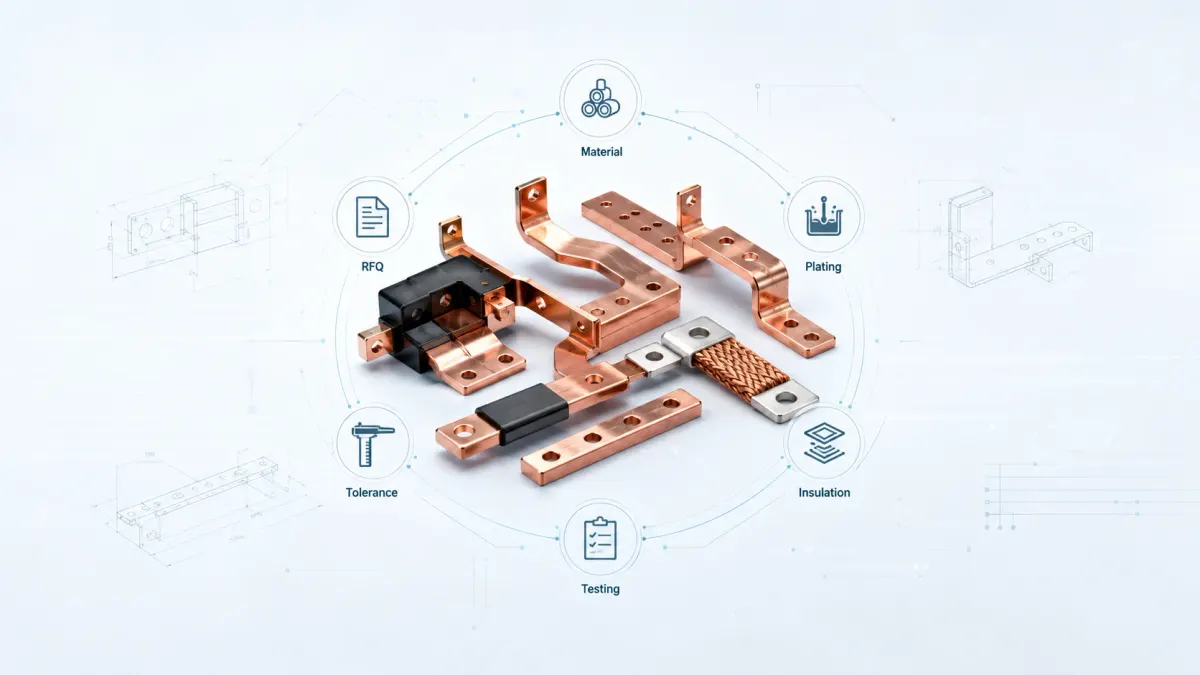
For an OEM buyer, choosing a busbar manufacturer is not the same as buying a simple strip of copper. A busbar is a designed current path. It affects voltage drop, temperature rise, connection reliability, vibration resistance, assembly speed, enclosure layout, and long-term field safety. In electric vehicles, battery energy storage systems, renewable energy inverters, data center power distribution, switchgear, chargers, industrial drives, and automation equipment, the busbar often becomes one of the quiet components that decides whether the whole system remains stable under real load.
This guide is written for purchasing managers, electrical engineers, mechanical engineers, sourcing teams, and project leaders who need to order custom copper busbars from a qualified supplier. It explains what to check before ordering, what documents to prepare, what questions to ask, what manufacturing evidence to request, and how to judge whether a supplier can support prototype development and repeatable production. It is also written from the perspective of JUMAI, a China-based manufacturer focused on custom soft, rigid, braided, and laminated copper busbars, with supporting capabilities in precision stamping, deep drawing, tooling, and mold components.
A strong busbar project starts before quotation. The buyer should not only ask, “How much is this copper part?” The better question is: “Can this busbar manufacturer understand our electrical load, mechanical space, insulation requirement, thermal target, assembly method, validation plan, and production schedule?” Once the question becomes more complete, the sourcing decision becomes much clearer.
- Why OEM busbar sourcing matters more than before
- What a busbar manufacturer actually controls
- Match the busbar type to the application, not to a catalog picture
- Material grade and conductivity: check the copper before checking the price
- Ampacity and temperature rise: do not buy by cross-section alone
- Dimensional control: the busbar must fit the assembly every time
- Contact surfaces, bolted joints, and plating decisions
- Insulation, creepage, clearance, and high-voltage details
- Manufacturing capability: prototype flexibility and production discipline
- Quality system, traceability, and documentation
- Standards and certification: know what belongs to the busbar and what belongs to the assembly
- RFQ preparation: what OEM buyers should send before quotation
- Drawing review: what a good manufacturer should notice
- Prototype approval: inspect function, not just appearance
- Cost: understand what drives the quotation
- Suggested buyer workflow before placing the order
- Final checklist for OEM buyers
- Conclusion: choose a busbar manufacturer that reduces engineering risk
- Frequently asked questions
Why OEM busbar sourcing matters more than before
Power systems are becoming denser. OEM equipment is expected to carry higher current in smaller space while maintaining safety, efficiency, and stable production cost. The market pressure behind this trend is visible in several major industries.
The International Energy Agency reported that global electric car sales topped 17 million in 2024, representing more than 20% of new cars sold worldwide. The same source reported that the global electric car fleet reached almost 58 million by the end of 2024. These numbers matter for busbar sourcing because EV battery packs, inverters, junction boxes, on-board chargers, and DC fast-charging systems all need compact high-current conductors that can survive thermal cycling, vibration, and automated assembly. See the IEA’s Global EV Outlook 2025 for the underlying market data.
Battery storage is expanding just as quickly. According to the IEA’s Global Energy Review 2026 battery storage update, 108 GW of new battery storage capacity was deployed worldwide in 2025, about 40% more than in 2024, and installed capacity was eleven times higher than in 2021. Large-scale BESS cabinets and containers use copper busbars for battery module interconnection, DC collection, inverter connection, protection devices, and switchgear interfaces. In those systems, a poor joint or undersized conductor does not merely reduce efficiency; it can create a thermal risk inside a very expensive energy asset.
AI data centers are creating another wave of high-current demand. The IEA estimates that data centers consumed around 415 TWh of electricity in 2024, about 1.5% of global electricity consumption, and projects global data center electricity consumption to reach around 945 TWh by 2030 in its base case. That is a major reason power distribution architectures inside data centers are receiving more attention. High-density rack power, UPS systems, power distribution units, busway systems, and switchboards all benefit from predictable conductor geometry, low-resistance joints, and controlled temperature rise. More details are available from the IEA’s Energy and AI analysis. The U.S. Department of Energy has also noted that data center deployment is a significant factor in near-term electricity demand growth and cited an EPRI estimate that data centers could consume up to 9% of U.S. electricity generation annually by 2030, up from 4% of total load in 2023. See the DOE’s discussion of clean energy resources for data center electricity demand.
For OEM buyers, these trends create two practical sourcing consequences. First, the busbar supplier must be able to support higher electrical and mechanical requirements than a traditional sheet metal shop. Second, the supplier must help the buyer turn a concept, drawing, or sample into a manufacturable component that can be repeated across production lots. This is where a specialized busbar manufacturer is different from a general metal parts vendor.
| Industry driver | Public data point | Why it matters for OEM busbars | Buyer implication |
|---|---|---|---|
| Electric vehicles | Electric car sales topped 17 million globally in 2024, according to the IEA | Battery packs, inverters, junction boxes, and chargers need compact current paths | Check vibration resistance, insulation, welding/bonding quality, and PPAP-style documentation |
| Battery energy storage | 108 GW of new battery storage capacity deployed worldwide in 2025, according to the IEA | BESS cabinets and containers require stable high-current DC interconnection | Check temperature rise, plating, bolted joint design, and module-to-module repeatability |
| AI and cloud data centers | IEA projects global data center electricity consumption to reach around 945 TWh by 2030 | Higher rack density increases demand for efficient power distribution | Check low resistance, thermal management, enclosure fit, and scalable production quality |
| Industrial power distribution | IEC 61439 practice emphasizes temperature-rise verification for busbars, connections, and functional units | Switchgear and control panels fail when hot spots are ignored | Check rated current, enclosure conditions, derating assumptions, and routine inspection records |
What a busbar manufacturer actually controls
A reliable busbar manufacturer controls more than cutting and bending. In a real OEM project, the supplier must manage material grade, conductive cross-section, bend geometry, hole position, burr direction, plating thickness, insulation coverage, creepage and clearance, terminal flatness, welding quality, marking, packaging, and traceability. A busbar may look simple on a drawing, but its performance depends on many small details.
For copper busbars, material selection is usually the starting point. JUMAI’s Custom Copper Busbars page describes the use of high-purity T2/C11000 copper and notes the company’s ability to manufacture rigid, braided, and laminated flexible busbars. The material is important because electrical conductivity and thermal performance are directly connected to copper quality. The Copper Development Association’s C11000 alloy listing shows a minimum copper content of 99.90% and notes that annealed C11000 is a high-conductivity copper with a minimum conductivity of 100% IACS. Buyers can review the public alloy data at Copper.org C11000 Alloy.
Manufacturing control is equally important. A copper bar with excellent conductivity can still fail if the hole is off-position, the bend radius causes stress cracking, the plating is uneven at the contact area, the insulation has thin spots, or the bolted joint is not flat enough. For this reason, OEM buyers should evaluate the supplier’s process route, inspection capability, and engineering communication before placing a production order.
A practical supplier review should include five control areas:
- Electrical performance: current rating, voltage drop, resistance, thermal rise, skin effect considerations, and contact resistance.
- Mechanical fit: dimensions, bends, holes, slots, hole-to-bend distance, flatness, torsion, and installation tolerance.
- Surface and insulation: tin, nickel, silver, bare copper, epoxy coating, heat-shrink sleeve, PA or PVC insulation, local masking, and edge coverage.
- Manufacturing repeatability: stamping, punching, CNC bending, diffusion welding, press welding, crimping, terminal forming, plating, insulation, marking, and packaging.
- Quality evidence: material certificates, inspection reports, first article inspection, process capability, traceability, and change control.
When a supplier can explain these controls clearly, the buyer has a stronger basis for trust. When a supplier only says “we can make it” without discussing thermal, mechanical, or quality risks, the buyer should slow down.
Match the busbar type to the application, not to a catalog picture
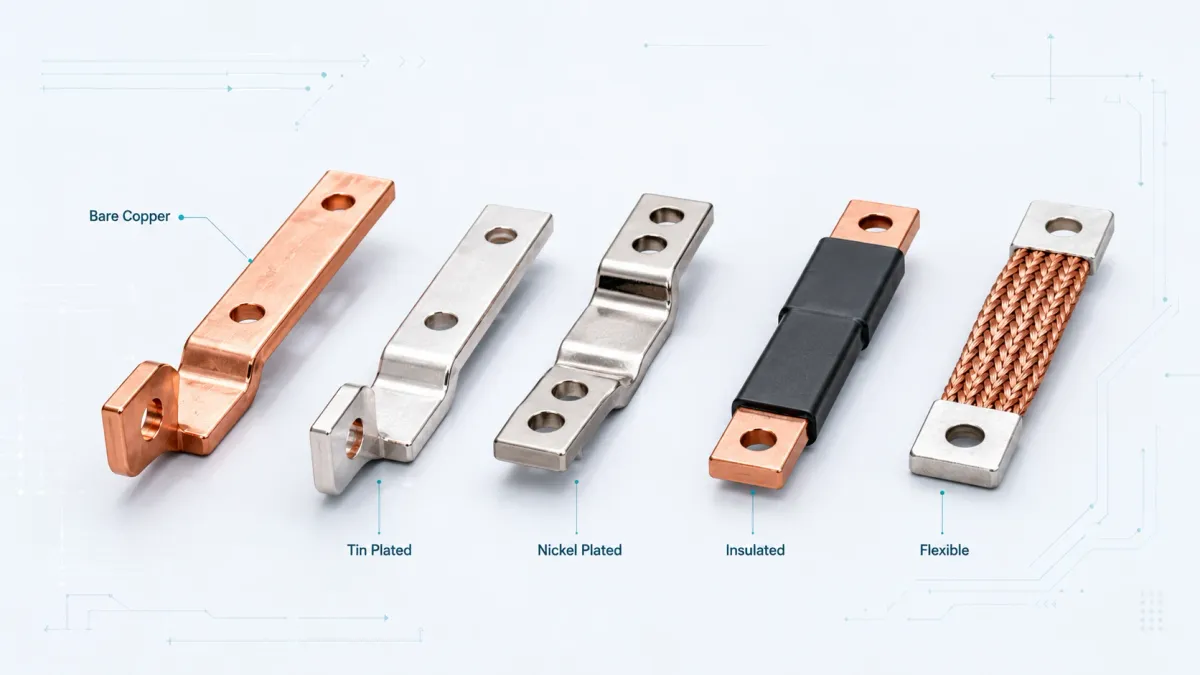
Many purchasing mistakes happen when a buyer selects a busbar only by visual similarity. A rigid copper bar, a laminated flexible busbar, a braided copper busbar, and an insulated copper link may all carry current, but they solve different problems. The best busbar manufacturer should help the buyer match the structure to the equipment environment.
Rigid busbars are ideal when the assembly is static, the routing is clear, and the conductor also provides mechanical stability. They are common in switchgear, power distribution cabinets, industrial drives, UPS systems, rectifiers, inverters, and some battery systems. Rigid bars are predictable, compact, easy to inspect, and suitable for high-current paths. However, they do not tolerate misalignment, vibration, or thermal movement as well as flexible designs.
Laminated flexible busbars are made from multiple thin copper foils bonded at the terminal areas while remaining flexible between the ends. They are useful in EV battery modules, BESS modules, compact power electronics, and applications where thermal expansion or assembly tolerance must be absorbed. JUMAI’s article on Flexible Busbar for EV Battery Modules explains why flexible interconnects can provide mechanical breathing room in battery packs exposed to thermal stress and road vibration.
Braided copper busbars are woven from fine copper wires and often finished with pressed or welded terminals. They are useful in high-vibration or motion-compensation areas, such as transformers, generators, motor connections, flexible grounding, and moving electrical assemblies. A braided link can absorb movement that would otherwise transfer stress into terminals or housings.
Insulated busbars add another level of design complexity. The copper body must carry current, but the insulation system must prevent short circuit, tracking, arcing, and accidental touch. In compact high-voltage systems, insulation is not an afterthought. The buyer should specify the insulation material, thickness target, voltage level, creepage and clearance, masking areas, cutout locations, and inspection method.
| Busbar type | Typical construction | Best-fit applications | Key buyer checks before ordering |
|---|---|---|---|
| Rigid copper busbar | Solid copper bar cut, punched, machined, and bent | Switchgear, UPS, industrial drives, inverters, distribution panels, static cabinet power paths | Bend tolerance, hole location, flatness, burr direction, plating at contact points, thermal rating |
| Laminated flexible busbar | Multiple copper foils bonded at terminals, flexible in the middle | EV battery modules, BESS modules, compact power electronics, thermal-expansion zones | Foil thickness, layer count, bonded area, fatigue requirement, insulation edge coverage, terminal resistance |
| Braided copper busbar | Woven copper wires with pressed, welded, or formed terminals | Transformers, vibration-heavy systems, grounding, moving interfaces | Strand specification, terminal compression, tensile strength, contact area, plating, flex life |
| Insulated busbar | Copper conductor with epoxy, sleeve, heat-shrink, or molded insulation | High-voltage batteries, power distribution cabinets, compact assemblies | Insulation material, dielectric requirement, creepage and clearance, masking, adhesion, partial discharge risk |
| Hybrid stamped or deep-drawn conductive part | Copper or conductive metal formed by stamping, drawing, and secondary finishing | Custom housings, terminals, shields, battery and electronics accessories | Tooling plan, thickness control, burr control, forming limit, dimensional inspection, production repeatability |
The buyer does not need to become a busbar design expert before contacting a supplier. However, the buyer should describe the working environment clearly. Is the part inside a vehicle? Is it in a fixed cabinet? Will it connect two components that move differently under heat? Will technicians touch it during maintenance? Is the conductor exposed to humidity, salt spray, oil mist, vibration, or repeated service cycles? These answers often determine whether a rigid, laminated, braided, or insulated busbar is the correct direction.
Material grade and conductivity: check the copper before checking the price
Copper price is visible. Conductivity loss is less visible, but it can become more expensive over the life of the equipment. A high-quality busbar manufacturer should be able to provide material certificates and explain the copper grade used for the project.
For many custom busbars, C11000 or equivalent high-conductivity copper is a practical choice because it offers excellent conductivity, availability, and formability for cutting, punching, bending, and plating. According to the Copper Development Association’s public C11000 alloy data, C11000 has minimum copper content of 99.90% and annealed conductivity of at least 100% IACS. This does not mean every busbar problem is solved by choosing C11000, but it gives the buyer a baseline for conductivity and material quality.
In special applications, the buyer may need oxygen-free copper, silver-plated copper, nickel-plated copper, or even copper-aluminum hybrid structures. For example, oxygen-free copper may be preferred for certain brazing, vacuum, or deep-drawing requirements. Nickel plating may be selected for higher temperature or corrosion resistance. Silver plating may be used where contact resistance and high-performance conductivity are critical, but it carries a cost penalty. Tin plating is commonly used because it improves solderability and oxidation resistance while remaining cost-effective for many power applications.
A buyer should ask the busbar manufacturer to confirm:
- Copper grade or equivalent standard.
- Copper purity and conductivity requirement.
- Temper condition, especially if bending or forming is required.
- Thickness tolerance and width tolerance.
- Plating type, thickness range, and applicable standard.
- Insulation material and thickness tolerance.
- Material certificate availability for each production lot.
- Whether material substitution requires written approval.
The final point is often overlooked. If an OEM approves a sample made from one copper grade and the supplier later uses another grade without notification, electrical performance, bend behavior, plating response, and long-term reliability may change. A supplier agreement should clearly state that material substitution requires buyer approval.
Ampacity and temperature rise: do not buy by cross-section alone
Ampacity is the current a conductor can carry continuously without exceeding the allowed temperature under defined installation conditions. It is tempting to treat ampacity as a simple area calculation: more copper area equals more current capacity. In real equipment, the situation is more complicated.
Temperature rise depends on conductor cross-section, surface area, ambient temperature, enclosure ventilation, adjacent heat sources, insulation, orientation, proximity to other conductors, connection resistance, duty cycle, and the thermal limits of nearby components. A busbar that performs well in open air may run hotter inside a sealed cabinet. A wide flat bar may dissipate heat differently from a thick narrow bar with the same cross-sectional area. A laminated flexible busbar may behave differently from a solid bar because the layers, bonded areas, and insulation all influence heat flow.
This is why standards and industry practice emphasize temperature-rise verification. Schneider Electric’s discussion of IEC 61439 explains that temperature rise testing verifies acceptable limits for components of an assembly, including busbars, connections, and functional units, and that each circuit and the assembly as a whole must carry rated current without excessive hot spots. The article also notes maximum temperature examples for copper busbars and other parts under IEC 61439 assumptions. Buyers can review the technical discussion at Schneider Electric’s IEC 61439 temperature-rise article.
For a custom busbar order, the supplier may not be responsible for certifying the complete electrical assembly unless that is part of the contract. However, a competent busbar manufacturer should still understand how busbar shape, cross-section, contact area, plating, and insulation affect temperature. JUMAI’s own article on Rigid Busbars Manufacturing Process warns buyers not to copy a busbar size from another cabinet unless installation conditions are similar, and recommends providing current, voltage, temperature-rise target, enclosure information, and duty cycle.
Before ordering, the OEM buyer should clarify these electrical inputs:
- Rated continuous current.
- Peak current and duration.
- Short-circuit withstand expectation, if relevant.
- Voltage level and AC/DC application.
- Frequency and whether skin effect matters.
- Ambient temperature and enclosure temperature.
- Natural convection, forced air, or liquid-cooled environment.
- Allowed temperature rise at busbar body and contact areas.
- Insulation temperature class.
- Distance to heat-sensitive components.
- Expected service life and duty cycle.
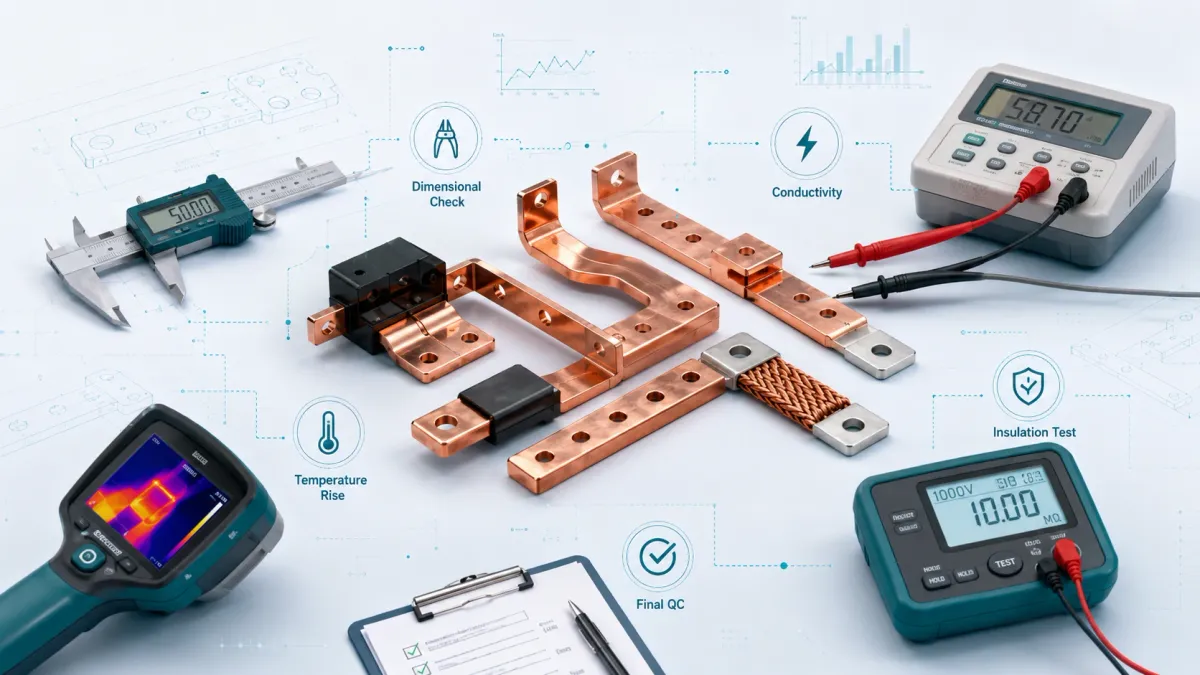
If the project is high-current, high-voltage, or safety-critical, the buyer should not rely on visual approval alone. Prototype resistance measurement, thermal imaging under load, temperature-rise testing, and design review are more useful than a perfect-looking sample sitting on a desk.
Dimensional control: the busbar must fit the assembly every time
A busbar can pass material inspection and still fail the project if it does not fit the assembly. OEM buyers often underestimate the importance of dimensional control because copper busbars look robust. In reality, copper is soft, bends can spring back, holes can distort near formed areas, long bars can twist, and terminal areas can lose flatness during plating or insulation.
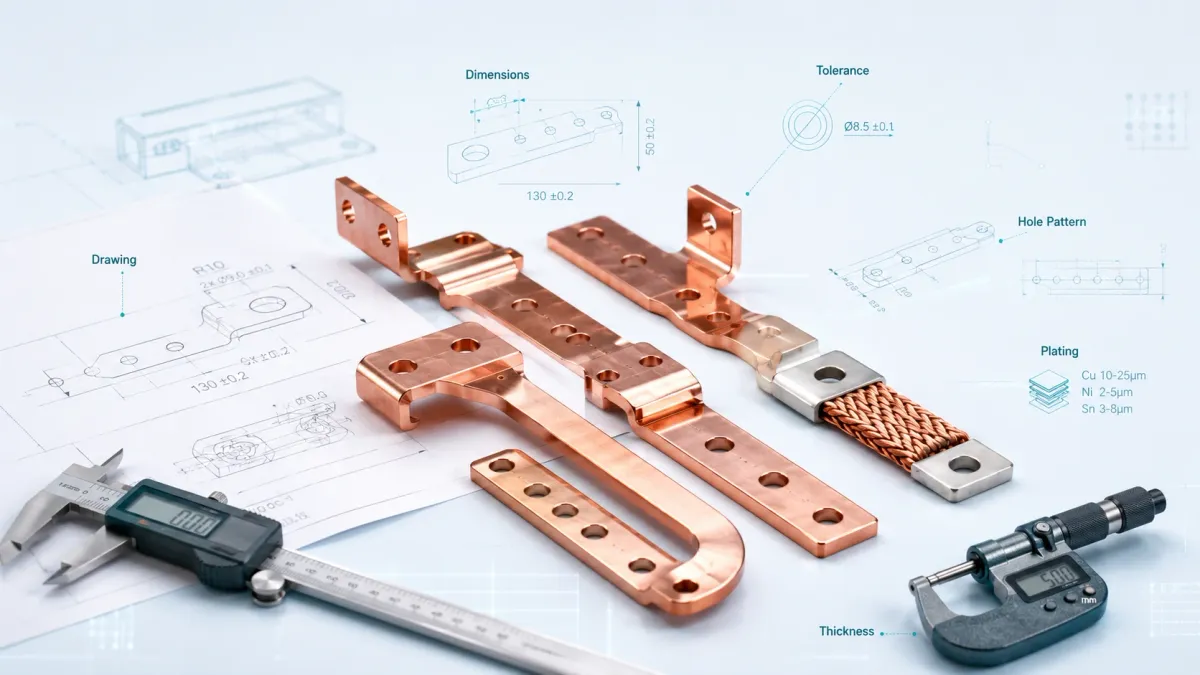
For rigid busbars, critical dimensions usually include length, width, thickness, hole diameter, slot size, hole-to-hole distance, bend angle, bend radius, offset height, terminal flatness, and overall twist. For flexible laminated busbars, critical dimensions include terminal geometry, bonded length, flexible zone length, layer stack alignment, insulation cutout position, and final free shape. For braided busbars, critical dimensions include braid length, terminal length, terminal thickness, hole position, and installed bend shape.
Dimensional tolerances should be realistic. Overly tight tolerances increase cost and may not improve performance. Overly loose tolerances create assembly problems. The best approach is to define critical-to-function dimensions and leave non-critical areas with practical manufacturing tolerance. A good busbar manufacturer will ask which dimensions are installation-critical, which are electrical-contact-critical, and which are cosmetic.
OEM buyers should check whether the supplier can support:
- CAD review using STEP, IGES, DWG, DXF, or PDF drawings.
- DFM feedback before tooling or mass production.
- CNC punching, machining, or stamping depending on volume.
- Controlled CNC bending for 2D and 3D shapes.
- Dedicated fixtures for repeatable forming.
- First article inspection reports.
- Go/no-go gauges for production inspection.
- Packaging methods that prevent deformation during shipment.
Packaging deserves special attention. Long copper bars and flexible busbars can be damaged after final inspection if they are stacked poorly, rubbed against each other, or compressed during export shipping. For plated or insulated busbars, poor packaging can cause scratches, dents, insulation scuffing, or contact surface contamination. A reliable busbar manufacturer should define packaging by part type, not use one generic carton method for every product.
Contact surfaces, bolted joints, and plating decisions
Many field problems appear at the joint rather than in the middle of the conductor. The joint is where electrical, mechanical, and environmental factors meet. A good busbar body with a poor contact surface can develop heat, oxidation, voltage drop, or intermittent performance.
Contact resistance is affected by surface flatness, plating type, plating thickness, contact area, bolt size, washer type, torque, surface cleanliness, and whether the joint experiences vibration or thermal cycling. For OEM buyers, the key point is simple: the contact area should be designed and manufactured as a functional surface, not treated as a cosmetic detail.
Tin plating is common in many busbar projects because it reduces oxidation and provides a practical balance between cost and performance. Nickel plating may be useful in higher-temperature or more corrosive conditions. Silver plating can reduce contact resistance for demanding applications but should be justified by the electrical and commercial requirements. Bare copper may be acceptable in some controlled environments, but oxidation and handling conditions must be considered.
Before ordering, the buyer should define:
- Which areas require plating and which areas must be masked.
- Plating material and thickness range.
- Whether the contact area must remain free of insulation.
- Whether the busbar will contact copper, aluminum, plated terminals, or mixed metals.
- Bolt size, torque specification, washer stack, and surface pressure.
- Expected maintenance or disassembly cycles.
- Environmental exposure such as humidity, salt spray, chemicals, or condensation.
A busbar manufacturer should be able to manufacture the part, but the OEM should still validate the complete bolted connection in the final assembly. The busbar, fastener, mating terminal, enclosure environment, and maintenance procedure work together. If one part changes, the joint performance can change.
Insulation, creepage, clearance, and high-voltage details
In low-voltage high-current systems, insulation may mainly prevent accidental contact and short circuit. In high-voltage EV, BESS, inverter, and data center power systems, insulation design becomes a safety-critical topic. The buyer should not simply say “add insulation” and leave the rest to the supplier.
The required insulation depends on voltage, pollution degree, environment, clearance, creepage, mechanical abrasion, installation method, operating temperature, fire requirement, and whether partial discharge is a concern. The insulation design must also account for edges, holes, bends, slots, mounting areas, and sharp corners. A busbar with good coating on flat surfaces but thin coverage at edges may fail in the real assembly.
Typical insulation options include heat-shrink tubing, PVC sleeve, PA coating, epoxy coating, powder coating, dipping, overmolding, and custom formed covers. Each method has trade-offs. Heat-shrink is flexible and efficient for many parts but may be difficult around complex geometry. Powder or epoxy coating can provide good coverage but requires process control at holes and contact-masked areas. Overmolding may improve integration but requires tooling investment.
The buyer should provide the busbar manufacturer with:
- Working voltage and maximum voltage.
- AC or DC operation.
- Required dielectric withstand test, if specified.
- Creepage and clearance targets.
- Insulation material preference.
- Required thickness or thickness range.
- Masking areas for electrical contact.
- Color requirement and polarity marking.
- Flame rating or material standard requirement, if applicable.
- Whether partial discharge testing is required.
- Expected abrasion, vibration, and thermal cycling environment.
For EV battery modules, JUMAI’s Flexible Busbar for EV Battery Modules article discusses how higher-voltage architectures increase the need for dielectric coatings, abrasion resistance, creepage, and clearance control in compact battery modules. That design thinking applies beyond vehicles. Any compact high-voltage assembly needs insulation designed around the actual geometry, not added as a final decorative layer.
Manufacturing capability: prototype flexibility and production discipline
An OEM usually needs two different things from a busbar manufacturer. During development, the buyer needs flexibility: quick design feedback, sample adjustment, small batches, and fast communication. During production, the buyer needs discipline: stable process control, documentation, repeatability, capacity planning, and controlled change management. The supplier must be good at both.
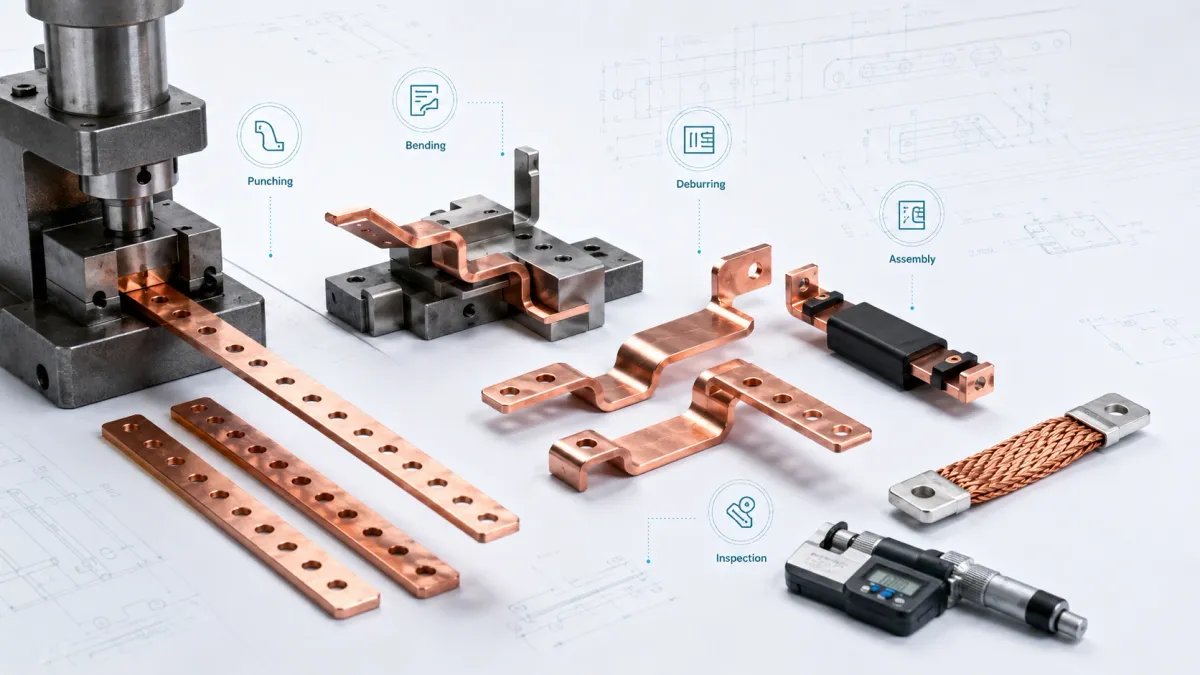
A typical custom copper busbar process may include material incoming inspection, cutting, stamping or punching, CNC machining, deburring, bending, forming, welding or bonding, plating, cleaning, insulation, marking, final inspection, and packaging. A laminated flexible busbar may add foil cutting, stacking, diffusion welding or press welding, terminal forming, insulation application, and flexibility inspection. A braided busbar may add braid selection, cutting, terminal pressing, welding, plating, and tensile or flex checks.
JUMAI’s About page describes capabilities in soft, hard, and braided copper busbars, plus precision metal forming, stamping, deep drawing, tooling, CNC machining, wire EDM, and surface grinding. These supporting capabilities are important because many custom busbar projects require more than a conductor. They may need brackets, stamped terminals, deep-drawn metal parts, prototype fixtures, or mold components. JUMAI’s Precision Deep Drawn Components service can also support related formed metal parts used around electrical assemblies.
When auditing a supplier, OEM buyers should look for manufacturing evidence instead of broad claims. Useful evidence includes process photos, machine lists, sample inspection reports, tooling examples, material certificates, plating reports, insulation samples, and actual parts similar to the buyer’s project. The supplier does not need to expose confidential customer designs, but it should be able to show comparable process capability.
Quality system, traceability, and documentation
Quality is not only about final inspection. A busbar can look correct at shipment and still fail if the process is uncontrolled. OEM buyers should check whether the busbar manufacturer has a practical quality system that covers incoming material, in-process inspection, final inspection, nonconforming product control, corrective action, traceability, and change management.
ISO 9001 is a useful baseline. ISO describes ISO 9001 as a globally recognized quality management standard that helps organizations improve performance, meet customer expectations, and demonstrate commitment to quality. It also states that ISO 9001 is the only standard in the ISO 9000 family that can be certified to, although certification itself is not mandatory. See ISO’s official ISO 9001 overview. A certificate alone does not guarantee a perfect busbar, but it helps confirm that the supplier has a management framework for controlled production.
For busbar projects, buyers should request documentation based on risk level. A simple industrial part may need a drawing, material certificate, and final inspection report. A high-voltage EV or BESS part may need first article inspection, process flow, control plan, plating thickness report, insulation test report, resistance measurement, traceability label, packaging standard, and change control agreement.
| Supplier check area | What the OEM should ask for | Why it matters | Red flag |
|---|---|---|---|
| Material control | Copper grade, material certificate, thickness tolerance, lot traceability | Conductivity and forming behavior depend on material consistency | Supplier cannot identify copper grade or lot source |
| Process control | Process flow, key machines, forming method, deburring method, plating/insulation route | Repeatability depends on controlled operations, not only skilled workers | Sample looks good, but no defined production route exists |
| Electrical validation | Resistance check, temperature-rise plan, contact surface control, insulation test | High-current parts fail through heat and joint resistance | Supplier only confirms appearance, not electrical function |
| Dimensional quality | First article inspection, critical dimension report, gauges or fixtures | Assembly fit depends on hole, bend, and flatness repeatability | Supplier refuses to discuss tolerances before quotation |
| Surface finish | Plating type, thickness range, masking plan, corrosion requirement | Oxidation and contact stability affect long-term reliability | Contact surfaces are plated or insulated inconsistently |
| Change control | Written approval before material, process, plating, or tooling changes | OEM validation becomes invalid if production changes silently | Supplier treats substitutions as normal purchasing decisions |
| Packaging | Part-specific packaging, separator, anti-scratch method, export protection | Copper and insulation can be damaged during shipment | Finished parts are bulk-packed without surface protection |
| Communication | Engineering contact, drawing review, RFQ clarification, response discipline | Custom parts require fast technical alignment | Supplier quotes quickly but ignores technical questions |
A strong quality conversation protects both sides. The buyer avoids hidden risk. The supplier avoids unrealistic expectations. The final order becomes easier to produce because critical requirements are clear from the beginning.
Standards and certification: know what belongs to the busbar and what belongs to the assembly
OEM buyers sometimes ask whether a busbar is “UL certified” or “IEC certified.” The answer depends on what is being certified. A loose custom copper busbar is not the same as a complete busway system, switchgear assembly, or battery pack. The busbar manufacturer can supply material, process, and inspection evidence, but the final assembly may require separate design verification, type testing, or certification by the OEM or system manufacturer.
UL Solutions provides information about UL 857, the Standard for Safety for Busways and Associated Fittings, and explains that the standard covers busway and associated fittings with construction and manufacturing requirements for certified busduct design. IEC 61439 practice, meanwhile, focuses on low-voltage switchgear and controlgear assemblies, including temperature-rise considerations for busbars and functional units. These standards are important reference points, but the buyer should define whether the custom busbar part itself, the busbar system, or the final equipment assembly requires certification.
For many custom OEM busbar orders, the practical requirement is not that the individual busbar carries a standalone certification mark. The practical requirement is that the busbar manufacturer provides the evidence the OEM needs for its own validation and compliance package. That evidence may include material certificates, dimensional reports, plating reports, insulation tests, RoHS/REACH declarations where required, salt spray results, torque recommendations, and process traceability.
JUMAI’s article on Busbar Copper Standards and Testing for Global Markets discusses the importance of material purity, coating thickness, thermal performance, and standards awareness for global power applications. OEM buyers can use such technical guides as a starting point, but the final project requirements should always be written into drawings, specifications, purchase contracts, and inspection plans.
RFQ preparation: what OEM buyers should send before quotation
A busbar RFQ becomes faster and more accurate when the buyer provides complete information. A vague request such as “quote this copper bar” usually creates back-and-forth messages, hidden assumptions, and a higher risk of price changes later. A complete RFQ allows the busbar manufacturer to review manufacturability, estimate material usage, define tooling needs, identify risk, and propose improvements.
At minimum, the buyer should send:
- 2D drawing with dimensions, tolerances, material, finish, and insulation requirement.
- 3D file such as STEP or IGES for complex bent parts.
- Annual quantity, prototype quantity, and expected production schedule.
- Application description: EV, BESS, data center, switchgear, inverter, industrial equipment, or another system.
- Electrical requirements: rated current, peak current, voltage, AC/DC, duty cycle, and temperature-rise target.
- Mechanical requirements: mounting method, mating components, fastener size, torque, vibration, and space restrictions.
- Surface requirement: bare copper, tin plating, nickel plating, silver plating, or other finish.
- Insulation requirement: material, color, coverage, voltage test, masking, and edge coverage.
- Compliance requirement: RoHS, REACH, UL-related documentation, IEC-related documentation, PPAP, first article inspection, or customer-specific format.
- Packaging and shipping requirements.
- Target cost or cost-reduction objective if available.
If the buyer does not have a final drawing, a sketch, sample, photos, installation space, and electrical requirements can still start the discussion. JUMAI’s Custom Copper Busbars page invites customers to send CAD drawings such as STEP, IGES, and PDF for engineering review. For early projects, this engineering review is often more valuable than a quick price because it helps prevent design mistakes before tooling or sampling.
Drawing review: what a good manufacturer should notice
A good busbar manufacturer should not only read the drawing; it should challenge the drawing where necessary. This does not mean the supplier should redesign the customer’s product without permission. It means the supplier should identify manufacturing risks before they become production problems.
During DFM review, the supplier should check whether holes are too close to bends, whether bend radius is realistic for the copper thickness and temper, whether the flatness requirement is achievable after bending and plating, whether insulation can cover the geometry evenly, whether contact areas are clearly masked, whether burr direction matters for assembly, and whether tolerances match the production method.
The supplier should also check whether the design is suitable for the expected volume. A prototype can be made by laser cutting, CNC punching, manual fixture bending, and secondary finishing. A high-volume production part may require progressive tooling, dedicated forming fixtures, automated inspection, or optimized nesting to reduce scrap. If the part is likely to move from prototype to mass production, early manufacturing strategy matters.
Questions the supplier should ask include:
- Is this part a prototype, pilot build, or mass production item?
- Which surfaces are electrical contact surfaces?
- Which dimensions are critical to assembly?
- Which dimensions can be adjusted for manufacturability?
- Does the busbar need to absorb tolerance or movement?
- Is the mating component fixed or adjustable?
- Will the part be installed manually or by automation?
- Will the busbar be reworked, serviced, or replaced in the field?
- Are there customer-specific inspection formats?
- Is the buyer validating the busbar alone or the complete assembly?
The best time to answer these questions is before quotation, not after the first sample fails to fit.
Prototype approval: inspect function, not just appearance
A clean prototype can create a false sense of confidence. OEM buyers should inspect samples against functional requirements, not just visual expectations. A prototype review should include dimensions, assembly fit, contact surface quality, insulation coverage, flexibility, resistance, heat behavior, and packaging condition after shipment.
For rigid busbars, the buyer should install the sample in the real assembly or a representative fixture. Check whether holes align without force, whether bends clear nearby components, whether bolts seat properly, whether contact surfaces remain flat, and whether the busbar creates stress on terminals. If the operator must bend the busbar by hand during installation, the design or tolerance chain needs review.
For laminated flexible busbars, check whether the flexible zone moves as intended, whether terminal areas remain stable, whether insulation cracks or wrinkles during movement, and whether the busbar can be installed repeatedly without damage. For braided busbars, check whether the braid length and terminal orientation allow natural installation without twisting or pulling.
Electrical checks should match project risk. A low-risk industrial busbar may only require dimensional and visual inspection at the prototype stage. A high-current battery or data center power part may require resistance measurement, temperature test, dielectric test, torque trial, thermal imaging, and vibration or cycling evaluation. The point is not to over-test every busbar. The point is to test the failure modes that matter for the application.
Cost: understand what drives the quotation
Busbar price is not only copper weight. Copper weight matters, but the final quotation is shaped by material grade, thickness, shape complexity, hole count, bend count, tolerance, surface finish, insulation, tooling, inspection, packaging, order quantity, and production stability.
A simple flat copper bar with two holes and tin plating is very different from a multi-layer flexible busbar with welded terminals, selective insulation, masked plating, tight flatness, serial marking, and export packaging. Two parts with the same copper weight can have very different process costs.
Buyers can improve quotation accuracy by separating cost drivers:
- Material cost: copper grade, thickness, width, yield, and scrap rate.
- Processing cost: cutting, punching, machining, bending, welding, deburring, cleaning, and forming.
- Surface cost: plating type, thickness, masking, polishing, corrosion protection, and inspection.
- Insulation cost: material, coverage complexity, masking, curing, testing, and rework risk.
- Tooling cost: prototype fixture, bending die, stamping die, progressive die, or inspection gauge.
- Quality cost: FAI, PPAP, special reports, traceability, extra testing, and customer audits.
- Logistics cost: packaging, labeling, export documents, and shipping method.
A qualified busbar manufacturer should be willing to discuss cost-down options. For example, the buyer may allow a slightly larger bend radius, change a slot to a round hole, simplify insulation masking, adjust tolerance on a non-critical dimension, combine similar part families, or move from CNC production to tooling after volume stabilizes. Cost reduction should never remove functional safety, but it can remove unnecessary manufacturing difficulty.
ars rather than only selling standard catalog conductors. The company’s Custom Copper Busbars service covers hard or rigid busbars, soft or braided busbars, and laminated flexible busbars, with customization in shape, size, finish, and insulation. This product range is important because OEM projects often include more than one conductor type in the same system.
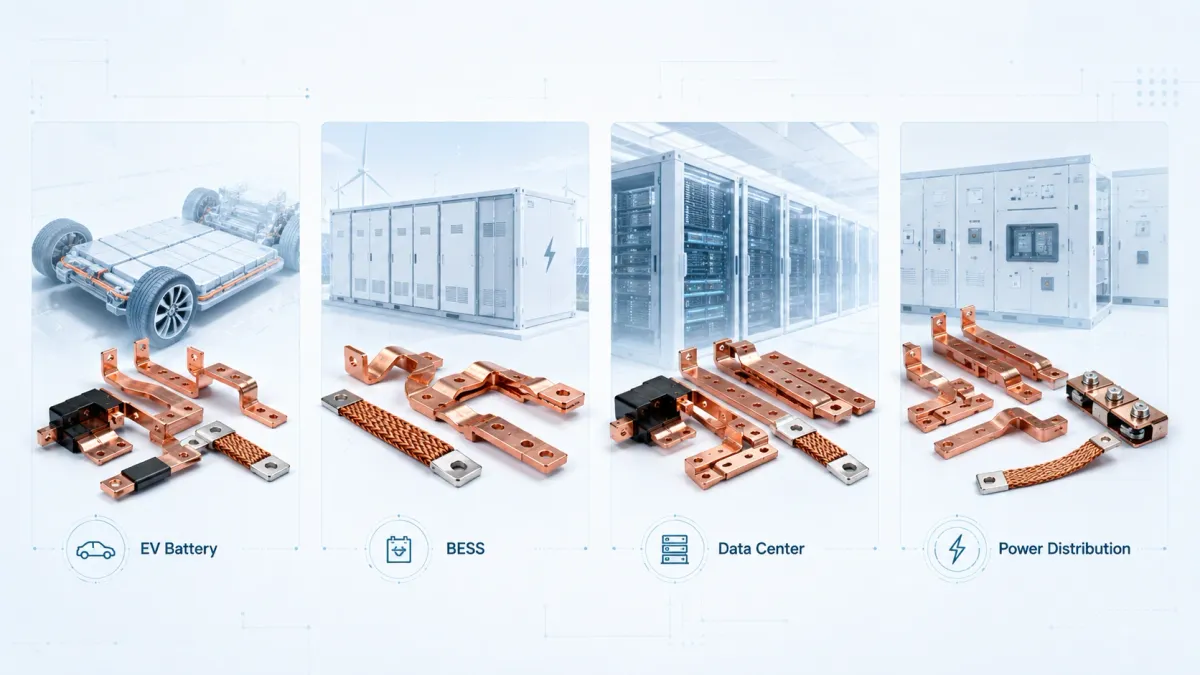
For example, a BESS cabinet may use rigid busbars for the main DC path, flexible laminated busbars for module tolerances, braided links for vibration or grounding, and stamped conductive parts for connection accessories. An EV battery project may require flexible interconnects, plated terminals, insulation masks, formed brackets, and custom packaging for automated assembly. A data center power product may need compact rigid bars, plated contact surfaces, tight hole tolerances, and repeatable insulation.
JUMAI’s supporting capabilities in precision stamping, deep drawing, tooling, and mold components also help when the busbar is part of a larger hardware set. The company’s Precision Deep Drawn Components page describes high-accuracy metal parts formed through stamping and drawing processes. The About JUMAI page highlights metal forming, stamping, deep drawing, tooling, CNC machining, wire EDM, and grinding capabilities. These are useful when the buyer wants a supplier that can support related custom metal components around the busbar assembly.
For OEM buyers, the practical value is not only that JUMAI can make copper parts. The value is that JUMAI can discuss the busbar as an engineered component: material, geometry, current path, surface, insulation, forming, tooling, testing, and production repeatability. This is the difference between a vendor and a manufacturing partner.
Suggested buyer workflow before placing the order
A structured workflow reduces sourcing risk. The buyer can use the following sequence for most custom busbar projects.
First, define the application and risk level. Is the part for a prototype display unit, a low-voltage cabinet, a high-current production system, an EV battery pack, a BESS container, or a data center power product? The risk level determines how much testing and documentation is needed.
Second, prepare the technical package. Include drawings, 3D files, electrical requirements, insulation requirements, plating requirements, and quantity expectations. If something is unknown, state that it is open for supplier recommendation instead of leaving it silent.
Third, request DFM review before final quotation. Ask the manufacturer to identify cost risks, tolerance risks, forming risks, insulation risks, and possible design improvements.
Fourth, agree on quotation assumptions. Confirm material, finish, insulation, inspection, packaging, tooling, sample lead time, production lead time, and validity period. A clear quotation is easier to compare than a low number with hidden assumptions.
Fifth, approve prototypes using functional tests. Install samples in the actual assembly, measure critical dimensions, inspect contact surfaces, verify insulation, and perform electrical or thermal checks based on project risk.
Sixth, freeze the production specification. After prototype approval, freeze drawings, material, process route, inspection plan, packaging method, and change-control rules.
Seventh, monitor early production. For the first batch, review inspection reports, packaging condition, installation feedback, and any operator comments. If there is a small issue, correct it before volume increases.
This workflow may look more formal than simply buying parts. In practice, it saves time because it prevents unclear requirements from becoming field failures.
Final checklist for OEM buyers
Before issuing a purchase order to a busbar manufacturer, buyers should confirm the following:
- The supplier understands the real application, not just the drawing.
- Copper grade, thickness, conductivity, and certificate requirements are defined.
- Rated current, voltage, duty cycle, ambient condition, and temperature-rise target are communicated.
- The busbar type is appropriate: rigid, laminated flexible, braided, insulated, or hybrid.
- Critical dimensions, bend tolerances, hole locations, and contact flatness are specified.
- Plating material, thickness, masking, and contact areas are defined.
- Insulation material, coverage, color, edge protection, and dielectric tests are specified.
- Bolted joint assumptions such as fastener size, torque, washer stack, and mating surface are known.
- Prototype inspection and approval methods are agreed.
- Production inspection reports and traceability are agreed.
- Packaging protects contact surfaces, plating, insulation, and shape.
- Any material, process, plating, tooling, or inspection change requires written approval.
If these points are clear, the sourcing process becomes more predictable. If many points are unknown, the buyer should treat the first order as an engineering development step rather than a final production release.
Conclusion: choose a busbar manufacturer that reduces engineering risk
The right busbar manufacturer does more than produce copper shapes. It helps the OEM buyer reduce electrical risk, thermal risk, assembly risk, quality risk, and supply risk. In modern power systems, that support is increasingly valuable because EVs, BESS, data centers, renewable energy equipment, and industrial power systems all demand compact, reliable, high-current conductors.
OEM buyers should evaluate suppliers based on material control, busbar type selection, dimensional capability, contact surface quality, insulation process, thermal awareness, documentation, communication, and production repeatability. Price still matters, but price should be compared only after the technical scope is clear. A low quote that ignores temperature rise, plating, insulation, or traceability is not a true saving.
For buyers developing custom soft, hard, braided, laminated, or insulated copper busbars, JUMAI can support engineering review, prototype development, and production manufacturing. The best next step is to prepare drawings, electrical requirements, target quantity, and application details, then contact the engineering team through JUMAI’s Custom Copper Busbars service page or the contact page. A clear RFQ helps both sides move faster, quote more accurately, and build a busbar that performs reliably in the final equipment.
Frequently asked questions
What should I check first when choosing a busbar manufacturer?
Start with technical fit, not price. Confirm whether the manufacturer understands your current rating, voltage, thermal environment, busbar type, copper grade, plating, insulation, and assembly method. A supplier that asks detailed engineering questions during RFQ is usually safer than a supplier that quotes instantly without clarifying the requirements.
Is C11000 copper good for busbars?
C11000 is widely used for electrical conductors because it offers high conductivity and practical manufacturability. The Copper Development Association lists C11000 with minimum 99.90% copper content and minimum 100% IACS conductivity in the annealed condition. However, the best copper grade depends on the application, forming requirement, surface finish, and operating environment.
Should I use rigid busbars or flexible busbars?
Use rigid busbars when the assembly is static, the geometry is stable, and structural consistency is important. Use laminated flexible or braided busbars when the connection must absorb vibration, thermal expansion, installation tolerance, or movement. EV battery modules, BESS modules, and compact power electronics often benefit from flexible structures, while switchgear and cabinet power distribution often use rigid bars.
Do custom busbars need insulation?
Not always. Insulation depends on voltage, spacing, enclosure design, touch safety, environmental exposure, and system standards. High-voltage EV, BESS, and compact inverter applications often require carefully designed insulation with defined material, thickness, masking, edge coverage, creepage, clearance, and testing. Low-voltage or protected cabinet applications may use bare or plated busbars if the system design allows it.
What documents should I send for an accurate busbar quote?
Send a 2D drawing, 3D file if available, material requirement, plating requirement, insulation requirement, rated current, voltage, duty cycle, application description, annual quantity, prototype quantity, and required inspection documents. If you do not have a final drawing, send a sketch, sample photos, installation space, and electrical requirements so the manufacturer can provide early DFM advice.
Can a busbar manufacturer certify my full electrical assembly?
Usually, a custom busbar manufacturer supplies the component and its supporting documentation. Certification of the complete assembly, such as a busway system, switchgear assembly, EV pack, or BESS cabinet, may require additional design verification or testing by the OEM or a certification body. The supplier can still provide material certificates, inspection reports, plating data, insulation test data, and traceability to support the OEM’s compliance work.
How can I reduce busbar cost without reducing reliability?
Cost-down options may include adjusting non-critical tolerances, simplifying bends, improving material nesting, changing a slot to a round hole, optimizing plating coverage, standardizing hole sizes, combining similar part families, or moving to dedicated tooling after volume is stable. Do not reduce copper cross-section, contact area, insulation, or plating quality without engineering validation.
Why should OEM buyers involve the busbar manufacturer early?
Early supplier involvement helps identify manufacturability risks before tooling, sampling, or validation. The manufacturer can review bend feasibility, hole location, flatness, burr direction, plating masks, insulation coverage, packaging, and inspection methods. Early DFM review usually costs less than redesigning the part after sample failure.