When buyers search for copper buss bars, they are usually looking for the same component that engineers more often call copper bus bars or copper busbars: high-conductivity copper conductors used to collect, distribute, and transmit electrical current inside power equipment. The spelling may look like a small detail, but in real procurement it can affect search results, drawing communication, supplier comparison, and even how a purchasing team finds the right manufacturer.
For JUMAI, this article uses copper buss bars as the core SEO keyword because many buyers still search that phrase. In technical documentation, however, the preferred wording is copper bus bars or copper busbars. The goal is not to argue about spelling. The goal is to help engineers, purchasing managers, EV battery designers, data center power teams, and industrial equipment manufacturers understand what they should specify before requesting a quote.
A copper bus bar is not simply a flat piece of copper. It is a current-carrying part whose performance depends on material grade, cross-sectional area, surface area, plating, insulation, bend accuracy, hole position, joint pressure, thermal environment, vibration, and assembly tolerance. A small error in any of these details can create excessive voltage drop, local hot spots, installation difficulty, or premature failure.
JUMAI manufactures custom copper busbars for applications such as EV batteries, BESS energy storage systems, renewable energy equipment, switchgear, transformers, AI server racks, power modules, and industrial electronics. The company also provides precision stamping, deep-drawn components, tooling, and mold-related services, but the core strength of the DeepDrawTech website is custom soft, rigid, laminated, and braided copper bus bar manufacturing.
This buying guide explains the terminology, application scenarios, engineering parameters, material choices, plating options, insulation methods, quality checks, and RFQ information that help global buyers purchase custom copper bus bars more efficiently.
- Copper Buss Bars, Copper Bus Bars and Copper Busbars: Which Term Is Correct?
- What a Copper Bus Bar Does in an Electrical System
- Why Copper Is Still the Standard Material for High-Current Bus Bars
- Copper Grades Commonly Used for Bus Bars
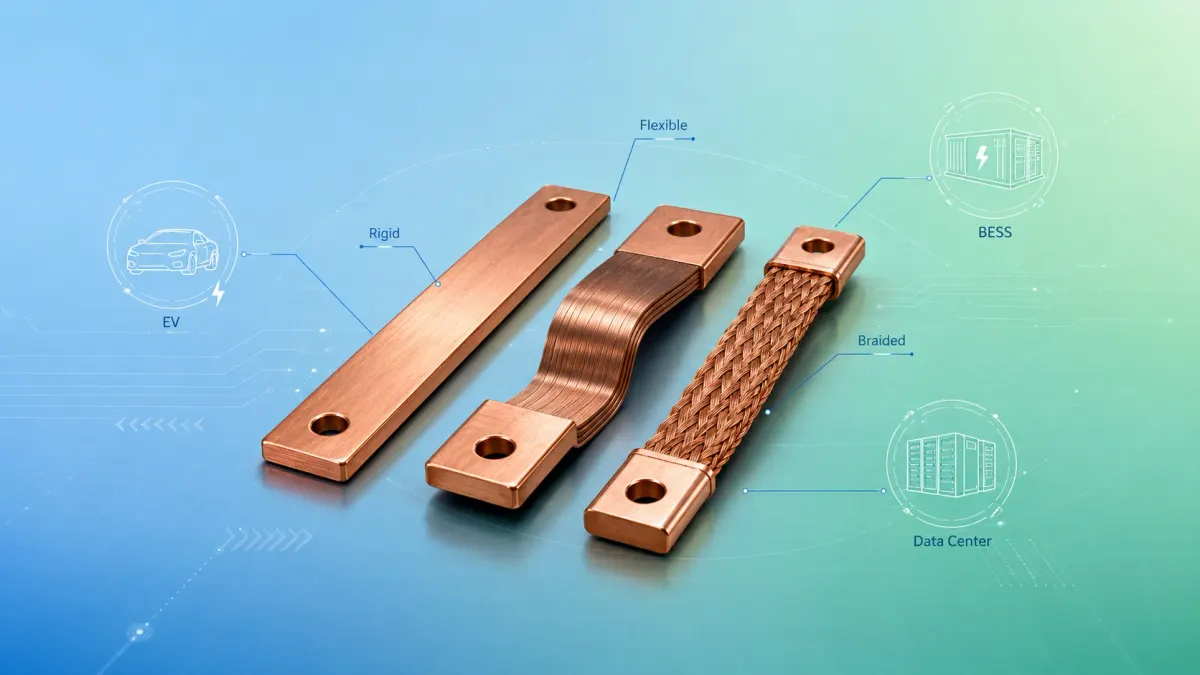
- Main Types of Copper Bus Bars JUMAI Manufactures
- Where Copper Bus Bars Are Used
- Market Trends Increasing Demand for Custom Copper Bus Bars
- Ampacity: Why the Same Copper Bar Can Carry Different Current in Different Systems
- Voltage, Insulation, Creepage and Clearance
- Plating Options: Tin, Nickel, Silver or Bare Copper?
- Mechanical Design: Holes, Bends, Slots, Burrs and Flatness
- Electrical Joint Design: The Hidden Source of Heat
- AC, DC, Skin Effect and Proximity Effect
- Short-Circuit Strength and Mechanical Support
- Application-Specific Buying Notes
- RFQ Checklist for Custom Copper Bus Bars
- Cost Drivers in Copper Bus Bar Manufacturing
- Quality Control: What Buyers Should Ask the Supplier to Verify
- How to Choose a Copper Bus Bar Manufacturer
- Why Work With JUMAI for Custom Copper Bus Bars
- Practical Example: How a Buyer Should Describe a Copper Bus Bar RFQ
- Common Mistakes When Buying Copper Buss Bars
- FAQ
- Final Buying Advice
Copper Buss Bars, Copper Bus Bars and Copper Busbars: Which Term Is Correct?
The most common engineering term is bus bar or busbar. Merriam-Webster defines a bus bar as a conductor or assembly of conductors used to collect current and distribute it to outgoing feeders. That definition is useful because it emphasizes the functional role of the part: a bus bar is not just a conductor; it is a distribution point inside an electrical system.
The spelling buss bar appears in search behavior, older documents, and some supplier catalogs, but it is less common in formal engineering references. In modern technical writing, bus bar and busbar are safer choices. In SEO writing, it is still reasonable to mention copper buss bars because buyers may type that phrase into Google, especially when they are not native English speakers or when they have seen the term in older purchasing records.
| Term | Best Use | Recommended for Drawings? | Notes for Buyers |
|---|---|---|---|
| Copper bus bar | Formal engineering writing, specifications, RFQ documents | Yes | Clear and widely understood in electrical engineering. |
| Copper busbar | Product category pages, SEO, compact technical content | Yes | Common in modern supplier websites and industry articles. |
| Copper buss bar | Search keyword, older usage, buyer-side terminology | Not preferred | Useful for SEO coverage, but not ideal as the main drawing term. |
| Copper buss bars | Plural search phrase | Not preferred | This article targets it because it has commercial search value. |
A practical recommendation is simple: use “copper bus bar” in drawings and specifications, and allow “copper buss bars” as a search variant in website content. This avoids confusion while still capturing buyer intent.
For example, a purchasing team may search “custom copper buss bars for battery pack,” but the engineering drawing should still define the part as “C11000 copper bus bar, tin plated, 2 mm thickness, 3D formed, insulation required.” That technical wording is clearer for manufacturing and inspection.
What a Copper Bus Bar Does in an Electrical System
A copper bus bar transfers electrical current between components while also supporting the mechanical layout of the assembly. In many systems, it replaces multiple cables, terminals, and lugs with a more compact and repeatable conductor. Because it has a defined shape, it can be optimized for short current paths, low voltage drop, low inductance, reliable thermal behavior, and faster assembly.
A simple bus bar may connect a circuit breaker to a contactor. A more complex bus bar may distribute high current across battery modules, connect DC links in an inverter, or route power through a server rack power distribution unit. In each case, the bus bar must be designed around the real operating environment rather than chosen only by length and width.
According to the Copper Development Association busbar guidance, ampacity tables for rectangular copper busbars are based on variables such as copper conductivity, surface condition, frequency, and allowable temperature rise. This is why a bus bar size that works in an open-air cabinet may not work inside a sealed inverter or a high-density battery pack.
At a basic level, a copper bus bar performs six jobs:
- It carries current with low electrical resistance.
- It distributes power to multiple outgoing circuits.
- It reduces voltage drop compared with poorly sized cable connections.
- It dissipates heat through surface area, convection, radiation, and conduction.
- It creates a stable mechanical interface for bolted, welded, or pressed connections.
- It simplifies assembly by replacing complicated wiring with repeatable metal geometry.
These functions are easy to understand, but difficult to perfect. The buyer must think about current, voltage, heat, vibration, space, insulation, corrosion, and service life at the same time.
Why Copper Is Still the Standard Material for High-Current Bus Bars
Copper is widely used for bus bars because it combines high electrical conductivity, strong thermal conductivity, good formability, reliable contact behavior, and long-term durability. The Copper Development Association alloy database for C11000 lists C11000 as a high-conductivity copper with minimum 99.90% copper content and minimum 100% IACS conductivity in annealed condition. That is one reason C11000/T2 copper is common in bus bar manufacturing.
Aluminum is also used in some applications, especially where weight or cost is a major concern. However, aluminum normally requires a larger cross-sectional area to carry the same current, and its oxide layer creates special challenges at joints. For compact, high-current, high-reliability equipment, copper often remains the preferred material.
| Property | Copper Bus Bar | Aluminum Bus Bar | Practical Meaning |
|---|---|---|---|
| Electrical conductivity | Very high; C11000 commonly reaches 100% IACS or higher in annealed condition | Lower than copper; larger section is usually required | Copper supports compact high-current layouts. |
| Thermal conductivity | Excellent | Good, but lower than copper | Copper helps move heat away from hot spots. |
| Density | Higher | Lower | Aluminum can reduce weight, but may need more volume. |
| Contact reliability | Strong when properly plated and bolted | Requires careful joint design due to oxide behavior | Copper is often easier for stable low-resistance joints. |
| Formability | Good for punching, bending, stamping, and lamination | Good, but springback and joint design differ | Both can be formed, but tooling and tolerances must match the material. |
| Typical use | EV packs, BESS, switchgear, data centers, inverters, power modules | Weight-sensitive packs, large distribution systems, some cost-driven designs | Selection should be based on current, space, weight, joint method, and cost. |
Copper is not automatically the best choice for every project. A lightweight EV subsystem may use aluminum or copper-aluminum hybrid conductors. A large busway may choose aluminum for cost and weight reasons. But when buyers need compact dimensions, strong conductivity, reliable bolted contact, excellent heat spreading, and flexible customization, copper remains a strong engineering choice.
Copper Grades Commonly Used for Bus Bars
The most common material for standard electrical copper bus bars is C11000 electrolytic tough pitch copper, often referred to as ETP copper. In China-related sourcing, buyers may also see the material described as T2 copper. For higher-purity or special applications, oxygen-free copper grades such as C10100 or C10200 may be used.
ASTM B187/B187M is a common reference for copper conductor bars, rods, and shapes. The ASTM B187 specification page states that the specification covers copper conductor bars, rods, and shapes for electrical bus and general applications, including soft annealed and hard tempers. Buyers should not treat a standard name as a substitute for a full specification, but it gives a recognized framework for material and product requirements.
| Material | Typical Description | Common Bus Bar Use | Buyer Notes |
|---|---|---|---|
| C11000 / T2 copper | Electrolytic tough pitch copper, high conductivity | Rigid bus bars, punched bars, formed bars, many power distribution parts | Excellent general-purpose choice for copper bus bars. |
| C10100 copper | Oxygen-free electronic copper, very high purity | High-performance electrical and thermal applications | Useful where oxygen content and conductivity are critical. |
| C10200 copper | Oxygen-free copper | Flexible conductors, high-reliability electrical assemblies | Often chosen for demanding forming or electrical requirements. |
| Tin-plated C11000 | C11000 with anti-oxidation tin surface | Cabinets, BESS, general power distribution, many bolted joints | Balances cost, corrosion resistance, and solderability. |
| Nickel-plated copper | Copper with nickel barrier layer | Higher-temperature or corrosive environments | Stronger corrosion and temperature resistance, but conductivity at the surface differs. |
| Silver-plated copper | Copper with high-conductivity silver contact surface | High-current, high-temperature, premium contact applications | Higher cost, but excellent contact performance when justified. |
A buyer should provide the expected material grade, but the manufacturer should also review whether that grade matches the process. For example, a very hard temper may hold shape well but may crack during tight bending. A softer temper may bend more easily but may require additional control for flatness and deformation. JUMAI’s article on C10100 vs C11000 copper busbar selection is a useful internal reference when the buyer is deciding between high-conductivity copper grades.
Main Types of Copper Bus Bars JUMAI Manufactures
JUMAI’s copper bus bar capability covers three broad categories: rigid bus bars, soft or braided bus bars, and laminated flexible bus bars. Each type solves a different mechanical and electrical problem.
Rigid copper bus bars
Rigid copper bus bars are solid flat conductors produced by cutting, punching, milling, bending, and surface finishing. They are ideal when the assembly is relatively static, when mechanical support is important, and when high current must be routed through a predictable path.
Typical applications include switchgear, control cabinets, transformer connections, industrial power distribution, server rack power modules, DC fast charging cabinets, and BESS racks. Rigid bars can be designed with bends, slots, threaded inserts, countersunk holes, embossing, and custom hole patterns. The manufacturing challenge is not only making the bar conductive; it is holding bend angle, hole position, burr direction, flatness, and plating quality within tolerance.
For more detail on rigid bar design, JUMAI’s rigid busbar design guide explains why rigid bars are structural conductors, not only current carriers. JUMAI’s rigid busbars manufacturing process also explains why buyers should provide current, voltage, enclosure, duty cycle, and temperature-rise targets rather than copying dimensions from another cabinet.
Soft and braided copper bus bars
Soft copper bus bars and braided copper connectors are used where movement, vibration, thermal expansion, or assembly misalignment must be absorbed. A braided copper bus bar is usually made from woven copper wire, sometimes bare and sometimes tin plated, with compressed or welded terminals at the ends.
These parts are common in EV systems, battery packs, transformer connections, power electronics, rail systems, vibration-heavy industrial equipment, and places where a rigid conductor would transfer too much stress to terminals. They are especially useful when the connection must carry high current but also tolerate small movement.
The design focus is different from rigid bars. Instead of only checking flatness and bend geometry, the buyer must consider braid cross-section, wire diameter, terminal compression quality, flexibility direction, fatigue life, and plating coverage. A braided bus bar can solve a mechanical problem that a thicker rigid bar cannot solve.
Laminated flexible copper bus bars
Laminated flexible bus bars use multiple thin copper foils bonded or welded at connection areas while remaining flexible in the middle. This structure is common in EV battery modules, power electronics, inverters, and compact DC-link assemblies. Thin copper layers improve flexibility and can reduce AC-related losses compared with a single thick conductor.
JUMAI’s flexible busbar for EV battery modules guide discusses why flexible busbars help battery systems absorb vibration and thermal expansion. In EV battery modules, the cells, modules, and pack structures experience repeated thermal cycles and road vibration. A conductor that is too rigid may transfer stress into the cell terminals or welded joints.
| Bus Bar Type | Best For | Main Advantages | Key RFQ Details |
|---|---|---|---|
| Rigid copper bus bar | Static high-current distribution | Strong structure, low voltage drop, precise routing | Material, thickness, hole position, bend angles, plating, insulation. |
| Braided copper bus bar | Vibration and movement | Flexibility, shock absorption, terminal compensation | Braid size, wire material, terminal shape, flexibility direction, plating. |
| Laminated flexible bus bar | Compact EV and power electronics | Flexible routing, heat spreading, reduced inductance potential | Foil thickness, layer count, welded area, insulation film, creepage/clearance. |
| Insulated copper bus bar | High-voltage or dense assemblies | Electrical safety, compact spacing, easier installation | Insulation material, dielectric requirement, exposed contact windows. |
The best choice depends on the application. A data center rack may need rigid tin-plated bars for compact power distribution. An EV battery module may need laminated flexible bars. A transformer connection may need braided bars to absorb vibration. A BESS cabinet may use all three types in different locations.
Where Copper Bus Bars Are Used
Copper bus bars appear in almost every industry where current must be moved safely and efficiently. Their form changes depending on the power level, installation space, environment, service life, and assembly method.
| Industry / Equipment | Typical Copper Bus Bar Function | Common Design Requirements | Why Customization Matters |
|---|---|---|---|
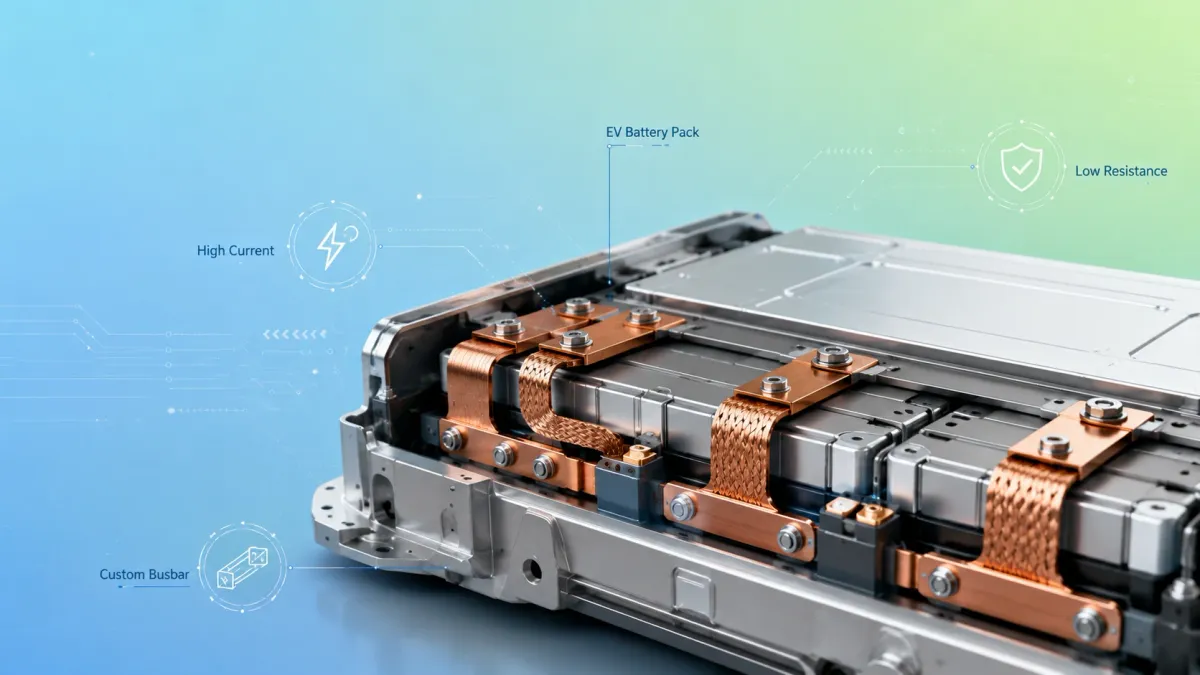
| EV battery packs | Connect cells, modules, contactors, fuses, and DC output points | Compact routing, vibration resistance, insulation, creepage and clearance | Pack layouts differ by cell format, voltage platform, and cooling structure. |
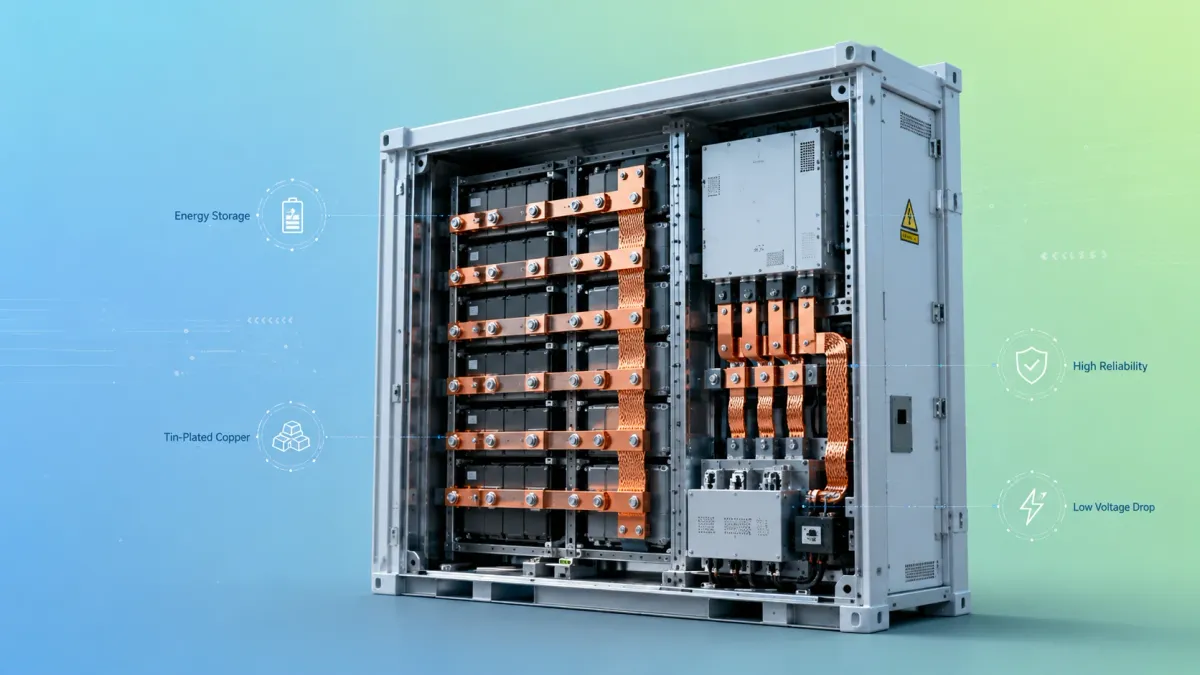
| BESS energy storage | Connect battery racks, DC combiner cabinets, PCS interfaces | High current, stable bolted joints, corrosion resistance, thermal control | Outdoor containers and rack layouts need custom hole positions and insulation. |
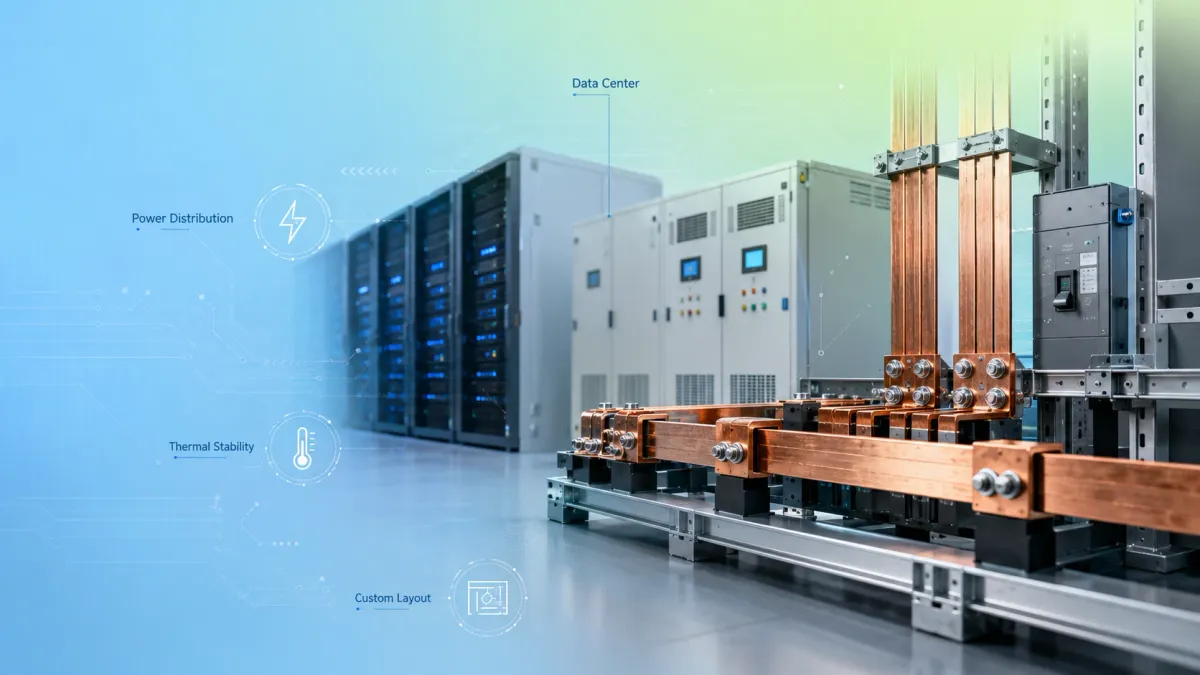
| AI data centers | Distribute power in server racks, PDUs, UPS systems, busway interfaces | High reliability, low voltage drop, compact installation, thermal management | Dense power architecture leaves little space for cable routing. |
| Switchgear and panels | Main and branch power distribution | Short-circuit strength, phase spacing, insulation, temperature rise | Cabinet designs, breaker brands, and standards differ by market. |
| Solar and wind equipment | DC and AC power routing in inverters and converters | Plating, thermal cycling, corrosion resistance, stable contacts | Renewable systems often face outdoor or semi-outdoor environments. |
| DC fast charging | Connect rectifier modules, contactors, fuses, output terminals | High current, high voltage, heat control, safe insulation | Charging cabinet layouts are compact and current-dense. |
| Industrial machinery | Power distribution in control systems and drives | Robustness, repeatable assembly, service access | Machine builders need predictable parts that reduce wiring complexity. |
In each sector, a custom copper bus bar can reduce assembly time, improve electrical performance, and make the final product easier to inspect. But custom design only works when the buyer provides enough application information. Without current, voltage, allowable temperature rise, insulation requirements, and mounting constraints, the supplier can only guess.
Market Trends Increasing Demand for Custom Copper Bus Bars
The demand for copper bus bars is linked to electrification. As more systems move from mechanical, hydraulic, or fuel-based architecture toward electric power architecture, the number of high-current connections grows. This is visible in EVs, battery energy storage, renewable energy, AI data centers, industrial automation, and charging infrastructure.
The International Energy Agency reported in its Global EV Outlook 2026 executive summary that global electric car sales grew by 20% in 2025 to exceed 20 million, meaning one-quarter of all new cars sold were electric. EV growth matters for bus bars because every EV contains multiple power interconnects: cell-to-cell connections, module bus bars, pack-level bus bars, inverter DC-link connections, contactor connections, fuse links, and charging-path conductors.
AI infrastructure is another major driver. The IEA’s Energy and AI analysis projects global data center electricity consumption to double to around 945 TWh by 2030, with data center electricity consumption growing around 15% per year from 2024 to 2030. Higher server density and higher rack power demand increase the need for efficient power distribution, low-resistance joints, UPS systems, busway connections, and custom copper conductors.
Renewable energy and storage also create demand. The IEA’s Renewables 2025 analysis projects almost 4,600 GW of global renewable power capacity additions between 2025 and 2030, with solar PV representing nearly 80% of the expansion. BloombergNEF reported that global energy storage capacity additions are expected to grow 23% in 2025. Solar inverters, wind converters, BESS racks, PCS cabinets, and DC combiner systems all require reliable internal power conductors.
| Growth Area | Public Data Point | Bus Bar Relevance |
|---|---|---|
| Electric vehicles | IEA: electric car sales exceeded 20 million globally in 2025 | More battery modules, inverters, charging interfaces, and pack-level interconnects. |
| AI data centers | IEA: data center electricity consumption projected to reach around 945 TWh by 2030 | More high-density power distribution, UPS systems, PDUs, and rack-level conductors. |
| Renewable power | IEA: almost 4,600 GW renewable capacity additions projected for 2025-2030 | More inverters, converters, switchgear, combiner boxes, and power cabinets. |
| Energy storage | BloombergNEF: storage capacity additions expected to grow 23% in 2025 | More BESS racks, DC bus systems, module links, and PCS connections. |
These numbers are not bus bar sizing standards. They are market signals. They show why global buyers increasingly need suppliers who can move beyond catalog parts and manufacture copper bus bars around a specific electrical architecture.
Ampacity: Why the Same Copper Bar Can Carry Different Current in Different Systems
Ampacity is the maximum continuous current a conductor can carry without exceeding a defined temperature limit. Many buyers ask for a copper bus bar by current rating only: “We need a 500 A copper buss bar.” That is understandable, but incomplete.
A 500 A bus bar in open air may be very different from a 500 A bus bar inside a sealed enclosure. A horizontal bar may cool differently from a vertical bar. A shiny bare copper bar may radiate heat differently from a coated or oxidized surface. A DC bus may behave differently from an AC bus at 50/60 Hz, especially as thickness increases. A bus bar close to other phases may suffer from proximity effects and localized heat.
JUMAI’s copper busbar ampacity calculation guide explains that ampacity is a dynamic variable influenced by environment, surface area, air circulation, material, and temperature rise. The Copper Development Association also publishes busbar ampacity tables for rectangular copper busbars at defined temperature rises and conditions.
The table below is a simplified preliminary reference for discussion only. It should not replace thermal simulation, prototype testing, or local code requirements.
| Copper Bar Size | Cross-Section | Typical Discussion Range | Important Caution |
|---|---|---|---|
| 15 mm x 3 mm | 45 mm² | Low to moderate current links | Sensitive to joint quality and airflow. |
| 20 mm x 5 mm | 100 mm² | Compact cabinet distribution | Check temperature rise in sealed enclosures. |
| 30 mm x 10 mm | 300 mm² | Higher-current equipment | AC skin effect and spacing begin to matter. |
| 50 mm x 10 mm | 500 mm² | Main conductors in cabinets and BESS | Requires careful joint pressure and heat path design. |
| 100 mm x 10 mm | 1,000 mm² | Large distribution systems | Mechanical support, short-circuit force, and thermal testing are important. |
A serious RFQ should include:
- Continuous current and peak current.
- AC or DC operation.
- Frequency for AC or switching applications.
- System voltage.
- Ambient temperature.
- Allowable temperature rise.
- Enclosure type and ventilation condition.
- Nearby heat sources.
- Duty cycle.
- Safety standard or test requirement.
The best bus bar is not necessarily the largest one. Oversizing increases copper cost, weight, and assembly difficulty. Undersizing creates heat, voltage drop, and reliability risk. The correct approach is to design for the actual current path, contact resistance, cooling condition, and allowable temperature rise.
Voltage, Insulation, Creepage and Clearance
Current determines heat. Voltage determines insulation risk. Many buyers focus heavily on ampacity but do not provide voltage information in the first RFQ. This creates problems because a copper bus bar for a 48 V system may not require the same creepage, clearance, or dielectric protection as a bus bar for a 400 V, 800 V, 1,000 V, or 1,500 V DC system.
In compact EV battery packs, BESS containers, and high-density power modules, the spacing between conductors is often limited. A custom insulated bus bar can help reduce assembly complexity while maintaining electrical safety. However, insulation is not just a coating. It must be designed around exposed contact areas, mounting holes, sharp edges, bend radii, temperature, abrasion, flame rating, and possible condensation.
Common insulation options include heat-shrink tubing, PVC dipping, epoxy powder coating, PA12 nylon coating, PET insulation film, PI film, and laminated dielectric structures. The correct choice depends on voltage, temperature, flexibility, thickness, abrasion resistance, and process cost.
| Insulation Type | Common Use | Advantages | Limitations |
|---|---|---|---|
| Heat-shrink tubing | Rigid bars and simple shapes | Cost-effective, fast, easy to inspect | Less suitable for complex 3D geometry or tight windows. |
| PVC dipping | Rigid bars with moderate requirements | Good coverage and economical protection | Thickness control and edge quality must be managed. |
| Epoxy powder coating | High-voltage or durable insulated bars | Strong dielectric and abrasion resistance | Masking contact areas requires precision. |
| PA12 / nylon coating | EV and compact high-voltage parts | Tough surface, good insulation behavior | Process control and material compatibility matter. |
| PET / PI film lamination | Laminated flexible bus bars | Thin, compact, suitable for layered structures | Requires careful bonding and edge design. |
Buyers should mark insulation windows clearly on drawings. The exposed copper or plated contact area must be large enough for the bolted or welded joint, while the insulated region must cover all areas where accidental contact or arcing risk exists.
Plating Options: Tin, Nickel, Silver or Bare Copper?
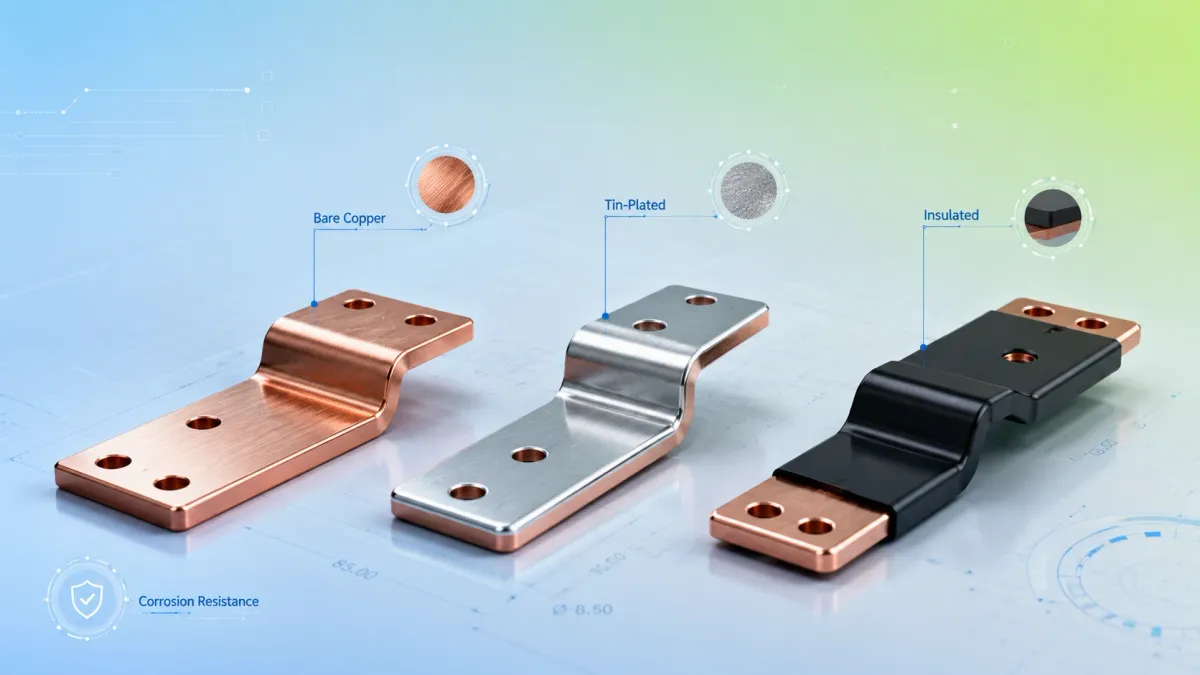
Bare copper has excellent conductivity, but it oxidizes. Copper oxide can increase contact resistance, especially at bolted joints. For this reason, many custom copper bus bars are plated or coated. Plating is not only cosmetic; it affects oxidation resistance, contact stability, solderability, corrosion behavior, and long-term maintenance.
Tin plating is common because it offers a good balance of cost, oxidation protection, and contact performance for many electrical cabinets, BESS systems, industrial panels, and general power distribution parts. Nickel plating is useful in higher-temperature or more corrosive environments, and it can act as a diffusion barrier. Silver plating is more expensive but may be justified for high-current, high-temperature, or premium contact applications because silver maintains strong electrical contact behavior.
| Surface Finish | Typical Use | Benefits | When to Be Careful |
|---|---|---|---|
| Bare copper | Short-life prototypes, controlled indoor systems, welding areas | Lowest process cost, no plating layer | Oxidation and appearance change over time. |
| Tin plating | General bus bars, cabinets, BESS, switchgear | Good oxidation protection, economical, widely used | Tin whisker risk and temperature limits may need review in sensitive systems. |
| Nickel plating | Corrosive or higher-temperature environments | Good barrier protection and durability | Higher contact resistance than silver; needs proper specification. |
| Silver plating | High-current contacts, premium electrical joints | Excellent conductivity and contact behavior | Higher cost; usually applied only where performance justifies it. |
| Selective plating | Parts with different functional zones | Cost control and optimized contact areas | Requires precise masking and clear drawings. |
A good drawing should define plating type, plating thickness, whether plating is full or selective, whether edges and holes must be plated, and whether contact areas require special flatness or roughness. For high-reliability assemblies, plating should be verified with thickness testing and adhesion checks.
Mechanical Design: Holes, Bends, Slots, Burrs and Flatness
Many copper buss bars fail commercially before they fail electrically. The part may be conductive, but it does not fit the assembly. Hole positions may be slightly off. A bend angle may collide with a cover. A burr may face the wrong side. A plating layer may be damaged around a sharp corner. A flat contact pad may become warped during punching.
Copper is ductile, but it still requires correct forming control. Thick copper bars need appropriate bend radius, tooling clearance, forming sequence, and springback compensation. Thin copper bus bar parts may need precision stamping dies to control burr height, flatness, and repeatability. JUMAI’s article on metal stamping dies for thin-gauge copper busbar parts is relevant for buyers developing high-volume thin copper components.
Important mechanical parameters include:
- Overall length, width, and thickness.
- Hole diameter and tolerance.
- Hole-to-edge distance.
- Slot width and slot length.
- Bend angle and bend direction.
- Bend radius.
- Flatness of contact areas.
- Burr direction and maximum burr height.
- Edge chamfer or deburring requirement.
- Threaded inserts, clinch nuts, weld nuts, or press-fit hardware.
- Plating after bending or bending after plating.
A buyer should not assume the supplier knows the assembly direction. The drawing should show which side contacts the mating part, where burrs are allowed, where burrs are not allowed, and which surfaces are functional contact surfaces. This is especially important for bus bars used in battery modules, switchgear, and server power systems.
Electrical Joint Design: The Hidden Source of Heat
The copper body of the bus bar is usually not the weakest point. The joint is often the real risk. A bolted connection can become hot if the contact area is too small, the surface is uneven, the plating is poor, the bolt torque is wrong, the washer stack is incorrect, or vibration loosens the joint over time.
When two metal surfaces touch, they do not contact across the full visible area. They touch at microscopic high points. Proper joint pressure helps flatten those peaks and create a low-resistance current path. This is why contact pad flatness, plating, surface cleanliness, bolt size, washer selection, and torque control all matter.
For high-current copper bus bars, buyers should define:
- Mating material.
- Contact area.
- Bolt size and grade.
- Washer type, including spring or Belleville washers if needed.
- Recommended torque.
- Whether lubrication is allowed.
- Whether anti-oxidation compound is required.
- Whether the joint must pass temperature-rise testing.
- Whether the joint will experience vibration or repeated maintenance.
If the system will be serviced repeatedly, the contact design must tolerate disassembly and reassembly. If the system is sealed for long life, the initial joint quality is even more important.
AC, DC, Skin Effect and Proximity Effect
DC current distribution across a copper bus bar is more uniform than AC current distribution. In AC systems, current tends to concentrate closer to the conductor surface as frequency rises. This is known as skin effect. At 50/60 Hz, skin effect is manageable for many bus bars, but it becomes more relevant as conductors get thicker. Proximity effect also occurs when nearby conductors influence current distribution through magnetic fields.
This is one reason multiple thinner copper bars with air gaps may perform better than one very thick copper bar in some AC systems. It is also one reason laminated bus bars are used in power electronics. Thin, wide conductors with controlled spacing can help reduce inductance and improve current distribution.
For DC battery systems, skin effect is less important, but switching ripple, inverter behavior, and transient conditions may still influence design. In high-speed power electronics, bus bar geometry affects not only current capacity but also electromagnetic behavior.
Buyers should tell the supplier whether the part operates in:
- DC battery power.
- 50/60 Hz AC distribution.
- High-frequency switching circuits.
- Pulsed current applications.
- Inverter DC-link systems.
- Charging systems with transient peaks.
A supplier cannot properly review bus bar geometry if it only knows the nominal current. Frequency, nearby conductors, phase arrangement, and switching behavior can all affect final design.
Short-Circuit Strength and Mechanical Support
A copper bus bar must survive more than normal current. In switchgear, power distribution, BESS cabinets, and industrial systems, the bus bar may experience short-circuit forces during fault conditions. High fault current creates strong electromagnetic forces between conductors. If the bus bar is not supported correctly, it may bend, move, damage insulation, loosen joints, or create dangerous clearances.
Short-circuit performance depends on conductor spacing, support spacing, bar orientation, insulation supports, enclosure structure, and fault duration. This is one reason busway and switchgear systems are governed by strict standards. UL provides information on UL 857 for busway and associated fittings, and Eaton describes busway, following NEMA terminology, as a prefabricated electrical distribution system consisting of bus bars in a protective enclosure.
A custom copper bus bar used inside equipment may not itself be a complete certified busway product, but the final assembly still needs to meet applicable electrical safety requirements. Buyers should define the target market and standard early, especially if the equipment will be sold in North America, Europe, or other regulated markets.
Application-Specific Buying Notes
EV battery copper bus bars
EV battery bus bars must balance conductivity, compactness, vibration resistance, thermal expansion, insulation, and automated assembly. The conductor may be rigid, flexible, laminated, or hybrid. Cell format also matters. Cylindrical cells, prismatic cells, and pouch cells use different interconnect strategies.
Important details include voltage platform, module layout, cell terminal material, connection method, insulation windows, welding method, sensor integration, temperature rise, and fatigue life. A flexible or laminated copper bus bar is often preferred where movement and thermal expansion must be absorbed.
BESS copper bus bars
Battery energy storage systems often use rack-level, module-level, and cabinet-level copper bus bars. These systems may operate outdoors or in containerized environments, so corrosion resistance, plating, insulation, and serviceability are important. The bus bar must support long-term reliability because maintenance cost can be high after installation.
BESS buyers should provide continuous current, peak current, DC voltage, rack layout, cabinet ventilation, expected ambient temperature, humidity exposure, and whether the system requires tin plating, nickel plating, epoxy coating, or heat-shrink insulation.
Data center copper bus bars
Data centers need efficient, reliable power distribution. As rack power density increases, cable routing becomes more difficult. Custom copper bus bars can simplify PDUs, UPS modules, rack distribution, and power shelves. Low voltage drop, repeatable assembly, and predictable thermal behavior are key.
For data center applications, the buyer should focus on compact routing, service access, low-resistance bolted joints, thermal dissipation, and stable quality for repeated production. A small improvement in connection reliability can matter when multiplied across thousands of racks.
Switchgear and industrial panels
Switchgear bus bars must follow strict electrical spacing, insulation, temperature-rise, and mechanical support rules. The bus bar may be bare, tin plated, heat-shrink insulated, epoxy coated, or mounted on insulating supports. The design must consider breaker terminal geometry, phase spacing, cabinet size, access for torque tools, and short-circuit forces.
For these projects, JUMAI recommends that buyers send assembly drawings, not only the bus bar drawing. The relationship between the bar, breaker, support, cover, and cable entry often determines whether the part can be installed efficiently.
Renewable energy inverters and DC fast charging
Solar inverters, wind converters, and charging cabinets require compact high-current paths. These systems may face heat, switching stress, outdoor environments, and high-voltage DC. Copper bus bars may connect power modules, contactors, fuses, capacitors, breakers, and output terminals.
In these applications, surface treatment and insulation can be just as important as copper thickness. If the bus bar is installed near heat-generating power modules, the temperature environment must be included in the RFQ.
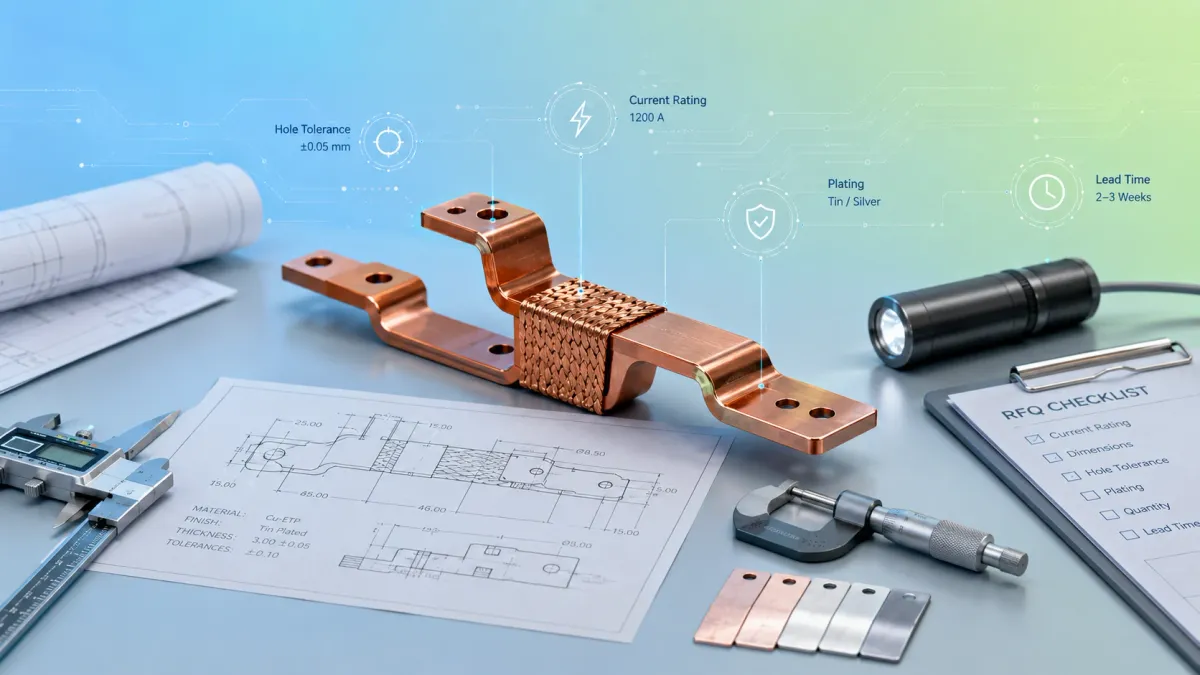
RFQ Checklist for Custom Copper Bus Bars
A strong RFQ saves time. It helps the supplier quote faster, prevents assumptions, and reduces engineering revisions. The table below can be used as a practical checklist before contacting JUMAI.
| RFQ Item | What to Provide | Why It Matters |
|---|---|---|
| Drawing files | PDF plus STEP, DXF, or 3D model | Allows manufacturing review, bend analysis, and tolerance confirmation. |
| Material | C11000/T2, C10100, C10200, or other | Conductivity, formability, and cost depend on material grade. |
| Thickness and width | Nominal dimensions and tolerances | Determines current capacity, forming process, and tooling. |
| Current | Continuous current, peak current, duty cycle | Required for thermal review. |
| Voltage | DC or AC voltage level | Required for insulation, creepage, and clearance. |
| Environment | Ambient temperature, humidity, altitude, enclosure | Affects derating, plating, and insulation choice. |
| Surface finish | Bare, tin, nickel, silver, selective plating | Controls oxidation, contact behavior, and cost. |
| Insulation | Heat shrink, epoxy, PA12, film, exposed windows | Defines safety and assembly requirements. |
| Application | EV, BESS, data center, switchgear, inverter, machinery | Helps supplier identify hidden risks. |
| Quantity | Prototype, pilot run, annual volume | Determines process selection and tooling strategy. |
| Testing | Dimensional report, conductivity, plating thickness, temperature rise | Aligns quality documentation with buyer expectations. |
| Packaging | Anti-scratch, anti-oxidation, separated parts | Protects finished surfaces during shipping. |
If the buyer is still in the concept stage, it is acceptable to send a rough layout and electrical targets. JUMAI can review manufacturability, suggest bend radius improvements, recommend plating, or identify tolerance risks before the drawing is frozen.
Cost Drivers in Copper Bus Bar Manufacturing
Copper price is important, but it is not the only cost driver. A custom copper bus bar quotation includes material, cutting, punching, bending, machining, deburring, cleaning, plating, insulation, inspection, packaging, and sometimes tooling. High-volume stamped parts may require dedicated dies. Low-volume prototypes may be produced with laser cutting, CNC punching, machining, and manual finishing.
Major cost factors include:
- Copper grade and thickness.
- Part size and material utilization.
- Complexity of bends and 3D geometry.
- Number of holes, slots, and precision features.
- Tolerance requirements.
- Burr control and edge finishing.
- Plating type and thickness.
- Full plating versus selective plating.
- Insulation type and masking complexity.
- Quantity and production repeatability.
- Testing and documentation requirements.
- Packaging requirements for finished surfaces.
The cheapest copper bus bar is not always the lowest-cost solution. A part that saves a few cents but increases assembly time, causes rework, or creates field failures is expensive. A well-designed bus bar can reduce wiring labor, improve repeatability, simplify inspection, and increase system reliability.
Quality Control: What Buyers Should Ask the Supplier to Verify
For custom copper bus bars, quality control should cover material, geometry, surface, electrical performance, and packaging. The exact inspection plan depends on the project, but the following items are common in professional manufacturing.
| Quality Item | Typical Inspection Method | What It Prevents |
|---|---|---|
| Material grade | Material certificate, supplier traceability | Wrong copper grade or unknown conductivity. |
| Thickness and width | Caliper, micrometer, CMM where needed | Fit issues and ampacity errors. |
| Hole position | CMM, optical inspection, gauges | Assembly misalignment and bolt problems. |
| Bend angle | Angle gauge, fixture check, CMM | Collision, poor fit, and stress concentration. |
| Flatness | Surface plate, feeler gauge, CMM | Poor contact and hot joints. |
| Burr height | Visual and dimensional inspection | Insulation damage and unsafe edges. |
| Plating thickness | XRF testing or approved method | Poor corrosion protection or contact behavior. |
| Insulation coverage | Visual, thickness, adhesion, dielectric test if required | Exposed conductor or dielectric failure. |
| Conductivity | Material certificate or conductivity test | Excessive resistance and heat. |
| Packaging | Visual check, surface protection | Scratches, oxidation, and deformation in shipment. |
For safety-critical projects, buyers may also request PPAP-style documentation, first article inspection, salt spray testing, temperature-rise testing, tensile testing for terminals, vibration testing, or customized validation plans.
How to Choose a Copper Bus Bar Manufacturer
A copper bus bar supplier should not only cut copper. The supplier should understand how electrical performance, mechanical tolerance, plating, insulation, and assembly interact. This is especially important for EV, BESS, data center, and switchgear projects where reliability and repeatability matter.
When evaluating suppliers, buyers should ask:
- Can the supplier manufacture rigid, braided, and laminated flexible bus bars?
- Can the supplier support prototype and mass production?
- Does the supplier understand C11000, C10100, C10200, and plated copper?
- Can the supplier perform punching, CNC bending, machining, deburring, plating, and insulation?
- Can the supplier review drawings for DFM before quoting final production?
- Can the supplier control burr direction, contact flatness, and hole position?
- Can the supplier support custom packaging to protect plated surfaces?
- Can the supplier provide inspection reports and material traceability?
- Does the supplier understand the application, not just the part shape?
JUMAI’s advantage is the combination of copper bus bar manufacturing with precision stamping, deep drawing, tooling, and mold-related experience. This matters because many copper bus bar designs include formed features, stamped details, tight tolerances, or custom tooling decisions. A supplier with tooling knowledge can often prevent manufacturing problems before they become expensive.
Why Work With JUMAI for Custom Copper Bus Bars
JUMAI focuses on custom copper bus bars for global industrial customers. The company manufactures rigid copper bus bars, braided copper connectors, laminated flexible bus bars, insulated copper bars, plated copper conductors, and application-specific power connection parts. It also supports precision stamped parts, deep-drawn components, mold components, and stamping die customization.
For buyers, the value is not only production capacity. The value is engineering communication. A good supplier helps translate current, voltage, layout, temperature, vibration, and assembly requirements into a manufacturable part.
JUMAI can support:
- Custom C11000/T2 copper bus bars.
- Rigid copper bars with punching, bending, and CNC machining.
- Braided copper bus bars for vibration and thermal movement.
- Laminated flexible bus bars for EV and power electronics.
- Tin, nickel, silver, and customized plating options.
- Heat-shrink, epoxy, PA12, PVC, and laminated insulation solutions.
- Prototype review and manufacturability feedback.
- Tooling and stamping die support for volume production.
- Quality inspection and packaging for global shipment.
For buyers who are still defining the design, JUMAI can start from drawings, samples, current requirements, or installation constraints. For buyers with mature drawings, JUMAI can review tolerances, material, plating, bend sequence, and inspection requirements before production.
Practical Example: How a Buyer Should Describe a Copper Bus Bar RFQ
A weak RFQ says:
“We need copper buss bars, 500 A, tin plated. Please quote.”
That request may generate a fast price, but it does not give enough information for a reliable engineering quotation. A stronger RFQ says:
“We need a custom C11000 copper bus bar for a 750 V DC BESS cabinet. Continuous current is 500 A, peak current is 800 A for 10 seconds. Ambient temperature is 45°C inside a ventilated cabinet. Target temperature rise is below 50°C. Material thickness is 5 mm, width is 40 mm, with two 90-degree bends and four M8 mounting holes. Tin plating is required on all surfaces, with exposed contact areas left uninsulated. Heat-shrink insulation is required between contact areas. Annual volume is 20,000 pieces after prototype validation. Please review manufacturability and suggest improvements.”
This second request allows the supplier to review the real design. It includes material, current, voltage, thermal environment, quantity, plating, insulation, hole size, and production expectation. The result is a better quotation and fewer revisions.
Common Mistakes When Buying Copper Buss Bars
Mistake 1: Choosing size only by current
Current rating depends on temperature rise, airflow, conductor surface, enclosure, AC/DC behavior, and joint design. A copper bar cannot be selected by current alone.
Mistake 2: Ignoring contact resistance
A large bus bar can still overheat at the joint. Contact pad flatness, plating, bolt torque, and surface cleanliness are critical.
Mistake 3: Using the wrong spelling in technical documents
“Copper buss bars” may help in search, but “copper bus bars” or “copper busbars” should be used in drawings, specifications, and purchase orders.
Mistake 4: Treating plating as decoration
Plating affects oxidation protection, contact stability, solderability, and corrosion resistance. The plating specification should include type, thickness, area, and inspection method.
Mistake 5: Forgetting insulation windows
Insulation must be designed around contact areas, holes, edges, bends, and clearance. A simple note that says “insulate bus bar” is not enough.
Mistake 6: Not sharing the assembly environment
The supplier needs to know whether the part is used in an EV battery, BESS cabinet, inverter, switchgear, or server rack. The same copper shape may need different plating, insulation, tolerance, or testing depending on the environment.
Mistake 7: Over-tight tolerances without functional reason
Tight tolerances increase cost. The drawing should distinguish critical dimensions from general dimensions. Contact surfaces and mounting holes may need tight control, while non-critical edges may not.
FAQ
Is “copper buss bars” wrong?
It is a common search phrase, but it is not the preferred engineering term. For formal drawings, specifications, and purchase orders, use copper bus bars or copper busbars. Website content can include “copper buss bars” to match buyer search behavior.
Are copper bus bars better than cables?
Copper bus bars are often better when the system needs compact routing, high current, repeatable assembly, lower inductance, and stable mechanical connections. Cables are better when the route must be highly flexible, service movement is frequent, or installation geometry is not fixed.
What copper grade is best for bus bars?
C11000/T2 copper is a common high-conductivity choice for many custom bus bars. C10100 or C10200 oxygen-free copper may be used for higher-purity or special electrical applications. The best grade depends on conductivity, forming, welding, cost, and environmental requirements.
Should copper bus bars be tin plated?
Tin plating is a common choice for oxidation protection and general electrical contact stability. However, nickel or silver plating may be better for certain high-temperature, corrosive, or premium contact applications. Bare copper may be acceptable for prototypes or controlled conditions, but oxidation must be considered.
What information is needed to quote a custom copper bus bar?
At minimum, provide drawings, material, thickness, current, voltage, surface finish, insulation requirement, quantity, application, and operating environment. For high-current parts, also provide temperature-rise target, enclosure airflow, duty cycle, and test requirements.
Can JUMAI produce both rigid and flexible copper bus bars?
Yes. JUMAI manufactures rigid copper bus bars, braided copper connectors, laminated flexible bus bars, insulated bus bars, plated conductors, and customized copper power connection components for industrial applications.
Why do EV battery packs use flexible bus bars?
EV battery packs experience vibration, thermal expansion, and compact packaging constraints. Flexible or laminated bus bars can absorb movement and reduce mechanical stress on terminals compared with fully rigid conductors.
Are bus bars used in data centers?
Yes. Data centers use bus bars in power distribution systems, UPS equipment, PDUs, rack-level power modules, busway interfaces, and high-density electrical assemblies. Rising rack power density makes compact, reliable conductors more important.
How does insulation affect bus bar design?
Insulation affects safety, spacing, dielectric performance, exposed contact windows, bend design, and assembly process. The buyer should define voltage, creepage and clearance needs, insulation material, and exposed copper areas.
Can one copper bus bar design be used for both AC and DC?
Sometimes, but not always. AC systems may require additional review for skin effect, proximity effect, phase spacing, and heating. DC systems may require different insulation, polarity spacing, and transient review. The supplier should know whether the application is AC, DC, or high-frequency switching.
Final Buying Advice
The phrase copper buss bars may bring buyers to the right product category, but successful procurement depends on much more than the keyword. A copper bus bar is an engineered electrical conductor. It must match the current, voltage, space, thermal environment, mechanical load, surface condition, insulation requirement, and assembly process of the final equipment.
For simple projects, a standard tin-plated C11000 copper bus bar may be enough. For EV batteries, BESS racks, AI data centers, inverters, switchgear, and DC fast charging systems, the safest path is to treat the bus bar as a custom power component from the beginning.
JUMAI can help buyers move from rough requirements to manufacturable copper bus bar designs by reviewing drawings, materials, plating, insulation, bend geometry, contact surfaces, and production feasibility. Whether your team calls them copper buss bars, copper bus bars, or copper busbars, the engineering goal is the same: safe, efficient, reliable power distribution in a component that fits your assembly the first time.
If you are developing a new project, send JUMAI your drawings, current rating, voltage level, operating environment, quantity, and surface requirements. The more complete your RFQ is, the faster the team can provide a practical quotation and manufacturing recommendation.