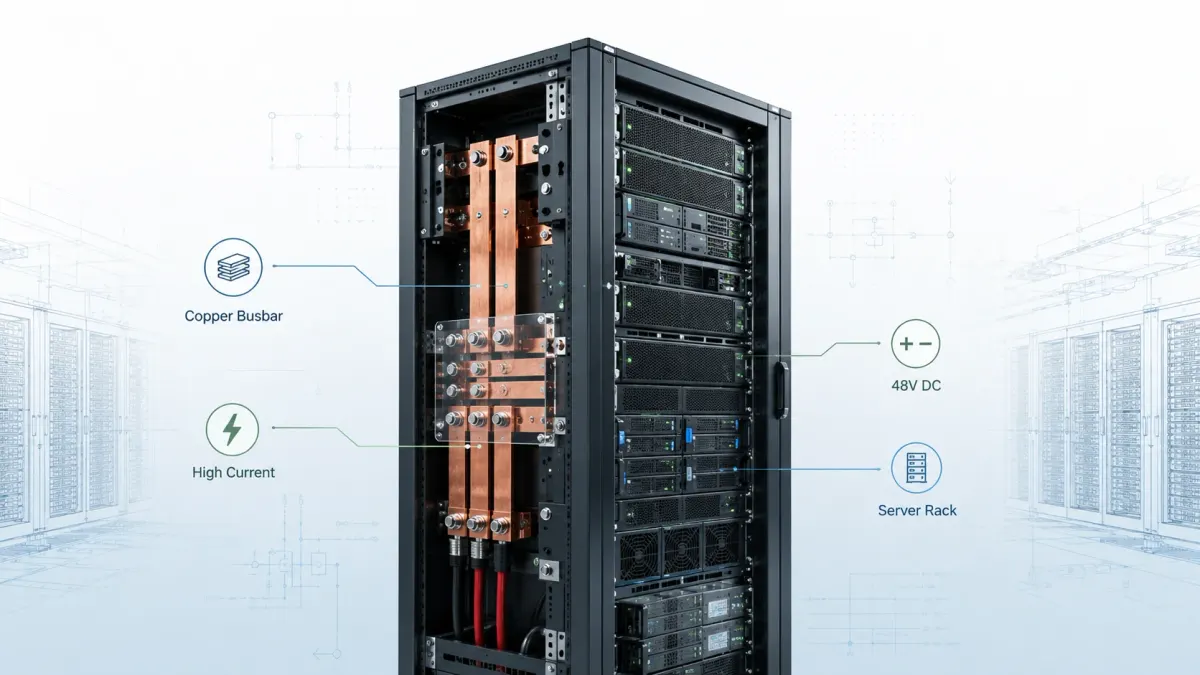
Modern data centers are being redesigned around one hard constraint: power must reach the rack safely, efficiently, and repeatably. Cloud platforms, AI inference clusters, GPU training systems, high-performance computing, telecom edge facilities, and enterprise colocation rooms all need more current in less space. That is why a bus bar for server rack power distribution is no longer a secondary metal part hidden inside the cabinet. It is part of the power architecture.
For a purchasing manager, the part may look simple: a copper strip, several holes, maybe a bend, a plating layer, and an insulation sleeve. For an electrical engineer, the same part must control voltage drop, temperature rise, contact resistance, mechanical stress, creepage distance, assembly tolerance, maintenance access, and production repeatability. For a data center owner, the same part affects uptime, scalability, safety, deployment speed, and the total cost of power infrastructure.
This article explains how copper busbar solutions are used in server racks and data center power distribution. It is written for data center buyers, rack integrators, power shelf designers, PDU manufacturers, switchgear builders, UPS suppliers, and OEM engineering teams that need custom rack-level conductors. It also explains where JUMAI can support the project through custom copper busbars, rigid busbars, laminated flexible busbars, braided copper connectors, insulation, surface finishing, stamping, bending, and related precision metal processing.
The main idea is simple: when rack power density rises, wiring space becomes valuable and every milliohm matters. A well-designed copper busbar creates a low-resistance, stable, serviceable current path. A poorly defined busbar becomes a hot spot, an assembly bottleneck, or a reliability risk. The buyer does not need to become a busbar specialist, but the buyer does need to prepare the right design data before requesting a quotation.
- Why data center buyers are paying more attention to rack busbars
- What a bus bar for server rack power distribution actually does
- Where the rack busbar fits in the data center power chain
- Practical data points for buyers
- Why copper is usually preferred for server rack busbars
- Rigid, laminated flexible, and braided copper busbars in server racks
- Electrical sizing in plain English
- 48V and 50V rack distribution: why it changes busbar design
- Contact resistance and surface finish
- Insulation, creepage, clearance, and touch safety
- Mechanical design details that decide whether installation is easy or painful
- RFQ checklist for a custom bus bar for server rack projects
- Thermal management: do not let the copper bar become the hidden heater
- Short-circuit force and mechanical support
- Manufacturing quality: what repeatability means in a data center project
- Cost drivers: why the cheapest copper bar may be expensive
- Design recommendations for data center rack busbars
- How JUMAI supports copper busbar solutions for server racks
- Sample specification language for a server rack busbar
- Common mistakes when buying busbars for server racks
- FAQ
- Build the rack power path before the rack becomes crowded
Why data center buyers are paying more attention to rack busbars
Data center electricity demand is growing quickly. The International Energy Agency projects that global data center electricity consumption could double to about 945 TWh by 2030 in its base case, with AI and digital infrastructure as major drivers. In the United States, the U.S. Department of Energy reported that data centers consumed about 4.4% of total U.S. electricity in 2023 and could consume about 6.7% to 12% by 2028, depending on the scenario. These numbers are facility-level numbers, but they have a very practical effect at the rack: more power must be delivered through power shelves, busways, rack PDUs, connectors, and internal conductors.
Rack power density is also moving upward. The Uptime Institute Global Data Center Survey 2025 states that average server rack power densities continue to rise slowly, with greater adoption of racks in the 10 kW to 30 kW range. At the high end, AI and liquid-cooled systems can go far beyond that. NVIDIA’s DGX GB rack scale system documentation describes a rack system using a bus bar structure to distribute power inside the rack, with power shelves converting AC power into nominal 50V-51V DC output and distributing it through the bus bar to rack components. The same document states that rack power consumption is approximately 120 kW.
This does not mean every server rack needs a 120 kW busbar. Most enterprise racks are still much lower. However, the trend changes the purchasing logic. Old low-density racks could often tolerate long cable runs, oversized bundles, loose routing space, and late-stage wiring changes. A higher-density rack cannot. It needs a more engineered power path.
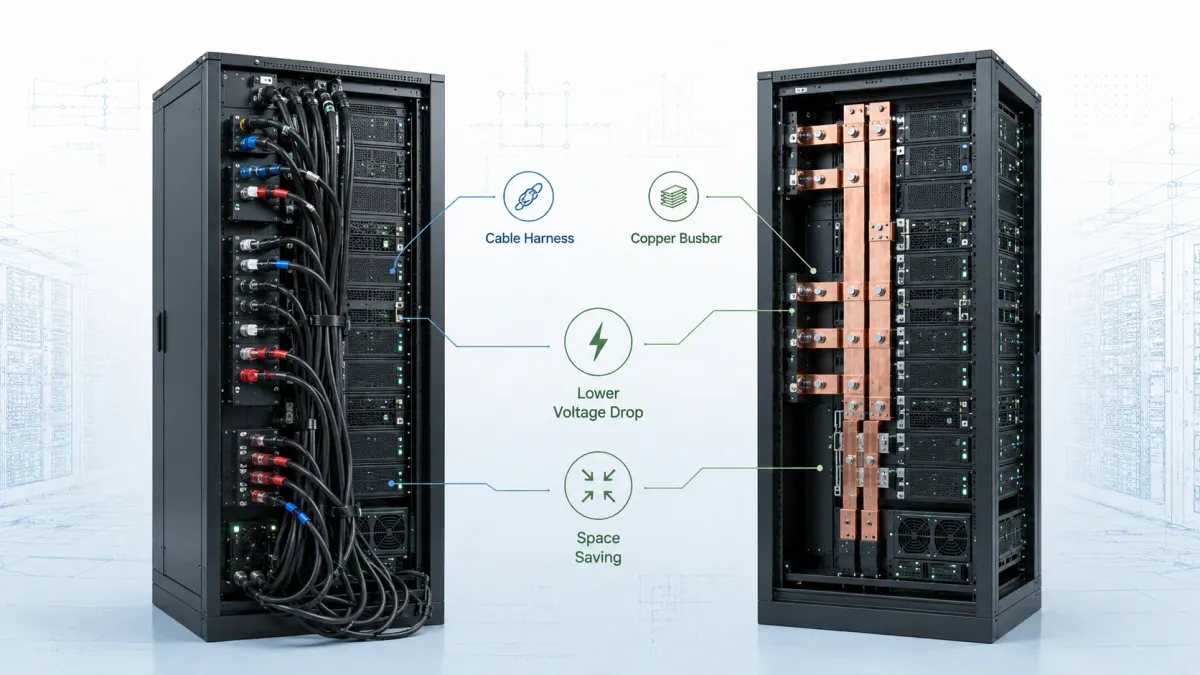
A bus bar for server rack power distribution becomes important for four reasons. First, copper busbars reduce resistance and can reduce heat in compact current paths. Second, a fixed busbar geometry improves repeatable assembly because holes, bends, and contact windows are defined before production. Third, busbars support modular power distribution, especially when power shelves and server trays connect through defined interfaces. Fourth, busbars can reduce wiring congestion, leaving more space for airflow, liquid cooling manifolds, monitoring cables, and service access.
What a bus bar for server rack power distribution actually does
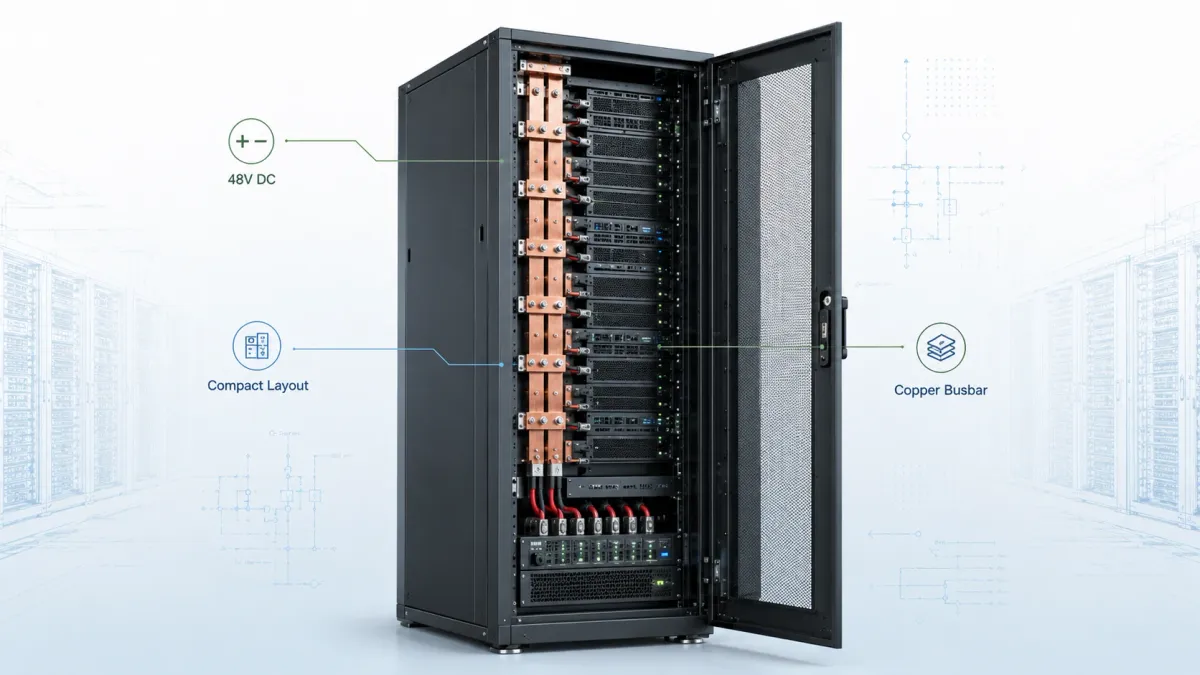
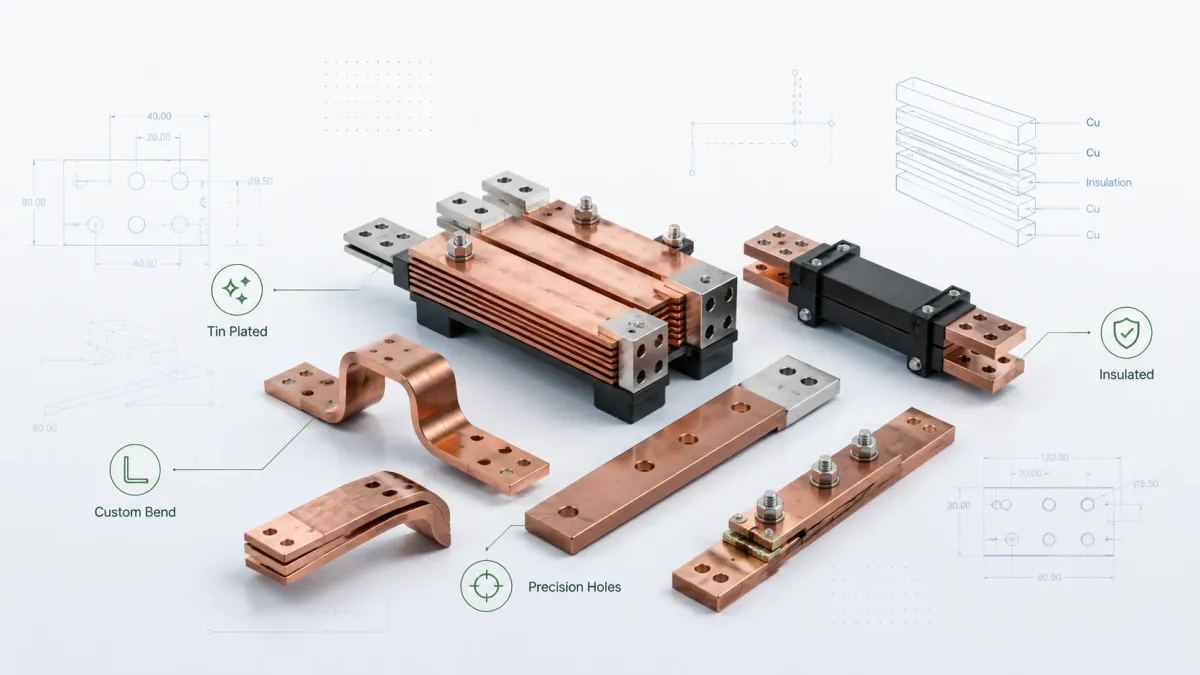
A busbar is a conductive metal component that collects and distributes electrical current. In a server rack, it may run vertically along the rack frame, horizontally behind a power shelf, inside a rack PDU, between rectifier modules and output terminals, or between battery backup modules and DC distribution points. It can be a rigid copper bar, a laminated flexible copper busbar, a braided copper shunt, or a combined assembly with rigid and flexible sections.
The basic function is easy to understand. A cable carries current through a round conductor. A busbar carries current through a flat or shaped conductor. The flat geometry gives the designer more control over surface area, contact area, heat dissipation, hole position, bend direction, and installation repeatability. In a data center rack, these details matter because a conductor is not only an electrical path. It is also a mechanical interface.
For example, a vertical 48V rack busbar may need defined contact points for blind-mate connectors. A power shelf output bar may need silver-plated contact zones, threaded holes, and insulation windows. A connection between a vibrating power module and a rigid rack frame may need a flexible copper link to absorb movement. A compact rack PDU may need a formed copper bar with offset bends to avoid other components while maintaining clearance.
JUMAI’s existing article Bus Bar for Server Rack Power Distribution: What Data Center Buyers Should Know provides a procurement checklist for buyers. This article goes further into copper busbar solution selection for data center power distribution, with more emphasis on business value, specification quality, and supplier communication.
Where the rack busbar fits in the data center power chain
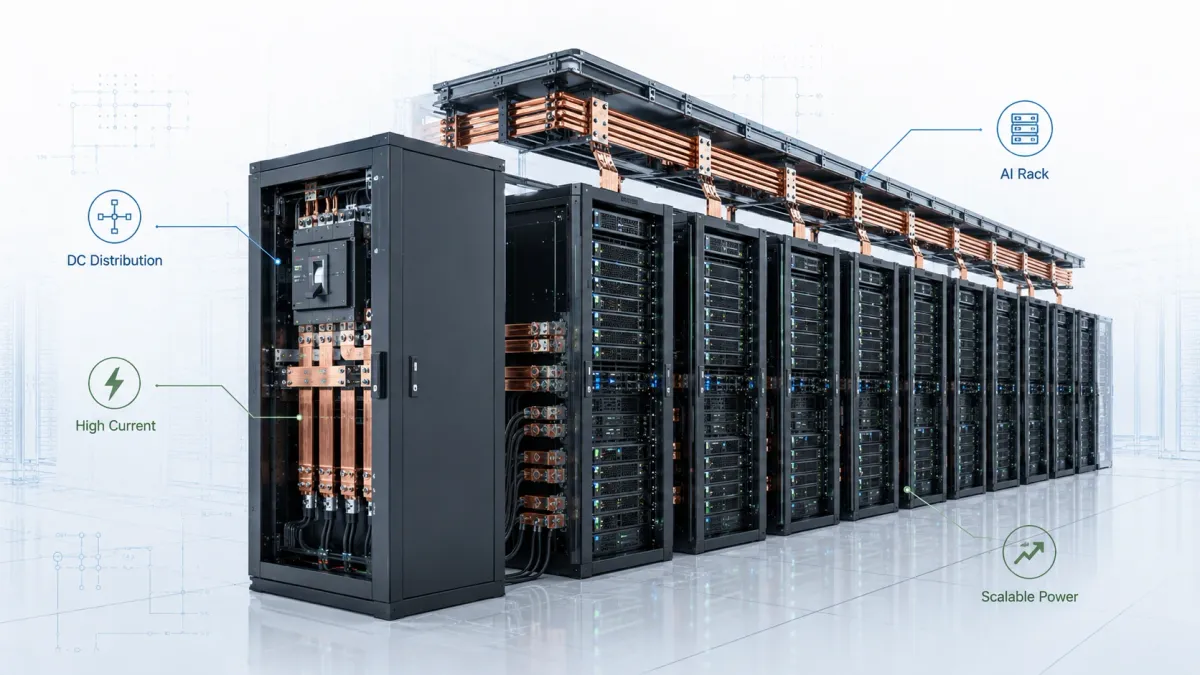
Power does not move from the utility directly into the server. A data center power chain may include utility input, transformer, switchgear, UPS, generator backup, busway, remote power panel, power distribution cabinet, rack PDU, power shelf, server power supply, DC/DC converter, and board-level regulators. The rack busbar is only one part of this chain, but it sits close to the expensive load.
In AC rack architectures, a busbar may be used inside a rack PDU or power distribution enclosure to connect breakers, receptacles, metering modules, surge protection, or input terminals. In 48V or 50V DC rack architectures, the busbar may be a main rack-level conductor that distributes DC output from power shelves to IT equipment. In battery-supported racks, a copper busbar may also connect backup battery modules, rectifier outputs, and load terminals.
The Open Compute Project Open Rack specifications page includes Open Rack V3 power shelf, 48V PSU, output connector, IT gear connector, and busbar-related files. This is important because hyperscale and AI infrastructure increasingly use rack-level power architectures that require precise mechanical and electrical interfaces. The Open Rack V3 base specification defines a 48V busbar geometry for Open Rack V3. The Open Rack V3 power output connector specification also discusses mating to the ORv3 busbar and notes plated contact points and blind-mate installation requirements. These public specifications show why rack busbars should be treated as engineered interfaces rather than generic copper stock.
In a custom project, the rack integrator may not follow OCP dimensions exactly. Many private data center platforms use proprietary rack frames, power shelves, and connectors. However, the engineering principles are the same: conductor geometry, interface plating, fastening, contact pressure, insulation, tolerance, and service access must be defined together.
Practical data points for buyers
The following table translates market and system-level trends into busbar sourcing implications. These figures should not be used as final design ratings. They are starting points for project discussion.
| Data center or rack power trend | Public reference point | What it means for busbar buyers |
|---|---|---|
| Global data center electricity demand may reach about 945 TWh by 2030 in the IEA base case | IEA Energy and AI | Power distribution parts will be reviewed more carefully because efficiency, scalability, and grid capacity are becoming board-level concerns. |
| U.S. data centers consumed about 176 TWh in 2023 and could reach 325-580 TWh by 2028 | U.S. DOE announcement | Data center expansion increases demand for repeatable rack-level power components, including busbars, power shelves, PDUs, and busway interfaces. |
| More racks are moving into the 10 kW to 30 kW range | Uptime Institute 2025 survey | Cable bundles become harder to route cleanly; busbars help reduce congestion and support consistent assembly. |
| Advanced AI rack systems can use rack-level busbar structures and very high rack power | NVIDIA DGX GB documentation | Buyers should discuss current segmentation, redundancy, contact plating, thermal rise, and serviceability before locking the rack power layout. |
| OCP Open Rack V3 includes public rack, power shelf, connector, and busbar-related specifications | Open Compute Project | Even custom racks benefit from a standards mindset: defined interfaces, tolerance control, plated contact zones, and verified mechanical mating. |
Why copper is usually preferred for server rack busbars
Copper is widely used for high-current conductors because it combines high electrical conductivity, high thermal conductivity, good formability, strong joint behavior, and predictable plating performance. According to the Copper Development Association’s C11000 alloy data, C11000 is a high-conductivity copper with a minimum conductivity of 100% IACS in the annealed condition and a copper content of at least 99.90%. For server rack busbars, this matters because lower resistance means less heat at a given current, and good thermal conductivity helps spread heat away from localized contact zones.
Aluminum can also be used in some power distribution systems, especially when weight and material cost are major concerns. However, copper is often chosen at the rack or cabinet level because it allows a smaller conductor cross-section for the same current capacity, provides better contact performance in compact joints, and works well with tin, nickel, and silver plating. In server rack applications, space is valuable. A compact copper bar can be easier to integrate than a larger aluminum conductor, especially where the bar must pass around power shelves, connectors, monitoring boards, fan walls, and cable-management hardware.
JUMAI’s Copper Busbar Guide explains copper busbar materials, types, manufacturing routes, insulation choices, and custom options in a practical way. For server rack projects, the most common copper material discussions include T2 copper, C11000 electrolytic tough pitch copper, oxygen-free copper such as C10200 or C10100 when required, and copper foil or braided copper constructions for flexible links.
The best copper grade depends on the application. A rigid output bar inside a power shelf may prioritize dimensional stability, flat contact surfaces, and plating quality. A laminated flexible link may prioritize bend life, foil thickness, bonding process, and terminal compression. A braided copper connector may prioritize flexibility, vibration absorption, and terminal crimp or weld quality. The buyer should not specify only “copper”. The buyer should specify the material grade, conductivity requirement, temper, plating, insulation, and inspection criteria.
Rigid, laminated flexible, and braided copper busbars in server racks
A server rack does not always use one busbar type. A high-current rack may combine several conductor formats. The main distribution path may be a rigid copper busbar because the geometry is stable and the contact interface must remain aligned. A power module connection may use a laminated flexible busbar because the module must tolerate vibration or small assembly movement. A grounding or equipotential bonding path may use a braided copper connector because it must remain flexible during maintenance.
JUMAI supports rigid copper busbars, laminated flexible busbars, braided copper busbars, plated copper conductors, and insulated assemblies. The Copper Bus Bars for Power Distribution article explains how busbars are used in power distribution, while the Flexible Copper Busbar article explains why flexible conductors are useful when routing, vibration, and assembly tolerance are important.
| Busbar solution | Typical rack-level use | Main advantage | Important specification details |
|---|---|---|---|
| Rigid copper busbar | Vertical rack busbar, rack PDU conductor, power shelf output bar, DC distribution cabinet link | Stable geometry, low resistance, good contact area, repeatable assembly | Copper grade, thickness, width, hole position, bend radius, flatness, plating, insulation windows, burr control |
| Laminated flexible copper busbar | Link between power shelf and output terminal, module-to-module power link, compact offset connection | Carries high current while allowing controlled bend and vibration absorption | Foil thickness, layer count, bonded or welded terminal areas, bend zone length, insulation film, plating at terminals |
| Braided copper busbar or shunt | Grounding link, moving connection, vibration isolation, serviceable cabinet link | Excellent flexibility and tolerance absorption | Braid cross-section, terminal compression, tin plating, sleeve or heat shrink, fatigue and pull testing |
| Insulated copper busbar | Dense rack PDU, DC distribution with limited clearance, high-touch-risk area | Reduces accidental contact and short-circuit risk | Insulation type, thickness, dielectric test, creepage and clearance, exposed contact windows, flame rating |
| Plated copper busbar | Connector interface, humid environment, high-reliability contact zone | Protects copper from oxidation and supports stable contact resistance | Tin, nickel, silver, or combined plating; contact area masking; plating thickness; adhesion and visual criteria |
Rigid busbars are often the easiest to inspect and assemble because the geometry is fixed. However, they transfer movement and thermal expansion into the terminals. Flexible busbars and braided connectors can protect sensitive interfaces by absorbing movement. The correct answer is not always rigid or flexible. The correct answer is usually a defined combination of conductor types.
Electrical sizing in plain English
A busbar must be sized for current, temperature rise, voltage drop, mechanical strength, and available installation space. The engineering details can become complex, but the basic electrical ideas are straightforward.
Current is the amount of electricity flowing through the conductor. At a given power level, lower voltage means higher current. The simple formula is:
Current = Power / Voltage
For example, a 30 kW rack at 48V DC represents about 625A before considering redundancy, conversion losses, load sharing, and architecture. A 120 kW rack at 50V represents about 2400A as a simplified total-current number. In a real rack, that current may be split across multiple power shelves, busbar sections, redundant feeds, and load zones. The example is useful because it shows why 48V and 50V racks need serious conductor design. A few milliohms of resistance can create meaningful heat.
Voltage drop is the voltage lost across the conductor and its joints. The simple formula is:
Voltage drop = Current x Resistance
Heat generated in the conductor is related to current squared:
Power loss as heat = Current x Current x Resistance
This is why contact resistance matters so much. If current doubles, the heat from the same resistance rises by four times. A contact area that was acceptable in a low-current cabinet may become a hot spot in a high-density rack. Surface flatness, contact pressure, plating, bolt torque, washer selection, and oxidation control all influence joint resistance.
For procurement, the important lesson is that busbar size is not selected from one universal chart. A supplier needs the continuous current, peak current, duty cycle, ambient temperature, cooling condition, allowable temperature rise, voltage drop limit, conductor length, installation orientation, insulation type, and contact design. Without these details, a quotation may only be a mechanical price, not a complete power-distribution solution.
48V and 50V rack distribution: why it changes busbar design
Many data center rack power designs are moving toward higher-voltage DC distribution inside the rack compared with legacy low-voltage board-level distribution. A 48V or nominal 50V rack architecture reduces current compared with 12V distribution for the same power, which helps reduce distribution losses and conductor size. However, high-power 48V racks can still involve very high current.
The design task is not simply to choose a thick bar. The engineer must decide how current is divided between feeds, how redundancy is handled, how the power shelf connects to the rack busbar, how IT gear mates with the busbar, and how service personnel can install or replace modules without damaging contact surfaces. The NVIDIA and OCP examples show that rack-level busbar distribution is not theoretical. It is already part of high-density rack systems.
For a custom server rack busbar, common design questions include:
- Should the rack use a vertical busbar, a rear-mounted distribution bar, or multiple local output bars?
- Should the conductor be bare, plated, insulated, or partly insulated with exposed contact windows?
- Should contact areas use tin plating, nickel plating, silver plating, or silver over nickel?
- Should the connector be bolted, plug-in, blind-mate, or welded to a flexible busbar?
- How much float or gatherability is needed to absorb rack tolerance?
- How will the design be inspected after production and after assembly?
These questions should be answered before tooling and mass production. When they are left until late-stage assembly, the result is often rework, high contact temperature, inconsistent torque, or excessive installation labor.
Contact resistance and surface finish
In a high-current server rack, the busbar joint is often more critical than the middle of the copper bar. A long, clean copper bar with a poor contact interface can still fail thermally. The contact interface must provide enough real metal-to-metal contact area under stable pressure.
Copper naturally oxidizes. Copper oxide is less conductive than clean copper. Plating helps protect the surface and improve joint behavior. Tin plating is widely used because it provides good corrosion protection and is cost-effective for many industrial power applications. Nickel plating can be used as a diffusion barrier or for harsher environments. Silver plating is often used where very low contact resistance and stable high-current contact performance are required, especially in connector mating zones.
The JUMAI custom copper busbars page lists tin plating, nickel plating, silver plating, and bare copper options, along with heat shrink tubing, PVC dipping, and epoxy powder coating for insulation. JUMAI’s Busbar Copper article also explains why material, plating, insulation, and manufacturing method must be selected according to the actual application rather than treated as isolated purchasing items.
For rack power distribution, surface finish should be specified in a way that production can verify. Instead of writing only “tin plated”, a better drawing may specify plating area, plating thickness, masking area, contact-window dimensions, edge condition, burr direction, adhesion expectations, and visual acceptance criteria. If a busbar must mate with a connector, the connector supplier’s contact-material requirement should be reviewed before choosing the plating system.
Insulation, creepage, clearance, and touch safety
A busbar can be bare, fully insulated, or partly insulated. In a low-voltage DC rack, bare copper may be acceptable in protected areas with controlled access and sufficient spacing. In many real assemblies, however, insulation is useful because it reduces accidental short-circuit risk, protects against contamination, and improves service safety.
Common insulation methods include heat-shrink tubing, PVC dipping, epoxy powder coating, PET film, polyimide film, PA12 nylon coating, silicone sleeves, or custom molded covers. The best choice depends on voltage, temperature, flame rating, bend radius, abrasion risk, assembly process, and inspection method. JUMAI’s Insulated Bus Bars article explains how insulated busbars are used when copper conductors need extra electrical protection in compact assemblies.
Creepage and clearance must be reviewed with the system standard, voltage, pollution degree, altitude, and insulation material. Clearance is the shortest air distance between conductive parts. Creepage is the shortest distance along an insulating surface. In server racks, the available space can be tight, especially near power shelves, monitoring boards, handles, fan modules, liquid cooling manifolds, and cable exits. A small design change, such as adding an insulation window or moving a hole, can change creepage and clearance.
Buyers should also ask whether the busbar is part of a certified assembly. A loose copper component is not the same as a certified rack power system. For busway systems, UL 857 applies to busways and associated fittings rated 1000V or less and 6000A or less. Low-voltage assemblies may also involve the IEC 61439 standards family, depending on equipment type and market. These standards do not automatically define every custom rack busbar, but they provide a useful safety and verification mindset: temperature rise, dielectric performance, short-circuit withstand, mechanical strength, markings, and installation conditions must be controlled.
Mechanical design details that decide whether installation is easy or painful
A busbar drawing is not only an electrical drawing. It is a mechanical manufacturing document. Server rack busbars often need holes, slots, threaded inserts, bends, offsets, insulation gaps, embossed features, locating edges, and smooth contact zones. Small details can decide whether the part installs quickly or creates repeated field problems.
Hole position is one of the most important details. If holes are used for bolted connections, the hole diameter, tolerance, positional tolerance, burr direction, and flatness around the hole should be defined. A burr under a washer can reduce real contact area. A hole that is slightly misaligned can force the installer to bend the bar or load the connector mechanically. A long slotted hole can help with tolerance, but it may reduce contact area if the washer and pad are not designed correctly.
Bend design is another common issue. Copper can be bent, but bend radius, material temper, grain direction, thickness, and plating sequence matter. Too small a bend radius can cause cracking or plating damage. Bends close to holes can distort the mounting area. Multiple bends in different planes may require CNC forming and fixture control. If the busbar is thick, the inside and outside bend surfaces experience different strain, and final hole positions must be checked after forming rather than assumed from flat length only.
Flatness is especially important at contact pads. A busbar can meet length and width dimensions while still having a warped contact surface. In high-current joints, poor flatness reduces contact area and increases local heating. For server rack power components, buyers should define which surfaces are functional contact surfaces and which surfaces are only mechanical clearance surfaces.
The Copper Busbar Guide provides a broader overview of manufacturing processes, including cutting, punching, bending, plating, insulation, inspection, and custom options. For rack projects, the practical objective is repeatability: every production lot should install the same way and carry current the same way.
RFQ checklist for a custom bus bar for server rack projects
The most expensive busbar problems often start with an incomplete RFQ. A supplier can quote copper, cutting, punching, bending, plating, and insulation from a drawing. But if the current, temperature rise, or contact function is not defined, the quote may not solve the real application problem. The following checklist helps buyers prepare useful information.
| RFQ item | What to provide | Why it matters |
|---|---|---|
| Electrical rating | Continuous current, peak current, voltage, AC or DC, duty cycle, redundancy concept | Determines conductor cross-section, temperature rise, insulation, and contact strategy |
| Rack architecture | 19-inch, OCP-style, custom rack, power shelf location, vertical or horizontal distribution | Controls geometry, mounting method, connector style, and service access |
| Cooling condition | Natural convection, forced air, liquid-cooled rack environment, nearby heat sources | Affects allowable current density and temperature rise |
| Mechanical drawing | 2D drawing and 3D model, hole positions, tolerances, bend radii, flatness areas | Prevents assembly mismatch and reduces sampling iterations |
| Material | Copper grade such as T2/C11000, temper, foil or solid bar, braid specification | Controls conductivity, formability, and mechanical behavior |
| Surface finish | Bare copper, tin, nickel, silver, silver over nickel, masking areas | Controls oxidation resistance and contact reliability |
| Insulation | Heat shrink, epoxy coating, PVC dipping, film insulation, sleeve, exposed windows | Controls safety, creepage, clearance, and handling protection |
| Contact method | Bolted joint, threaded hole, press-fit, blind-mate connector, welded flexible link | Determines contact area, torque, plating, and tolerance strategy |
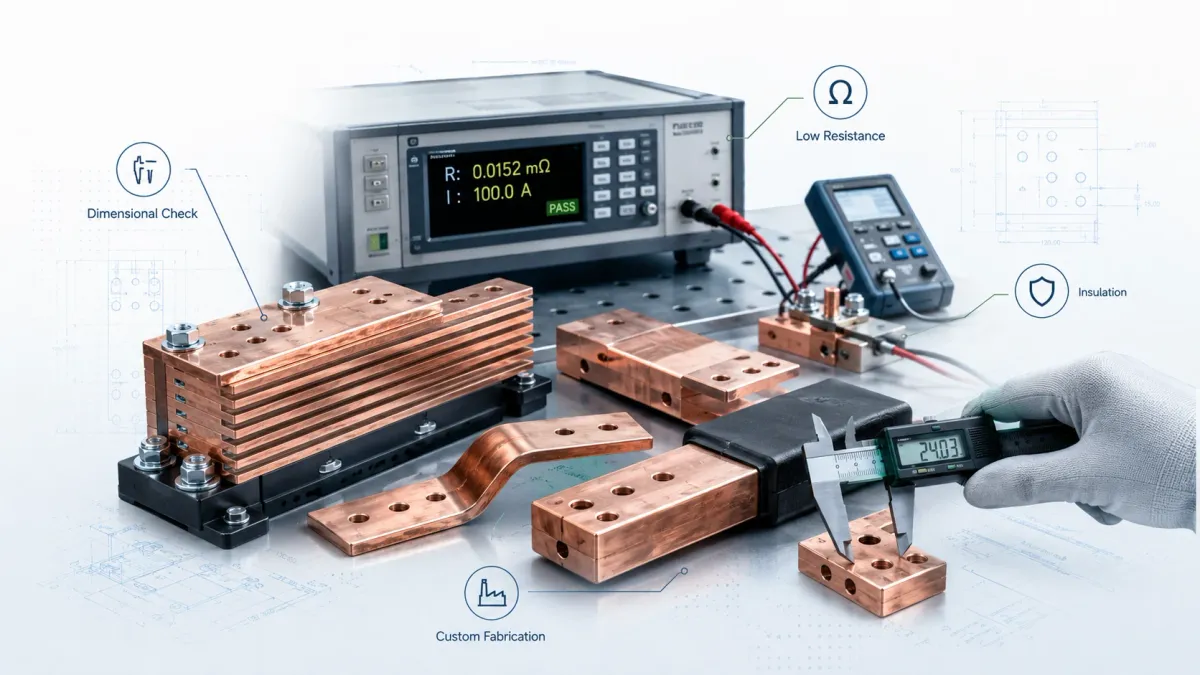
| Testing | Dimensional inspection, plating inspection, dielectric test, pull test, thermal test support | Provides evidence for quality approval and production control |
| Packaging | Anti-oxidation packaging, contact-surface protection, labeling, lot traceability | Prevents damage before assembly and supports data center project logistics |
When buyers send this information early, the supplier can suggest improvements. A slightly wider bar, a different bend location, a masked plating area, a rounded edge, or a longer flexible section may reduce risk without increasing cost significantly. Good communication before sampling is cheaper than redesign after failed assembly.
Thermal management: do not let the copper bar become the hidden heater
The power loss in a busbar becomes heat. In a low-power cabinet, this heat may be small. In a high-current server rack, it can become a real thermal management issue. The challenge is not only average copper temperature. Hot spots at joints, plated areas, bends, and stacked conductors can age insulation, loosen connections, and reduce system reliability.
A practical rack busbar design should review both conductor heating and joint heating. Conductor heating depends on cross-section, length, copper conductivity, current, air movement, and nearby heat sources. Joint heating depends on contact resistance, surface flatness, plating, pressure, torque, washers, contamination, and vibration. In many field failures, the copper body is large enough, but the joint is not stable enough.
For preliminary discussions, buyers often ask, “How many amps can this copper bar carry?” The honest answer is: it depends. The same copper cross-section can carry different current depending on enclosure temperature, airflow, allowable temperature rise, orientation, insulation thickness, and whether the connection points are cooled or trapped in dead air. A bare copper bar in strong airflow behaves differently from an insulated bar inside a crowded rack PDU.
For critical projects, the final design should be verified through thermal calculation, simulation, or temperature-rise testing at the assembly level. The busbar supplier can support manufacturing data and sample parts, but the rack or PDU manufacturer usually needs to verify the complete assembly under real load conditions. JUMAI can help by controlling copper dimensions, contact flatness, plating quality, insulation windows, and repeatable manufacturing, so the tested design remains stable during production.
Short-circuit force and mechanical support
High current does not only create heat. Fault current can create strong electromagnetic forces between conductors. Parallel busbars carrying opposite or same-direction currents can attract or repel each other during a short-circuit event. The higher the fault current, the higher the mechanical stress on busbar supports, insulators, bolts, and connector interfaces.
Server rack busbars are often smaller than switchgear main busbars, but high-density DC architectures can still require serious mechanical support. A long vertical conductor may need insulating brackets, spacers, covers, and grounding strategy. A flexible link may need enough movement allowance without rubbing against sharp edges. A laminated busbar may need correct layer bonding and terminal reinforcement. A braided shunt may need strain relief so the terminal does not become the fatigue point.
The buyer should clarify the expected fault-current condition, protection device, clearing time, and any assembly-level short-circuit testing requirement. If this information is not available during early design, the supplier can still produce a sample, but the design should not be treated as fully validated. In data centers, reliability is not based on copper thickness alone. It comes from the complete system: conductor, support, insulation, protection, and verification.
Manufacturing quality: what repeatability means in a data center project
Custom busbar manufacturing for data centers is not the same as cutting a copper strip from stock. The part may need laser cutting, stamping, CNC punching, deburring, bending, tapping, welding, diffusion bonding, cold pressing, plating, insulation, marking, inspection, and protective packaging. Each step can affect the next step.
For example, if a punched hole has a burr, plating may cover the burr but not remove the contact risk. If a bar is bent before plating, the plating coverage may be consistent, but the plating must tolerate the final geometry. If a bar is plated before bending, the bending process may crack or damage the plating. If heat shrink is applied after plating, the exposed contact window must be protected from adhesive residue and scratches. If a flexible laminated busbar is compressed at the terminal, layer alignment and weld quality must be controlled.
JUMAI’s How to Choose a Copper Busbar Manufacturer article explains why a custom busbar supplier should understand the part as an electrical, mechanical, thermal, and safety-critical interface. This is especially true in data center rack projects because multiple racks may use the same part, and a small tolerance issue can repeat across hundreds or thousands of assemblies.
Good quality control usually includes incoming material verification, dimensional inspection, bend-angle inspection, hole-position measurement, burr inspection, surface-finish inspection, plating inspection, insulation visual inspection, dielectric testing when required, terminal pull testing for braided or flexible parts, and packaging inspection. For high-volume programs, first article inspection and control plans can reduce risk before mass production.
Cost drivers: why the cheapest copper bar may be expensive
Busbar cost is influenced by copper weight, copper grade, thickness, width, complexity, tolerance, production volume, plating, insulation, tooling, inspection, and packaging. However, the lowest piece price does not always mean the lowest project cost. A low-cost part that requires manual rework, creates installation delays, runs hot, or damages contact surfaces can cost far more than the initial saving.
In server rack production, installation time matters. A busbar that aligns correctly, has clean holes, protected contact windows, and consistent bends can reduce assembly labor. A part that arrives scratched, oxidized, or poorly packed may slow the assembly line. A bar that needs field modification can destroy quality control. A busbar that causes a hot spot can create warranty risk, downtime risk, and customer confidence problems.
Buyers should compare quotes based on total value, not only copper price. Important commercial questions include:
- Does the supplier understand the electrical function of the part?
- Can the supplier review drawings and suggest manufacturable improvements?
- Can the supplier hold tolerances over repeated production lots?
- Can the supplier coordinate plating and insulation without damaging contact areas?
- Can the supplier package parts so contact surfaces arrive clean?
- Can the supplier support prototypes, pilot runs, and volume production?
For a data center rack project, these questions are not optional. The busbar is part of the uptime chain.
Design recommendations for data center rack busbars
The following recommendations come from practical busbar engineering and manufacturing experience. They are not a substitute for project-specific validation, but they can help buyers avoid common mistakes.
First, define the current path before defining the copper shape. Many teams start with the available mechanical space and then fit copper into that space. That is understandable, but the current path should be reviewed first. Identify source, load, return path, redundancy, protection device, and service boundary. After that, convert the electrical path into a copper geometry.
Second, treat contact surfaces as functional surfaces. Mark them on the drawing. Define plating, flatness, scratch limits, burr direction, and packaging protection. Do not let the contact surface become an undefined cosmetic area.
Third, use flexibility where the rack needs tolerance absorption. A rigid busbar is excellent for fixed distribution, but it should not force a power module, connector, or terminal to absorb misalignment. Use laminated flexible copper busbars or braided copper connectors where vibration, thermal expansion, or service movement is expected.
Fourth, review insulation as part of the geometry, not as an afterthought. Insulation has thickness, edge behavior, cutback length, and process limits. A heat-shrink sleeve can move. Powder coating needs masking. Film insulation needs termination details. Exposed contact windows must be large enough for assembly but not so large that they create unnecessary touch risk.
Fifth, plan for inspection. If a dimension is critical, it must be measurable. If plating thickness is critical, define where it should be measured. If a bend angle is critical, define the datum and tolerance. If a thermal test is required, agree on sample condition and assembly method.
Sixth, involve the busbar manufacturer before the drawing is frozen. Many cost and reliability improvements are easiest before tooling. For example, changing a bend radius, moving a slot, adjusting a hole pattern, or changing plating masks can save time during mass production.
How JUMAI supports copper busbar solutions for server racks
JUMAI focuses on custom copper busbars and related precision metal components for high-current applications. For server rack and data center power distribution projects, JUMAI can support rigid copper busbars, laminated flexible copper busbars, braided copper busbars, plated copper conductors, insulated busbar assemblies, stamped copper parts, terminal plates, brackets, spacers, covers, and custom tooling components.
The support process usually begins with drawing review. The engineering team reviews the 2D drawing, 3D model, material, current requirement, plating, insulation, hole pattern, bend geometry, and production quantity. If the project is still in early design, JUMAI can help the buyer compare rigid, flexible, and braided conductor options. If the drawing is already fixed, JUMAI can focus on manufacturability, tolerance control, tooling, sampling, and production planning.
JUMAI’s manufacturing capabilities include cutting, stamping, CNC punching, bending, tapping, cold pressing for braided terminals, diffusion welding or bonding for laminated flexible conductors, plating coordination, insulation processing, and dimensional inspection. The company also supports related deep drawn and stamped metal components, which can be useful when the busbar assembly needs covers, brackets, terminal plates, or precision metal accessories.
For buyers who are building data center power equipment, JUMAI’s value is not only copper processing. It is the ability to discuss the busbar as part of a real application: rack power shelves, power distribution units, UPS cabinets, rectifier systems, switchgear, backup power equipment, and compact DC distribution. That application knowledge helps reduce the risk of buying a part that is mechanically correct but electrically incomplete.
Sample specification language for a server rack busbar
The following sample wording can help buyers prepare an RFQ. It should be adapted by the engineering team and verified against project standards.
Part name: Custom copper busbar for server rack DC power distribution.
Application: Rack-level conductor between power shelf output and server rack distribution interface.
Material: C11000 copper or equivalent high-conductivity copper, minimum 99.90% Cu, conductivity target 100% IACS unless otherwise approved.
Electrical requirement: Continuous current to be confirmed by buyer; supplier to review conductor cross-section for manufacturability. Final temperature-rise validation to be performed at assembly level by rack manufacturer.
Surface finish: Tin plating for general contact areas or silver over nickel for connector mating areas as specified on drawing. Plating thickness, masking area, and exposed contact windows to follow approved drawing.
Insulation: Heat shrink, epoxy powder coating, or other approved insulation. Contact windows must remain clean and free of insulation residue. Insulation material and thickness to be confirmed according to voltage, clearance, creepage, and flame-rating requirement.
Mechanical requirements: All hole positions, bend angles, flatness areas, and burr directions according to drawing. Functional contact surfaces to be protected during production and packaging. Edges to be deburred unless otherwise specified.
Inspection: First article inspection required. Dimensional report, plating visual inspection, insulation visual inspection, and packaging check required. Additional dielectric, pull, or thermal test support to be agreed separately.
This type of specification helps the supplier understand the application instead of quoting only a copper shape. It also creates a better record for engineering review, purchasing approval, and quality inspection.
Common mistakes when buying busbars for server racks
One common mistake is to copy a cable current rating mindset into busbar purchasing. A cable rating is usually based on conductor size, insulation, installation method, and thermal conditions. A busbar rating also depends on geometry, airflow, contact interfaces, supports, enclosure, and assembly condition. A simple cross-section comparison is not enough.
Another mistake is to ignore the return path. In DC systems, the power path and return path must both be considered. Their spacing and orientation affect electromagnetic forces and voltage behavior. In some designs, the return conductor is part of a separate bar, chassis path, or combined busbar structure. The design must be clear.
A third mistake is to choose plating without understanding the mating surface. Tin-to-tin, silver-to-silver, and mixed-metal contacts can behave differently under load, vibration, and environment. Connector supplier requirements should be checked. If a connector specification requires silver over nickel at the mating zone, the busbar drawing should not simply say “tin plated all over”.
A fourth mistake is to make insulation too late in the process. Insulation cutback, masking, coating thickness, and edge coverage affect the final part. If the copper geometry is designed without insulation space, the finished part may interfere with the rack or reduce clearance.
A fifth mistake is to treat prototypes as production-ready without process control. A prototype made by manual adjustment may work in one rack, but production needs repeatable tooling, fixtures, plating control, insulation control, and inspection criteria.
FAQ
What is the best material for a bus bar for server rack power distribution?
High-conductivity copper is usually preferred for compact high-current rack conductors because it provides low resistance, good thermal performance, and reliable contact behavior. C11000 and T2 copper are common choices. Oxygen-free copper may be considered when the application requires it, but many rack-level power conductors can use standard high-conductivity copper if the design, plating, and testing are correct.
Is a copper busbar always better than cable in a server rack?
No. Cable is still useful where routing flexibility, service loops, or standard wire harnesses are preferred. A copper busbar becomes more attractive when current is high, space is limited, repeated assembly is important, contact surfaces must be controlled, or wiring congestion becomes a problem. Many racks use both: busbars for main distribution and cables for local or low-current connections.
Should the server rack busbar be tin plated or silver plated?
Tin plating is cost-effective and widely used for corrosion protection and general power contacts. Silver plating is used when very low contact resistance and stable high-current connector performance are required. Nickel can be used as a barrier layer or for specific environments. The correct plating should match the mating connector, contact pressure, current, environment, and budget.
Does a 48V server rack still need insulation?
Often yes. Even when voltage is not high, short-circuit energy can be significant because the current is high. Insulation, covers, and controlled spacing reduce accidental contact and short-circuit risk. The final decision depends on the equipment standard, access level, service method, clearance, creepage, and fault-current protection.
Can JUMAI design the full rack power system?
JUMAI focuses on custom copper busbars, flexible busbars, braided copper connectors, insulation, plating, precision metal processing, and related components. For complete rack power system certification, the rack or power equipment manufacturer must validate the full assembly. JUMAI can support the conductor design, manufacturability review, sampling, production, and quality control needed for the busbar portion of the system.
What drawings should be sent for a quotation?
Send a 2D drawing with tolerances, a 3D model if available, current and voltage requirements, material grade, plating requirements, insulation requirements, quantity, expected production schedule, and photos or layout information showing how the busbar fits inside the rack. If the design is not final, send the available space and connection requirements so JUMAI can suggest conductor options.
Build the rack power path before the rack becomes crowded
A bus bar for server rack power distribution is a small component compared with the total data center facility, but it sits close to the load and has a direct effect on reliability. As rack density rises, the power path must be cleaner, shorter, more repeatable, and easier to inspect. Copper busbars help achieve this when they are designed as electrical-mechanical components, not bought as commodity strips.
For data center buyers, the most useful step is to define the application clearly: current, voltage, rack architecture, cooling, connector style, plating, insulation, mechanical tolerance, and testing expectation. With that information, a supplier can help select a rigid busbar, laminated flexible copper busbar, braided copper connector, or combined assembly.
JUMAI supports custom copper busbar projects for data center power distribution, server rack power supplies, rack PDUs, UPS cabinets, switchgear, rectifier systems, backup power equipment, and other high-current industrial applications. To start a project, buyers can review JUMAI’s custom copper busbars page, study the Copper Busbar Guide, and prepare an RFQ with the checklist above. A better-defined busbar project usually leads to a safer rack, faster assembly, more stable thermal performance, and a lower total project risk.