Selecting a copper busbar manufacturer is not the same as buying a standard metal strip from a catalog. In custom electrical projects, the busbar is part conductor, part mechanical component, part thermal path, and part safety-critical interface. A small error in hole position, bend angle, plating choice, insulation window, or contact flatness can create oversized voltage drop, unexpected heat rise, assembly delays, warranty claims, or even a field safety risk.
This is why experienced buyers do not evaluate a busbar supplier only by unit price. They ask whether the manufacturer understands the full electrical environment: continuous current, peak current, ambient temperature, available space, vibration, creepage and clearance, plating compatibility, torque, insulation, and the way the part will be assembled into a battery pack, switchgear cabinet, inverter, server rack, charger, or power distribution unit.
For global OEMs, electrical contractors, battery pack integrators, data center hardware companies, and industrial equipment builders, a good copper busbar supplier should be able to turn a project drawing into a repeatable, inspectable, and production-ready component. The best supplier will also help identify manufacturability risks before the first sample is made.
JUMAI focuses on custom soft, rigid, and braided copper busbars for demanding applications. On the JUMAI custom copper busbars page, the company describes its use of high-purity T2/C11000 copper, rigid busbars, soft/braided busbars, laminated flexible busbars, surface finishes, insulation options, and project review support. This article explains how to choose a copper busbar manufacturer for custom electrical projects and how to evaluate whether a supplier is truly prepared for engineering-grade production.
- Why the Manufacturer Choice Matters More Than the Copper Price
- Understand What Kind of Copper Busbar Your Project Needs
- Market Growth Makes Supplier Capability More Important
- Start With Engineering Review, Not Price Negotiation
- Evaluate Material Knowledge: C11000, T2 Copper, and When Alternatives Matter
- Check Manufacturing Capabilities in Detail
- Ask How the Manufacturer Controls Quality
- Confirm Standards Awareness for Your Target Market
- Review Heat, Resistance, and Contact Design
- Consider Industry-Specific Requirements
- Compare Prototype Support and Production Scalability
- Do Not Judge Cost by Unit Price Alone
- Prepare a Strong RFQ Package
- Watch for Red Flags When Choosing a Copper Busbar Manufacturer
- How JUMAI Fits Custom Electrical Projects
- Practical Selection Workflow
- FAQ: Choosing a Copper Busbar Manufacturer
- Final Recommendation
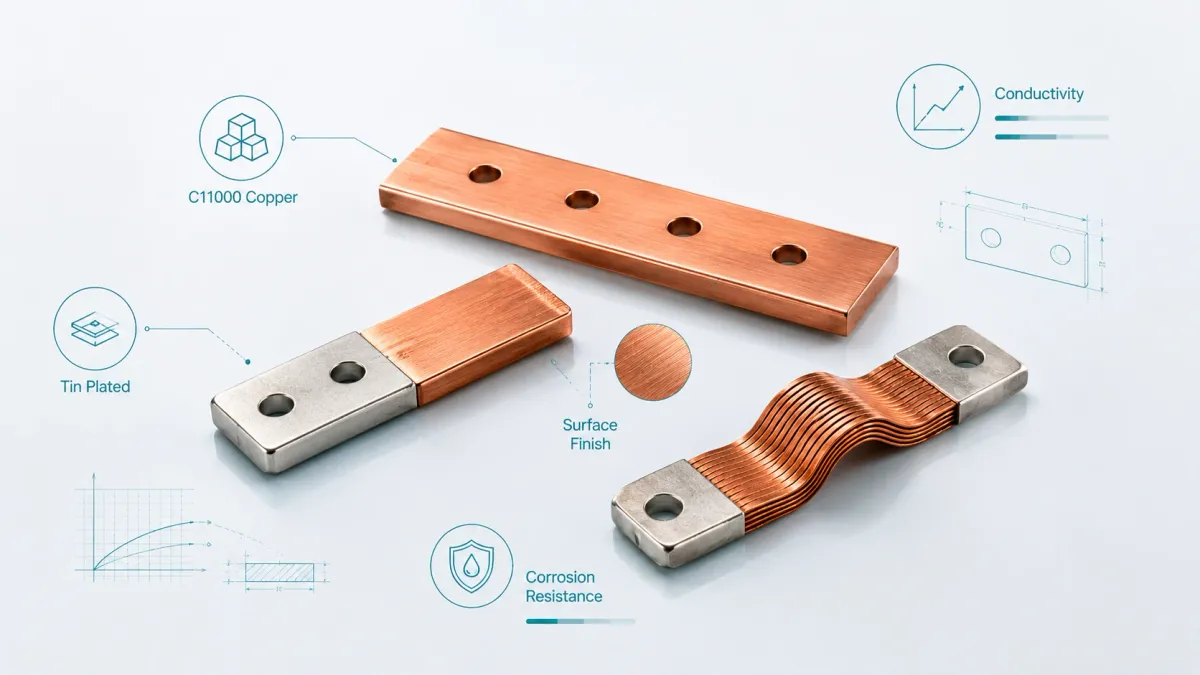
Why the Manufacturer Choice Matters More Than the Copper Price
Copper is the visible cost, but manufacturing control is what protects the project. A busbar made from good copper can still fail if the bend radius is too tight, the welded terminal overheats, the plating is inconsistent, the insulation edge is poorly controlled, or the mounting holes do not match the cabinet or battery module.
In high-current systems, the busbar is usually not isolated from other design decisions. It interacts with cooling airflow, fastening torque, contact pressure, enclosure temperature, fuse or breaker layout, battery terminal geometry, inverter DC link design, cabinet service access, and electrical standards. A manufacturer that only asks for length, width, thickness, and quantity may miss the real engineering risk.
Copper’s electrical performance explains why it remains a preferred conductor. The Copper Development Association’s C11000 data shows C11000 electrolytic tough pitch copper has a minimum copper content of 99.90%, minimum conductivity of 100% IACS in annealed condition, and listed electrical conductivity of 101% IACS at 68°F. For busbar sizing, the Copper Development Association also publishes busbar ampacity tables based on rectangular Copper No. 110 busbars and temperature rises of 30°C, 50°C, and 65°C above ambient. These references are useful, but they are starting points, not a substitute for project-specific validation.
Real projects add constraints that a table cannot fully solve. A copper strip in open air behaves differently from the same strip inside a sealed battery pack. A plated contact near a warm IGBT module behaves differently from a bare conductor in a ventilated switchboard. A rigid bar in a static cabinet has different mechanical risk from a flexible laminated busbar inside an EV battery pack exposed to vibration and thermal cycling. This is why choosing a capable copper busbar manufacturer is an engineering decision, not just a purchasing decision.
The decision also matters because custom busbars often sit on the critical path of product launch. If the first samples are wrong, the delay does not affect only the busbar. It can delay enclosure assembly, electrical testing, certification work, customer samples, pilot production, and final shipment. A qualified manufacturer helps reduce this risk by reviewing drawings, recommending manufacturable tolerances, suggesting plating or insulation changes, and confirming inspection methods before production.
Understand What Kind of Copper Busbar Your Project Needs
Before you compare suppliers, you need to define the type of busbar required by the application. A manufacturer may be excellent at simple rigid copper bars but weak at laminated flexible busbars. Another supplier may be good at soft braided links but unable to hold tight hole-position tolerances on thick CNC-bent rigid bars. The right match depends on the electrical, mechanical, and assembly environment.
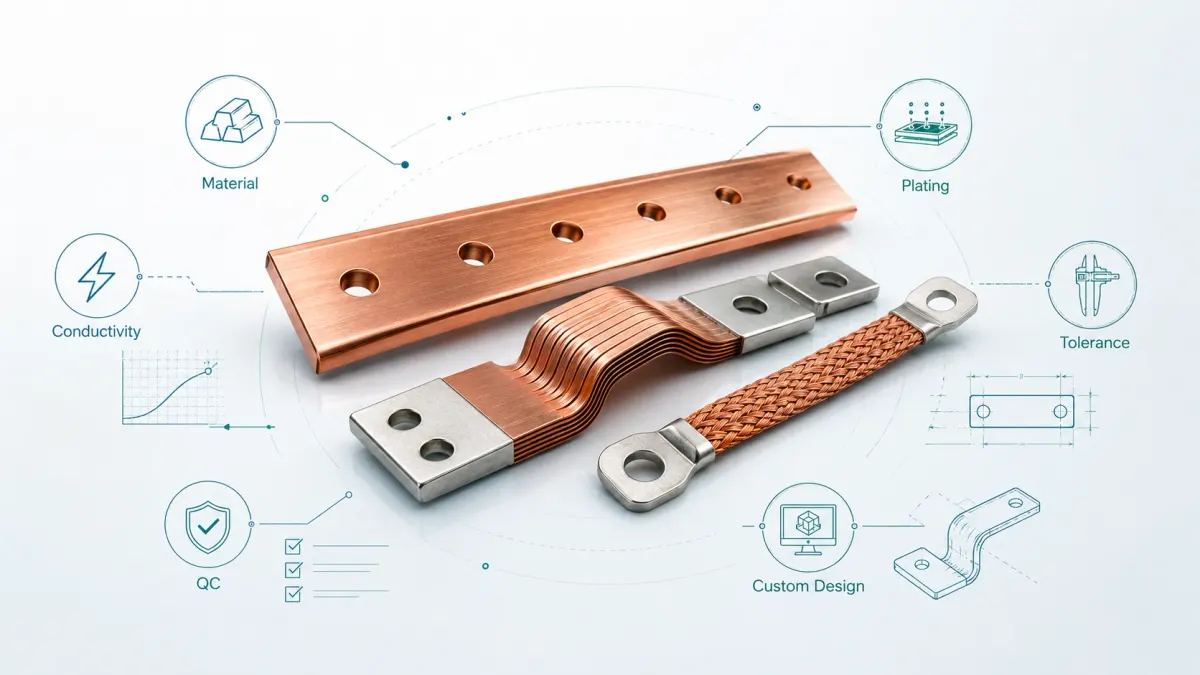
Rigid copper busbars are solid conductors that are usually cut, punched, drilled, deburred, bent, plated, and sometimes insulated. They are common in switchgear, control cabinets, UPS systems, inverters, power distribution units, and industrial equipment. JUMAI’s copper busbar guide explains that rigid busbars are suitable when the current path is fixed and the mechanical layout is stable.
Laminated flexible copper busbars are made from multiple layers of thin copper foil, usually welded or bonded at the terminal areas while the middle section remains flexible. They are useful where the assembly needs controlled flexibility, compact routing, or stress relief between components. JUMAI’s article on flexible copper busbars for EV batteries, BESS, and power distribution emphasizes that the busbar should bend where the design intends it to bend, not at the welded terminal, hole edge, or insulation transition.
Braided copper busbars are made from woven fine copper wires with pressed, welded, or formed terminals. They are often selected for vibration absorption, misalignment compensation, grounding, and flexible power connections. In the right application, a braided design can reduce mechanical stress on terminals and make assembly easier. However, braid density, terminal compression, plating, and insulation sleeves must be controlled carefully.
Insulated busbars add another layer of design responsibility. The insulation may be heat shrink, PVC dipping, epoxy powder coating, sleeve wrapping, selective coating, or molded insulation. JUMAI’s guide to insulated bus bars for battery packs, switchgear, and power cabinets separates rigid insulated copper busbars, laminated flexible insulated busbars, braided insulated busbars, and multi-layer laminated busbars. The insulation choice affects safety, creepage, clearance, abrasion resistance, heat dissipation, and inspection.
| Project type | Common busbar style | Key requirements | What to ask the manufacturer |
|---|---|---|---|
| EV battery pack or BESS module | Laminated flexible busbar, insulated rigid busbar, nickel/tin-plated terminal busbar | High current, vibration resistance, thermal cycling, insulation windows, creepage and clearance | Can you control weld area, bend zone, insulation edge, hole tolerance, and plated contact surface? |
| Data center server rack or power shelf | Rigid copper busbar, laminated busbar, compact power distribution bar | High power density, low voltage drop, repeatable assembly, compact geometry, heat management | Can you support tight dimensional control and stable surface finish for high-volume assemblies? |
| Low-voltage switchgear or power cabinet | Rigid copper busbar, tinned copper bar, insulated busbar | Continuous current, short-circuit withstand design, cabinet spacing, torque, service access | Can you produce consistent bends, flat contact pads, clean edges, and documentation for inspection? |
| Solar inverter or wind power converter | Rigid or laminated copper busbar | Thermal management, plating durability, compact routing, reliable DC link connection | Can you advise on copper thickness, plating, insulation, and heat-rise risk? |
| Industrial machinery or automation equipment | Rigid busbar, braided connector, grounding braid | Vibration, maintenance access, moderate to high current, fast replacement | Can you support prototypes, custom terminals, and stable repeat orders? |
This first classification prevents a common sourcing mistake: treating all busbars as the same product. A manufacturer that understands the difference between rigid, laminated flexible, and braided copper busbars can help avoid over-design, under-design, and unnecessary tooling cost.
Market Growth Makes Supplier Capability More Important
The need for custom copper busbars is being pushed by electrification, battery storage, renewable energy, and AI-driven data center expansion. These trends increase current density and force electrical systems to become more compact, more efficient, and easier to assemble.
The International Energy Agency reported that global electric car sales exceeded 17 million in 2024, rising by more than 25%, and that more than 20% of new cars sold worldwide were electric. The same IEA analysis expects electric car sales to exceed 20 million in 2025, representing more than one-quarter of total car sales. This matters for copper busbars because EV platforms use custom current-carrying parts throughout battery packs, junction boxes, inverters, charging systems, and high-voltage distribution units.
Battery energy storage systems also create demand for reliable busbar connections. BESS projects require safe and repeatable connections between cells, modules, racks, DC combiners, PCS equipment, and protection devices. The busbar must be sized not only for current, but also for heat, installation tolerance, insulation safety, maintenance, and fault conditions. JUMAI’s battery busbar design guide gives a practical RFQ example for an 800 V DC battery pack connection with continuous current, peak current, insulation, hole size, temperature range, prototype quantity, and annual volume all defined.
Data centers are another important driver. The IEA’s Energy and AI report projects that global data center electricity consumption could double to around 945 TWh by 2030, with data center electricity consumption growing by around 15% per year from 2024 to 2030. AI servers and high-density racks increase the importance of efficient power distribution, compact busbar routing, low-loss connections, and stable thermal behavior.
These market trends create pressure on supply chains. Buyers need copper busbar manufacturers that can scale from prototype to production while keeping the same drawing control, inspection discipline, and communication speed. A supplier that works for a simple sample order may not be ready for annual volume production if it lacks tooling control, plating management, incoming material traceability, or repeatable packaging.
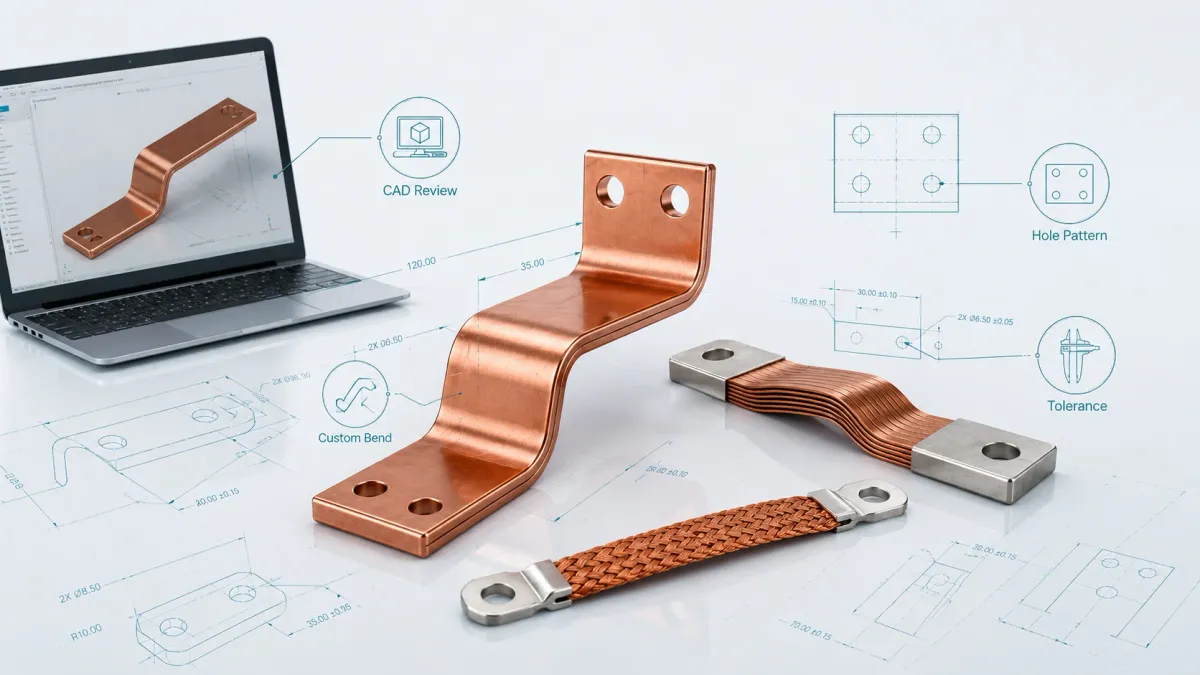
Start With Engineering Review, Not Price Negotiation
A serious custom busbar project should begin with engineering review. Price matters, but it should come after the manufacturer understands the application, drawing, tolerance, material, finish, insulation, and testing requirements. If the supplier quotes instantly without technical questions, the price may be based on assumptions that later become change orders, sample failures, or production disputes.
A competent copper busbar manufacturer should review the current path first. That includes continuous current, peak current, duty cycle, voltage, AC or DC operation, allowable temperature rise, ambient temperature, and nearby heat sources. The manufacturer does not need to replace the electrical engineer, but it should understand how manufacturing choices affect resistance, contact quality, and heat.
The next review area is mechanical geometry. A rigid copper busbar may look simple on a PDF drawing, but manufacturing requires control of bend radius, springback, flatness, burr direction, hole deformation, edge condition, and plating thickness. A laminated flexible busbar requires control of foil layer count, weld zone, transition geometry, insulation edge, and allowable flex area. A braided busbar requires control of braid cross-section, terminal compaction, and terminal-to-braid joint integrity.
The third review area is assembly practicality. Can the operator install the busbar without forcing it into position? Are the holes slotted or round? Is there enough access for a torque tool? Will the plated contact area remain clean after handling? Does the insulation window align with the contact pad? Is the bend direction clearly specified? Are there left-hand and right-hand versions that could be mixed during production? These questions are practical, but they often determine whether the project runs smoothly.
For WordPress readers who are still defining the busbar itself, JUMAI’s article on copper bus bars for power distribution is a useful internal reference because it explains why busbars matter in power distribution and why the same current rating can behave differently in a compact sealed enclosure than in a ventilated cabinet.
Evaluate Material Knowledge: C11000, T2 Copper, and When Alternatives Matter
A manufacturer should be able to explain which copper grade it uses and why. For many busbar applications, high-conductivity electrolytic tough pitch copper such as C11000 or T2 copper is a practical choice because it combines conductivity, formability, thermal conductivity, and availability. Copper.org lists C11000 as electrolytic tough pitch copper, with 99.90% minimum copper and high conductivity. The same material data also lists busbars as an electrical use case because of electrical conductivity, thermal conductivity, and corrosion resistance.
However, material selection is not only a conductivity question. Some projects need oxygen-free copper, special temper, specific grain size, controlled hardness, or particular plating compatibility. A battery project may prioritize formability and stable welded terminals. A switchgear project may prioritize flatness, stiffness, and consistent contact areas. A data center power component may prioritize low resistance, tight tolerances, and repeatable installation. A grounding braid may prioritize flexibility and fatigue resistance.
A good copper busbar manufacturer should be able to discuss the following material points clearly:
- Copper grade, such as C11000, T2, C10100, or oxygen-free copper when required.
- Copper purity and conductivity documentation from the material supplier.
- Temper or hardness, because bendability and springback change with material condition.
- Thickness tolerance and width tolerance, because cross-section affects resistance and heat rise.
- Surface condition before plating, because oxidation and contamination affect contact quality.
- Material traceability, especially for safety-critical or high-volume orders.
Do not accept vague statements such as “red copper” or “high-purity copper” without documentation if your application is sensitive. The supplier should be able to provide material grade, certificate information, and inspection records when required. This does not mean every small prototype needs a full PPAP-style package, but it does mean the manufacturer should have a controlled way to prove what material was used.
Check Manufacturing Capabilities in Detail
The phrase “custom copper busbar manufacturer” can mean different things. Some companies cut and bend simple bars. Some outsource plating and insulation. Some buy finished busbars from another factory. Some are trading companies. Others have in-house cutting, punching, CNC bending, welding, terminal pressing, deburring, polishing, plating coordination, insulation, and inspection.
The right choice depends on project risk. If your part is simple, outsourcing may be acceptable. If your project involves tight tolerances, high current, high voltage, vibration, or repeated production, you need more manufacturing control.
Important manufacturing capabilities include cutting, punching, CNC bending, milling or drilling, edge rounding, deburring, flattening, surface cleaning, diffusion welding or press welding for laminated flexible busbars, terminal pressing for braided connectors, plating, insulation, and final inspection. JUMAI states that its copper busbar capabilities include punching, bending, plating, and insulation to CAD specifications, along with rigid, soft/braided, and laminated flexible types on its custom copper busbar service page.
Bending capability deserves special attention. Copper is ductile, but thick copper can still crack, deform, or spring back if bend design and tooling are poor. A manufacturer should understand minimum bend radius, bend direction relative to grain when relevant, tooling marks, and how plating behaves around bent areas. If the bend is too close to a mounting hole, the hole may deform. If the bend is too close to a welded terminal on a flexible laminated busbar, fatigue risk increases.
Deburring and edge treatment also matter. Burrs can cut insulation, reduce creepage distance, create assembly injuries, and introduce inconsistent contact. In insulated busbars, rough edges can create weak points under heat shrink, powder coating, or sleeve insulation. In battery packs, edge condition is even more important because compact high-voltage designs leave less room for error.
Surface treatment is another differentiator. Tin plating is widely used for oxidation resistance and solderability in many electrical applications. Nickel plating may be used for harsher temperature or corrosion environments. Silver plating may be selected for high-performance contact surfaces where cost is justified. The manufacturer should not simply ask which plating you want; it should understand the operating environment, mating material, contact pressure, and expected service life.
Insulation capability should be evaluated by both material and process. Heat shrink tubing is simple and useful, but it may not fit every geometry. Epoxy powder coating can provide a robust insulated surface but requires control of coating thickness, masking, cure, adhesion, and inspection. PVC dipping, sleeve wrapping, and selective insulation each have advantages and limitations. For high-voltage battery or compact power electronics projects, the insulation edge location can be as important as the insulation material itself.
Ask How the Manufacturer Controls Quality
Quality control is not a slogan. For custom copper busbars, it should appear in drawings, incoming inspection, process control, operator instructions, inspection records, packing, and nonconformance handling.
ISO 9001 is a useful baseline because it provides a globally recognized quality management framework. The ISO page for ISO 9001:2015 quality management systems explains that operations necessary to meet customer requirements must be planned, implemented, and controlled. For busbar buyers, this does not mean ISO 9001 alone guarantees a perfect component, but it does suggest the supplier has a process-based quality system.
The manufacturer should be able to explain how it controls material, dimensions, surface finish, plating thickness, insulation, and final packaging. If the part has critical dimensions, the inspection plan should identify them. If the part has a plated contact area, the supplier should be able to control masking and thickness. If the part has insulation, the supplier should be able to check coverage, exposed copper windows, adhesion, and damage.
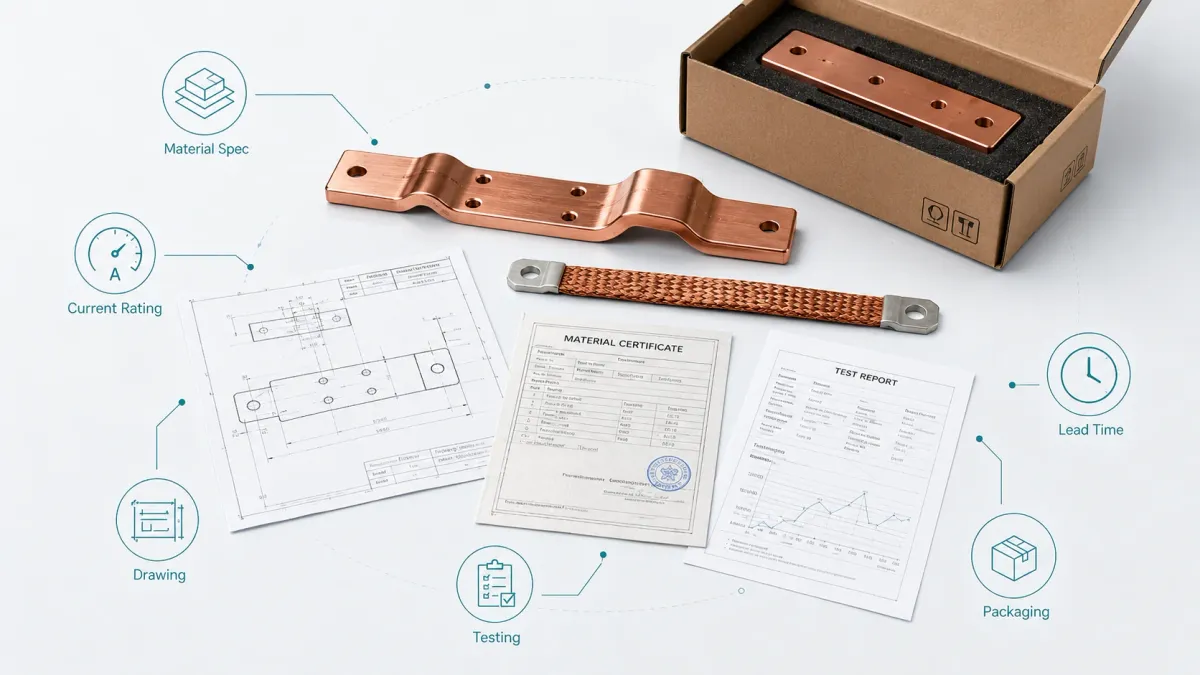
For many projects, the most important quality documents are simple but practical: material certificate, dimensional inspection report, plating report, insulation inspection, visual inspection standard, packaging method, and sample approval record. For more demanding projects, buyers may request first article inspection, capability data for critical dimensions, lot traceability, or production control plans.
| Evaluation area | What good looks like | Buyer question | Evidence to request |
|---|---|---|---|
| Material control | Copper grade and temper are defined and traceable | Which copper grade and temper will be used? | Material certificate, supplier specification, incoming inspection record |
| Dimensional control | Critical dimensions are measured consistently | Which dimensions are critical to function and assembly? | First article inspection, CMM or caliper report, drawing with inspection marks |
| Bend and forming control | Bend angle, radius, flatness, and hole position remain stable | How do you control springback and bend-to-hole tolerance? | Sample report, tooling notes, process photos if available |
| Surface finish and plating | Contact areas are clean, plated, and protected | What plating thickness and masking method will you use? | Plating report, visual standard, salt spray requirement if needed |
| Insulation control | Insulation edge, thickness, adhesion, and exposed windows are controlled | How do you inspect insulation coverage and damage? | Insulation inspection checklist, thickness record, dielectric test if specified |
| Production repeatability | Sample approval transfers into batch control | How do you prevent sample-to-production drift? | Control plan, approved sample, lot inspection report |
| Packaging | Parts arrive without scratches, deformation, or oxidation | How will you protect contact surfaces and bends during shipment? | Packaging specification, photos, export carton method |
A practical buyer should also look for the manufacturer’s attitude toward quality problems. Good suppliers do not pretend defects never happen. They show how problems are contained, analyzed, corrected, and prevented. In custom electrical projects, a fast and honest corrective action process can be as valuable as a low defect rate.
Confirm Standards Awareness for Your Target Market
A copper busbar is usually a component inside a larger product, not the final certified system. Still, the busbar manufacturer should understand the standards environment around your application. The supplier does not need to certify the whole switchgear cabinet or battery system, but it should know why material, spacing, insulation, current rating, and documentation matter.
For low-voltage switchgear and controlgear assemblies, many global projects reference the IEC 61439 series. The IECEE page for IEC 61439-6 describes definitions, service conditions, construction requirements, technical characteristics, and verification requirements for busbar trunking systems. For North American switchboard applications, UL Solutions describes UL 891 as the most common standard for dead-front switchboards, broadly recognized and applied in North America. UL also notes that manufacturers under the UL 891 General Coverage Program must use components and design parameters within the applicable requirements and quality control processes.
For buyers, the key point is not that every busbar must carry a separate UL or IEC mark. The key point is that the busbar must support the compliance of the finished assembly. If the final product needs UL, IEC, CE, or customer-specific validation, the busbar drawing should reflect the relevant requirements: material, current path, clearances, insulation rating, contact surface, torque assumptions, temperature limits, and traceability.
A qualified copper busbar manufacturer should be comfortable discussing standards in practical terms. It should understand why an exposed copper edge may be a safety issue, why an insulation window must be positioned accurately, why an over-torqued or under-torqued connection can create heat, and why a plating choice can affect long-term contact resistance. UL’s dead-front switchboard application guide defines ampacity as the current a conductor can carry continuously under conditions of use without exceeding its temperature rating, and it also warns that incorrect torque can produce overheating or conductor damage.
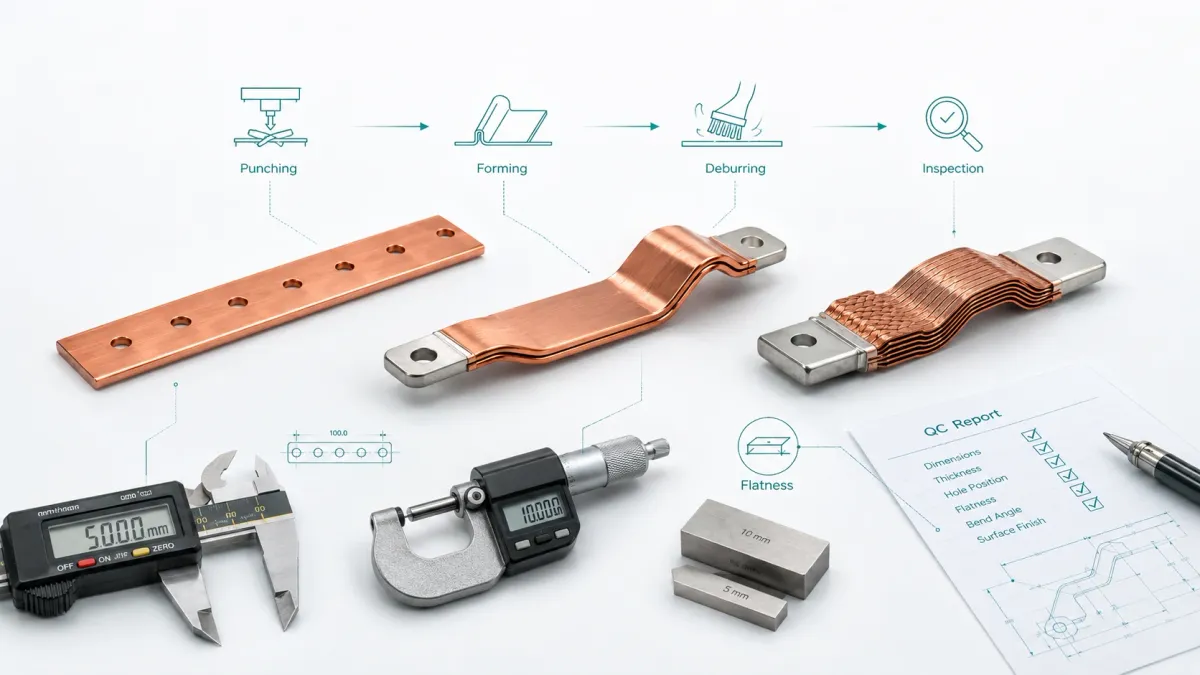
Review Heat, Resistance, and Contact Design
Most busbar failures are not caused by the copper body suddenly becoming unable to carry current. They often start at joints, contact surfaces, bends, or areas with poor heat dissipation. A custom copper busbar manufacturer should understand how manufacturing affects these risk points.
Resistance is affected by cross-section, copper conductivity, length, temperature, and joint quality. Heat is affected by resistance, current, duty cycle, ambient temperature, surface area, airflow, enclosure design, nearby heat sources, and radiation. Contact temperature is affected by contact area, flatness, plating, torque, washer design, surface cleanliness, and mating material.
This is why two busbars with the same copper thickness can perform differently. A longer current path creates more resistance. A narrow neck near a mounting hole can become a hot spot. A poor contact surface can overheat even if the copper cross-section is large enough. A tight enclosure can trap heat. A plated surface contaminated by handling oil can degrade contact quality. A bolted joint without proper torque control can loosen under vibration or thermal cycling.
The manufacturer should therefore review not only the copper size, but also the current path geometry. Are there bottlenecks near holes? Is the contact pad large enough? Is the bend reducing effective cross-section? Is the copper exposed to airflow? Are multiple layers welded properly in a laminated flexible busbar? Is the braid terminal compressed evenly? Is there enough clearance from other conductors? These are the questions that separate engineering manufacturing from basic fabrication.
For preliminary work, published ampacity tables such as the Copper Development Association’s busbar tables are useful. But production designs should be validated under real conditions when the current, enclosure, duty cycle, or safety margin is critical. A responsible manufacturer will not promise that a busbar is safe for a specific current without understanding the installation environment.
Consider Industry-Specific Requirements
Different industries use copper busbars for different reasons. The best copper busbar manufacturer for one industry may not be the best for another. When evaluating suppliers, match their experience to your application.
EV Battery Packs and High-Voltage Distribution
EV battery projects require a careful balance of conductivity, flexibility, insulation, vibration resistance, and assembly control. A busbar may connect cells, modules, fuses, contactors, current sensors, service disconnects, and inverter interfaces. The design may need to handle continuous current, short peak current, fast assembly, compact space, and high-voltage safety.
Flexible laminated busbars are often used where battery modules move slightly due to vibration, thermal expansion, or assembly tolerance. The welded terminal area must be stable, but the middle section must remain flexible. If flexibility occurs at the hole edge or weld transition instead of the designed bend zone, fatigue risk increases. This is why the manufacturer must understand foil thickness, layer count, weld quality, insulation transition, and bend zone design.
Tin or nickel plating may be selected for terminal areas depending on the mating material and environment. Insulation may need to be orange for high-voltage visual identification, though color alone does not prove electrical performance. The buyer should define operating temperature range, current, voltage, creepage and clearance targets, mounting method, and validation requirements.
Battery Energy Storage Systems
BESS busbars may look similar to EV battery busbars, but the operating profile can be different. Stationary systems may emphasize long service life, thermal stability, cabinet assembly, field maintenance, and large-scale repeatability. The project may involve module-level busbars, rack-level busbars, DC combiner busbars, grounding busbars, and PCS connections.
A BESS buyer should ask whether the manufacturer can support both prototype and production, because energy storage systems often move from pilot to scaled deployment. The busbar design should consider installation tolerance, service access, insulation durability, and packaging for site delivery. A damaged contact surface or insulation edge can create field delays even if the part passed factory inspection.
Data Centers and AI Server Power Infrastructure
Data center power infrastructure rewards compact, efficient, and repeatable current paths. As rack power density increases, designers must reduce voltage drop, simplify assembly, and maintain serviceability. Busbars may be used in rack power shelves, power distribution units, UPS cabinets, rectifier systems, switchgear, and backup power equipment.
The IEA projection that data center electricity consumption may double by 2030 shows why power distribution components are under increasing pressure. A server rack or power shelf may require high current in a compact envelope, with strict dimensional control and clean surfaces. The manufacturer must hold tolerances consistently because even small assembly variation can affect installation speed and contact reliability.
For data center components, ask about flatness, surface protection, plating consistency, packaging cleanliness, and repeat production control. Also ask how the supplier prevents scratches and oxidation on contact surfaces during export shipping.
Switchgear, Control Cabinets, and Power Distribution
Switchgear and power cabinet busbars require predictable geometry, stable contact areas, correct spacing, and reliable documentation. Rigid copper bars are common because they provide structural support and a visible current path. The supplier should understand how to produce accurate bends, clean holes, deburred edges, and flat contact surfaces.
Projects that support UL 891, IEC 61439, or customer-specific panel standards may require more documentation than a simple industrial component. Even if the busbar itself is not separately certified, it may need material traceability, inspection reports, plating documentation, and clear identification. For large assemblies, labeling and packaging by cabinet section can save significant assembly time.
Renewable Energy and Power Electronics
Solar inverters, wind converters, DC combiners, and power electronics systems often require copper busbars with good thermal behavior and compact routing. These applications can involve pulsed current, high operating temperature, and close placement to semiconductors, capacitors, or protection devices. Low inductance may also matter in certain laminated busbar designs.
The manufacturer should understand plating, insulation, heat, and mechanical support. It should also be able to produce consistent parts after design changes, because power electronics products often go through several prototype revisions before final production.
Compare Prototype Support and Production Scalability
Custom electrical projects usually pass through several stages: concept, prototype, engineering validation, pilot production, and mass production. The manufacturer should be able to support the stage you are in now and the stage you plan to reach later.
For prototypes, speed and engineering feedback matter. You may need only 10, 20, or 50 pieces, but the samples must be realistic enough for assembly and testing. A prototype that is hand-made without production-like process control may pass early evaluation but fail when moved to batch production. Ask the manufacturer whether prototype samples use the same material, bend process, plating, insulation, and inspection method planned for production.
For production, repeatability matters more than speed alone. The supplier must control tooling, work instructions, material batches, plating subcontractors if any, inspection frequency, packaging, and delivery schedules. If annual volume is expected to grow, the supplier should discuss capacity, tooling life, fixture control, lead time, and quality documentation.
This is especially important for parts that require custom tooling or fixtures. A bending fixture, welding fixture, punching die, or insulation mask may be necessary to hold repeatability. Tooling cost can be justified if it reduces batch variation and inspection time. A professional manufacturer will explain when tooling is needed and when it is not.
Do Not Judge Cost by Unit Price Alone
The lowest unit price is not always the lowest project cost. A cheap copper busbar can become expensive if it causes redesign, rework, delayed certification, assembly problems, overheating, poor contact, field failure, or high incoming inspection workload.
When comparing quotations, check what is included. Does the price include material certificate? Plating? Insulation? Deburring? Cleaning? Custom packaging? First article inspection? Engineering review? Tooling? Sample revision? Export packing? A quote that looks lower may exclude important items or assume looser tolerances.
Copper price volatility is also part of the discussion. For high-volume orders, manufacturers may quote copper price validity periods, material price adjustment rules, or staged procurement. A transparent supplier will explain how copper price affects quotation validity and how production orders are scheduled.
Buyers should also consider yield. Complex punched or bent busbars may generate scrap. Thick copper, plating masks, insulation processes, and tight tolerances can increase production cost. A good manufacturer may suggest geometry changes that reduce scrap or simplify processing without weakening performance.
Prepare a Strong RFQ Package
The quality of the supplier’s answer depends heavily on the quality of the buyer’s RFQ. A vague request such as “quote copper busbar 300 A” is not enough. The manufacturer needs technical and commercial information to evaluate material, process, tolerance, plating, insulation, inspection, packaging, and lead time.
A complete RFQ does not need to be complicated, but it should include the information that affects manufacturing and performance. The following checklist can be used by purchasing teams, engineers, and project managers before contacting a copper busbar manufacturer.
| RFQ item | Why it matters | Example information to provide |
|---|---|---|
| Drawing files | Defines geometry and tolerances | PDF drawing plus STEP, DXF, DWG, or 3D model if available |
| Copper grade and thickness | Affects conductivity, bendability, and cost | C11000/T2 copper, 2 mm thickness, half-hard or soft temper if specified |
| Current and voltage | Helps review cross-section and insulation risk | 300 A continuous, 600 A peak for 10 seconds, 800 V DC system |
| Application environment | Affects plating, insulation, and mechanical design | EV battery pack, BESS rack, switchgear, data center power shelf |
| Operating temperature | Affects insulation and contact design | -40°C to 105°C, or cabinet ambient plus temperature rise target |
| Surface finish | Affects oxidation and contact resistance | Bare copper, tin plating, nickel plating, silver plating, selective plating |
| Insulation | Affects safety and manufacturability | Heat shrink, epoxy coating, PVC dipping, selective insulation, exposed contact windows |
| Critical dimensions | Guides inspection plan | Hole position, bend angle, contact flatness, terminal thickness, overall length |
| Standards or customer requirements | Ensures documentation alignment | IEC 61439 project, UL 891 switchboard assembly, internal battery pack specification |
| Quantity and timeline | Determines process, tooling, and pricing | 30 prototypes, 500 pilot pieces, 20,000 annual production pieces |
| Documentation | Prevents approval delays | Material certificate, inspection report, plating report, sample approval record |
| Packaging and logistics | Protects parts during shipment | Contact surface protection, part number labels, cabinet-section grouping, export cartons |
JUMAI’s project inquiry process asks buyers to send CAD drawings such as STEP, IGES, and PDF for engineering review. This is practical because a custom copper busbar manufacturer cannot accurately evaluate bend sequence, tooling access, insulation windows, and inspection points from a rough text description alone.
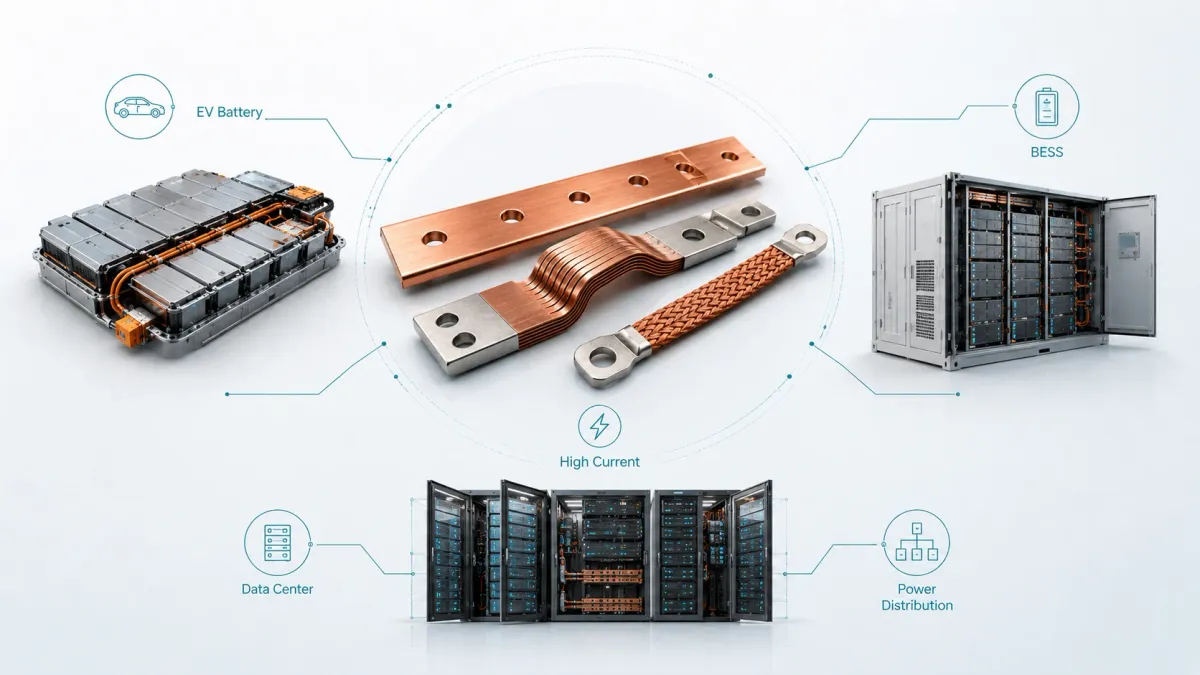
Watch for Red Flags When Choosing a Copper Busbar Manufacturer
A supplier may have attractive pricing and still be a poor fit for custom electrical projects. Watch for signs that the company does not understand busbar engineering or cannot control production risk.
One red flag is a quotation without technical questions. If the project involves current, voltage, plating, insulation, or bends, the manufacturer should ask for drawings and application details. A supplier that quotes only by weight may be treating the busbar as a raw metal part, not an electrical component.
Another red flag is unclear material description. If the supplier cannot state copper grade, purity, temper, or certificate availability, the buyer has little control over conductivity and mechanical behavior. Terms such as “red copper” or “pure copper” may be acceptable in casual conversation, but they should not be the final specification for a high-current component.
Poor sample documentation is also a warning. If the first samples arrive without inspection records, plating confirmation, or drawing revision control, future production may be difficult to manage. A buyer should know exactly which drawing revision was used, what material was used, and which dimensions were checked.
A fourth red flag is weak packaging. Copper is soft compared with steel, and contact surfaces can be scratched or oxidized. A busbar that leaves the factory in good condition can still arrive damaged if the packaging does not protect bends, corners, plating, and insulation. This is particularly important for export shipments.
Finally, be cautious when a supplier says every design is easy. Good manufacturers are confident, but they also identify risks. They may warn about a tight bend radius, a narrow bridge between holes, an exposed copper edge, a plating mask problem, or an insulation transition risk. That feedback is not a problem; it is a sign of engineering awareness.
How JUMAI Fits Custom Electrical Projects
For buyers looking for a copper busbar manufacturer with custom engineering support, JUMAI’s positioning is aligned with high-current and precision applications. The company focuses on custom copper busbars, including hard/rigid busbars, soft/braided busbars, and laminated flexible busbars. It also supports surface finishes such as tin, nickel, and silver plating, as well as insulation options for ready-to-assemble parts.
JUMAI’s custom copper busbar service emphasizes high-purity T2/C11000 copper, punching, bending, plating, insulation, CAD-based customization, and applications in NEVs, renewable energy, power distribution, and data centers. This matches the core requirements of many custom electrical projects where the busbar must be designed around the equipment, not forced into a standard catalog shape.
The company’s broader manufacturing background also matters. JUMAI provides deep drawn components, precision stamping dies, and tooling or mold components in addition to copper busbars. For busbar buyers, this tooling knowledge can be valuable when a project requires repeatable forming, custom fixtures, stable hole patterns, or production-friendly part design. A supplier that understands tooling can often suggest small changes that reduce cost and improve repeatability.
For a buyer, the practical way to work with JUMAI is to provide a complete RFQ package: drawing, 3D model if available, copper grade, current, voltage, surface finish, insulation, application environment, quantity, timeline, and documentation requirements. The earlier the technical information is shared, the easier it is to identify manufacturing risks before samples are produced.
Practical Selection Workflow
A structured selection workflow helps buyers avoid choosing a supplier based only on price or sales promises. The following process is suitable for OEMs, system integrators, electrical equipment manufacturers, and sourcing teams.
First, define the application. State whether the part is for an EV battery pack, BESS cabinet, switchgear assembly, data center power unit, renewable energy inverter, industrial machinery, or another application. Include current, voltage, duty cycle, ambient temperature, and installation environment.
Second, classify the busbar. Decide whether the project likely needs a rigid copper busbar, laminated flexible busbar, braided busbar, insulated busbar, or a combination. If you are unsure, ask the manufacturer to review the current path and mechanical constraints.
Third, prepare drawings and requirements. Provide 2D and 3D files, material, plating, insulation, tolerances, and key inspection dimensions. If the design is not final, mark it as a prototype revision and ask for manufacturability comments.
Fourth, ask technical questions before asking for final price. Ask about bend feasibility, plating process, insulation options, material certificate, critical dimensions, sample lead time, tooling needs, and inspection documents. Compare the quality of the answers, not only the speed.
Fifth, order realistic samples. The sample should use production-like material and process whenever possible. If the prototype is simplified, document the differences clearly so nobody mistakes prototype performance for production performance.
Sixth, evaluate the samples in the real assembly. Check fit, torque access, contact area, heat, insulation clearance, and handling. If the part requires electrical or thermal testing, test it under realistic conditions.
Seventh, approve production with revision control. Lock the drawing revision, material, process, plating, insulation, inspection plan, packaging, and documentation. A small undocumented change can create large problems later.
FAQ: Choosing a Copper Busbar Manufacturer
What is the most important factor when choosing a copper busbar manufacturer?
The most important factor is whether the manufacturer can control the part as an electrical and mechanical component, not just as a piece of copper. Look for material knowledge, engineering review, forming capability, plating and insulation control, inspection discipline, and experience with your application.
Is C11000 copper good for busbars?
Yes, C11000 electrolytic tough pitch copper is widely used for electrical busbars because it offers high conductivity, good formability, and practical availability. Copper.org lists C11000 with minimum 99.90% copper and high IACS conductivity. However, some projects may require oxygen-free copper, special temper, or specific customer standards.
Should I choose a rigid busbar or a flexible busbar?
Choose a rigid busbar when the current path is fixed, the assembly is stable, and mechanical support is useful. Choose a laminated flexible or braided busbar when the design needs vibration absorption, tolerance compensation, compact routing, or controlled flexibility. In battery packs and dynamic environments, flexible busbars can reduce stress on terminals when designed correctly.
Does tin plating improve busbar performance?
Tin plating can help reduce oxidation and improve contact stability in many environments, but it is not automatically the best choice for every project. Nickel plating or silver plating may be better for certain temperature, corrosion, or contact-performance requirements. The decision should consider mating material, contact pressure, operating temperature, environment, and cost.
Do copper busbars need insulation?
Not always. Some busbars are bare copper or plated copper inside controlled assemblies. Insulation is needed when the design requires touch protection, phase separation, high-voltage safety, creepage and clearance control, or protection from accidental contact. The insulation method must match the geometry and operating environment.
Can ampacity tables decide the final busbar size?
Ampacity tables are useful for preliminary sizing, but they do not replace project-specific validation. Actual performance depends on ambient temperature, enclosure ventilation, surface condition, current waveform, duty cycle, adjacent heat sources, contact design, and installation method.
What files should I send for a custom copper busbar quotation?
Send a PDF drawing and a 3D file such as STEP if available. Include copper grade, thickness, current, voltage, plating, insulation, tolerances, application, quantity, timeline, and documentation requirements. The more complete the RFQ, the more accurate the quote and engineering review.
How can I know whether a supplier is a real manufacturer?
Ask about in-house processes, equipment, inspection methods, sample photos, material certificates, plating control, insulation process, and quality documents. A real manufacturer should be able to discuss bend sequence, tooling, tolerances, and inspection details. A trading company may still be useful in some cases, but the buyer should know who controls production.
Why should I involve the manufacturer before the drawing is final?
Early manufacturer review can identify bend-radius problems, hole deformation risk, plating mask issues, insulation edge problems, tolerance conflicts, and cost-saving changes. This can reduce sample iterations and shorten the path to production.
What makes JUMAI a suitable option for custom copper busbar projects?
JUMAI focuses on custom soft, rigid, braided, and laminated flexible copper busbars, with capabilities for CAD-based customization, punching, bending, plating, insulation, and engineering review. The company also supports related precision manufacturing services such as deep drawn components and tooling, which can be useful for custom electrical projects that require repeatable production.
Final Recommendation
Choosing a copper busbar manufacturer should be treated as part of electrical project risk management. The right supplier can help improve current-carrying performance, thermal behavior, assembly speed, documentation, and production repeatability. The wrong supplier may deliver a cheaper part but create hidden costs through redesign, rework, inspection burden, or field problems.
For custom electrical projects, start with the application rather than the copper size. Define the current, voltage, environment, geometry, contact method, insulation need, standards context, and production plan. Then evaluate whether the manufacturer can control material, forming, plating, insulation, inspection, packaging, and revision management.
If your project involves EV batteries, BESS cabinets, data center power systems, renewable energy converters, switchgear, or industrial power distribution, a specialized copper busbar manufacturer is usually a better choice than a general metal fabricator. JUMAI can support custom copper busbar projects from drawing review to prototype and production, including rigid copper busbars, laminated flexible busbars, braided copper connectors, plated contact areas, and insulated designs.
To move forward, prepare your drawing files, electrical requirements, material expectations, finish, insulation, quantity, and timeline. A clear RFQ allows the manufacturer to provide more than a price. It allows the manufacturer to become an engineering partner in building a safer, cleaner, and more reliable power connection.