
In the rapidly evolving landscape of modern engineering, the demand for efficient, reliable, and adaptable electrical power distribution systems has never been higher. From the sprawling infrastructure of hyperscale data centers to the compact, high-density energy modules of Electric Vehicles (EVs), the arteries of these systems—the busbars—must perform flawlessly under increasingly extreme conditions. As the Editor-in-Chief at JUMAI, a premier global manufacturer of custom copper busbars and deep drawn stamping dies, I have witnessed firsthand the transformative impact of advanced material engineering on these critical components.
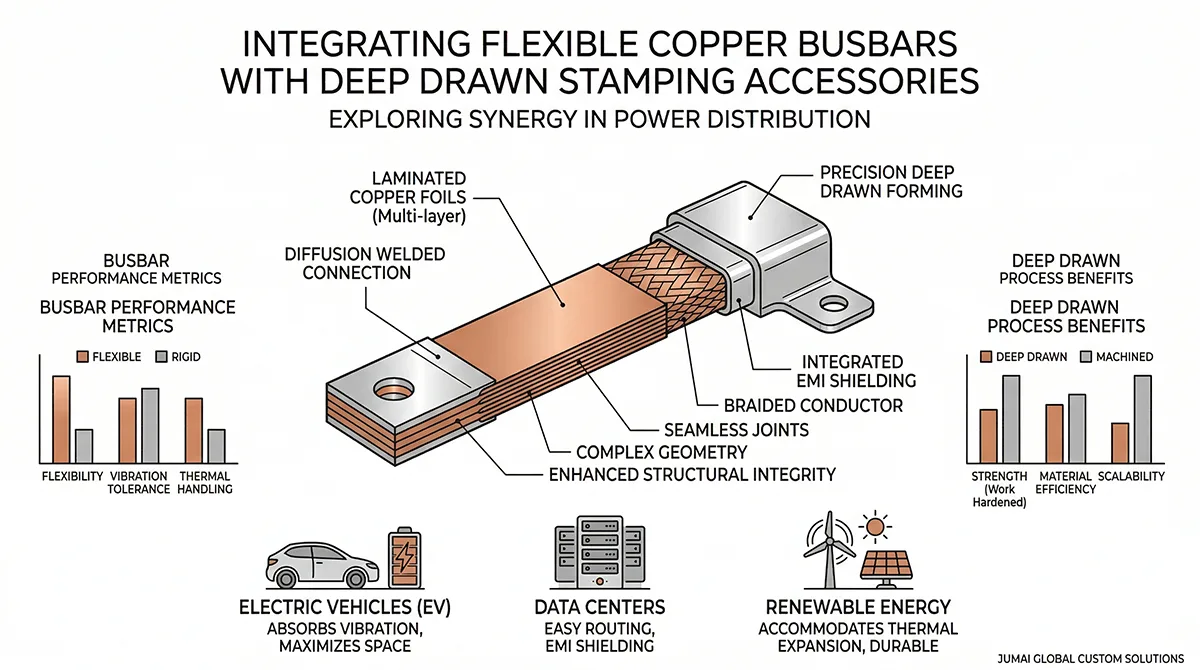
Historically, rigid copper busbars were the industry standard. While excellent for static environments, they fall short in dynamic applications characterized by thermal expansion, mechanical vibration, and severe space constraints. This is where Flexible Copper Busbars enter the equation. When these flexible conductors are seamlessly integrated with precision-engineered Deep Drawn Stamping Accessories, the result is a holistic power transmission solution that offers unparalleled electrical conductivity, mechanical resilience, and long-term reliability.
This comprehensive guide serves as an authoritative resource for global B2B clients, exploring the technical nuances, manufacturing excellence, and strategic advantages of integrating flexible copper busbars with deep drawn stamping technologies.
Demystifying Flexible Copper Busbars: Engineering for Dynamics
What Are Flexible Copper Busbars?
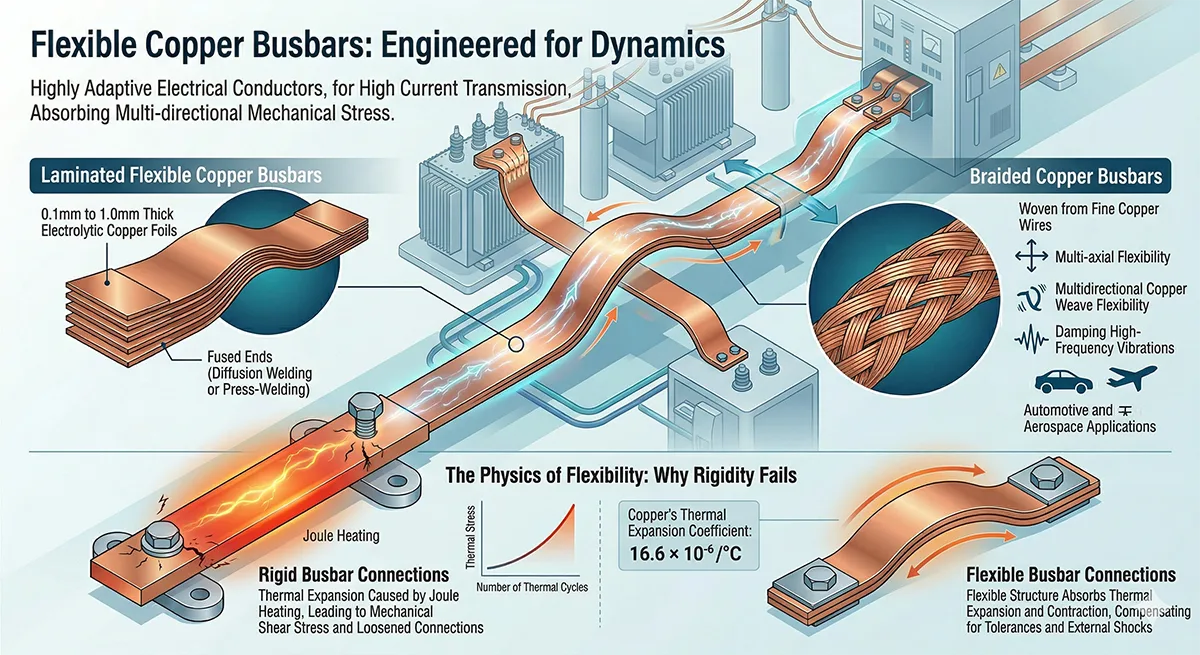
Flexible copper busbars are highly adaptable electrical conductors engineered to transmit significant amounts of current while absorbing multi-directional mechanical stresses. Unlike their rigid counterparts, which are extruded or milled from solid copper blocks, flexible busbars are constructed using specialized techniques to maintain conductivity while maximizing pliability.
At JUMAI, we manufacture several variations of these dynamic conductors, primarily focusing on two core constructions:
- Laminated Flexible Copper Busbars: Composed of multiple thin layers of highly conductive electrolytic copper foils (typically 0.1mm to 1.0mm in thickness). These foils are fused at the ends using a diffusion welding process or press-welding, leaving the middle section free to flex.
- Braided Copper Busbars: Constructed from woven strands of fine copper wire. This configuration offers multi-axis flexibility and is exceptional at dampening high-frequency vibrations, making it a staple in automotive and aerospace applications.
The Physics of Flexibility: Why Rigidity Fails
In advanced engineering applications, rigid connections are vulnerable to catastrophic failure modes over time. When heavy electrical currents pass through a conductor, Joule heating occurs. According to the Copper Development Association, copper expands at a rate of approximately $16.6 \times 10^{-6}$ per degree Celsius. In a rigid system bolted between two heavy transformers, this thermal expansion creates immense mechanical shear stress on the mounting points, eventually leading to structural fatigue, loosened bolts, increased contact resistance, and potential thermal runaway.
Flexible copper busbars absorb this expansion and contraction naturally. Their structural elasticity compensates for tolerance mismatches during assembly, thermal cycling during operation, and mechanical shock from external environments.
Comparative Analysis: Flexible vs. Rigid Busbars
To understand the operational supremacy of flexible busbars in dynamic environments, consider the following data-driven comparison:
| Performance Metric | Rigid Copper Busbars | Flexible Copper Busbars |
|---|---|---|
| Vibration Tolerance | Poor (Prone to micro-fractures) | Excellent (Dampens multi-axis vibration) |
| Thermal Expansion Handling | Low (Transmits stress to terminals) | High (Absorbs expansion/contraction) |
| Space Efficiency (Routing) | Requires calculated angular bends | Highly adaptable to tight, complex spaces |
| Installation Time | High (Requires precise alignment) | Low (Accommodates slight misalignments) |
| Current Density (Skin Effect) | Standard | Improved in laminated/braided configurations |
| Weight | Heavier | Generally lighter for equivalent ampacity |
(Data sourced from internal JUMAI R&D testing protocols and industry-standard electrical engineering parameters).
The Art and Science of Deep Drawn Stamping Accessories
To unlock the full potential of flexible copper busbars, they must be mounted, protected, and connected using hardware that meets their exact engineering standards. This is where Deep Drawn Stamping becomes a critical piece of the manufacturing puzzle.
Understanding Deep Drawing Technology
Deep drawing is an advanced sheet metal forming process. A flat sheet metal blank is drawn into a forming die by the mechanical action of a punch. It is classified as “deep” drawing when the depth of the drawn part exceeds its diameter. This process is capable of producing seamless, complex, and highly durable three-dimensional shapes.
At JUMAI, our deep drawing capabilities are utilized to manufacture critical accessories for busbar systems, including:
- Custom Terminal Enclosures: Seamless housings that protect electrical joints from environmental contaminants (dust, moisture, corrosive gases).
- Precision Mounting Brackets: High-strength, lightweight brackets designed to secure flexible busbars without impinging on their natural range of motion.
- EMI/RFI Shielding Caps: Copper or aluminum drawn caps that mitigate electromagnetic interference in sensitive environments like data centers and telecommunications hubs.
- Contact Receptacles: High-precision, high-surface-area joints that ensure maximum electrical transfer between the busbar and the power source.
The Superiority of Deep Drawn Accessories
Why choose deep drawn stamping over traditional casting or CNC machining for busbar accessories? The answers lie in material science and production scalability:
- Work Hardening: As the metal is stretched and drawn during the JUMAI deep drawing process, its crystalline structure aligns, resulting in “work hardening.” This means the final accessory is often stronger than the original base material, providing superior mechanical protection.
- Seamless Construction: Deep drawn parts have no seams, welds, or joints. This eliminates the risk of weak points where mechanical failure or moisture ingress can occur—a critical requirement for offshore wind turbines and automotive undercarriages.
- Strict Tolerances at Scale: Once a deep drawing die is perfected by our JUMAI engineers, it can stamp millions of identical parts with tolerances as tight as $\pm 0.01mm$. This ensures perfect integration with our custom flexible copper busbars every single time.
- Material Optimization: Deep drawing minimizes scrap waste compared to CNC machining, making it an economically and environmentally sustainable choice for large-scale OEM orders.
The Core Strategy: Integrating Flexible Copper Busbars with Deep Drawn Accessories
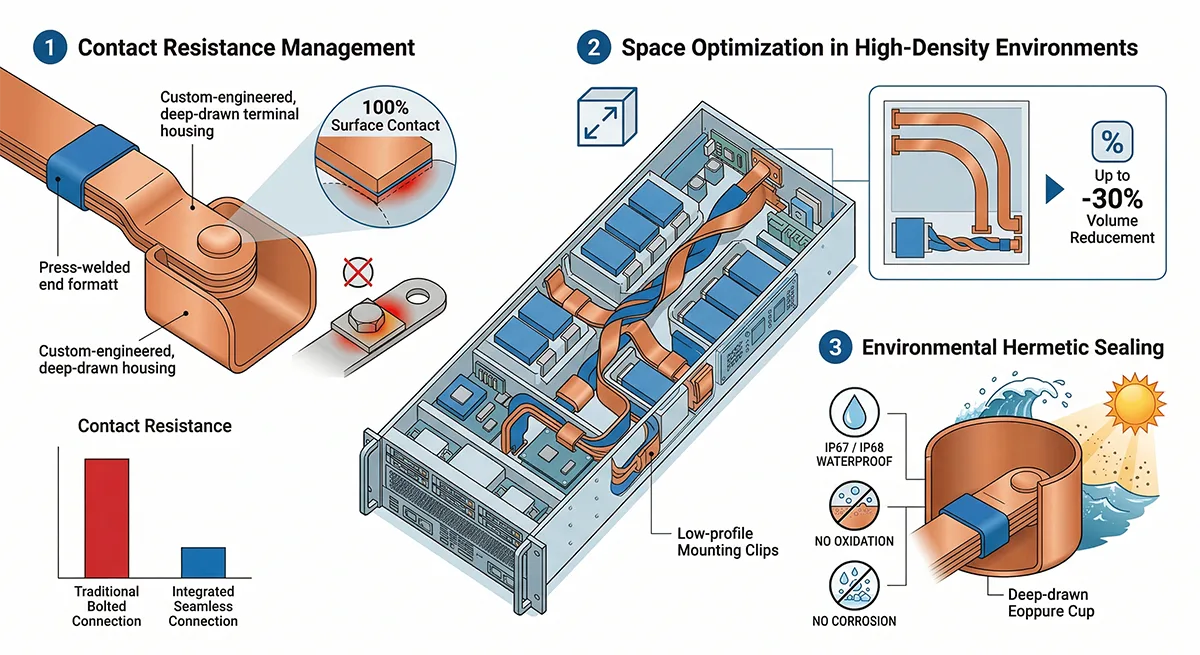
The true innovation in modern power distribution lies not just in the components themselves, but in their synergy. By integrating JUMAI’s flexible copper busbars with our in-house engineered deep drawn stamping accessories, engineers can resolve the most complex electro-mechanical bottlenecks.
1. Managing Contact Resistance
The weakest point in any electrical system is the connection. High contact resistance generates heat, leading to energy loss and potential fire hazards. Integrating a flexible copper busbar with a custom-engineered, deep-drawn terminal ensures a perfectly matched mating surface.
Because we manufacture both components at DeepDrawTech, we engineer the press-welded ends of the flexible busbar to perfectly match the internal radii of the deep-drawn contact housing. This achieves near 100% surface contact, drastically lowering resistance and maximizing ampacity.
2. Space Optimization in High-Density Environments
Modern engineering trends demand smaller footprints. Whether it is an electric vehicle battery pack or a blade server chassis, space is at a premium. Rigid busbars require wide, sweeping bend radii and bulky bolt-on connections.
Flexible copper busbars can be routed through serpentine channels, folded, or twisted to fit minimal volumes. When paired with low-profile, deep-drawn mounting clips that hold the busbars securely without adding bulk, designers can reduce the overall volume of the power distribution module by up to 30%, increasing the energy density of the final product.
3. Environmental Hermetic Sealing
In sectors like marine engineering or solar energy, busbars are exposed to harsh environments. By utilizing a deep-drawn copper or stainless-steel enclosure accessory, the connection points of the flexible busbar can be hermetically sealed. The seamless nature of the deep-drawn cup, combined with industrial epoxies or gaskets, ensures IP67 or IP68 waterproof ratings, protecting the conductive copper from oxidation and galvanic corrosion.
Industry-Specific Applications and Technical Data
The integration of JUMAI’s flexible copper busbars and deep drawn accessories is not a theoretical concept; it is a proven architecture driving the most critical industries today.
A. Electric Vehicles (EVs) and Hybrid Powertrains
The automotive sector is undergoing a historic transition. According to the International Energy Agency (IEA), the global electric car fleet exceeded 26 million in 2022 and continues to grow exponentially. This growth places immense pressure on battery technology and power distribution.
The Challenge: EV battery modules are subjected to constant vibration, rapid acceleration G-forces, and extreme temperature fluctuations during fast charging (generating significant thermal expansion). Rigid connectors between battery cells frequently fail under these conditions, causing arcing.
The JUMAI Solution:
We supply Tier 1 automotive manufacturers with custom braided and laminated flexible copper busbars to connect individual battery modules. These busbars flex dynamically as the vehicle moves, absorbing the kinetic energy. Furthermore, we provide deep-drawn stamping accessories in the form of robust battery terminal caps. These caps protect the sensitive battery posts from mechanical shear forces while providing a perfect, high-surface-area connection point for the flexible busbar.
Data Snapshot: JUMAI EV Flexible Busbar Ampacity (Standard Ambience 30°C, $\Delta$T 45°C)
| Cross-Sectional Area (mm2) | Braided Busbar Ampacity (Amps) | Laminated Busbar Ampacity (Amps) | Recommended Deep Drawn Terminal Thickness |
|---|---|---|---|
| 50 | ~250 A | ~275 A | 1.5 mm |
| 100 | ~420 A | ~460 A | 2.0 mm |
| 200 | ~700 A | ~760 A | 3.0 mm |
| 400 | ~1100 A | ~1250 A | 4.0 mm |
(Note: Ampacity ratings vary based on precise airflow, insulation, and duty cycles. JUMAI engineers provide custom derating charts for every bespoke order).
B. Hyperscale Data Centers & AI Computing
As artificial intelligence models grow, the power required to train them has skyrocketed. Modern AI server racks routinely consume upwards of 40kW to 100kW per rack. The U.S. Department of Energy notes that efficient power delivery is critical to maintaining PUE (Power Usage Effectiveness) targets.
The Challenge: Delivering massive amperage to densely packed server blades requires heavy copper routing. Rigid busbars are incredibly difficult to install in retrofitted server racks and transmit vibration from cooling fans, which can loosen connections over time, increasing resistance and heat.
The JUMAI Solution:
Our flexible laminated copper busbars are used to connect Uninterruptible Power Supplies (UPS) to the main rack Power Distribution Units (PDUs). Because our busbars can be pre-formed and customized to exact lengths, data center technicians can route them through tight rack enclosures effortlessly. We pair these with deep-drawn EMI shielding accessories that snap over the connection joints, preventing the high-current magnetic fields from interfering with sensitive network cabling nearby.
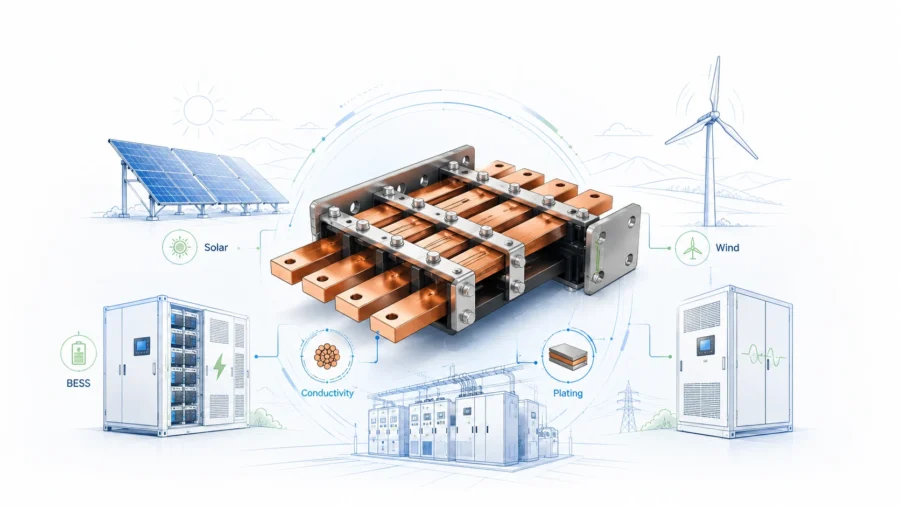
C. Renewable Energy: Solar and Wind Power
The Challenge: Wind turbine nacelles sit hundreds of feet in the air, vibrating constantly and rotating to face the wind. The generator within the nacelle must transmit power down the tower. Similarly, solar inverter stations are exposed to extreme desert heat and freezing nights, causing massive thermal expansion.
The JUMAI Solution:
For wind turbines, braided flexible copper busbars are essential. They bridge the gap between the vibrating generator and the static transformer lines. To combat the severe weather conditions in solar arrays, JUMAI provides flexible busbars treated with heavy tin or silver plating, housed within deep-drawn, weather-proof junction box accessories. This ensures a maintenance-free lifespan of 20+ years in the harshest outdoor environments.
The JUMAI Manufacturing Advantage: Precision and Customization
At https://www.deepdrawtech.com/, we do not just sell components; we engineer solutions. Our integration of flexible busbar manufacturing and deep drawn stamping under one roof provides significant advantages for our global clientele.
1. Material Purity and Sourcing
We utilize premium T2 (C11000) Electrolytic Tough Pitch (ETP) Copper and Oxygen-Free High Conductivity (OFHC) Copper. This guarantees a minimum electrical conductivity of 99.9% IACS (International Annealed Copper Standard).
2. Advanced Press Welding Technology
For our laminated flexible busbars, JUMAI employs advanced molecular diffusion welding. High pressure and heat are applied to the layered copper foils at the connection ends. This melts the copper on a molecular level without the use of solder or flux, transforming the layered ends into a solid, unified block of copper. This results in zero internal contact resistance and a connection point that is stronger than the parent material.
3. Custom Surface Treatments
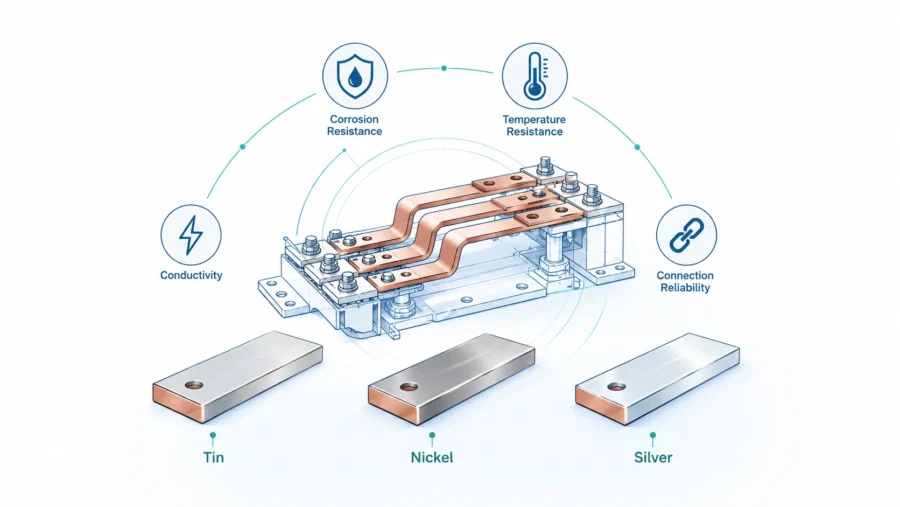
To further enhance the durability of our flexible copper busbars and deep drawn accessories, we offer comprehensive in-house electroplating services:
- Tin Plating: Prevents copper oxidation, highly recommended for industrial and outdoor applications.
- Nickel Plating: Offers superior hardness and resistance to corrosive chemicals, ideal for marine or battery-acid environments.
- Silver Plating: Maximizes conductivity at the contact joints, utilized primarily in high-frequency aerospace and defense applications.
4. Bespoke Deep Drawn Die Creation
Our deep drawn stamping accessories are not off-the-shelf. If an engineer designs a custom high-voltage switchgear requiring a uniquely shaped terminal cover, our in-house tool and die makers will CNC machine a custom tungsten-carbide stamping die. Because we own the tooling process, we can reduce prototyping lead times from months to mere weeks.
5. Stringent Quality Control
Before any integrated busbar system leaves our facility, it undergoes rigorous testing:
- Micro-ohm Resistance Testing: Ensuring the contact point between the flexible busbar and the deep drawn accessory meets specified low-resistance thresholds.
- Thermal Imaging & Heat Rise Tests: Subjecting the busbars to maximum load to monitor thermal dissipation.
- Tensile Strength & Flex-Cycle Testing: Simulating a decade of vibration to guarantee the braided or laminated joints will not fracture.
Insulation and Dielectric Protection in Dynamic Environments
In the first section of our comprehensive guide, we established the mechanical and electrical superiority of Flexible Copper Busbars when paired with custom deep drawn accessories. However, bare copper cannot operate safely in modern, densely packed high-voltage environments. Effective insulation is paramount to prevent short circuits, protect personnel from arc flashes, and ensure compliance with stringent global safety standards.
The challenge with insulating a dynamic component is that the insulation material must match the mechanical elasticity of the busbar itself. If the copper flexes but the insulation is brittle, micro-cracks will form. Over time, these cracks allow moisture and dust to penetrate, leading to catastrophic dialectric breakdown. At JUMAI, we utilize advanced polymer science to encapsulate our power routing solutions securely.
Primary Insulation Technologies for Flexible Busbars
- Heat Shrinkable Tubing (Polyolefin / PVC):This is the most common and cost-effective method for insulating laminated flexible copper busbars. The tubing is slipped over the bare copper and heated, causing it to shrink and conform tightly to the busbar’s geometry. For high-voltage applications (up to 35kV), we utilize heavy-wall, cross-linked polyolefin that offers exceptional flame retardance, strictly adhering to the Underwriters Laboratories (UL) 94 V-0 flammability standard.
- Epoxy Powder Coating (Fluidized Bed Dipping):For complex geometries where heat shrink tubing cannot conform—such as highly irregular twisted busbars or integrated deep drawn terminals—epoxy powder coating is the gold standard. The copper component is heated and dipped into a fluidized bed of suspended epoxy resin powder. The powder melts upon contact, creating a seamless, uniform, and highly durable dielectric shell. This method provides superior thermal conductivity compared to PVC, allowing the busbar to dissipate heat more effectively.
- Extruded Silicone and Elastomers:In environments subjected to extreme temperature volatility (such as aerospace or arctic military installations), silicone extrusion provides unparalleled flexibility. It maintains its elastomeric properties from $-60^\circ\text{C}$ to $+250^\circ\text{C}$, ensuring the flexible copper busbars remain protected regardless of the ambient climate.
Dielectric Performance Data
When engineering a custom power distribution unit (PDU), understanding the dielectric strength of your insulation is critical. Dielectric strength is the maximum electric field a material can withstand under ideal conditions without breaking down.
| Insulation Material | Dielectric Strength (kV/mm) | Operating Temp Range (°C) | Flexibility / Bend Radius Impact | Primary Application |
|---|---|---|---|---|
| Standard PVC Heat Shrink | 15 – 20 kV/mm | -40 to +105 | Moderate | Standard Industrial Switchgear |
| Cross-linked Polyolefin | 20 – 25 kV/mm | -55 to +125 | High | EV Battery Packs, Data Centers |
| Epoxy Powder Coating | 25 – 35 kV/mm | -40 to +130 | Rigid (Coats the final shape) | High-Voltage Medical Imaging |
| Extruded Silicone | 18 – 22 kV/mm | -60 to +250 | Extreme | Aerospace, Heavy Rail Systems |
(Note: The above data represents standard industry baselines. JUMAI engineers can customize dielectric thickness to meet specific isolation requirements).
The Metallurgy of Deep Drawn Stamping Accessories
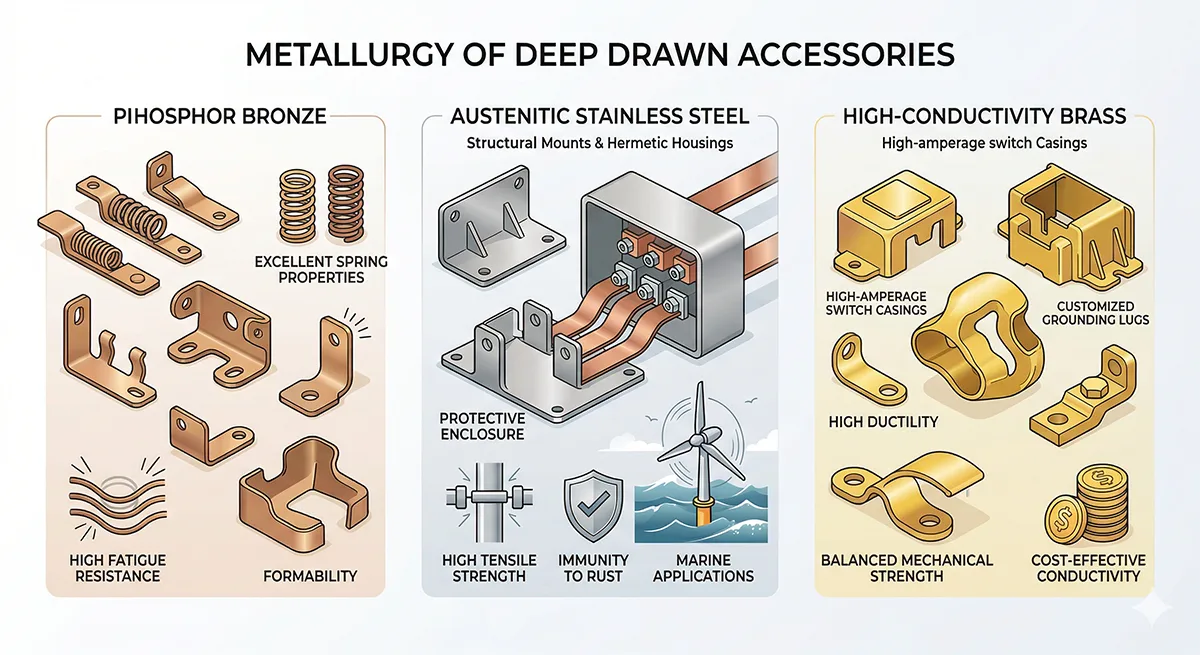
While the flexible copper busbars carry the current, the deep drawn accessories are the structural anchors that interface with the rest of the machine. The choice of metal for these stamped accessories dictates the mechanical integrity, magnetic properties, and corrosion resistance of the entire assembly.
At JUMAI, we do not limit our deep drawing capabilities to just copper. We draw a variety of advanced alloys to suit the specific engineering demands of our clients.
1. Phosphor Bronze (C51000 / C52100)
When a deep drawn accessory needs to act as a spring-loaded contact or a high-fatigue mounting bracket, pure copper is often too soft. Phosphor bronze is an alloy of copper, tin, and phosphorus. The deep drawing process work-hardens this material, giving it excellent spring qualities, high fatigue resistance, and excellent formability, all while maintaining acceptable electrical conductivity.
2. Austenitic Stainless Steel (SS304 / SS316L)
In applications where the accessory serves purely as a structural mount or a protective hermetic housing (and does not need to carry current), stainless steel is the ultimate choice. In marine applications, such as offshore tidal energy generators, flexible copper busbars must be protected from saltwater. We utilize deep drawn SS316L enclosures to house the connection points. Stainless steel offers incredible tensile strength and immunity to rust.
3. High-Conductivity Brass (C26000 Cartridge Brass)
Brass is highly ductile, making it an exceptional candidate for complex deep drawing processes. It is frequently used for manufacturing the structural casings of high-amperage switches and customized grounding lugs. It balances mechanical strength with reasonable conductivity, offering a cost-effective alternative to pure copper for non-critical conductive accessories.
Step-by-Step Integration and Assembly Methodology
The true value of JUMAI lies in our ability to deliver fully integrated, pre-assembled solutions. Procuring flexible copper busbars from one vendor and deep drawn mounting brackets from another introduces massive tolerance risks and supply chain bottlenecks.
Here is how our engineering team ensures flawless integration:
Step 1: Collaborative CAD & FEA Modeling
Before any metal is cut, JUMAI engineers work alongside the client to map out the physical space. We utilize Finite Element Analysis (FEA) to simulate how the flexible copper busbars will behave under thermal load and mechanical vibration. This ensures the drawn accessories are designed to support the busbar at the exact nodes of maximum stress.
Step 2: Precision Stamping and Deep Drawing
Using our proprietary tungsten-carbide dies, we stamp and draw the accessory components (e.g., terminal covers, grounding clips, or EMI shields). The deep drawing process ensures these parts have no seams, resulting in a watertight and structurally unified component.
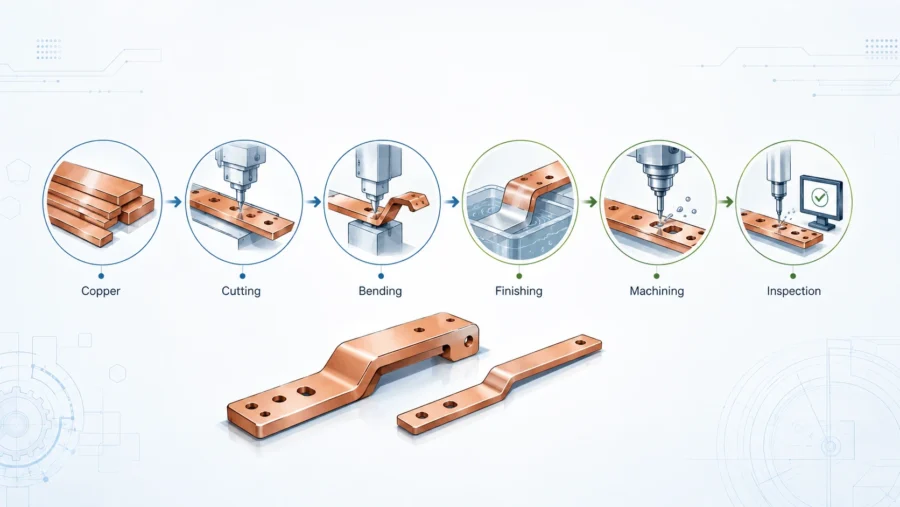
Step 3: Busbar Forming and Press-Welding
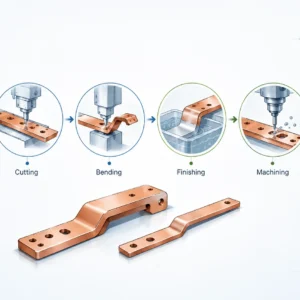
Simultaneously, the layered copper foils or braided wires are cut to length. The ends are placed into a diffusion welding press, where intense heat and pressure fuse the individual strands into a solid, highly conductive terminal block.
Step 4: Mating and Permanent Fastening
The flexible copper busbars are then mated to the deep drawn accessories. Depending on the application, this integration is achieved via:
- Ultrasonic Welding: For bonding thin copper accessories directly to the busbar terminals without introducing massive heat that could damage insulation.
- Riveting / Clinching: A mechanical fastening method that creates a cold-weld between the deep drawn bracket and the busbar, ideal for high-vibration automotive environments.
- TIG Welding / Brazing: Used for heavy-duty, high-amperage industrial applications requiring absolute structural permanence.
Cost-Benefit Analysis: Custom Tooling vs. Off-The-Shelf
A common hesitation among procurement managers is the initial upfront cost of custom deep drawn tooling. Why invest in a custom die when standard lugs and rigid busbars are readily available? The answer becomes evident when calculating the Total Cost of Ownership (TCO) for large-scale production.
The Hidden Costs of Conventional Assemblies
Using off-the-shelf rigid busbars and standard cast brackets in complex modern equipment (like a densely packed wind turbine nacelle) requires extensive manual labor. Technicians must precisely align heavy components, install multiple bolts, apply torque markings, and utilize complex wiring harnesses to bypass spatial constraints.
Furthermore, standard components have higher failure rates under dynamic stress. According to the American Society of Mechanical Engineers (ASME), vibration-induced loosening of bolted electrical joints is a leading cause of maintenance downtime in industrial machinery.
The JUMAI ROI Equation
When transitioning to an integrated system of flexible copper busbars and custom deep drawn accessories, the financial benefits scale rapidly:
- Drastic Reduction in Assembly Time: A pre-engineered, flexible busbar with an integrated, snap-on deep drawn terminal eliminates the need for manual alignment and multi-bolt torquing. Assembly line speed can increase by up to 40%.
- Elimination of Maintenance Downtime: The natural vibration-dampening properties of the flexible busbar, combined with the seamless, work-hardened strength of the deep drawn accessory, practically eliminates joint fatigue. The system becomes “install and forget.”
- Material Savings: Deep drawing is a near-net-shape manufacturing process. Unlike CNC machining, which cuts away material to create a shape, deep drawing stretches the metal. This results in incredibly low scrap rates, lowering the per-unit cost of the copper or steel used.
Hypothetical B2B Cost Comparison (10,000 Unit Production Run of an EV Battery Module)
| Cost Factor | Traditional Rigid Busbar & Cast Terminals | JUMAI Flexible Busbar & Deep Drawn Terminals |
|---|---|---|
| Initial Tooling Cost | Low (Standard Lugs) | High (Custom Die Creation) |
| Per Unit Material Cost | Medium (High scrap from CNC/milling) | Low (Deep drawing stretches material, minimal waste) |
| Labor (Assembly Time) | High (15 mins per unit) | Low (3 mins per unit – snap fit/pre-welded) |
| Warranty/Failure Rate | ~2.5% (Vibration loosening) | < 0.1% (Vibration absorbed) |
| Total Estimated Cost | Highest over 5 years | Significant ROI achieved after Year 1 |
Quality Assurance: Guaranteeing Performance Under Pressure
At JUMAI, we understand that our components sit at the heart of mission-critical infrastructure. A failure in our integrated systems means a data center goes dark, or an electric vehicle stalls. Therefore, our testing protocols are brutally rigorous.
Every batch of integrated flexible copper busbars and deep drawn accessories undergoes a battery of tests compliant with ISO 9001 and IATF 16949 (Automotive Quality Management) standards.
- Salt Spray Corrosion Testing (ASTM B117): To verify the integrity of our tin, nickel, or silver plating, parts are subjected to continuous saline fog for up to 1000 hours to ensure zero oxidative degradation.
- High-Current Temperature Rise Testing: We push current through the integrated assembly—often exceeding the rated ampacity by 20%—and utilize FLIR thermal imaging to ensure the custom deep drawn contact joints dissipate heat efficiently without exceeding maximum temperature thresholds.
- Destructive Tensile Pull Testing: We forcefully pull the mated connection between the flexible busbar and the deep drawn accessory to ensure the mechanical clinching or ultrasonic weld exceeds the sheer strength requirements of the application environment.
The Future of Power Distribution with JUMAI
The rapid electrification of our global economy—driven by renewable energy integration, the proliferation of AI data centers, and the transition to electric mobility—requires hardware that defies traditional limitations.
The future belongs to systems that are adaptable, resilient, and highly efficient. The integration of Flexible Copper Busbars and Deep Drawn Stamping Accessories is not just an incremental improvement; it is a foundational shift in electrical engineering architecture.
By acting as a single-source manufacturer for both the dynamic conductors and the precision structural accessories, JUMAI empowers global innovators to push the boundaries of what their machines can achieve. We remove the bottlenecks of space, vibration, and thermal expansion, allowing you to design power systems that are smaller, lighter, safer, and infinitely more reliable.
Ready to revolutionize your power architecture?
Contact the engineering and sales team at JUMAI today. Visit our website to upload your CAD drawings, request a custom prototype, and discover how our integrated flexible copper busbars and deep drawn manufacturing capabilities can drive your next big innovation forward.