Battery bus bars are no longer simple pieces of copper cut into a rectangular shape. In modern battery packs, energy storage cabinets, power conversion units and high-current industrial assemblies, the bus bar has become a designed electrical, thermal and mechanical component. It carries current, controls voltage drop, helps manage heat, saves space, improves assembly repeatability and often becomes one of the most visible indicators of whether an OEM project has been engineered for production or only built as a prototype.
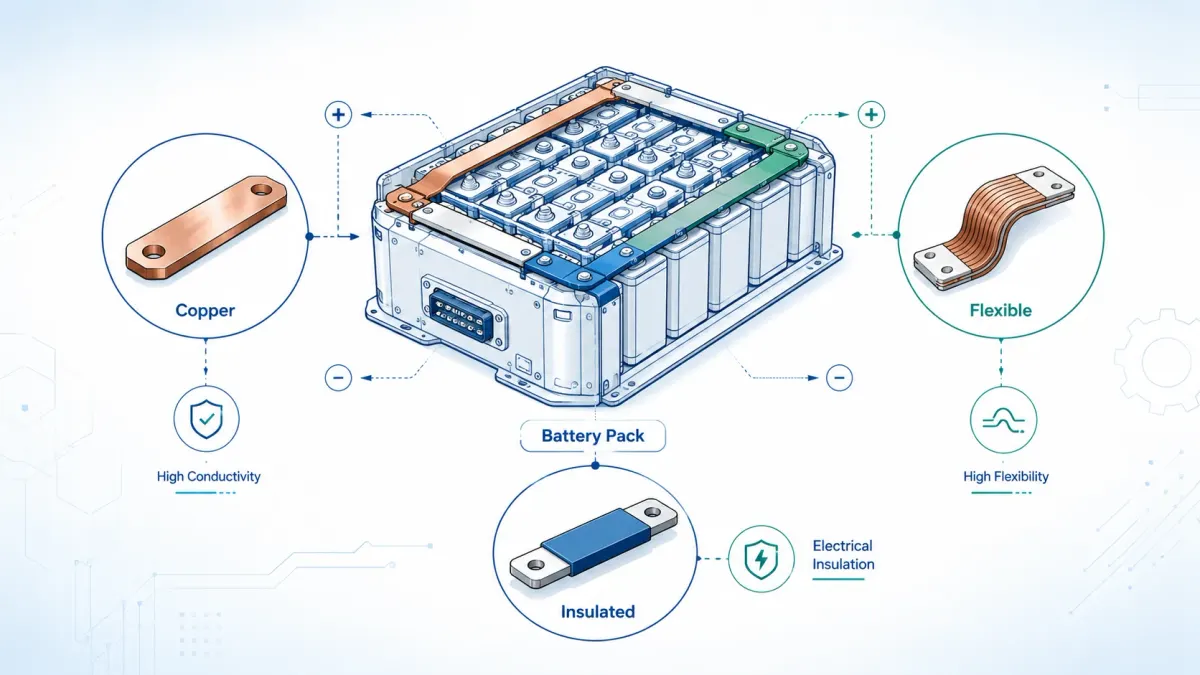
For OEM teams, the question is rarely “Do we need a bus bar?” The more practical question is: what kind of battery bus bar should be used for this current level, voltage class, space envelope, vibration environment, insulation requirement and production volume? A rigid copper bus bar may be ideal for a stable module-to-module connection. A laminated flexible copper bus bar may be safer where thermal expansion, tolerance stack-up or service movement is expected. A braided copper bus bar may be preferred when multi-axis vibration absorption is more important than a flat laminated profile. An insulated bus bar may be mandatory when compact high-voltage routing leaves little margin for accidental contact, contamination, creepage or clearance problems.
JUMAI manufactures custom copper bus bars for OEM projects that need practical manufacturing support, not only theoretical design advice. The product range includes rigid copper busbars, braided copper busbars and laminated flexible busbars, with custom punching, bending, plating, insulation and project-based drawing review. For projects that also require stamped conductive parts, deep drawn metal components or tooling support, JUMAI can combine copper bus bar fabrication with broader precision metal manufacturing capabilities.
This guide explains how OEM buyers and engineers can compare copper, flexible and insulated battery bus bars before sending an RFQ. It is written for battery pack manufacturers, BESS integrators, EV subsystem suppliers, DC power equipment builders, data center power hardware companies and industrial electronics teams that need manufacturable copper parts for prototype, pilot and production programs.
- Why Battery Bus Bars Matter More in OEM Projects
- A Practical Definition of Battery Bus Bars
- Useful Industry Data for Battery Bus Bar Planning
- Copper Battery Bus Bars: Why Copper Remains the Preferred Choice
- Copper vs. Aluminum for Battery Bus Bars
- Rigid Battery Bus Bars
- Flexible Laminated Battery Bus Bars
- Braided Battery Bus Bars
- Insulated Battery Bus Bars
- Plating and Surface Finish Options
- Electrical Design: Resistance, Voltage Drop and Heating
- Mechanical Design: Vibration, Tolerance and Thermal Expansion
- Thermal Design: From Copper Size to System Heat Flow
- Battery Bus Bar Selection Matrix
- Manufacturing Process for Custom Battery Bus Bars
- OEM RFQ Checklist for Battery Bus Bars
- Common Battery Bus Bar Design Mistakes
- Battery Bus Bars for EV Projects
- Battery Bus Bars for BESS and Renewable Energy Storage
- Battery Bus Bars for Data Centers and High-Current DC Power
- How JUMAI Supports OEM Battery Bus Bar Projects
- Sample Specification Framework for a Battery Bus Bar Drawing
- How to Compare Supplier Quotations
- From Prototype to Production
- Frequently Asked Questions
- Conclusion: Choose Battery Bus Bars as Engineered OEM Components
Why Battery Bus Bars Matter More in OEM Projects
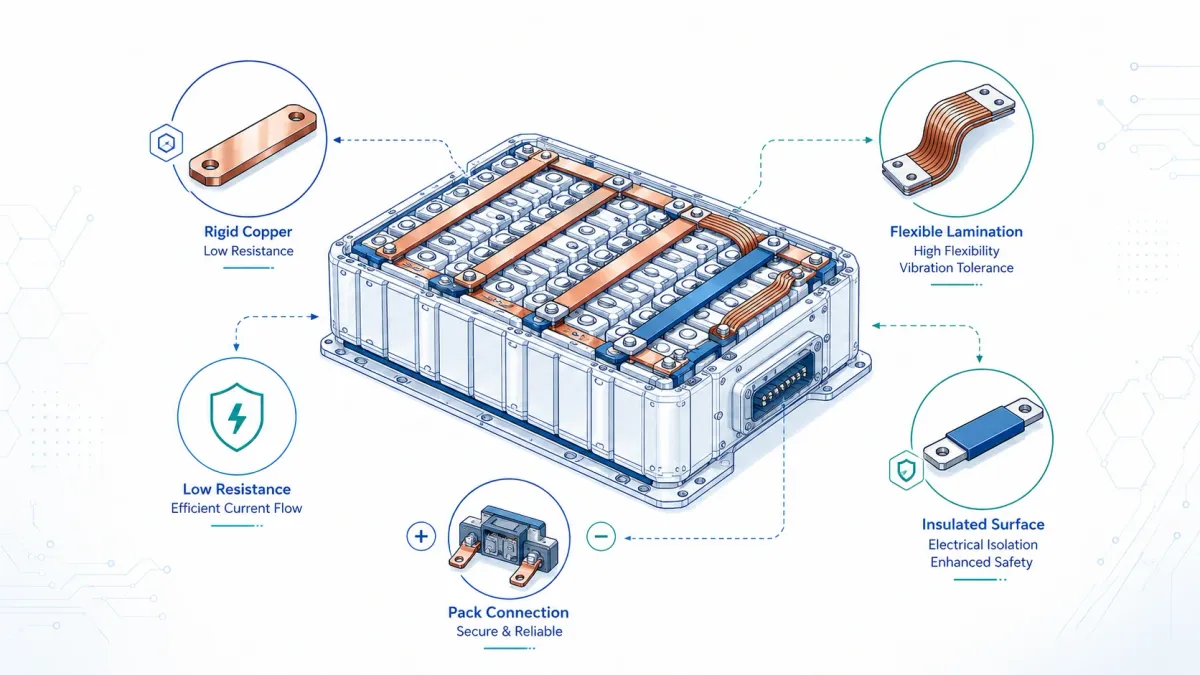
A battery system is a network of electrochemical cells, mechanical structures, sensors, fuses, contactors, battery management electronics and power conductors. The bus bar seems simple because it has no software and no moving parts. However, its design affects several system-level outcomes:
- Electrical efficiency, because every micro-ohm of resistance becomes heat at high current.
- Temperature distribution, because current concentration, poor contact pressure or undersized cross-section can create hot spots.
- Pack reliability, because vibration, thermal cycling and installation tolerance can fatigue rigid conductors or stress battery terminals.
- Assembly repeatability, because punched holes, bend accuracy, insulation masking and plated contact areas must match the production fixture.
- Serviceability, because technicians need safe access, clear polarity, stable torque surfaces and predictable insulation coverage.
- Certification readiness, because spacing, insulation, flame behavior and component documentation are reviewed in regulated battery and power systems.
The business impact is direct. A bus bar that works in one lab sample may fail in mass production if the hole tolerance is too loose, the edge radius damages the coating, the insulation creeps into the contact area, or the copper thickness forces an impossible bend radius. OEM teams therefore need a supplier that can review both the drawing and the manufacturing route. JUMAI’s article on copper busbar materials, types, manufacturing and custom options provides a broader overview of these decisions; this article focuses specifically on battery bus bar projects.
The growth of electric vehicles and energy storage also makes battery bus bar engineering more important. According to the IEA Global EV Outlook 2025, EV battery demand was about 1 TWh in 2024 and is expected to exceed 3 TWh by 2030 under the Stated Policies Scenario. More battery capacity means more modules, more interconnects, more high-current paths and more opportunities for connection losses. Each battery bus bar may be small compared with the complete pack, but thousands or millions of repeated conductive parts can determine the production quality of an entire platform.
A Practical Definition of Battery Bus Bars
A battery bus bar is a conductive component used to connect battery cells, modules, racks, contactors, fuses, current sensors, terminal blocks or power electronics within a battery system. It is usually made from copper or aluminum, although high-performance OEM projects often choose copper because of its superior electrical and thermal conductivity. In JUMAI projects, the common copper grades include T2 copper and C11000 electrolytic tough pitch copper, depending on drawing, availability and project requirements.
Battery bus bars can be grouped by structure:
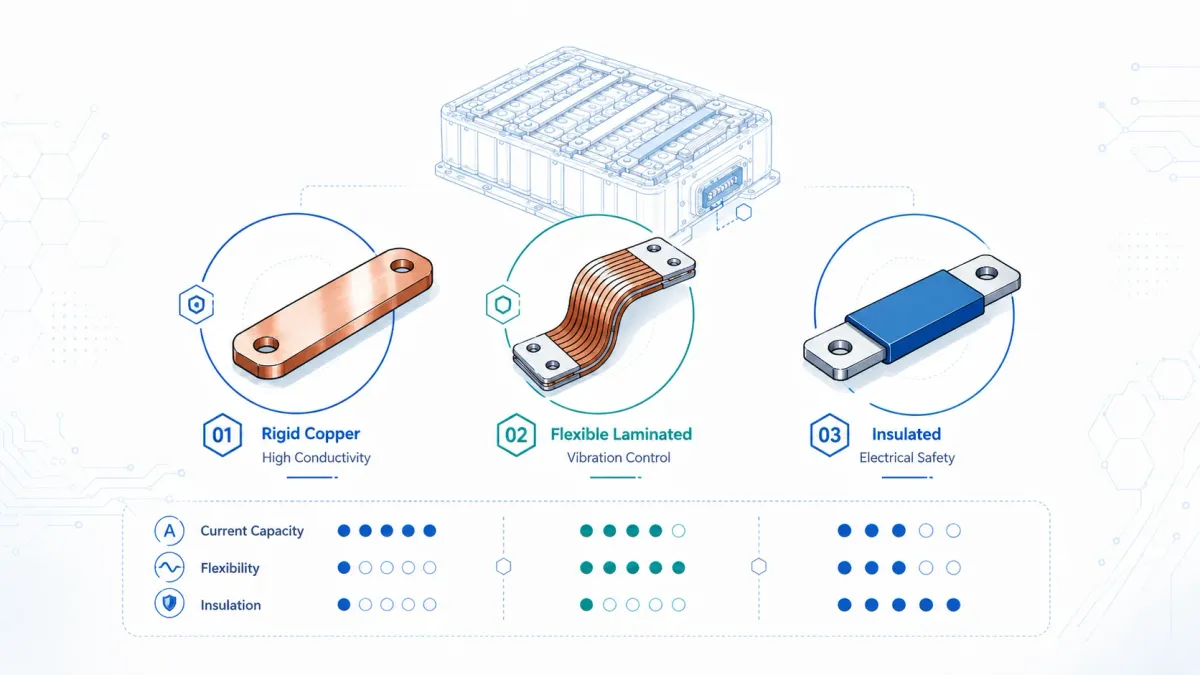
- Rigid battery bus bars – solid copper bars or plates that are cut, punched and formed into a stable shape.
- Flexible laminated battery bus bars – stacks of thin copper foils bonded or welded at the terminals while remaining flexible between the ends.
- Braided battery bus bars – woven copper wire conductors with compressed, welded or otherwise finished terminals.
- Insulated battery bus bars – rigid, laminated or braided copper bus bars with heat-shrink tubing, dipped PVC, epoxy powder coating, PA12 nylon, PET, polyimide, silicone or another insulation system.
- Hybrid bus bar assemblies – combinations of rigid sections, flexible zones, plated contact pads, sensing features, mounting hardware or protective layers.
In a low-current consumer product, a wire harness may be enough. In a high-current battery pack, a bus bar is often preferred because it provides a lower-profile connection, better geometric repeatability, larger contact area, more predictable heat dissipation and easier robotic or fixture-based assembly. For a deeper comparison between bus bars and cables in power distribution, JUMAI has also published a related guide on rigid busbar vs. cable selection.
Useful Industry Data for Battery Bus Bar Planning
The following table collects planning-level data points that can be used to support a business-oriented battery bus bar article. These values should not replace final engineering validation, but they help OEM buyers understand why material choice, temperature rise, insulation and documentation matter.
| Data point | Public source | Why it matters for battery bus bars |
|---|---|---|
| EV battery demand is expected to grow from about 1 TWh in 2024 to more than 3 TWh in 2030 under the IEA STEPS scenario. | IEA Global EV Outlook 2025 | Higher battery deployment creates higher demand for repeatable, safe and scalable interconnect components. |
| C11000 copper is listed by the Copper Development Association as high-conductivity copper with minimum 100% IACS conductivity in the annealed condition and 99.90% minimum copper content. | Copper.org C11000 alloy data | Conductivity is a key reason copper is selected for compact, high-current battery bus bars. |
| ASTM B187/B187M establishes requirements for copper conductor bars, rods and shapes for electrical bus applications, including dimensional, mechanical, electrical resistivity and chemical composition requirements. | ASTM B187/B187M | OEM drawings often reference recognized material standards to reduce ambiguity between buyer and supplier. |
| IEC 60664-1 deals with insulation coordination up to AC 1000 V or DC 1500 V in low-voltage supply systems and provides requirements for clearances, creepage distances and solid insulation. | IEC 60664-1:2020+AMD1:2025 | Battery bus bar insulation is not cosmetic; spacing and solid insulation must match voltage, pollution degree and system design. |
| ISO 16750-3:2023 applies to electric and electronic systems and components for vehicles, including electric propulsion systems, and describes mechanical loads. | ISO 16750-3:2023 | EV battery interconnects must be designed with vibration and mechanical stress in mind, especially for module and pack assemblies. |
| UL 9540 covers energy storage systems and references related safety standards such as UL 1973 for stationary batteries. | UL Solutions ESS certification | BESS projects may require material traceability, insulation documentation and component information that supports system certification. |
For an OEM purchasing team, the lesson is clear: battery bus bars should be purchased as engineered parts, not as generic metal strips. The drawing should define the material, thickness, surface finish, insulation system, contact area, hole quality, bend tolerance and inspection requirements. If the drawing is incomplete, the RFQ should at least describe the battery system environment so the supplier can identify risks before production.
Copper Battery Bus Bars: Why Copper Remains the Preferred Choice
Copper is widely used in battery bus bars because it combines high electrical conductivity, high thermal conductivity, good formability and stable performance in bolted or welded contact areas. The Copper Development Association lists C11000 as a high-conductivity copper with minimum 100% IACS conductivity in the annealed condition. In practical terms, this means copper can carry high current with lower resistance than many alternative metals, allowing a compact conductor to reduce voltage drop and heat generation.
For a battery system, this matters because the conductor is not only a path for current. It is also part of the thermal network. When current flows through a conductor, the heat generated by the conductor follows the familiar relationship P = I²R. If current doubles, resistive heating increases by four times, assuming resistance is unchanged. This is why small increases in contact resistance or conductor length can become serious in high-current packs.
Copper also provides useful mechanical characteristics for manufacturing. It can be punched, stamped, CNC bent, formed into complex 3D paths, plated, welded and insulated. JUMAI’s custom copper bus bar capability includes precision punching, multi-axis bending, plating, insulation and rapid prototype support, which is important when an OEM project moves from CAD to a physical sample.
However, copper is not magic. It must still be sized correctly. A thin copper strip may have excellent conductivity as a material but still be inadequate if the cross-sectional area is too small, the current path is too long, the ambient temperature is high, or the contact surface is poorly controlled. For this reason, a good RFQ should include working current, peak current, duty cycle, ambient temperature, allowable temperature rise, system voltage, airflow condition and mounting method whenever possible.
Copper vs. Aluminum for Battery Bus Bars
Aluminum bus bars are used in many electrical applications because aluminum is lighter and can be more cost-effective by weight. In some large battery systems, aluminum may be attractive when weight reduction is more important than compact size. Yet copper often remains preferred for OEM battery bus bars where space is limited, current density is high, contact resistance must be controlled, or the bus bar must be formed into a compact geometry.
A simplified comparison is shown below.
| Selection factor | Copper battery bus bar | Aluminum battery bus bar | Practical OEM comment |
|---|---|---|---|
| Electrical conductivity | Higher conductivity, often allowing smaller cross-section for the same resistance target. | Lower conductivity than copper, usually requiring more cross-sectional area. | Copper is useful when enclosure space is tight. |
| Thermal behavior | Excellent thermal conductivity helps spread heat. | Good thermal conductivity, but lower than copper. | Thermal design still depends on shape, airflow and contact quality. |
| Weight | Heavier by volume. | Lighter by volume. | Aluminum may help in weight-sensitive designs. |
| Contact stability | Good when plated and assembled with correct torque and surface control. | Requires careful surface preparation because aluminum oxide can affect contact. | Mixed copper-aluminum interfaces need special engineering. |
| Fabrication | Excellent for punching, bending, stamping, plating and welding processes. | Can also be fabricated, but alloy and surface condition matter. | Supplier process experience is critical for both materials. |
| Typical use case | Compact high-current packs, premium interconnects, flexible laminated conductors, high-reliability contacts. | Large bus structures, weight-sensitive systems, cost-driven layouts with enough space. | OEM teams should compare total system cost, not only raw material price. |
The decision should not be made only from commodity price. A lower raw material cost can be lost if the bus bar becomes larger, requires more complex joints, increases assembly risk or creates thermal issues. For many battery OEM projects, copper is selected because it gives engineers more design margin in a compact space.
Rigid Battery Bus Bars
A rigid battery bus bar is a solid conductive part made from copper sheet, plate or bar. It may be blanked, laser cut, CNC machined, punched, tapped, chamfered, deburred, bent, plated and insulated depending on the drawing. Rigid bus bars are common in battery modules, BESS cabinets, power distribution units, DC combiner sections and high-current industrial assemblies.
The main advantage of a rigid copper bus bar is repeatability. Once the geometry is correct, every part can position the connection points in the same place. This improves assembly speed and reduces wiring variation. A rigid bus bar can also provide mechanical support, predictable contact area and a clean installation appearance. In static or semi-static assemblies, rigid bus bars are often the most economical and robust solution.
Rigid bus bars are especially suitable when:
- The connected components are fixed and accurately located.
- The bus bar does not need to absorb significant movement.
- The enclosure provides enough space for the required bend radius.
- The pack or cabinet needs clean, repeatable, fixture-friendly assembly.
- The conductor also acts as a structural or positioning element.
- High current must be routed through a compact, low-profile path.
Rigid bus bars also have limitations. They are less forgiving when battery modules move during thermal cycling, when installation tolerances are wide, or when vibration can transfer stress into terminals. If a rigid part bridges two components that move differently, the bus bar can become a mechanical lever. That risk is one reason flexible battery bus bars are increasingly used in EV packs and modular energy storage systems.
For design guidance on when rigid or flexible structures are more suitable, see JUMAI’s article on rigid busbars vs. flexible busbars.
Flexible Laminated Battery Bus Bars
A flexible laminated battery bus bar is usually made from multiple layers of thin copper foil. The ends are bonded, press-welded, diffusion welded or otherwise consolidated to create solid contact zones, while the middle section remains flexible. This structure allows the conductor to carry high current while absorbing movement, installation tolerance and thermal expansion.
Flexible laminated copper bus bars are useful in EV battery modules, battery pack jumpers, energy storage racks, inverter connections and compact power electronics. They can be designed as flat flexible conductors, offset jumpers, S-shaped links, U-shaped links or custom 3D flexible connectors. Compared with a wire cable, a laminated bus bar can provide a lower profile and more controlled routing. Compared with a rigid bar, it can reduce mechanical stress on terminals.
JUMAI’s article on flexible busbars for EV battery modules explains why flexible copper conductors are valuable in dynamic battery environments. In simple language, the flexible section acts like a controlled spring. It helps the electrical connection survive small relative movements that would otherwise be transferred into battery terminals, welds or threaded joints.
Flexible laminated bus bars are especially suitable when:
- Battery modules experience vibration or thermal expansion.
- The connection must bridge two parts with different tolerances.
- The conductor must fit into a narrow height envelope.
- The OEM wants lower inductance than a long looped cable path.
- The installation requires a defined bend zone.
- Contact ends need to remain solid while the middle section remains flexible.
The design risk is that flexibility must be engineered, not guessed. The copper foil thickness, number of layers, bend length, bend direction, terminal consolidation process and insulation coverage all affect fatigue life and current performance. A flexible bus bar should not be forced into a bend radius smaller than intended. The RFQ should therefore include installed position, movement direction, minimum bend radius and whether the part will be bent once during assembly or flexed repeatedly during service.
Braided Battery Bus Bars
A braided battery bus bar is made from many fine copper wires woven into a flexible conductor. The braid is usually connected to solid terminals through pressing, welding, soldering or other termination processes. Braided copper bus bars are useful when flexibility is required in multiple directions or when the connection must absorb vibration, shock or misalignment.
In battery systems, braided copper bus bars may be used for grounding paths, module jumpers, cabinet door bonding, moving interfaces, service links or vibration-heavy equipment. They can be bare copper, tinned copper or otherwise finished depending on corrosion and contact requirements. Tinned braided connectors are common when oxidation resistance and solderability are important.
Compared with laminated flexible bus bars, braided bus bars offer stronger multi-axis flexibility. Compared with cables, they may provide a wider contact surface and a flatter conductive path. However, braided structures can be harder to insulate uniformly, and the termination quality is critical. If the braid-to-terminal joint is poorly compressed or overheated during production, it may become a resistance point.
A braided battery bus bar should be selected when the movement pattern is complex, when the conductor needs to bend and twist, or when the application is closer to a flexible bonding strap than a flat module interconnect. For flat, space-limited battery module links, a laminated flexible copper bus bar may be easier to package and insulate.
Insulated Battery Bus Bars
Insulated battery bus bars are used when bare conductive copper would create unacceptable safety, spacing or contamination risks. Insulation can help prevent accidental contact, short circuits, tracking, abrasion and foreign-object bridging. In compact high-voltage battery packs, insulation is often one of the most important parts of the bus bar design.
Common insulation options include heat-shrink tubing, PVC dipping, epoxy powder coating, PA12 nylon coating, PET film, polyimide film, silicone sleeves and molded or overmolded insulation. Each option has a different balance of cost, thickness control, dielectric strength, abrasion resistance, temperature performance, edge coverage, masking accuracy and suitability for complex geometry.
IEC 60664-1 provides a framework for insulation coordination, including clearances, creepage distances and solid insulation for equipment up to AC 1000 V or DC 1500 V in low-voltage supply systems. The exact spacing requirements depend on voltage, pollution degree, material group, altitude and application standards. A bus bar supplier should not replace the system designer’s compliance responsibility, but it should understand that coating thickness, edge radius and exposed copper areas are safety-critical details.
A practical insulation comparison is shown below.
| Insulation option | Advantages | Limitations | Typical battery bus bar use |
|---|---|---|---|
| Heat-shrink tubing | Fast, economical, good for straight or simple shapes. | Limited coverage around complex bends and terminals; cut ends must be controlled. | Simple rigid links, service parts, low to medium complexity jumpers. |
| PVC dipping | Can cover complex shapes and provide thick visible insulation. | Thickness control and masking may be less precise than film or powder processes. | Custom rigid bars, complex profiles, visible protective coating. |
| Epoxy powder coating | Strong dielectric layer, good adhesion and abrasion resistance when process is controlled. | Requires edge preparation, masking and curing control. | High-voltage rigid or laminated bus bars, compact battery packs. |
| PA12 nylon coating | Tough, abrasion-resistant and useful for demanding environments. | Requires compatible process and geometry; cost may be higher. | EV battery and power electronics bus bars needing robust insulation. |
| PET or polyimide film | Thin, controlled insulation, suitable for laminated structures. | Requires careful lamination and edge design. | Laminated bus bars, compact multilayer conductive assemblies. |
| Silicone sleeve or coating | Flexible and temperature-resistant. | May be bulkier or less precise depending on design. | Flexible connections, serviceable areas, thermal cycling environments. |
The biggest insulation mistake is treating coating as an afterthought. Sharp copper edges can cut or thin the coating. Holes may need masking so that contact surfaces remain conductive. Bend zones may crack if the insulation process is not matched to the formed geometry. Exposed copper may be necessary at terminals but dangerous if it is left too close to another conductor. For this reason, the RFQ should clearly show which areas must be insulated, which areas must remain bare or plated, and which edges require rounding before coating.
Plating and Surface Finish Options
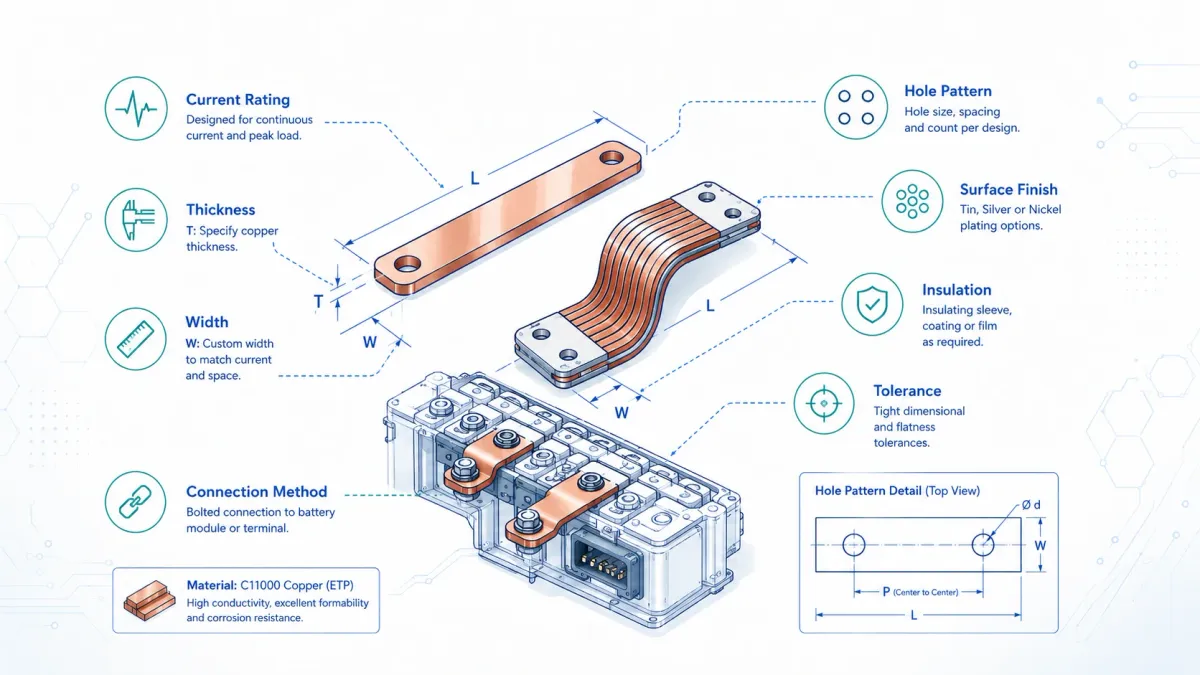
Copper oxidizes over time. In some applications this oxidation is manageable, but in high-current bolted joints or harsh environments, surface finish becomes important. Battery bus bars may be supplied as bare copper, tinned copper, nickel-plated copper, silver-plated copper or with selective plating only at contact areas.
Tin plating is common because it provides general oxidation resistance and reasonable contact performance at a practical cost. Nickel plating is often selected for higher temperature or harsher corrosion environments, but it has different contact behavior and should be specified carefully. Silver plating provides excellent conductivity and contact performance, but it is more expensive and usually used selectively where the benefit justifies the cost.
| Surface finish | Main benefit | Common concern | Typical OEM use |
|---|---|---|---|
| Bare copper | Lowest processing cost, excellent base conductivity. | Oxidation and appearance change; contact stability depends on environment. | Internal prototypes, controlled environments, welded connections. |
| Tin plating | Good general anti-oxidation protection and widely used contact finish. | Whisker risk and temperature limits should be reviewed for critical projects. | Battery module links, power distribution connections, BESS cabinets. |
| Nickel plating | Better high-temperature and corrosion resistance than tin in some environments. | Higher contact resistance than silver; process control matters. | Harsh environments, high-temperature zones, corrosion-sensitive assemblies. |
| Silver plating | Excellent contact performance and high conductivity at interfaces. | Higher cost; tarnish appearance may occur. | Premium contact pads, high-current bolted joints, critical low-resistance interfaces. |
| Selective plating | Reduces cost by plating only functional areas. | Requires precise masking and process control. | Large bus bars with defined contact pads and insulated sections. |
For OEM drawings, the plating specification should include coating material, thickness range, plated area, masking requirements, adhesion requirement, salt spray or corrosion test expectation if relevant, and whether the bus bar will be welded after plating. A supplier cannot quote accurately if the drawing simply says “surface treatment required” without defining the finish.
Electrical Design: Resistance, Voltage Drop and Heating
Battery bus bar electrical design starts with current, voltage drop and temperature rise. The simplified resistance of a straight conductor is:
R = ρ x L / A
Where R is resistance, ρ is the resistivity of the material, L is conductor length and A is cross-sectional area. In real bus bars, bends, holes, narrowed sections, contact joints, plating, temperature and current distribution complicate the calculation. However, the basic relationship is still useful: longer current paths increase resistance, and larger cross-sectional areas reduce resistance.
Voltage drop is calculated as:
Vdrop = I x R
Power loss is calculated as:
P = I² x R
These equations explain why current rating must be handled carefully. At 100 A, a small resistance may create manageable heat. At 500 A, the same resistance creates 25 times more heat because heating follows the square of current.
The following simplified example compares three copper bus bars with the same length but different cross-sections. The values are illustrative only and do not include contact resistance, bends, holes, temperature coefficient or cooling condition.
| Example copper section | Relative resistance | Voltage drop at same current | Heating at same current | Practical meaning |
|---|---|---|---|---|
| 20 mm x 1 mm | Highest | Highest | Highest | May be too thin for high-current continuous duty. |
| 20 mm x 2 mm | About half of 20 x 1 | Lower | Lower | Better thermal margin if space allows. |
| 30 mm x 2 mm | About one-third of 20 x 1 | Much lower | Much lower | More suitable for high current but requires wider package space. |
This is why bus bar drawings often evolve during prototype review. The first CAD model may fit the space, but thermal testing may show that the width, thickness or contact area needs to increase. JUMAI’s copper busbar ampacity calculation guide discusses ampacity thinking in more detail. The correct current rating depends on bus bar geometry, copper grade, ambient temperature, enclosure ventilation, adjacent heat sources, insulation, allowable temperature rise and test method.
For business communication, it is better to avoid claiming a universal ampacity for a copper strip. A 30 mm x 3 mm copper bus bar does not have one fixed current rating in every application. It may perform differently in open air, inside a sealed plastic battery case, under forced airflow, near hot cells, or with thick insulation that slows heat dissipation. Responsible suppliers ask for the use condition because the same copper size can behave very differently in different assemblies.
Mechanical Design: Vibration, Tolerance and Thermal Expansion
Battery systems are mechanical environments as much as electrical systems. EV battery packs face road vibration, shock, temperature cycles and installation tolerance. Stationary BESS cabinets face thermal cycling, transport vibration, field installation variation and long service life expectations. Data center backup battery systems face compact installation, service access and strict uptime expectations.
ISO 16750-3:2023 is relevant because it describes mechanical loads for electric and electronic systems and components in road vehicles, including electric propulsion systems and components with maximum working voltages according to voltage class B. While not every battery bus bar is itself certified to ISO 16750-3, automotive OEMs and Tier suppliers often design with those mechanical stress categories in mind.
A rigid bus bar can work very well when both ends are fixed to stable components. But if one end moves relative to the other, the rigid bar can push or pull on the terminal. This can cause loosening, fatigue or damage over many cycles. Flexible laminated or braided bus bars reduce that risk by absorbing movement.
OEM engineers should consider:
- Is the bus bar connecting two modules, or a module and a fixed enclosure?
- Will the connected parts expand at different rates during heating?
- Is there a tolerance stack-up between holes, studs, module positions or fixture points?
- Will the bus bar be bent during installation?
- Is the flexible section expected to move repeatedly during operation?
- Are there sharp edges or unsupported spans that could vibrate?
- Is the bus bar loaded by cable pull, technician handling or service movement?
A manufacturable design often includes enough clearance, proper bend radius, rounded edges, stable contact surfaces, defined torque zones and flexible sections only where needed. Over-flexibility can also be a problem. A bus bar that moves too much may rub against insulation, loosen hardware or complicate assembly. The goal is controlled compliance, not uncontrolled softness.
Thermal Design: From Copper Size to System Heat Flow
The thermal behavior of a battery bus bar depends on both heat generation and heat removal. Heat generation comes from conductor resistance and contact resistance. Heat removal depends on copper surface area, airflow, enclosure material, nearby components, insulation thickness, mounting points and thermal paths into terminals or structures.
Copper’s high thermal conductivity helps spread heat, but insulation can reduce heat dissipation from the surface. This creates a tradeoff. Insulation improves electrical safety, but a thick or low-conductivity coating may increase the operating temperature if the bus bar is already near its thermal limit. That does not mean insulation should be avoided; it means thermal design and safety design must be evaluated together.
Key thermal questions include:
- What is the continuous current and peak current?
- How long does the peak current last?
- What temperature rise is acceptable above ambient?
- Is the battery enclosure sealed or ventilated?
- Are cells, contactors, fuses or power electronics nearby?
- Does the insulation cover the full length or only selected areas?
- Are contact pads large enough to avoid local heating?
- Will the bus bar be tested under worst-case ambient temperature?
In early RFQ discussions, buyers often provide only a current value. That is not enough. A battery bus bar carrying 300 A for 10 seconds in open air is very different from a bus bar carrying 300 A continuously inside a sealed cabinet at elevated ambient temperature. JUMAI can manufacture the part according to drawing, but the system designer should validate current rating through calculation, simulation and physical temperature-rise testing.
Battery Bus Bar Selection Matrix
The following selection matrix helps OEM teams choose an initial bus bar direction before detailed engineering review.
| Application condition | Recommended option | Reason |
|---|---|---|
| Fixed module-to-module connection with accurate alignment | Rigid copper bus bar | Simple, repeatable, cost-effective and easy to inspect. |
| Connection between modules with vibration or tolerance variation | Laminated flexible copper bus bar | Absorbs movement while keeping defined contact ends. |
| Door bonding, grounding, moving interface or multi-axis vibration | Braided copper bus bar | Excellent flexibility in multiple directions. |
| High-voltage compact pack with limited spacing | Insulated copper bus bar | Helps reduce short-circuit and accidental contact risk. |
| High-current bolted interface | Copper bus bar with controlled plating and flat contact pads | Reduces contact instability and supports repeatable torque assembly. |
| Harsh or humid environment | Tinned or nickel-plated copper bus bar with suitable insulation | Improves oxidation and corrosion resistance. |
| Prototype with uncertain geometry | Rapid prototype rigid or flexible sample | Allows fit, assembly and thermal validation before tooling or batch production. |
| Production program with repeat orders | Fully specified drawing with material, plating, insulation and inspection plan | Reduces variation and improves supply chain communication. |
This matrix is a starting point. The final design may combine options. For example, an EV battery pack may use rigid copper bus bars inside a stable module, laminated flexible bus bars between modules, braided grounding straps for enclosure bonding and epoxy-coated bus bars near high-voltage distribution zones.
Manufacturing Process for Custom Battery Bus Bars
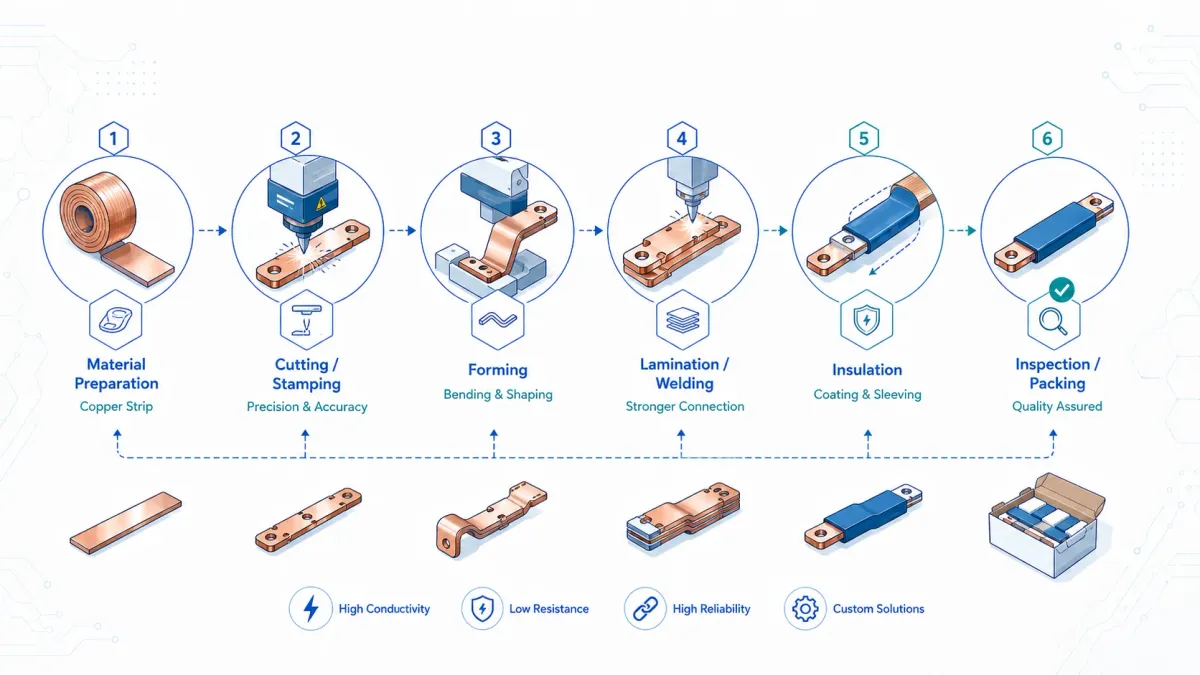
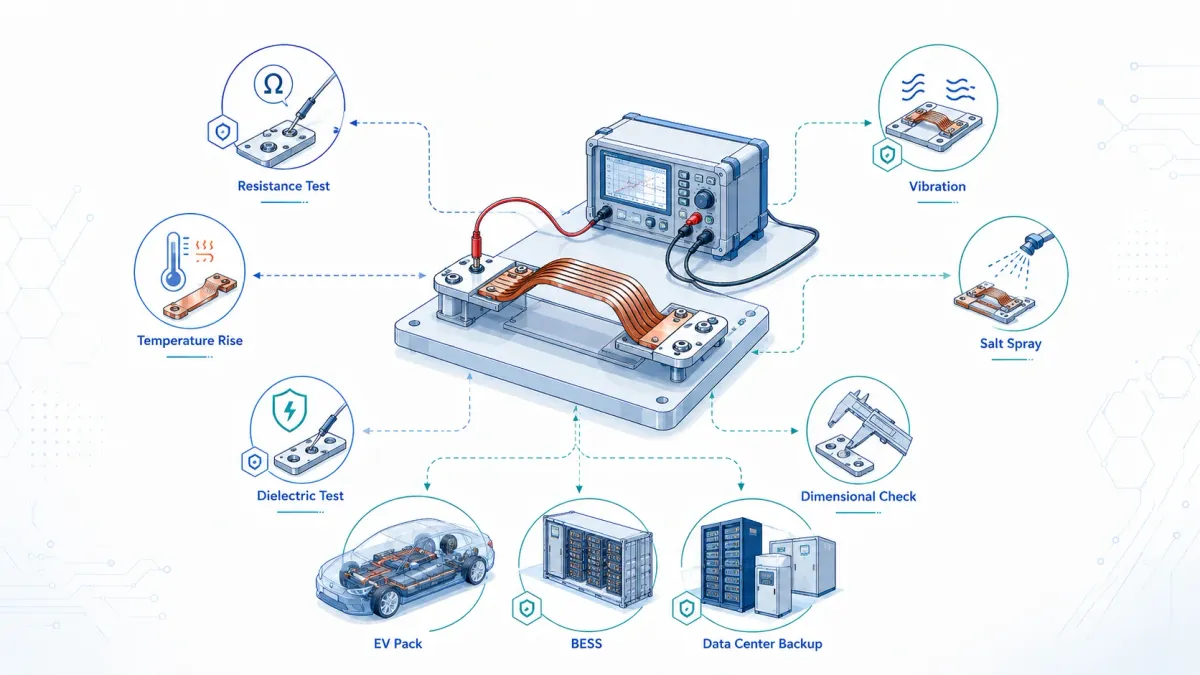
A custom battery bus bar normally moves through several manufacturing steps. The exact process depends on whether the part is rigid, laminated flexible or braided. However, the typical workflow includes drawing review, material selection, cutting or blanking, punching, forming, deburring, cleaning, welding or pressing if needed, plating, insulation, inspection and packaging.
Drawing Review and DFM
The first step is design for manufacturability. A supplier reviews the 2D drawing, 3D model, material requirement, thickness, bend lines, hole sizes, tolerances, plating and insulation zones. For battery projects, DFM also checks whether the design creates coating risks, burr risks, impossible bends or contact areas that are too close to insulation.
A good DFM review may recommend:
- Increasing bend radius to reduce cracking risk.
- Adding edge radius before coating.
- Adjusting hole tolerance to match assembly hardware.
- Separating conductive contact zones from insulation zones.
- Changing a rigid design to a flexible design where movement is expected.
- Using selective plating to reduce cost.
- Adding inspection dimensions that are actually measurable.
Cutting, Punching and Forming
Rigid bus bars are typically cut from copper sheet or bar, then punched or machined. Holes may be round, slotted, countersunk, tapped or designed for studs. Bends may be simple 90-degree bends or complex multi-axis forms. The forming process must account for copper thickness, grain direction, bend radius, springback and surface quality.
For laminated flexible bus bars, thin copper foils are stacked and consolidated at the ends. The flexible section must remain free enough to bend while the terminal section becomes stable enough for bolting or welding. JUMAI’s diffusion bonded flexible busbar guide explains one approach to creating stable terminal areas in multi-layer copper structures.
Deburring and Edge Preparation
Deburring is critical for battery bus bars. A sharp burr can damage insulation, reduce clearance, create assembly injury risk or become a source of electrical stress concentration. For coated bus bars, edge radius is especially important because coatings tend to thin at sharp corners. A beautiful coating on a flat surface is not enough if the edge coverage fails.
OEM drawings should define burr limits, edge break requirements and critical contact surface requirements. If the part is insulated, the edge preparation should be discussed before the coating process is selected.
Plating and Cleaning
Before plating, copper surfaces must be cleaned properly. Oil, oxide, fingerprints or residue can affect adhesion and contact quality. Plating may be full-surface or selective. If the part will later receive insulation, the process sequence matters. Some projects require plating first and insulation later; others require masking to keep contact pads exposed.
Insulation and Masking
Insulation requires precise masking. Contact surfaces, threaded holes, welding areas and grounding points may need to remain conductive. If coating enters these areas, assembly may fail or contact resistance may increase. If masking is too large, exposed copper may reduce safety spacing. Therefore, the drawing should show insulation boundaries clearly.
Inspection and Documentation
Battery OEMs usually need more than dimensional inspection. Depending on the project, inspection may include material certificate review, plating thickness, coating thickness, adhesion, dielectric test, continuity test, visual inspection, hole position, flatness, bend angle, burr check, packaging condition and traceability. For certification-driven BESS projects, documentation can be as important as the part itself.
OEM RFQ Checklist for Battery Bus Bars
A complete RFQ reduces quotation time and prevents repeated clarification. The following checklist can be copied into an OEM sourcing template.
| RFQ item | What to provide | Why it matters |
|---|---|---|
| 2D drawing | PDF with dimensions, tolerances, material, finish and notes. | Defines the commercial and inspection baseline. |
| 3D model | STEP, IGES or other neutral CAD file. | Helps review bends, fit and complex geometry. |
| Copper grade | T2, C11000, C10200 or project standard. | Affects conductivity, cost, availability and welding behavior. |
| Thickness and width | Nominal values plus tolerance. | Determines resistance, forming feasibility and thermal margin. |
| Current requirement | Continuous current, peak current, duty cycle. | Needed for thermal and electrical review. |
| Voltage class | Nominal and maximum working voltage. | Affects insulation and spacing discussion. |
| Environment | EV, BESS, data center, industrial, marine or other. | Helps assess vibration, corrosion, temperature and certification needs. |
| Insulation area | Drawing layer or marked PDF showing coated and bare areas. | Prevents contact masking errors. |
| Plating requirement | Tin, nickel, silver, bare copper or selective plating. | Affects cost, contact performance and corrosion resistance. |
| Assembly method | Bolting, welding, riveting, clamping or press-fit. | Contact surface and hole design depend on assembly method. |
| Hardware | Stud size, bolt size, washer type, torque if known. | Contact pressure affects resistance and reliability. |
| Quantity | Prototype, pilot batch and annual volume. | Determines process route and pricing model. |
| Inspection needs | FAI, PPAP, material certificate, dielectric test, plating report. | Aligns supplier documentation with OEM quality requirements. |
| Packaging | Anti-scratch, anti-oxidation, separated layers, labels. | Prevents damage to plating and insulation during shipment. |
If the project is still in early design, the RFQ can include open questions. For example: “We are considering a rigid copper bus bar, but the modules may move during thermal cycling. Please review whether a flexible laminated bus bar is safer.” This allows JUMAI to provide engineering feedback rather than simply quoting a risky drawing.
Common Battery Bus Bar Design Mistakes
Battery bus bars fail most often because small practical details are ignored. The following issues are common in early OEM drawings.
Underspecified Current Conditions
A drawing may say “300 A bus bar” without defining continuous current, peak current, duty cycle, ambient temperature, cooling condition or allowable temperature rise. This is not enough for responsible design. Current rating is a system result, not a single material property.
Contact Area Too Small
A copper bar may have enough cross-sectional area, but the bolted contact area may still be too small or uneven. Poor contact flatness, low torque, surface contamination or coating residue can increase contact resistance and create hot spots.
Sharp Edges Under Insulation
Sharp edges can cut into heat-shrink tubing or thin out powder coating. In high-voltage packs, this can become a long-term insulation risk. Edge radius should be designed before coating is selected.
Rigid Bar Used Across Moving Parts
A rigid bar connecting two parts that move differently may transfer mechanical stress to terminals. A flexible laminated or braided bus bar may be safer.
Plating Not Matched to Environment
Bare copper may be acceptable in some controlled internal locations but risky in humid, corrosive or service-exposed areas. Tin, nickel or silver plating should be selected based on contact needs, temperature, corrosion risk and cost.
Insulation Boundary Not Defined
If the drawing does not show where insulation starts and stops, the supplier may make assumptions. Those assumptions can cause exposed copper, blocked contact areas or inconsistent coating edges.
Prototype Geometry Treated as Production Geometry
A hand-adjusted prototype can hide tolerance problems. Production parts must fit without manual bending, grinding or forcing. OEM teams should use prototype testing to finalize dimensions before volume release.
Battery Bus Bars for EV Projects
EV battery packs are among the most demanding applications for battery bus bars. They combine high current, high voltage, vibration, thermal cycling, weight pressure, compact packaging and production repeatability. The bus bar must survive the vehicle environment while supporting efficient assembly.
In EV packs, copper bus bars may connect cells, modules, contactors, fuses, current sensors and power distribution units. Rigid bus bars are useful inside stable subassemblies. Flexible laminated bus bars are useful between modules or between a module and a pack-level component. Braided straps may be used for grounding, bonding or areas that require multi-axis flexibility.
As pack voltage increases, insulation becomes more important. Compact 400 V and 800 V architectures reduce packaging space while raising the consequences of insulation mistakes. IEC 60664-1 and automotive standards do not turn a bus bar supplier into the system certifier, but they do show why creepage, clearance and solid insulation must be treated as engineering parameters. For high-voltage EV applications, exposed copper, coating thickness, edge radius and terminal spacing should all be reviewed carefully.
A useful EV design approach is to separate the bus bar system into zones:
- Cell-level and module-level interconnects.
- Module-to-module jumpers.
- Pack power distribution bus bars.
- High-voltage service disconnect or fuse connections.
- Grounding and bonding straps.
- Sensor or current measurement interfaces.
Each zone may need a different structure. A single battery pack may use several bus bar types rather than one universal design.
Battery Bus Bars for BESS and Renewable Energy Storage
Battery energy storage systems have different priorities from EV packs. Weight may be less critical, but service life, safety, field installation, corrosion resistance, certification documentation and cabinet-level thermal performance are very important. BESS bus bars may connect battery racks, power conversion systems, DC disconnects, fuses, contactors and cabinet-level distribution points.
UL Solutions explains that UL 9540 covers energy storage systems and equipment, including electrical, electrochemical, mechanical and other energy storage technologies, and references related standards such as UL 1973 for batteries used in stationary applications. This does not mean a copper bus bar alone is “UL 9540 certified.” Instead, it means the complete ESS certification process may require the system integrator to document materials, insulation, spacing, enclosure design and safety behavior. Supplying clean drawings, traceable material and consistent insulation helps the OEM or integrator prepare for that process.
For BESS projects, practical bus bar requirements often include:
- Tin plating for stable contact and oxidation resistance.
- Insulation for high-voltage cabinet safety.
- Clear labels or color coding for polarity.
- Large contact pads for bolted field connections.
- Packaging that protects plating during shipment.
- Repeatable hole positions for cabinet assembly.
- Documentation for material and finish.
JUMAI’s article on flexible copper busbars for EV batteries, BESS and power distribution is a useful internal resource for readers comparing these application areas.
Battery Bus Bars for Data Centers and High-Current DC Power
Data centers are power-dense environments. Even when the battery system is not inside the server rack, backup power, UPS systems, DC distribution, battery cabinets and power conversion equipment require reliable high-current conductors. Bus bars can reduce wiring complexity, improve service organization and support repeatable cabinet manufacturing.
Data center projects usually value uptime, neat routing, thermal stability and maintainability. A bus bar that is easy to inspect, torque, replace and document can reduce service risk. Insulation and touch protection are also important because technicians may work in crowded electrical spaces.
For data center backup battery systems, copper bus bars may be used in:
- Battery cabinets and strings.
- UPS DC links.
- Power distribution panels.
- Switchgear connections.
- Rack-level or cabinet-level power assemblies.
- Grounding and bonding conductors.
The selection between rigid and flexible bus bars depends on whether the connection is fixed, serviceable or exposed to movement. Rigid copper bus bars are common in cabinets. Flexible laminated or braided links may be used where tolerances, door movement, removable modules or vibration isolation require compliance.
How JUMAI Supports OEM Battery Bus Bar Projects
JUMAI is positioned for OEM customers who need custom conductive copper parts rather than catalog-only components. The company manufactures custom copper busbars including hard/rigid bus bars, soft/braided bus bars and laminated flexible bus bars. JUMAI also supports surface finishes such as tin, nickel and silver plating, along with insulation options such as heat shrink, PVC dipping and epoxy powder coating.
For battery bus bar projects, JUMAI can support:
- Drawing review and manufacturability feedback.
- Rigid copper bus bar punching, bending and machining.
- Laminated flexible copper bus bar production.
- Braided copper bus bar terminal processing.
- Tin, nickel, silver or bare copper finish options.
- Heat-shrink, PVC dipped, epoxy coated and other insulated options.
- Prototype samples before mass production.
- Inspection and packaging according to project needs.
- Related precision stamped or deep drawn components when the project requires more than bus bars.
This broader capability is useful for OEM programs because battery systems rarely need only one metal part. A battery module may need bus bars, brackets, shields, stamped terminals, deep drawn covers, small conductive plates and custom fixtures. A supplier with copper bus bar and precision metal manufacturing experience can help reduce communication gaps between electrical design and production reality.
Sample Specification Framework for a Battery Bus Bar Drawing
The following framework can help OEM teams write a clearer drawing note. It should be adapted to the project’s internal standards and final engineering requirements.
Part name: Battery positive bus bar / Battery module jumper / DC link bus bar
Material: C11000 copper or T2 copper, thickness X mm, hardness/temper per drawing
Surface finish: Tin plating X micrometers on all surfaces, or selective plating on marked contact areas
Insulation: Epoxy powder coating / heat-shrink tubing / PA12 coating / other, color orange or black as specified, coating thickness X to Y mm, no coating on contact pads
Critical dimensions: Hole diameter, center distance, bend angle, flatness at contact pads, overall installed height
Edge condition: Deburr all edges, no sharp burrs, edge radius or edge break as specified before coating
Electrical requirement: Continuous current X A, peak current X A for X seconds, maximum allowable temperature rise X degrees C under system test conditions
Inspection: First article inspection, plating thickness report, coating visual inspection, continuity test, dielectric test if required
Packaging: Each part separated to protect plating and insulation, batch label with part number, revision and quantity
This framework helps the supplier understand what matters. It also helps purchasing teams compare quotations fairly. If one supplier quotes bare copper while another quotes tinned and insulated copper with inspection reports, the prices are not directly comparable.
How to Compare Supplier Quotations
Battery bus bar quotations should be compared beyond unit price. A low price may hide missing process steps, weak documentation or unrealistic assumptions. OEM buyers should compare:
- Material grade and thickness.
- Copper price basis and scrap handling.
- Tooling or fixture cost.
- Cutting, punching and forming process.
- Plating type and thickness.
- Insulation process and masking scope.
- Prototype lead time and production lead time.
- Inspection items included in the quote.
- Packaging method.
- Revision control and drawing responsibility.
- Supplier experience with EV, BESS or high-current assemblies.
A supplier that asks detailed questions is not necessarily making the process slower. It may be preventing a production problem. For example, if a drawing shows insulation but does not define bare contact pads, the supplier should ask. If a rigid bus bar bridges two moving battery modules, the supplier should flag the mechanical risk. If a bend is too close to a plated contact area, the supplier should review process sequence.
From Prototype to Production
Many battery bus bar projects begin with prototypes. At this stage, the OEM may still be adjusting module layout, terminal positions, current rating, thermal design and enclosure clearance. Prototype parts should be used to test fit, assembly torque, contact area, thermal behavior, insulation coverage and service access.
After prototype validation, the design should be frozen into a controlled drawing revision. Production release should not depend on informal notes such as “same as sample.” Samples are useful, but drawings control repeatability. The production drawing should include all critical features discovered during prototype testing.
A practical development sequence is:
- Share concept drawing, 3D model and application data.
- Review material, thickness, bus bar type, finish and insulation.
- Produce prototype samples.
- Test fit, torque, voltage drop and temperature rise.
- Check insulation, spacing and service access.
- Update drawing based on findings.
- Confirm inspection plan and packaging.
- Release pilot batch.
- Validate production assembly.
- Move to stable repeat production.
This sequence may seem longer than simply ordering metal parts. In reality, it reduces delays because it catches issues before volume production. For battery systems, a small bus bar mistake can stop an entire pack assembly line.
Frequently Asked Questions
What is the best material for battery bus bars?
Copper is often the preferred material for compact high-current battery bus bars because it has high electrical and thermal conductivity. C11000 and T2 copper are common choices. Aluminum can be used when weight and cost are priorities, but it usually requires a larger cross-section for similar resistance and needs careful contact engineering.
Are flexible battery bus bars better than rigid bus bars?
Flexible bus bars are not automatically better. They are better when movement, vibration, thermal expansion or tolerance variation must be absorbed. Rigid bus bars are often better for stable, fixed connections where repeatability, low cost and simple inspection matter. Many battery systems use both.
When should a battery bus bar be insulated?
A battery bus bar should be insulated when bare copper would create short-circuit, accidental contact, tracking, contamination or spacing risks. High-voltage and compact battery systems often require insulation. The insulation design should account for voltage, temperature, abrasion, edge radius, coating thickness, masked contact zones and applicable system standards.
Can JUMAI manufacture custom battery bus bars from drawings?
Yes. JUMAI supports custom copper bus bar manufacturing from customer drawings, including rigid copper bus bars, laminated flexible copper bus bars, braided copper bus bars, plating and insulation. OEM customers can send 2D drawings and 3D files for review.
What information is needed for a battery bus bar RFQ?
A strong RFQ should include a 2D drawing, 3D model, material, thickness, finish, insulation zones, current requirement, voltage class, application environment, quantity, inspection requirements and packaging expectations. If some details are unknown, the buyer should describe the battery system and ask for manufacturability feedback.
Is a copper bus bar current rating universal?
No. Current rating depends on conductor geometry, ambient temperature, cooling condition, insulation, contact resistance, duty cycle and allowable temperature rise. The same copper size may perform differently in open air and inside a sealed battery enclosure. Final validation should include calculation and physical testing.
What plating is commonly used for battery bus bars?
Tin plating is widely used for general oxidation resistance and practical contact performance. Nickel plating may be used in harsher or higher-temperature environments. Silver plating is used for premium low-resistance contact areas where cost is justified. Bare copper may be acceptable in controlled conditions or welded connections.
Can one bus bar design work for EV, BESS and data center systems?
Sometimes the same manufacturing process can be used, but the design requirements are different. EV systems emphasize vibration, weight and compact high-voltage routing. BESS systems emphasize service life, safety documentation, cabinet assembly and certification support. Data center systems emphasize uptime, serviceability and thermal stability. The bus bar should be designed for the specific application.
Conclusion: Choose Battery Bus Bars as Engineered OEM Components
Battery bus bars look simple, but they influence electrical efficiency, heat generation, mechanical reliability, insulation safety, assembly speed and long-term service performance. For OEM projects, the right decision is not only copper vs. aluminum or rigid vs. flexible. The real decision is how to combine material, geometry, contact design, plating, insulation and manufacturing control into a part that performs reliably in the complete battery system.
Copper bus bars remain a strong choice because they provide high conductivity, compact current carrying capacity, good thermal spreading and versatile manufacturability. Rigid copper bus bars are excellent for stable connections. Laminated flexible copper bus bars are valuable when movement and tolerance must be absorbed. Braided copper bus bars are useful for multi-axis flexibility and bonding. Insulated bus bars are essential when voltage, spacing and touch protection require more than bare metal.
For OEM buyers, the best starting point is a complete RFQ package: drawing, model, current, voltage, environment, finish, insulation, quantity and inspection needs. For engineering teams, the best starting point is to identify the real operating condition: continuous current, peak current, temperature rise, vibration, thermal expansion, clearance, creepage and assembly method.
JUMAI supports OEM customers with custom battery bus bars, including copper rigid, flexible, braided and insulated options. If your project involves EV batteries, energy storage systems, DC power equipment, renewable energy hardware, data center power distribution or industrial high-current assemblies, you can start with JUMAI’s custom copper busbar manufacturing service or send your drawing through the project inquiry page. A well-designed battery bus bar is not just a conductor. It is a small component with a large influence on the safety, efficiency and manufacturability of the whole power system.