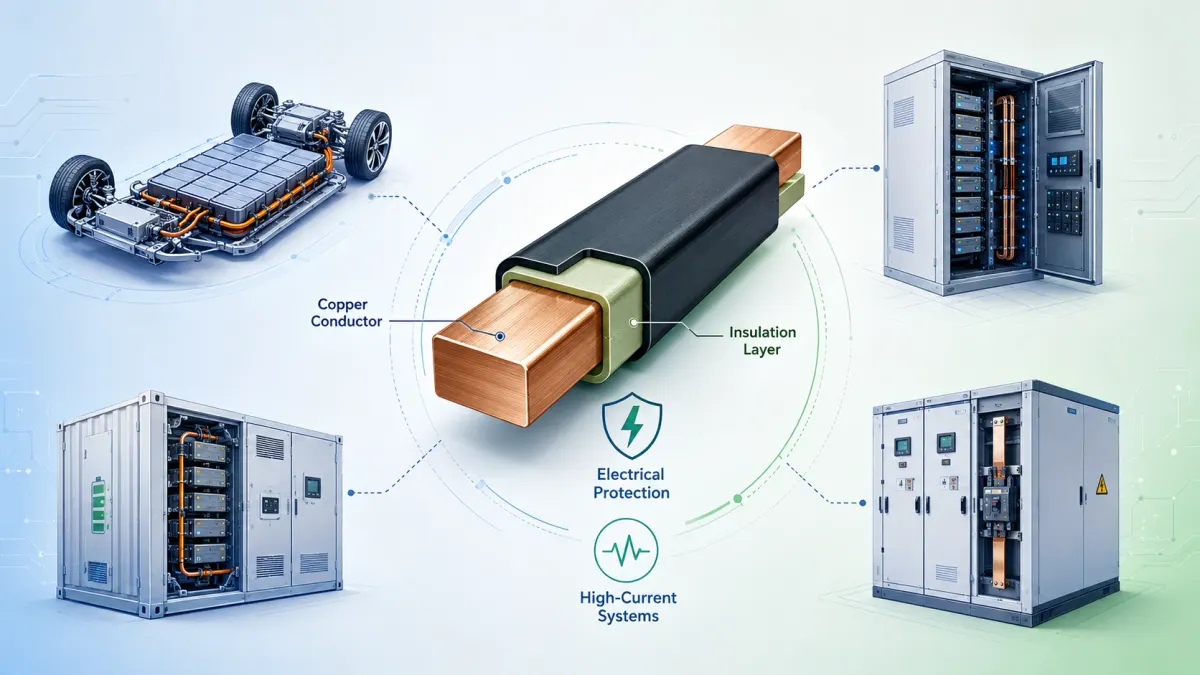
In a high-current electrical system, a copper busbar is not just a metal strip. It is a controlled power path that must carry current, release heat, fit into a limited space, survive vibration, and remain safe during years of operation. When the system voltage is low, the layout is open, and the busbar is well separated from other conductors, bare copper may be enough. But when the same copper conductor is installed inside an EV battery pack, a BESS cabinet, a compact inverter, a data center power distribution unit, a switchgear assembly, or a renewable energy converter, the situation changes. The buyer is no longer asking only whether the copper busbar can carry current. The more important question becomes: does this busbar need extra electrical protection?
That is where the insulated busbar becomes important. An insulated busbar is a copper or aluminum conductor with an added protective insulation layer, sleeve, coating, film, cover, or overmolded structure. In most high-performance applications, copper is preferred because of its excellent conductivity, predictable forming behavior, reliable bolted joints, and strong thermal performance. The Copper Development Association lists C11000 copper as a high-conductivity copper with 99.90% minimum copper content and, in the annealed condition, minimum conductivity of 100% IACS. That material basis is one reason copper busbars remain a common solution for high-current paths in demanding power assemblies. See the Copper Development Association’s C11000 alloy data for the material reference.
For buyers, engineers, sourcing teams, and project managers, insulation is often misunderstood. Some teams treat insulation as a cosmetic color layer. Some teams assume any heat shrink sleeve is enough. Others over-specify insulation and increase cost, size, lead time, and thermal resistance unnecessarily. A better approach is to define insulation as part of the busbar’s electrical, thermal, mechanical, environmental, and manufacturing design. That is the purpose of this guide.
JUMAI manufactures custom flexible copper busbars, rigid copper busbars, braided copper busbars, and related precision metal components for global customers. On the Custom Copper Busbars page, JUMAI describes its main product range as rigid, braided, and laminated flexible busbars manufactured for applications such as NEVs, renewable energy, and power distribution. This article explains when an insulated busbar is needed, how to compare insulation methods, what design details affect safety and cost, and what information a buyer should prepare before sending an RFQ.
- What an insulated busbar really does
- Why copper busbars need extra protection in modern power systems
- When an insulated busbar is usually required
- The standards logic behind insulation, creepage and clearance
- Electrical data that buyers should understand before choosing insulation
- Common insulation methods for copper busbars
- Insulation as part of the busbar geometry
- Extra electrical protection in EV battery packs
- Extra electrical protection in BESS cabinets and energy storage containers
- Extra electrical protection in data centers and high-density power distribution
- Extra electrical protection in switchgear, control panels and industrial equipment
- How insulation affects contact areas and plating
- Testing and inspection for insulated busbars
- How to choose the right insulation material
- Bare, sleeved, coated or laminated: a practical selection matrix
- RFQ checklist for insulated busbar buyers
- Cost factors in insulated busbar manufacturing
- Manufacturing steps JUMAI considers for insulated busbar projects
- Common mistakes buyers should avoid
- How to discuss an insulated busbar project with JUMAI
- Practical buyer examples
- Why insulated busbars support better commercial outcomes
- Final recommendations
- FAQ
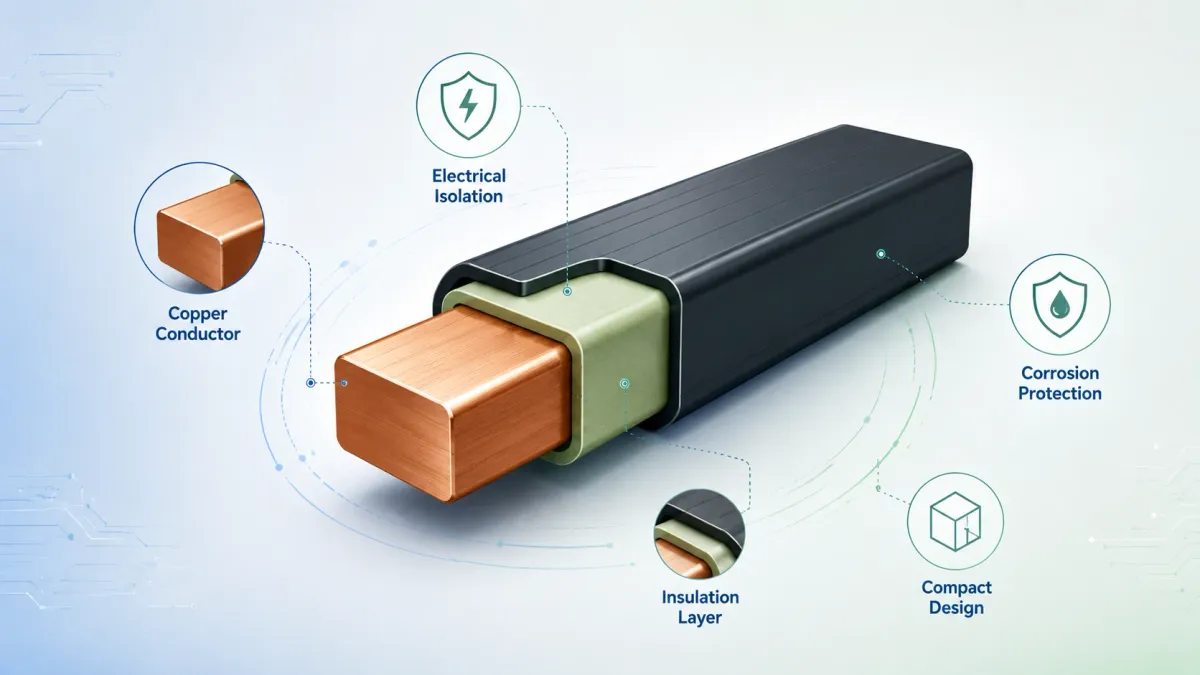
What an insulated busbar really does
An insulated busbar is a conductive busbar with additional protection between the live conductor and its surroundings. The insulation may be applied directly to the copper, wrapped around it, laminated between multiple copper layers, molded around it, or installed as a separate removable protective cover. The function is not limited to preventing accidental touch. In many real projects, busbar insulation solves several problems at the same time.
First, insulation reduces the probability of electrical contact between adjacent conductors, the enclosure, fasteners, tools, cooling plates, battery module cases, or other grounded metal parts. Second, it helps maintain dielectric performance in compact layouts where creepage and clearance distances are limited. Third, it can reduce the risk of flashover, tracking, carbonization, or surface leakage in humid, dusty, or polluted environments. Fourth, it can provide a visual warning function; for example, high-voltage EV systems often use orange-colored insulation as a practical identification convention. Fifth, insulation can improve assembly robustness by preventing abrasion between the busbar and nearby parts.
However, insulation is not a substitute for good conductor design. It does not correct an undersized copper cross-section, a poorly designed bend, a loose bolted joint, a sharp burr, or a layout with insufficient spacing under the required standard. In fact, insulation may make thermal design more difficult because it adds a layer between hot copper and ambient air. The buyer should think of the insulated busbar as a complete engineered part rather than a bare busbar with an afterthought coating.
The most practical definition is this: an insulated busbar is a current-carrying component where the conductor geometry and the insulation system are designed together to control electrical risk, heat rise, mechanical stress, assembly tolerance, and long-term reliability.
Why copper busbars need extra protection in modern power systems
The growth of EVs, battery storage, renewable power conversion, high-density data centers, and industrial electrification has changed the role of busbars. Older low-voltage distribution equipment often had more space, lower energy density, and simpler service conditions. Modern equipment is different. It must deliver more current in less space, often at higher voltage, while meeting stricter safety expectations.
The International Energy Agency reports that data centers consumed around 415 TWh of electricity in 2024, about 1.5% of global electricity consumption, and that data center electricity consumption had grown at about 12% per year over the previous five years. See the IEA’s page on energy demand from AI and data centres. High-density computing does not automatically mean every internal connection needs an insulated copper busbar, but it does increase the importance of compact, repeatable, safe power distribution. In racks, PDUs, UPS systems, battery cabinets, and power conversion equipment, insulation can help manufacturers package high-current conductors safely in a smaller envelope.
Battery energy storage is another major driver. The IEA’s Global Energy Review 2026 states that 108 GW of new battery storage capacity was deployed worldwide in 2025, 40% more than in 2024, and that installed battery storage capacity was eleven times higher than in 2021. See the IEA’s battery storage technology update. In BESS containers and cabinets, busbars are exposed to repeated cycling, high DC current, possible condensation, maintenance operations, and fault-energy concerns. The cost of a busbar insulation failure can be much higher than the price difference between a bare copper bar and a properly insulated assembly.
EV battery packs add even more complexity. ISO 6469-3 covers electrical safety requirements for voltage class B electric propulsion circuits and auxiliary circuits in electrically propelled road vehicles. The ISO page for ISO 6469-3 describes requirements for protection against electric shock and thermal incidents. In EV packs, insulated busbars are used not only because of voltage, but also because of vibration, module movement, thermal expansion, service safety, and compact pack architecture. JUMAI’s article on flexible copper busbars for EV batteries, BESS and power distribution explains why flexible copper busbars are practical in EV batteries, renewable energy systems, charging systems, and industrial high-current assemblies.
The lesson is simple: the more compact, powerful, and safety-critical the assembly becomes, the more carefully the insulation decision must be made.
When an insulated busbar is usually required
Not every copper busbar needs insulation. Many open busbar systems work safely with bare copper when spacing, guarding, enclosure design, and installation rules are properly managed. But there are clear situations where extra electrical protection is usually necessary or strongly recommended.
| Situation | Why bare copper may be risky | Typical insulation response | Buyer decision point |
|---|---|---|---|
| High voltage DC or AC circuits | Higher electric field stress increases shock and arc risk | Heat shrink, epoxy powder coating, fluidized bed coating, laminated insulation, molded cover | Confirm voltage class, insulation coordination standard, test voltage, and spacing |
| Compact conductor spacing | Adjacent phases or polarities are close to each other | Thin high-dielectric film, laminated structure, coating, barriers | Review creepage, clearance, assembly tolerance, and pollution degree |
| EV battery packs and e-mobility modules | Vibration, movement, service handling, and pack-level safety requirements | Orange insulation, flexible laminated busbar, PA/PET/PI sleeve, epoxy coating | Confirm voltage, vibration profile, bend area, exposed terminals, and service zones |
| BESS racks and cabinets | High DC current, repeated cycling, condensation risk, and maintenance exposure | Coated rigid busbar, insulated flexible connector, protective cover | Confirm cabinet environment, IP rating, thermal rise, and fault isolation strategy |
| Data center power distribution | Dense power architecture and limited maintenance space | Insulated rigid busbar, touch-safe covers, laminated busbar | Confirm rack/PDU layout, airflow, current, and service accessibility |
| Switchgear and control panels | Multiple phases, busbar supports, short-circuit forces, and maintenance operations | Sleeving, phase-color insulation, barriers, busbar boots | Confirm applicable IEC, UL, or local code requirements |
| Renewable energy inverters and combiner systems | Outdoor or semi-outdoor conditions, humidity, dust, heat cycling | UV-resistant sleeve, coating, molded protection, sealed covers | Confirm solar/wind environment, temperature range, and contamination risk |
| High-vibration machinery | Relative movement can damage bare copper or contact nearby metal | Braided insulated straps, flexible laminated busbar | Confirm vibration, movement range, fatigue requirement, and end-terminal design |
This table should not be used as a final engineering rule. Instead, it gives buyers a practical screening method. If the busbar is high-voltage, high-current, compact, exposed, serviceable, mobile, or installed in a harsh environment, insulation should be considered early in the design stage.
The standards logic behind insulation, creepage and clearance
A busbar buyer does not always need to be a standards expert, but they should understand the basic logic behind insulation requirements. Electrical protection usually depends on three related ideas: clearance, creepage, and solid insulation.
Clearance is the shortest distance through air between two conductive parts. Creepage is the shortest distance along the surface of an insulating material between two conductive parts. Solid insulation is the dielectric material between live conductors or between a live conductor and accessible metal. In a real insulated busbar, all three can matter. A coating may reduce the chance of accidental contact, but exposed cut edges, mounting holes, terminals, or stripped areas still require spacing control.
IEC 60664-1 is widely referenced for insulation coordination in low-voltage equipment. The IEC webstore page for IEC 60664-1:2020 states that it applies to equipment with rated voltage up to AC 1,000 V or DC 1,500 V connected to low-voltage supply systems, and that it provides requirements for determining clearances, creepage distances, and criteria for solid insulation. This is very relevant to many EV, BESS, inverter, data center, and industrial DC applications.
For low-voltage switchgear and controlgear assemblies, the IEC 61439 series is also important. The IECEE page for IEC 61439-6 describes definitions, service conditions, construction requirements, technical characteristics, and verification requirements for busbar trunking systems. Even when a custom busbar itself is only one component inside a larger assembly, the final panel, cabinet, or system manufacturer may need to verify the complete assembly under an applicable standard.
This is why a good custom busbar RFQ should not simply say “insulate this copper bar.” It should define rated voltage, working voltage, impulse withstand requirement if known, environmental condition, system standard, exposed areas, test requirement, and whether the busbar is part of a certified assembly. JUMAI can manufacture the custom insulated busbar, but the buyer or system integrator should identify the certification pathway and final assembly requirements.
Electrical data that buyers should understand before choosing insulation
Because copper is an excellent conductor, buyers sometimes focus only on cross-section and ignore heat. But busbar insulation changes heat transfer. A bare copper surface can lose heat by convection and radiation. A coated or sleeved busbar may release heat differently, depending on insulation thickness, material thermal conductivity, airflow, surface area, mounting, and enclosure temperature.
The Copper Development Association provides DC copper busbar ampacity guidance. That reference notes that the copper busbar basis is ETP-110 copper with 100% IACS conductivity per ASTM B187. Ampacity tables are useful, but actual designs still require derating and verification because busbar orientation, grouping, ambient temperature, enclosure ventilation, joint resistance, plating, and allowable temperature rise all matter.
The following simplified calculation table is not a replacement for ampacity design. It only shows why conductor size matters before insulation is added. The values use copper resistivity of approximately 0.01724 ohm-mm2/m at 20°C. Power loss is estimated by I²R for one meter of straight copper conductor, before considering temperature rise, joints, plating, enclosure effects, or insulation thermal resistance.
| Copper cross-section | Approx. resistance at 20°C | Loss at 500 A | Loss at 1,000 A | Loss at 1,500 A | Loss at 2,000 A |
|---|---|---|---|---|---|
| 100 mm² | 0.1724 mΩ/m | 43 W/m | 172 W/m | 388 W/m | 690 W/m |
| 150 mm² | 0.1149 mΩ/m | 29 W/m | 115 W/m | 259 W/m | 460 W/m |
| 200 mm² | 0.0862 mΩ/m | 22 W/m | 86 W/m | 194 W/m | 345 W/m |
| 300 mm² | 0.0575 mΩ/m | 14 W/m | 57 W/m | 129 W/m | 230 W/m |
| 400 mm² | 0.0431 mΩ/m | 11 W/m | 43 W/m | 97 W/m | 172 W/m |
| 600 mm² | 0.0287 mΩ/m | 7 W/m | 29 W/m | 65 W/m | 115 W/m |
This table helps explain a common engineering mistake. A buyer may ask for thick insulation to improve safety, but if the copper cross-section is too small, the part may run hotter than expected. Higher temperature can reduce insulation life, soften certain sleeves, accelerate adhesive aging, and increase contact resistance at joints. For this reason, the conductor and insulation should be selected together.
A practical rule is to review current first, thermal rise second, insulation third, and manufacturing feasibility fourth. If insulation is specified before the current path is stable, the project may require expensive redesign later.
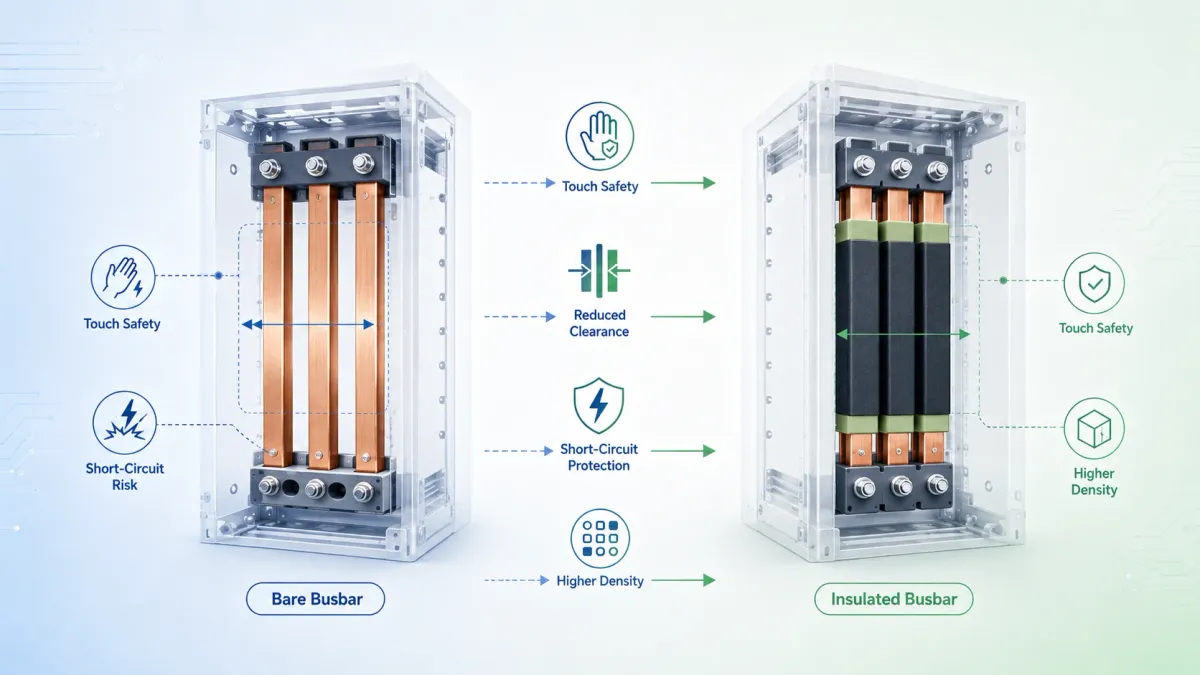
Common insulation methods for copper busbars
There is no single best insulation method for every busbar. The correct choice depends on voltage, geometry, bend radius, exposed terminals, current, heat, environment, production volume, and cost target. The following table compares common options used in custom copper busbar projects.
| Insulation method | Typical advantages | Typical limitations | Suitable applications | Key RFQ details |
|---|---|---|---|---|
| Heat shrink tubing | Cost-effective, widely available, good for straight or gently formed bars | Can wrinkle on complex bends; cut edges and terminals need careful control; temperature rating varies | Switchgear, control panels, battery links, service covers | Material, color, wall thickness, shrink ratio, temperature rating, exposed copper length |
| PVC sleeve or dip coating | Economical and flexible for moderate requirements | Lower high-temperature capability than advanced films or epoxy systems | Low-voltage cabinets, indoor power assemblies | Voltage, thickness, flame rating, operating temperature, color |
| Epoxy powder coating | Durable, clean appearance, good abrasion resistance, suitable for many rigid busbars | Masking is required at contact zones; coating thickness must be controlled near holes and edges | Rigid busbars, BESS cabinets, inverters, power distribution | Coating thickness, color, dielectric test, masked areas, surface pretreatment |
| Fluidized bed coating | Thick, uniform protection for suitable shapes; good edge coverage | Requires process control and may be less suitable for very tight dimensional tolerances | High-current rigid bars, battery and power modules | Material grade, coating window, thickness range, plug/mask requirements |
| PET or polyester film wrapping | Thin, consistent insulation, useful in laminated structures | Edge sealing and adhesive quality are critical | Laminated busbars, compact DC links, inverter busbars | Film type, layer count, overlap, adhesive, dielectric test |
| Polyimide film | High-temperature performance, thin profile, good dielectric properties | Higher material cost; edge protection must be engineered | Compact high-temperature electronics, inverters, aerospace-type assemblies | Temperature requirement, film thickness, adhesive, creepage/clearance design |
| PA or nylon sleeve | Good abrasion resistance and mechanical toughness | Moisture absorption and temperature limits must be considered | EV battery interconnects, flexible busbar protection | Material grade, wall thickness, bend zone, color, flame rating |
| Silicone sleeve or molded boot | Flexible, good thermal and environmental tolerance depending on grade | Larger size and higher cost than simple sleeve | Terminals, flexible links, vibration zones, maintenance-exposed areas | Hardness, flame rating, temperature range, fit tolerance |
| Overmolded insulation | Integrated shape, strong touch protection, repeatable assembly | Tooling cost and development time are higher | High-volume EV, battery, and industrial modules | 3D model, resin type, tooling tolerance, exposed terminals, pull-off test |
| Separate protective cover | Service-friendly, can protect bolted joints and live terminals | Does not replace base spacing design; extra parts and assembly steps | Switchgear, panels, data center distribution, maintenance areas | Cover material, fixing method, service access, labeling |
For many custom projects, the final solution combines methods. A rigid copper bar may use epoxy coating on the main body, bare plated contact pads at the ends, and molded boots over bolted terminals. A flexible laminated busbar may use PET or polyimide insulation between copper layers, plus outer film, plus local spacers. A braided copper connector may use a flexible sleeve and pressed terminals with controlled exposed copper length. The best design is rarely the most complicated design. It is the design that provides enough protection without creating unnecessary thermal, dimensional, or cost problems.
JUMAI’s rigid busbar manufacturing process article explains that real busbar projects may also require brackets, protective covers, terminal plates, insulation windows, spacers, positioning features, or stamped accessories. This is important because insulation often affects not only the busbar, but also the surrounding mechanical package.
Insulation as part of the busbar geometry
A custom insulated busbar is shaped before, during, or after the insulation process depending on the material and design. This sequence matters. If a copper busbar is formed after coating, the insulation may crack or thin at bend areas. If it is formed before coating, masking and coating uniformity become more important. If heat shrink is applied after forming, wrinkles or uneven wall thickness can occur at tight bends. If a film-laminated busbar is used, the copper layer shape, adhesive system, and insulation edge offset must be engineered together.
The most common geometry-related insulation issues include sharp corners, burrs, small bend radii, hole edges, narrow slots, exposed cut ends, and inconsistent terminal windows. A tiny burr may be acceptable on a non-critical metal bracket, but on an insulated busbar it can damage the insulation layer from inside or increase electric field concentration at an edge. That is why deburring, edge rounding, polishing, controlled punching, and proper inspection are essential.
Insulation also changes dimensional tolerance. If a 3 mm copper bar receives a 0.5 mm coating on each side, its local thickness may become about 4 mm before considering tolerance. This can affect mounting clips, slots, battery module channels, busbar supports, molded covers, and clearance to adjacent components. Buyers should not provide only the copper dimensions. They should specify whether drawings show bare copper dimensions, finished insulated dimensions, or both.
For compact systems, the engineering drawing should mark several zones clearly: exposed contact area, insulation start and stop line, allowable insulation overspray, no-coating zones, bend zones, label zones, and areas where cosmetic defects are acceptable or unacceptable. Without these zones, suppliers may quote the part differently, and the buyer may receive inconsistent proposals.
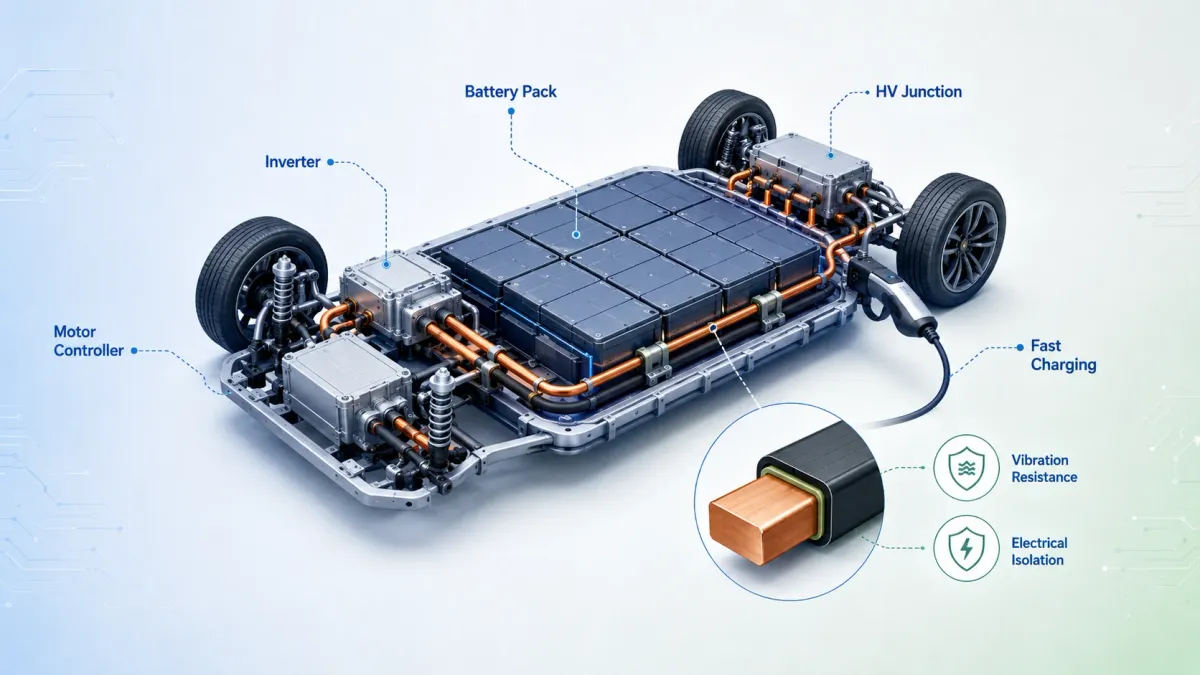
Extra electrical protection in EV battery packs
EV battery packs are one of the clearest examples of why insulated busbars matter. The busbar must connect modules or cells, carry high current, survive vibration, allow thermal expansion, and fit into a compact structure with covers, cooling plates, sensors, and service disconnects. An EV battery busbar can fail not only because the copper is too small, but also because the insulation system is damaged during assembly or operation.
For EV battery packs, insulation often serves five functions. It helps prevent accidental touch during assembly and service. It reduces the risk of contact between positive and negative conductors. It protects against abrasion from module cases or covers. It gives visual identification for high-voltage paths. It helps manage compact spacing where a larger air gap is not practical.
Flexible busbars are especially common in EV modules because batteries move slightly under vibration, thermal cycling, and mechanical stress. JUMAI’s page on flexible busbar for EV battery modules discusses the use of flexible busbars in battery modules and highlights the importance of insulation materials such as PA12 or epoxy for high-voltage environments. For many EV designs, a laminated flexible copper busbar or braided busbar is better than a rigid bar because it reduces mechanical stress on terminals.
However, flexibility does not remove the need for insulation control. A flexible busbar may bend during installation, and the insulation must tolerate that movement without cracking, peeling, or exposing copper. The buyer should define the minimum bend radius, number of bend cycles if relevant, operating temperature, vibration profile, and whether the busbar will be installed once or flexed repeatedly.
Important EV battery busbar RFQ details include pack voltage, maximum continuous current, peak current duration, short-circuit assumptions if known, orange color requirement, terminal plating, insulation thickness, exposed copper window, dielectric withstand test, insulation resistance test, flame rating expectation, and whether the busbar must meet a vehicle-level or pack-level approval process. If the buyer does not know all of these details, they should at least provide the system standard and assembly drawing so the busbar manufacturer can review manufacturability.
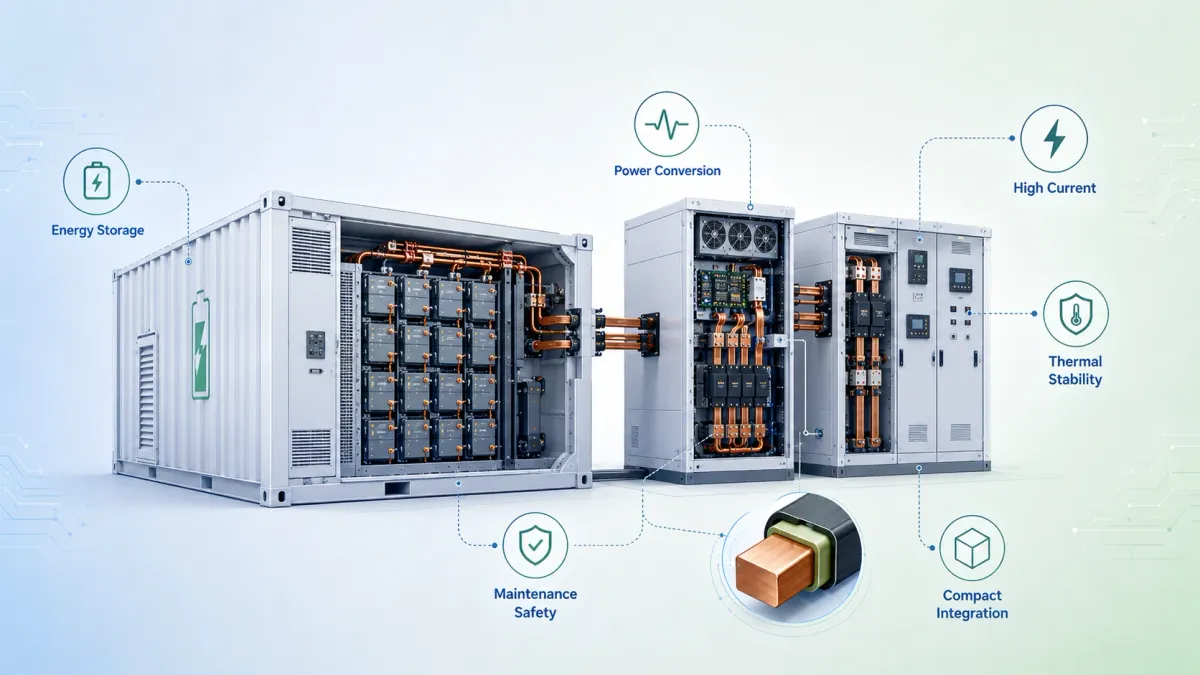
Extra electrical protection in BESS cabinets and energy storage containers
Battery energy storage systems use many busbars: module interconnects, rack busbars, DC combiner bars, cabinet main conductors, PCS connections, and grounding paths. In these systems, insulation is not only about voltage. It is also about service safety, fault containment, environmental exposure, and long operating life.
A BESS cabinet may operate in outdoor or semi-outdoor conditions. Even if the busbars are inside an enclosure, they may experience humidity, condensation, dust, salt mist depending on location, thermal cycling, and maintenance operations. During installation, technicians may work near live or potentially energized sections. In this environment, an insulated busbar can reduce the risk of accidental contact, contamination-related tracking, and tool-drop faults.
But BESS busbars also carry sustained current. A thick sleeve that looks safe may trap heat. If the cabinet has limited airflow, the busbar may run hotter than expected. This is why BESS busbar design should combine conductor sizing, insulation choice, cabinet airflow, mounting method, and temperature-rise validation. When in doubt, the buyer should request thermal simulation, prototype testing, or conservative derating.
For BESS projects, a practical insulation strategy often separates the busbar into zones. The main conductor body may be coated or sleeved. Bolted joints may remain plated and exposed only inside a covered terminal region. Service-access areas may use removable insulating covers. Flexible links may use insulated braided or laminated conductors to absorb cabinet tolerance and thermal movement. This zoned design usually works better than trying to apply one insulation material everywhere.
Buyers should also consider maintainability. If a bolted joint must be inspected, retorqued, or replaced, permanent overmolding may not be ideal. A removable protective cover may be better. If the part must be sealed for life inside a module, laminated or molded insulation may be more appropriate. The decision should follow the service model of the final product.
Extra electrical protection in data centers and high-density power distribution
Data center power systems need safe, efficient, and repeatable power distribution. As rack power density increases, internal conductors, busways, PDUs, UPS systems, battery strings, and power conversion units must fit into compact layouts. Insulated busbars can help reduce space, improve assembly repeatability, and support safer maintenance.
Unlike EV packs, data center equipment is usually installed in controlled indoor environments. The vibration level is lower, but the importance of uptime is extremely high. A preventable electrical fault can lead to downtime, service risk, or equipment damage. For this reason, insulation and touch protection are often specified even when the environment is clean.
Insulated busbars in data center equipment are commonly used in UPS cabinets, battery cabinets, rack-level power distribution, switchboards, high-current DC systems, and prefabricated power modules. The design goal is often not extreme flexibility but controlled routing, compact phase separation, low voltage drop, stable thermal behavior, and service-safe construction.
The buyer should pay special attention to airflow. In some data center equipment, a bare busbar can be cooled by cabinet airflow. Adding thick insulation may change the temperature profile. The right answer may be a coated busbar with exposed heat-spreading surfaces, a larger copper cross-section, a busbar with optimized orientation, or a touch-safe cover that does not fully wrap the copper. Thermal validation is more important than cosmetic preference.
For data center and UPS projects, useful RFQ details include load current, redundancy architecture, allowable voltage drop, cabinet airflow direction, maximum ambient temperature inside the enclosure, maintenance access requirement, color coding, phase identification, and whether the part is used in an AC or DC section. Because data center installations may follow regional electrical codes and assembly standards, the busbar drawing should align with the final equipment certification plan.
Extra electrical protection in switchgear, control panels and industrial equipment
In switchgear and industrial control panels, busbars often connect breakers, contactors, disconnects, transformers, drives, and distribution blocks. The traditional approach may use bare copper bars with busbar supports and covers. But as panels become more compact and global export requirements become stricter, more buyers are asking for insulated busbars, phase-color sleeves, terminal boots, and protective covers.
The main risks include phase-to-phase short circuits, accidental tool contact, limited working space, contamination, vibration from nearby machinery, and installation variation between panel builders. An insulated busbar can reduce some of these risks, but it must work together with support spacing, torque control, short-circuit withstand design, and enclosure layout.
In industrial equipment, insulation must also survive practical handling. A beautiful coating is not enough if it chips during installation. Edges around holes should be designed with enough radius. Masked contact areas should be clean and repeatable. If the busbar is bent in multiple planes, the insulation process must be selected with manufacturing in mind.
JUMAI’s article on rigid busbars vs flexible busbars explains that flexible busbars are useful where movement, misalignment, thermal expansion, vibration, or repeated mechanical stress are present. In panels and industrial machinery, this distinction can help buyers decide whether the insulated part should be rigid, flexible laminated, or braided.
How insulation affects contact areas and plating
Most busbar failures occur at interfaces, not in the middle of the copper bar. Bolted joints, welded areas, pressed terminals, and contact pads are critical. Insulation must protect the live conductor without contaminating the contact surface or interfering with torque, flatness, or plating.
For many copper busbars, the contact area is plated with tin, nickel, silver, or another finish depending on temperature, corrosion risk, mating material, and cost. The insulation should stop at a controlled distance from the contact zone. If coating creeps under the contact pad, contact resistance can rise. If the exposed copper window is too large, touch and spacing risks increase. If the insulation edge is too close to the bolt hole, it may crack during tightening.
A good drawing should specify the exposed contact window precisely. For example, it may define the length of bare plated contact from the hole centerline, the acceptable insulation edge tolerance, the maximum coating thickness near the transition, and whether the transition must be sealed. The drawing should also state whether plating is applied before or after insulation, because the sequence affects masking, adhesion, and process cost.
JUMAI’s article on C10100 vs C11000 copper busbar selection can help buyers think about copper grade selection. For many power distribution busbars, C11000 or equivalent high-conductivity copper is suitable. For special welding, brazing, vacuum, or high-temperature conditions, oxygen-free copper may be considered. Material choice, plating, and insulation should be specified together.
Testing and inspection for insulated busbars
Testing requirements depend on the application, standard, and risk level. A simple low-voltage indoor busbar may need dimensional inspection, plating inspection, and visual insulation checks. A high-voltage EV or BESS busbar may require more rigorous testing such as dielectric withstand, insulation resistance, coating thickness, adhesion, bend inspection, thermal cycling, salt spray, vibration, flame rating documentation, and traceability.
UL Solutions describes UL 94 plastic flammability testing as a method used to determine V-0, V-1, and V-2 ratings by evaluating burning time, afterglow time, and dripping behavior. See UL’s page on combustion fire tests for plastics. Buyers should be careful here: a material’s UL 94 rating is not the same as certification of the complete busbar. It is a material-level flammability classification. The final assembly may require additional testing.
The following table summarizes common inspection items.
| Inspection or test item | What it checks | Why it matters | Typical stage |
|---|---|---|---|
| Copper grade verification | Material certificate, alloy, conductivity basis | Confirms conductor performance and traceability | Incoming material |
| Dimensional inspection | Length, width, thickness, hole position, bend angle, finished size | Ensures fit in battery, cabinet, panel, or module | In-process and final |
| Burr and edge inspection | Hole edges, cut edges, corners, bend areas | Prevents insulation puncture and assembly damage | Before insulation |
| Plating inspection | Tin/nickel/silver thickness, coverage, contact area | Supports low contact resistance and corrosion control | After plating |
| Coating or sleeve thickness | Insulation uniformity and finished dimensions | Controls dielectric performance and fit | After insulation |
| Adhesion or peel check | Bonding strength of coating or film | Reduces risk of delamination | Process validation |
| Dielectric withstand test | Ability to withstand specified voltage for specified time | Verifies insulation barrier for the stated requirement | Final or sample test |
| Insulation resistance test | Leakage resistance between conductor and test electrode or adjacent conductor | Screens contamination, pinholes, and weak insulation | Final or sample test |
| Visual inspection | Wrinkles, cracks, exposed copper, bubbles, burns, color | Catches practical defects before shipment | Final |
| Thermal validation | Temperature rise under load | Confirms conductor and insulation design | Prototype or type test |
| Packaging inspection | Protection against shipping abrasion | Prevents insulation damage during logistics | Final packing |
A common commercial problem is that buyers ask for “100% test” without defining the test method, voltage, time, acceptance criteria, or sampling plan. A better RFQ says, for example, that the part requires a dielectric withstand test at a specified voltage for a specified duration between the conductor and a wrapped electrode or fixture, with leakage current threshold defined by the buyer’s standard. If the buyer does not have this information, JUMAI can discuss practical options, but the final requirement should match the system’s certification plan.
How to choose the right insulation material
The right insulation material depends on the environment and the purpose of the insulation. Buyers should not select material only by color or price. The following factors are more important.
Operating temperature: The insulation must tolerate the expected continuous and peak temperature of the busbar surface. This includes self-heating from current, enclosure temperature, nearby heat sources, and fault or overload conditions. NEMA-style insulation temperature classes are commonly discussed in electrical equipment; for example, Class A is often associated with 105°C, Class B with 130°C, Class F with 155°C, and Class H with 180°C. These classes are mostly used for insulation systems rather than a simple busbar sleeve, but they remind buyers to think in terms of thermal endurance, not only short-term melting point.
Dielectric strength: The material must withstand the electrical stress required by the system. Thin film may have excellent dielectric strength, but edges, holes, overlaps, scratches, and air gaps can become weak points. Practical busbar insulation design must consider the complete shape, not only a datasheet value.
Mechanical toughness: EV and industrial busbars may experience vibration, abrasion, bending, and installation handling. A brittle coating may pass a voltage test when new but chip during assembly. A flexible sleeve may tolerate movement better.
Environmental resistance: Humidity, condensation, oil, coolant, dust, salt, UV exposure, and cleaning chemicals can affect material life. A data center cabinet and an outdoor renewable energy converter have very different environmental needs.
Flame behavior: For electrical equipment, flame rating may be important. UL 94 V-0 is often requested for insulating materials, but the buyer should check whether the rating applies to the exact material thickness and color used.
Manufacturing compatibility: The selected insulation must match the busbar’s bends, holes, terminals, coating masks, production volume, and tolerances. A material that looks excellent on a datasheet may be impractical for a complex 3D rigid busbar.
Serviceability: Permanent overmolding may protect well, but it can make inspection or repair difficult. Removable covers may be better for service-access areas.
In many cases, the best material is not the highest-temperature or most expensive option. It is the material that meets the required voltage, temperature, environment, mechanical, assembly, and cost conditions with stable manufacturing quality.
Bare, sleeved, coated or laminated: a practical selection matrix
Buyers often ask whether they should choose a sleeved busbar, epoxy coated busbar, laminated busbar, or molded busbar. The answer depends on the product structure. The following matrix provides a practical starting point.
| Project condition | Better starting option | Reason |
|---|---|---|
| Simple straight rigid bar, moderate voltage, indoor panel | Heat shrink or sleeve | Economical and easy to apply |
| Complex 3D rigid bar, higher abrasion risk | Epoxy powder coating or fluidized coating | Better surface conformity and durable finish |
| Very compact DC link, inverter, or power module | Laminated busbar with film insulation | Low profile, controlled layer spacing, reduced loop inductance |
| EV module interconnect with movement | Flexible laminated busbar with PA/PET/PI insulation | Absorbs tolerance and thermal movement |
| High-vibration connection | Insulated braided copper busbar | Excellent flexibility and vibration absorption |
| Service-exposed bolted terminals | Busbar body insulation plus removable terminal cover | Protects live parts while allowing maintenance |
| High-volume integrated module | Overmolded insulation | Repeatable assembly and integrated protection |
| High heat, limited airflow | Larger copper area plus selective insulation or cover | Avoids thermal bottleneck from full wrap insulation |
For low-inductance power electronics, laminated busbars can provide benefits beyond insulation. They can place positive and negative conductors close together with controlled dielectric layers, reducing loop area and improving electrical performance. For simple power distribution, however, a rigid coated copper busbar may be more cost-effective.
JUMAI’s busbar copper material guide discusses copper material selection for low-resistance paths and explains how laminated busbars can combine conductivity, insulation, and compact routing. Buyers can use that article together with this guide when comparing laminated and rigid designs.
RFQ checklist for insulated busbar buyers
A complete RFQ saves time, reduces back-and-forth communication, and makes supplier quotations easier to compare. For an insulated busbar, the RFQ should include more than a PDF drawing. It should define the electrical, thermal, insulation, mechanical, and quality requirements as clearly as possible.
| RFQ item | What to provide | Why it matters |
|---|---|---|
| Application | EV battery, BESS, inverter, data center, switchgear, industrial equipment | Helps supplier understand risk level and practical service conditions |
| Busbar type | Rigid, flexible laminated, braided, soft copper link | Determines process route and insulation options |
| Copper material | C11000, T2, C10100, oxygen-free copper, or equivalent | Controls conductivity, forming, welding, and cost |
| Current | Continuous current, peak current, overload duration | Determines copper cross-section and heat rise |
| Voltage | Working voltage, rated voltage, AC/DC, impulse requirement if known | Determines insulation coordination and test method |
| Standard | IEC, UL, ISO, automotive OEM specification, customer internal standard | Aligns testing and documentation |
| Drawing | 2D PDF plus 3D CAD if possible | Prevents tolerance and forming misunderstandings |
| Finished dimensions | Bare copper dimensions and finished insulated dimensions | Avoids fit problems after coating or sleeving |
| Insulation material | Preferred material or performance requirement | Allows supplier to select process and quote accurately |
| Thickness | Nominal and tolerance, or dielectric requirement | Affects safety, fit, heat, and cost |
| Exposed copper zones | Contact pads, holes, terminals, grounding areas | Prevents insulation from contaminating contact surfaces |
| Plating | Tin, nickel, silver, bare copper, selective plating | Affects contact resistance, corrosion, and masking |
| Temperature | Ambient, conductor rise, peak temperature | Determines material thermal suitability |
| Environment | Indoor, outdoor, humidity, salt mist, coolant, oil, dust | Determines coating and sleeve resistance |
| Mechanical stress | Vibration, movement, installation bend, fatigue | Determines flexible vs rigid design and insulation durability |
| Test requirement | Dielectric withstand, insulation resistance, coating thickness, adhesion | Avoids quality disputes |
| Quantity | Prototype, pilot, mass production annual volume | Determines tooling and process economics |
| Packaging | Individual protection, separators, anti-scratch packing | Prevents insulation damage before assembly |
The buyer does not need to know every answer before contacting JUMAI. But the more information the buyer provides, the faster JUMAI can review design feasibility, suggest the right process, and quote the project accurately. For new designs, the best approach is to share the electrical requirement, assembly layout, available space, and target production volume first. Then the busbar manufacturer can help identify whether the part should be rigid, flexible laminated, braided, coated, sleeved, or redesigned.
Cost factors in insulated busbar manufacturing
Insulation adds cost, but the cost is not only the material price. The total price of an insulated busbar depends on copper material, cutting, punching, bending, deburring, cleaning, plating, masking, insulation process, inspection, testing, packaging, scrap risk, and production volume. Complex insulation windows and selective plating can cost more than a simple full-body sleeve.
The main cost drivers include geometry complexity, insulation method, masking difficulty, coating thickness tolerance, number of exposed terminals, need for special tooling, test requirements, production volume, and cosmetic standard. A busbar with ten precisely masked contact pads will cost more than a busbar with two simple ends. A 3D bent bar with tight coating thickness requirements will cost more than a flat bar. A high-volume overmolded design may require tooling investment but can become cost-effective in mass production.
Buyers should avoid specifying unnecessary features. For example, if the busbar is fully hidden inside a cabinet, perfect cosmetic surface may not be required. If the busbar operates at moderate voltage with generous spacing, an expensive high-temperature film may not be necessary. If the contact area is covered by a terminal boot, the main body insulation may not need to extend extremely close to the bolt hole.
On the other hand, under-specifying insulation can be more expensive in the long run. If field failures, assembly rework, certification delays, or safety redesign occur, the cost difference between two insulation options becomes insignificant. A good supplier quotation should make the trade-off visible: one option for economical production, one option for stronger electrical protection, and one option for harsh environments if needed.
Manufacturing steps JUMAI considers for insulated busbar projects
A custom insulated busbar project usually begins with design review. JUMAI checks whether the drawing can be manufactured reliably, whether bend radii are reasonable, whether holes and edges can be deburred properly, whether insulation windows are clear, and whether the specified insulation process matches the geometry. If the project involves high current, JUMAI may also discuss copper cross-section, plating, joint area, heat rise, and assembly constraints.
The typical manufacturing route may include copper material preparation, cutting or stamping, CNC bending, punching, milling if required, deburring, edge rounding, cleaning, plating, masking, insulation application, curing or shrinking, final inspection, electrical testing if specified, labeling, and protective packaging. The exact sequence changes according to the insulation method. For example, epoxy coating often requires surface pretreatment and curing. Heat shrink requires sleeve selection, controlled shrink temperature, and inspection around bends. Laminated flexible busbars require copper foil preparation, stacking, welding or pressing of terminal areas, film insulation, and dimensional control.
Because JUMAI also supports precision stamping, deep-drawn components, and custom tooling, busbar projects can be reviewed together with related metal parts. That can be valuable when the busbar needs spacers, shields, brackets, covers, terminals, or special mounting features. The goal is not merely to supply a copper strip. The goal is to make a reliable current path that fits the buyer’s complete assembly.
This matters in early-stage product development. Many busbar problems are easier to solve before tooling or enclosure design is finalized. If JUMAI receives only a final locked drawing, design improvement options may be limited. If JUMAI receives the assembly context earlier, it can suggest changes such as increasing bend radius, moving an insulation edge away from a hole, adding a larger contact pad, improving manufacturability of a terminal, or changing from rigid to flexible construction.
Common mistakes buyers should avoid
The first mistake is treating insulation thickness as the only safety factor. Thick insulation may help, but safety also depends on creepage, clearance, dielectric quality, edge condition, test voltage, contamination, and assembly design.
The second mistake is ignoring heat. Insulation can reduce heat dissipation. If the busbar already runs hot, adding insulation without increasing copper area or improving airflow may shorten insulation life.
The third mistake is allowing sharp copper edges under insulation. Burrs, punched-hole edges, and sharp corners can cut into sleeves or create weak points in coating. Deburring and edge control should be part of the drawing.
The fourth mistake is not defining contact windows. If insulation overlaps the contact surface, electrical resistance can rise. If the exposed area is too large, touch protection and spacing may be reduced.
The fifth mistake is using one insulation method for every zone. A busbar body, bend zone, terminal area, and service-access area may need different protection strategies.
The sixth mistake is copying a material from another project without checking environment and temperature. A sleeve that works in an indoor control panel may not be suitable for a high-temperature inverter or outdoor BESS cabinet.
The seventh mistake is asking for a test without specifying the method. “Hi-pot test required” is not enough. The RFQ should define voltage, duration, test points, acceptance criteria, and sampling.
The eighth mistake is forgetting finished dimensions. Coating and sleeves add thickness. If the buyer sends only bare copper dimensions, the finished insulated busbar may interfere with the assembly.
The ninth mistake is choosing rigid copper when a flexible connector is needed. If the assembly has vibration, thermal movement, or tolerance stack-up, a flexible laminated or braided busbar may prevent terminal stress.
The tenth mistake is over-optimizing price before proving reliability. For a safety-critical power assembly, a small saving on insulation can create much larger risks during certification, assembly, or field operation.
How to discuss an insulated busbar project with JUMAI
A productive discussion usually starts with the application, not the drawing. Tell JUMAI where the busbar is used: EV battery module, BESS cabinet, inverter DC link, data center PDU, switchgear, renewable energy converter, or industrial machine. Then provide voltage, current, space, temperature, and expected insulation performance. If available, send the 3D assembly model or screenshots that show nearby metal parts, covers, and service access.
For prototype projects, the first goal is usually feasibility. JUMAI can help identify whether the part can be made with existing processes, where insulation risks exist, and what design changes can reduce cost or improve reliability. For mass production projects, the discussion should include tooling, inspection, process stability, packaging, and annual volume.
If the buyer already has a drawing, it should include material, copper thickness, bend angles, hole tolerances, surface treatment, insulation material, insulation thickness, exposed contact zones, plating requirement, test requirement, and labeling. If the drawing is not complete, JUMAI can still review it, but the quotation may need assumptions.
The best RFQ conversations are collaborative. The buyer understands the system requirement. JUMAI understands copper busbar fabrication, forming, insulation process control, and manufacturability. When both sides share information early, the final insulated busbar is more likely to meet safety, cost, and lead-time targets.
Practical buyer examples
Consider a BESS cabinet manufacturer designing a 1,500 V DC rack connection. The busbar is inside a cabinet but close to a grounded frame and accessible during maintenance. A bare copper busbar may carry current, but it creates unnecessary service risk. A coated rigid copper busbar with controlled exposed terminals and removable terminal covers may be a practical solution. The RFQ should define voltage, current, coating thickness, masked terminal areas, dielectric test, operating temperature, and cabinet environment.
Consider an EV battery module where the positive and negative paths must pass through a compact area near cell terminals. The conductors need some flexibility because the module experiences vibration and thermal movement. A rigid coated busbar may transfer stress to terminals. A flexible laminated copper busbar with film insulation and carefully controlled exposed welding or bolting areas may be better. The RFQ should include movement, vibration, bend radius, voltage, current, and terminal interface requirements.
Consider a data center UPS power module where airflow is carefully controlled. The busbar needs touch protection, but thick full-wrap insulation could raise temperature. The best design might use a larger copper section, selective coating, and protective covers around service-access regions instead of fully enclosing every surface. The RFQ should provide thermal limits, cabinet airflow, current, voltage, and maintenance access.
Consider a switchgear panel where phase identification and service safety are important. Heat shrink sleeves or epoxy-coated busbars with phase colors may be suitable, but the design must preserve contact quality at bolted joints. The RFQ should define phase colors, contact pad dimensions, plating, torque conditions, and final assembly standard.
These examples show that insulation is not one decision. It is a set of decisions about conductor shape, electrical spacing, material, process, testing, serviceability, and cost.
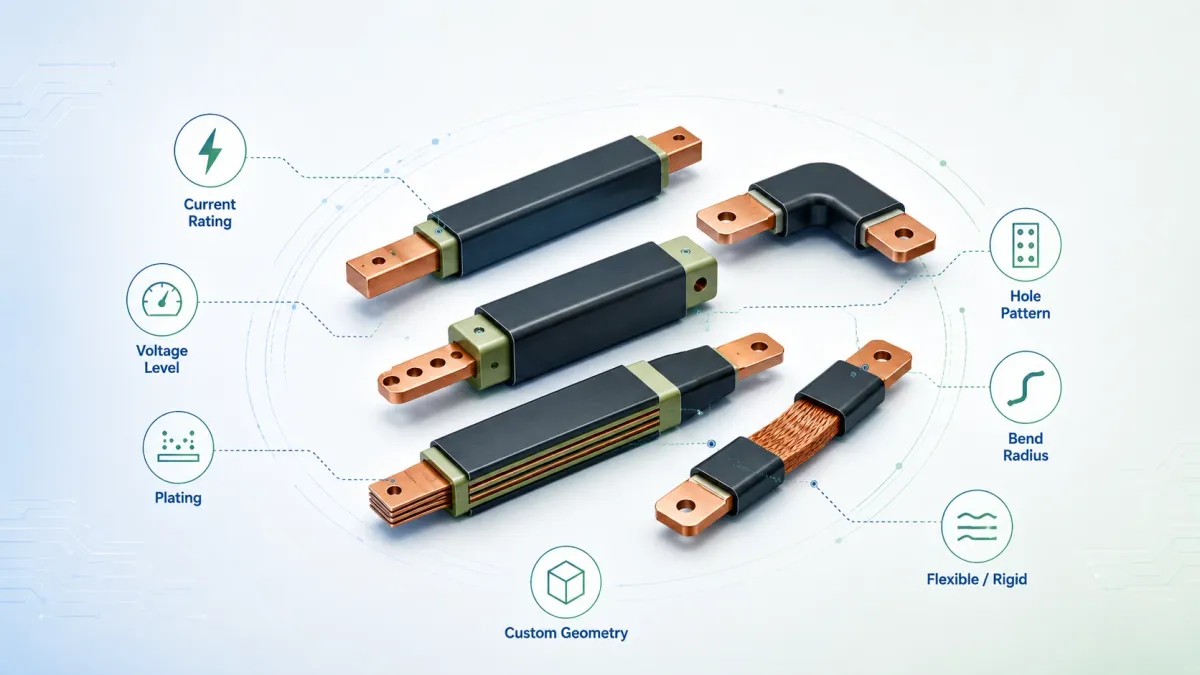
Why insulated busbars support better commercial outcomes
From a business perspective, an insulated busbar can reduce more than electrical risk. It can improve assembly repeatability, reduce wiring complexity, save space, simplify maintenance, support certification planning, improve product appearance, and reduce field-service uncertainty. For OEMs and system integrators, these benefits can matter as much as material cost.
Compared with cable assemblies, copper busbars can provide predictable routing, lower profile, easier automated assembly, better heat spreading, and cleaner installation. JUMAI’s article on rigid busbar vs cable comparison discusses why busbars can be preferred for power distribution when layout, current capacity, and repeatability matter. When insulation is added correctly, the busbar can become a safer and more integrated power distribution component.
For procurement teams, the key is to compare total value instead of only unit price. A low-cost insulated busbar that requires rework, fails testing, or causes assembly interference is not a saving. A well-designed busbar that fits correctly, passes inspection, and reduces installation labor can improve the total project economics.
For engineering teams, the key is to involve the busbar supplier early. A small change in hole position, bend radius, exposed copper window, or insulation start line can reduce manufacturing risk significantly. Early design-for-manufacturing review is especially valuable for EV, BESS, data center, renewable energy, and high-current industrial products.
Final recommendations
An insulated busbar should be specified whenever the electrical, mechanical, environmental, or service conditions make bare copper risky. The most common triggers are high voltage, compact spacing, accessible live parts, vibration, thermal movement, harsh environments, contamination risk, maintenance exposure, and certification requirements. But insulation should not be selected blindly. It must be coordinated with copper size, heat rise, contact design, plating, bend geometry, creepage, clearance, and final assembly standards.
For most buyers, the safest workflow is simple. First, define the system requirement: voltage, current, temperature, environment, standard, and available space. Second, decide whether the conductor should be rigid, flexible laminated, or braided. Third, choose an insulation method that matches the geometry and risk level. Fourth, define exposed contact windows and plating. Fifth, confirm inspection and test requirements. Sixth, review manufacturability before locking the drawing.
JUMAI supports custom insulated copper busbar projects for EV batteries, BESS cabinets, renewable energy equipment, data center power distribution, switchgear, and industrial high-current assemblies. Whether the project needs a rigid coated copper busbar, a flexible laminated busbar, an insulated braided connector, or a complete design review for manufacturability, JUMAI can help translate electrical requirements into manufacturable copper components.
If your project involves insulated busbars, prepare your voltage, current, application, drawing, insulation expectation, test requirement, and production volume. Then contact JUMAI through DeepDrawTech to review the design and develop a custom copper busbar solution that balances safety, conductivity, thermal performance, manufacturability, and cost.
FAQ
What is an insulated busbar?
An insulated busbar is a copper or aluminum conductor with an added insulation layer, sleeve, coating, film, cover, or molded protection. In high-current custom applications, copper is commonly used because of its high conductivity and reliable mechanical performance. The insulation helps reduce electrical contact risk, improve touch protection, and support compact power distribution.
Does every copper busbar need insulation?
No. A bare copper busbar can be suitable when the system has enough spacing, proper guarding, controlled access, and an appropriate enclosure. Insulation becomes more important when voltage is higher, spacing is tighter, live parts are accessible, the environment is harsh, or the busbar is used in EV, BESS, data center, switchgear, or inverter equipment.
Is thicker insulation always better?
Not always. Thicker insulation may improve mechanical protection or dielectric margin, but it can also increase size, reduce heat dissipation, make bending difficult, and raise cost. The correct insulation thickness depends on voltage, test requirement, material, geometry, temperature, and assembly spacing.
Which insulation method is best for copper busbars?
There is no universal best method. Heat shrink is economical for simple shapes. Epoxy coating is useful for many rigid busbars. Laminated film is common in compact power modules. Sleeves are useful for flexible links. Overmolding is suitable for high-volume integrated assemblies. The correct choice depends on the busbar shape, voltage, current, temperature, environment, and production volume.
Can JUMAI manufacture both rigid and flexible insulated busbars?
Yes. JUMAI manufactures custom rigid copper busbars, flexible laminated copper busbars, braided copper busbars, and related precision components. JUMAI can review drawings, insulation windows, plating requirements, material selection, and manufacturability for prototype and production projects.