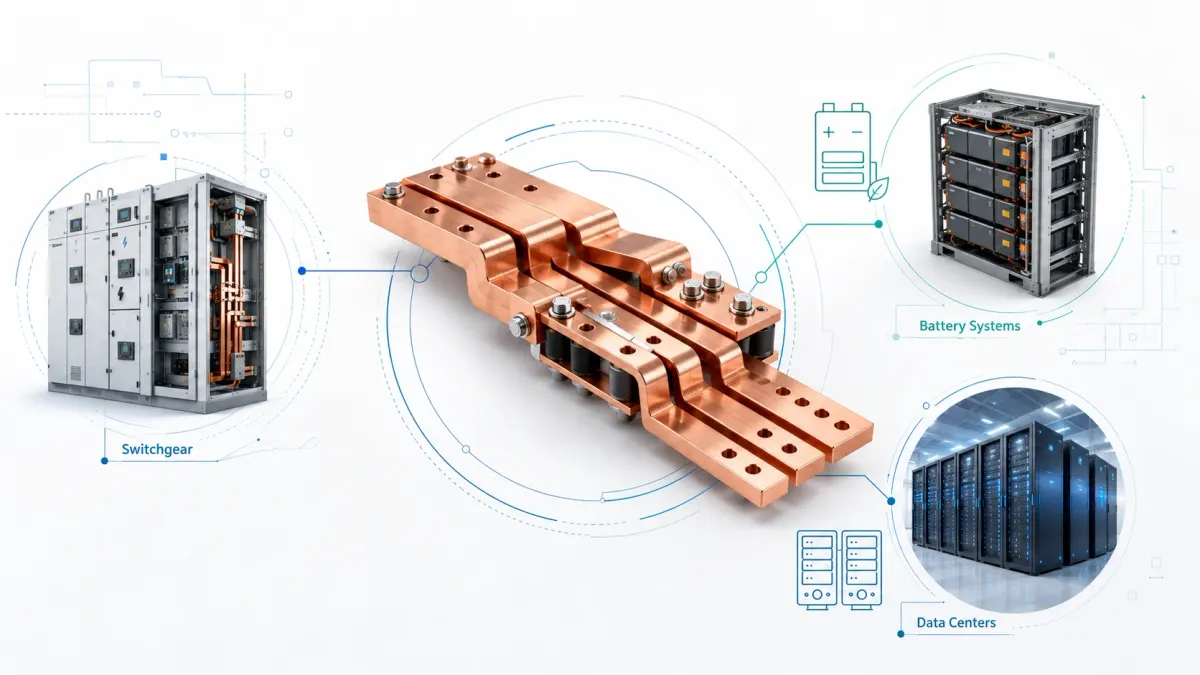
A power bus bar may look like a simple metal conductor, but in modern electrical equipment it is often one of the most important parts of the entire power path. It carries current, spreads heat, supports repeatable assembly, protects connection quality, reduces wiring complexity and helps the final product meet safety, reliability and production targets. In switchgear, a bus bar may connect breakers, feeders, transformers and power sections. In battery systems, it may link battery modules, contactors, fuses, shunts, inverters and DC distribution units. In data centers, it may support UPS cabinets, rack power shelves, 48 V power distribution, high-current server loads and compact power conversion assemblies.
This is why a power bus bar should not be treated as a commodity strip of copper. A buyer may start with the question, “What copper size do I need for 300 A, 800 A or 2,000 A?” The more useful question is broader: “What bus bar design will carry the current safely, control temperature rise, maintain low contact resistance, fit the enclosure, survive mechanical stress, support insulation requirements and remain manufacturable at the required volume?”
JUMAI focuses on custom copper busbars for global industrial customers, including rigid copper busbars, laminated flexible busbars, braided copper busbars, insulated bus bars, plated contact parts and related precision metal components. Buyers can start from the JUMAI Custom Copper Busbars page for a quick overview, then use this article as a practical application guide for three demanding markets: switchgear, battery systems and data centers.
The timing is important. Electrification is pushing more current through smaller equipment. The International Energy Agency reported in its Global EV Outlook 2026 that electric car sales exceeded 20 million units in 2025, equal to about one-quarter of all new cars sold globally. The same report expects electric car sales to continue rising in 2026. Battery energy storage is also expanding quickly. In the IEA report Batteries and Secure Energy Transitions, global energy storage capacity needs to increase sixfold to 1,500 GW by 2030 in the Net Zero Scenario, with batteries accounting for most of that growth. Data centers are another major driver. The IEA’s Energy and AI analysis projects that global data center electricity consumption could reach around 945 TWh by 2030, roughly double the 2024 level. More EVs, more batteries, more renewable energy and more AI infrastructure all point to the same practical need: safer, denser and more repeatable high-current power distribution.
For OEMs, panel builders, battery pack designers, data center equipment manufacturers and sourcing teams, the power bus bar is therefore both an engineering component and a purchasing decision. A good supplier should not only cut copper. It should understand the drawing, the current path, the contact interface, the thermal risk, the insulation window, the process tolerance and the final assembly environment.
- What is a power bus bar?
- Why power bus bars are used instead of cable in many high-current systems
- Market drivers behind modern power bus bar demand
- Key performance parameters buyers should define before ordering
- Power bus bar applications in switchgear
- Power bus bar applications in battery systems
- Power bus bar applications in data centers
- Copper material and surface finish selection
- Thermal design: why ampacity charts are only a starting point
- Short-circuit withstand and mechanical support
- Manufacturing process for custom power bus bars
- Quality control items buyers can request
- RFQ checklist for power bus bar projects
- Common design mistakes and how to avoid them
- How JUMAI supports power bus bar projects
- Practical selection guide by application
- FAQ
- A better power bus bar starts with a better specification
What is a power bus bar?
A power bus bar is a conductive component used to collect, distribute or transfer electrical current between circuits, modules or power devices. It is commonly made from copper or aluminum, but high-conductivity copper is preferred in many compact, high-current systems because it offers excellent electrical conductivity, strong thermal performance, good formability and reliable bolted-joint behavior when the surface finish is selected correctly. The Copper Development Association alloy database identifies C11000 copper as a high-conductivity copper with minimum 99.90% copper content and minimum 100% IACS conductivity in the annealed condition. ASTM also defines requirements for copper conductor bar, rod and shapes for electrical bus applications in ASTM B187/B187M.
In practical equipment, a power bus bar can take many forms:
- A straight or bent rigid copper bar used as a fixed current path.
- A laminated flexible copper busbar made from stacked copper foils joined at terminal areas.
- A braided copper connector used for grounding, bonding, vibration absorption or tolerance compensation.
- A plated copper busbar with tin, nickel or silver finish at the contact surface.
- An insulated bus bar with heat shrink, epoxy powder coating, PVC dipping, sleeve insulation, film insulation or molded covers.
- A complex stamped or formed conductor that integrates holes, slots, bends, offsets, embossing, tabs or assembly features.
The choice depends on the system. A rigid bar is often best for fixed high-current distribution inside switchgear or power cabinets. A laminated flexible busbar may be better where two terminals move relative to each other or where the conductor must fit through a compact path. A braided copper connector is often useful for grounding, bonding and vibration zones. JUMAI’s guide What Is a Flexible Busbar and Why Is It Used in High-Current Electrical Systems? explains the difference between fixed and flexible conductor structures in more detail.
A power bus bar is also a thermal and mechanical part. Current creates heat because every conductor has resistance. The basic loss relationship is simple: power loss increases with the square of current. If current doubles, resistive heat rises by roughly four times when resistance remains the same. This is why a small increase in contact resistance, poor plating, loose bolts, insufficient overlap or undersized copper can become a major reliability problem in high-current equipment. A well-designed bus bar reduces unnecessary resistance, spreads heat over a flatter surface and gives the assembly team a controlled geometry that is easier to install than multiple large cables.
Why power bus bars are used instead of cable in many high-current systems
Cables are useful because they are flexible, familiar and easy to route in low-volume builds. However, high-current equipment often needs more than flexibility. It needs repeatability. A cable assembly can introduce variations in bend radius, lug angle, crimp quality, routing path, clamp position and installation torque. In prototypes, this may be acceptable. In production, those variations can create assembly delays, thermal inconsistency and service risk.
A power bus bar gives the engineering team a defined current path. The copper thickness, width, hole position, bend angle, contact area, plating area and insulation window can all be controlled in the drawing. This makes the part easier to inspect and easier to assemble repeatedly. JUMAI’s article Copper Bus Bars for Power Distribution explains why a well-designed copper bus bar gives the manufacturer a repeatable current path that can be cut, punched, bent, plated, insulated, inspected, packed and assembled with controlled quality.
There are five common reasons buyers move from cable to power bus bars:
- Lower resistance in a compact space. A flat conductor can provide a large cross-section and a broad surface area for heat dissipation.
- Better assembly repeatability. Hole patterns, terminal windows and bend geometry are fixed by the drawing.
- Cleaner cabinet layout. Bus bars can reduce cable bundles, clamps and routing conflicts.
- Improved contact control. Flat plated surfaces support bolted or welded interfaces more consistently than loose cable lugs.
- Application-specific customization. The same project can combine rigid, laminated flexible, braided and insulated busbars.
This does not mean busbars are always better than cables. Cables still have value in field wiring, long-distance routing and flexible service connections. The best design may combine both. For example, a switchgear cabinet may use rigid copper busbars for the main distribution path, flexible laminated links to absorb tolerance near a transformer or breaker, and cable harnesses for control wiring. The goal is not to replace every cable. The goal is to use the right conductor where current, space, heat and assembly quality matter most.
Market drivers behind modern power bus bar demand
The commercial demand for power bus bars is connected to a bigger industrial trend: electricity is moving closer to the load, and the load is becoming denser. EV battery packs must deliver high current in a moving vehicle. BESS cabinets must connect many modules safely in compact DC systems. Switchgear must distribute power with verified short-circuit and temperature-rise performance. Data centers must deliver more power to racks while controlling loss and heat. These requirements create a growing need for custom copper conductors.
| Market driver | What the data says | Why it matters for power bus bars |
|---|---|---|
| Electric vehicles | IEA reported that electric car sales exceeded 20 million in 2025, about 25% of global new car sales. | EV packs need compact, insulated, vibration-tolerant copper links between modules and power electronics. |
| Battery storage | IEA says global energy storage capacity must rise sixfold to 1,500 GW by 2030 in the NZE Scenario. | BESS racks and cabinets need repeatable DC busbars, module links, grounding straps and insulated conductors. |
| AI and data centers | IEA projects data center electricity consumption around 945 TWh by 2030 in its base case. | UPS, PDU, rack power and 48 V distribution require low-loss, high-current conductors in compact spaces. |
| Switchgear modernization | IEC 61439-2 defines requirements for power switchgear and controlgear assemblies up to 1,000 V AC or 1,500 V DC. | Verified assemblies need busbars designed for temperature rise, dielectric performance and short-circuit withstand. |
These market forces do not automatically tell a buyer which copper thickness or plating should be used. They do explain why “standard strip plus drilling” is often not enough. When equipment becomes smaller and more powerful, the conductor must be designed as part of the electrical system.
Key performance parameters buyers should define before ordering
A custom power bus bar supplier can provide better feedback when the buyer defines the real operating conditions. A drawing that only shows length, width and hole diameter may be enough to quote a piece of metal, but it is not enough to judge a power component. For a serious busbar project, the RFQ should include electrical, mechanical, thermal and environmental information.
| Parameter | Why it matters | Practical buyer input |
|---|---|---|
| Continuous current | Determines conductor cross-section and heat generation. | Rated current in A, duty cycle and operating time. |
| Peak or surge current | Affects short-time heating and mechanical stress. | Peak current, duration and repetition. |
| Voltage | Influences insulation, clearance and creepage. | AC/DC voltage, working voltage and test voltage if known. |
| Temperature rise limit | Protects insulation, terminals and nearby parts. | Ambient temperature and allowed rise at rated current. |
| Short-circuit rating | Determines mechanical support and conductor spacing. | Available fault current, duration and applicable standard. |
| Contact interface | Controls joint resistance and hot-spot risk. | Bolt size, torque, overlap area, washer type and mating material. |
| Surface finish | Protects the contact surface and improves long-term stability. | Bare copper, tin, nickel, silver or selective plating. |
| Insulation system | Prevents accidental contact and phase-to-phase risk. | Material, color, thickness, exposed windows and dielectric test. |
| Mechanical envelope | Controls fit inside the cabinet, rack or battery pack. | STEP/IGES files, PDF drawings, bend direction and tolerance. |
| Production volume | Affects process choice, tooling and cost. | Prototype quantity, pilot run and annual demand. |
This information helps avoid a common sourcing problem: the buyer asks for price before the design is complete, and the supplier quotes the visible copper shape without understanding the application. Later, the team discovers that the bend radius is too tight, the terminal area is not flat enough, the coating covers a required contact window, or the part overheats in the enclosure. Early design clarification is cheaper than late-stage correction.
Power bus bar applications in switchgear
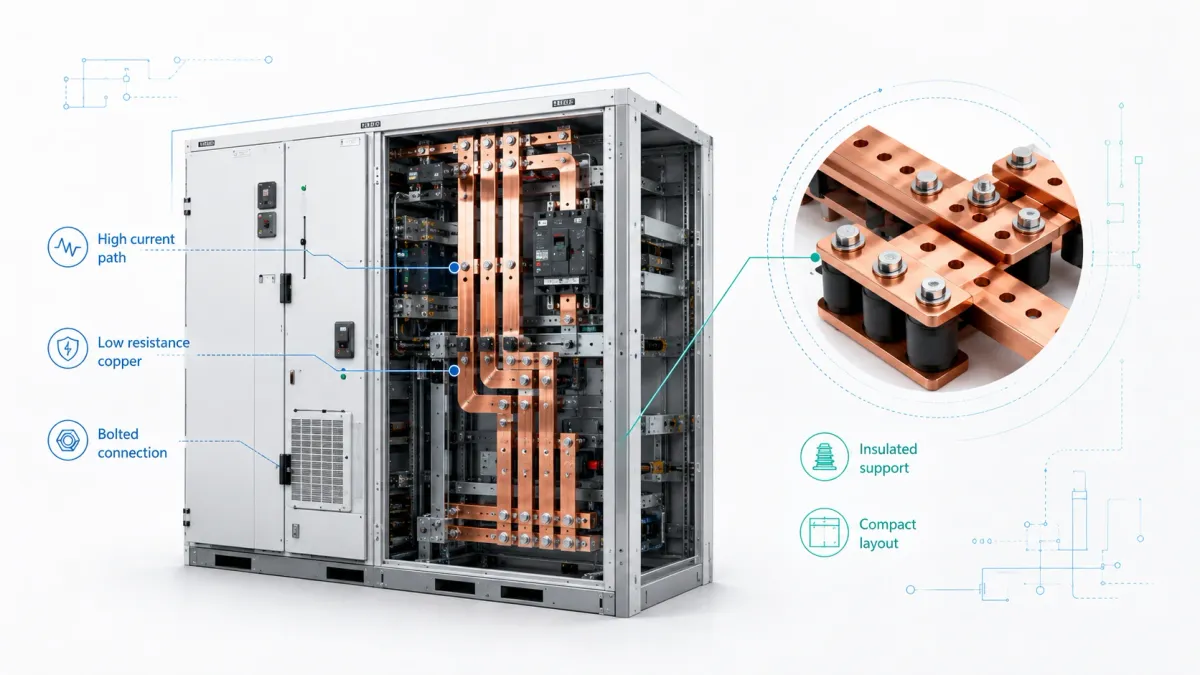
Switchgear is one of the most traditional and demanding applications for power bus bars. In low-voltage switchgear and switchboards, busbars distribute current between incoming sections, circuit breakers, feeder sections, metering compartments, neutral bars and grounding systems. In medium-voltage and special power equipment, busbar design must also account for insulation coordination, short-circuit force, phase spacing, support insulators and enclosure geometry.
International standards shape how switchgear is designed and verified. IEC 61439-1:2020 covers general definitions, service conditions, construction requirements, technical characteristics and verification requirements for low-voltage switchgear and controlgear assemblies. IEC 61439-2:2020 defines specific requirements for power switchgear and controlgear assemblies with rated voltage not exceeding 1,000 V AC or 1,500 V DC. For North American switchboards, UL notes that UL 891 is widely used for dead-front switchboards. For low-voltage power circuit breaker switchgear, UL 1558 covers metal-enclosed assemblies containing devices such as low-voltage power circuit breakers, switches, controls, instrumentation and metering.
A busbar used in switchgear must do more than carry rated current. It must remain stable during short-circuit events, maintain spacing between phases, avoid unsafe temperature rise and connect reliably to breakers or other devices. During a fault, high current can create strong electrodynamic forces between conductors. If the supports, spacing or copper geometry are weak, bars can deform, stress terminals or damage insulation. For this reason, switchgear busbars are usually designed together with supports, insulators, enclosure layout and protective-device coordination.
Common switchgear busbar locations
Power bus bars can appear in several zones of a switchgear assembly:
- Main busbars distributing current across sections.
- Vertical riser busbars connecting the main bus to feeder devices.
- Feeder busbars connecting breakers, switches or outgoing terminals.
- Neutral and grounding bars supporting safe return and bonding paths.
- Flexible links connecting moving or tolerance-sensitive devices.
- Transition busbars connecting transformers, rectifiers, bus ducts or cable terminals.
Each location has different priorities. Main busbars emphasize continuous current, temperature rise, short-circuit withstand and support spacing. Feeder bars emphasize hole accuracy, contact flatness and clean routing. Grounding bars emphasize continuity, corrosion resistance and service accessibility. Flexible links emphasize movement, vibration relief and alignment tolerance.
Why copper remains the preferred switchgear material
Copper is widely used in switchgear because it combines high conductivity with strong thermal behavior and stable mechanical properties. Higher conductivity means less resistance for a given size. Less resistance means less voltage drop and lower heat generation. The Copper Development Association explains in its Electrical Conductivity design guide that commercially pure copper products can exceed 100% IACS because refining and processing have improved since the original IACS reference was adopted. In practical switchgear design, this helps engineers keep the assembly compact without sacrificing current capacity.
However, copper grade alone does not guarantee performance. The joint is often the most critical part. A copper bar with a poor bolted connection can run hotter than a properly designed smaller bar. Contact performance depends on surface flatness, plating, overlap area, bolt torque, washer selection, contamination control and thermal cycling. Tin plating is commonly used because it helps slow oxidation and provides a stable contact surface for many industrial environments. Nickel plating may be selected for higher temperature or corrosion-resistant requirements. Silver plating may be used in high-performance contact zones, but cost often limits it to selective areas.
JUMAI’s article Busbar Copper: Why Copper Is Still the Preferred Material for High-Current Conductors explains that copper affects not only power loss and voltage drop, but also cabinet size, cooling strategy, insulation aging and service life.
Design guidance for switchgear buyers
For switchgear projects, the buyer should avoid specifying only “copper busbar, tin plated, according to drawing.” That may be enough for a repeat order, but for a new design it leaves too much room for interpretation. A more complete request should include rated current, system voltage, short-circuit rating, ambient temperature, enclosure type, insulation requirement, plating specification, support spacing, contact method and applicable standard.
For example, a practical switchgear RFQ could say:
“We need custom copper power bus bars for a low-voltage switchgear assembly. Rated current is 1,600 A continuous. System voltage is 400/480 V AC. The assembly will be evaluated under IEC 61439. Busbars require tin-plated contact areas, deburred edges, M10 mounting holes, controlled flatness at bolted joints, and epoxy insulation on selected phase sections with uncoated terminal windows. Prototype quantity is 30 sets, followed by annual production of 2,000 sets after validation.”
This type of request gives the supplier enough information to review manufacturability and ask useful engineering questions. JUMAI can support rigid copper busbars, insulated bus bars and related precision stamped or deep-drawn parts when the switchgear assembly requires brackets, covers, spacers or formed contact pieces.
Power bus bar applications in battery systems
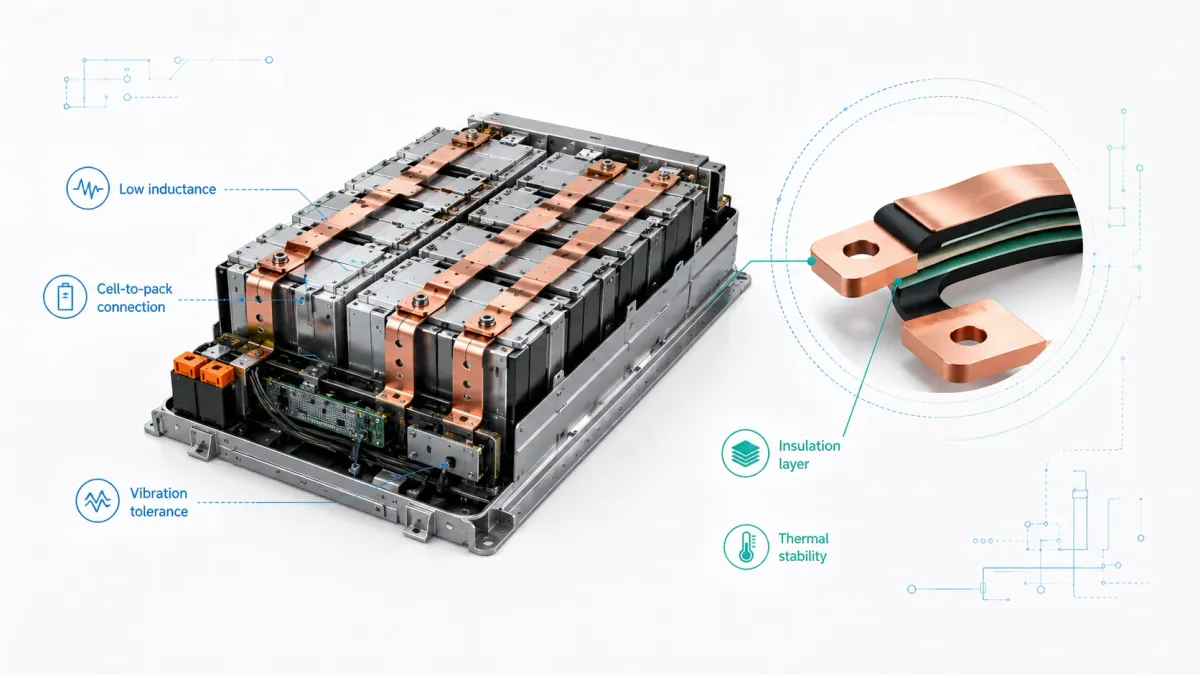
Battery systems are one of the fastest-growing markets for custom power bus bars. The term “battery system” can include EV battery packs, battery energy storage systems, industrial battery cabinets, backup power systems, marine battery packs, forklifts, charging systems and high-voltage DC test platforms. In all of these applications, the busbar must carry large current safely while fitting into a compact mechanical structure.
The busbar in a battery pack may connect cell groups, modules, fuses, contactors, current sensors, shunts, pre-charge circuits, DC link capacitors or inverter terminals. In a BESS cabinet, busbars may connect battery modules in racks, join string-level protection devices, support DC combiner layouts and connect to PCS or inverter equipment. Because DC systems can sustain arcs differently from AC systems, insulation, spacing, service protection and clear documentation become especially important.
JUMAI’s Battery Busbar Design Guide explains that battery projects should specify not only the conductor shape but also rated voltage, dielectric test, insulation material, thickness, exposed terminal area and operating environment. This is important because a battery busbar is often very close to other conductors, module housings, sensors, cooling plates or grounded metal. Small insulation mistakes can cause large safety problems.
Rigid, flexible and braided busbars in battery systems
Battery systems may use several busbar types in the same assembly:
- Rigid copper busbars are useful where the connection points are fixed and the current path must be stable, compact and easy to assemble.
- Laminated flexible busbars are useful where the conductor must absorb vibration, tolerance stack-up or thermal expansion.
- Braided copper connectors are useful for grounding, bonding and movement zones.
- Insulated bus bars are used where accidental contact, phase-to-phase short circuit or tool-drop risk must be reduced.
EV battery packs are exposed to vibration, shock, temperature changes and mechanical tolerance. A rigid bar may be excellent for a fixed module-to-module connection, but it can transfer stress into terminals when connected parts move. A laminated flexible busbar can act as a controlled movement zone. It uses stacked copper foils bonded or welded at terminal areas while the middle section remains flexible. This design can carry high current while reducing stress on cells, modules and fasteners.
BESS cabinets are usually less exposed to road vibration than vehicles, but they still face thermal cycling, transport shock, installation tolerance, maintenance handling and cabinet-level layout constraints. In many stationary systems, rigid busbars provide clean and repeatable routing, while flexible or braided conductors help at module transitions, doors, grounding points and serviceable connections.
JUMAI’s Flexible Copper Busbar: A Practical Guide for EV Batteries, BESS and Power Distribution explains the commercial value of flexible copper busbars: lower assembly complexity, better space utilization, controlled current paths and improved mechanical reliability.
Insulation requirements in battery busbars
Battery busbar insulation must be treated as part of the electrical design, not as a late cosmetic cover. The insulation system may include heat shrink tubing, epoxy powder coating, PVC dipping, silicone sleeve, PET or PI film, molded covers or laminated insulation layers. The correct option depends on voltage, temperature, flexibility, fire requirements, abrasion risk, bend geometry and production volume.
For a rigid copper busbar, epoxy powder coating or heat shrink may be practical if the geometry is simple and terminal windows are clearly defined. For a laminated flexible busbar, film, sleeve or flexible coating must tolerate bending without cracking or exposing copper. For braided conductors, sleeve or heat shrink may protect the braid while still allowing movement. JUMAI’s article Insulated Bus Bars for Battery Packs, Switchgear and Power Cabinets is a useful internal reference because it separates rigid insulated busbars, laminated flexible insulated busbars and braided insulated busbars as different product families.
The buyer should define exposed copper areas carefully. If insulation covers a bolted contact surface, the part cannot be assembled correctly. If the exposed window is too large, the part may create touch or short-circuit risk. If coating edges are poorly controlled, insulation may lift, crack or interfere with washers. For higher-voltage battery systems, teams should also review clearance, creepage, dielectric test, pollution environment and service accessibility according to the applicable equipment standard.
Battery system example
A clear battery busbar RFQ might look like this:
“We need a custom insulated power bus bar for an 800 V DC EV battery pack. The busbar connects two modules. Continuous current is 300 A, peak current is 600 A for 10 seconds, operating temperature is -40°C to 105°C, and the busbar must tolerate vibration and thermal cycling. Preferred construction is laminated flexible copper with tin-plated terminal areas, orange insulation, two M6 mounting holes and controlled exposed copper windows. Prototype quantity is 50 pieces, and expected annual volume is 20,000 pieces after validation. STEP and PDF drawings are available.”
This request tells the supplier why the part exists, not only what it looks like. It also helps the supplier decide whether rigid copper, laminated flexible copper, a braided connector or a hybrid design is the best manufacturing direction.
Power bus bar applications in data centers
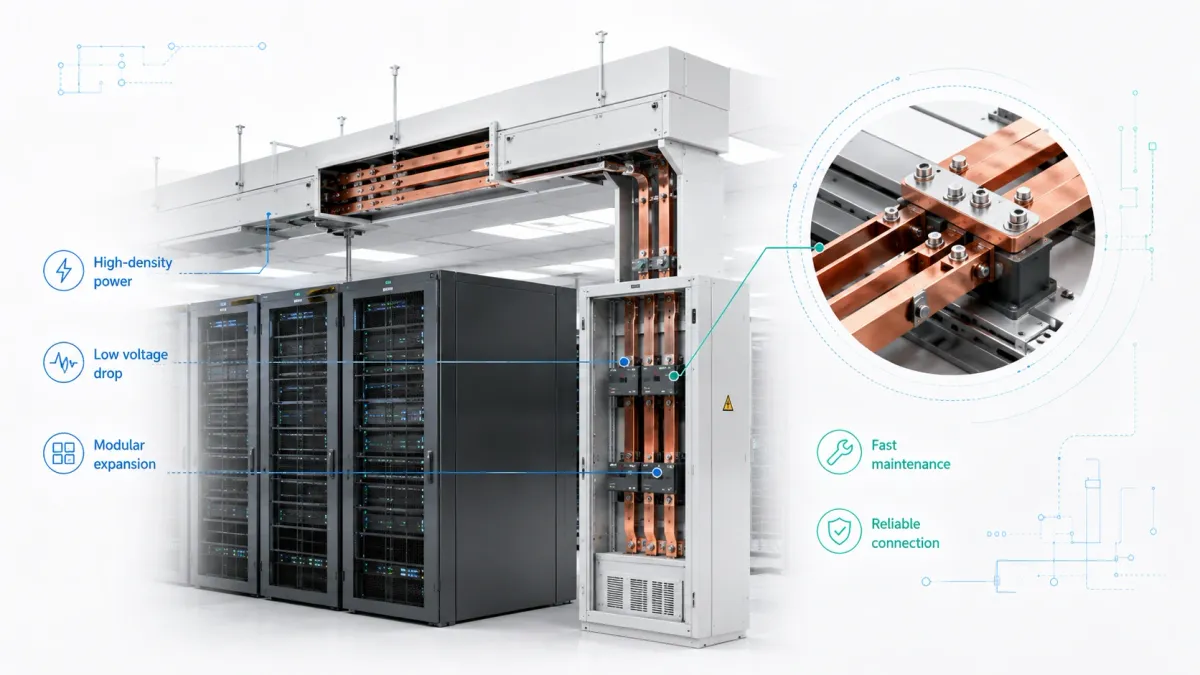
Data centers are no longer low-density rooms filled with ordinary servers. AI training clusters, GPU inference platforms, cloud computing, edge computing, telecom infrastructure and high-performance computing are pushing much more power into each rack and cabinet. This makes the power bus bar increasingly important at multiple levels: upstream switchgear, transformers, UPS cabinets, busway systems, power distribution units, rack PDUs, power shelves and server power modules.
The IEA’s Energy and AI report says data center electricity consumption could more than double to around 945 TWh by 2030, and AI is a major driver of this growth. The same topic page notes that data center electricity demand grows much faster than total electricity demand from other sectors in the base case. For data center operators and equipment manufacturers, this growth turns power distribution from a background infrastructure issue into a design bottleneck.
A data center power chain may include utility input, transformers, medium-voltage switchgear, low-voltage switchgear, UPS systems, generators, busway, remote power panels, rack PDUs, power shelves, server power supplies and DC/DC converters. A busbar inside a rack may be physically small compared with the building, but it sits close to the load. Any voltage drop, hot spot, loose connection or installation error at this level can affect expensive IT equipment.
JUMAI’s article Bus Bar for Server Rack Power Distribution explains how rack-level busbars are becoming more important as AI servers and high-density racks push more current into compact spaces. It also discusses rigid copper busbars, laminated flexible busbars, braided grounding links and insulated busbars around server racks.
48 V distribution and high-current implications
Many high-density computing architectures use 48 V power distribution to reduce current compared with lower-voltage distribution while still supporting efficient DC conversion near the load. Even at 48 V, currents can be very high when rack power rises. For example, a 24 kW load at 48 V requires about 500 A before conversion losses are considered. A 48 kW load requires about 1,000 A. At these current levels, milliohms matter. A small resistance increase at a joint can create heat, waste energy and reduce voltage margin.
This is where busbar geometry helps. A flat copper conductor can provide a low-resistance path, a broad heat-dissipation surface and defined contact points. It can also reduce cable congestion in the rack. A rigid busbar may serve as a vertical or horizontal power spine. A laminated flexible busbar may connect a power shelf to a module where tolerance or service movement exists. A braided copper strap may provide grounding or bonding continuity to rack frames, doors and removable panels.
Data center busbar design priorities
Data center equipment buyers should focus on several design priorities:
- Low voltage drop. High current at low voltage leaves less margin for unnecessary resistance.
- Stable contact resistance. Bolted joints must remain stable under thermal cycling and service handling.
- Temperature control. Busbars near electronics, power shelves or enclosed airflow paths must not create hot spots.
- Repeatable assembly. Rack manufacturing requires controlled hole locations, bend geometry and exposed contact windows.
- Insulation and touch protection. Compact racks may place conductors close to grounded frames or service zones.
- Grounding and bonding. Braided copper can support flexible bonding where panels or modules move.
- Scalability. A busbar design may need to support multiple rack configurations or power levels.
A strong RFQ for a data center rack busbar should include current, voltage, rack layout, cooling environment, expected temperature rise, surface finish, mounting method, insulation requirement, mating hardware and service conditions. For upstream data center power equipment such as UPS cabinets or PDUs, the buyer should also define short-circuit requirements, applicable standards and enclosure constraints.
Copper material and surface finish selection
Material selection starts with conductivity, but it should not end there. Most industrial copper power bus bars use high-conductivity copper such as C11000/ETP copper or oxygen-free grades such as C10200/C10100 when the application requires specific purity, weldability or environmental performance. The best choice depends on electrical performance, forming, welding, plating, cost and availability.
| Option | Main advantage | Typical use | Buyer note |
|---|---|---|---|
| C11000 / ETP copper | High conductivity and broad availability. | General switchgear, cabinets, busbars and power distribution. | Often the practical default for cost-performance balance. |
| C10200 oxygen-free copper | High purity and good conductivity. | Higher-reliability electrical parts and selected welded designs. | Useful when oxygen content or process behavior matters. |
| C10100 oxygen-free electronic copper | Very high purity. | Special high-reliability or demanding process applications. | Higher cost; specify only when the application needs it. |
| Tin plating | Stable contact surface and oxidation resistance. | Switchgear, battery links, power cabinets, general busbars. | Common balance of performance and cost. |
| Nickel plating | Higher-temperature and barrier performance. | Harsh environments or selected dissimilar-metal interfaces. | Confirm temperature, thickness and contact requirements. |
| Silver plating | Excellent contact performance. | High-performance switchgear or special contact zones. | Often best used selectively because of cost. |
| Insulated coating | Touch protection and phase separation. | Battery packs, BESS cabinets, compact switchgear and racks. | Define bare terminal windows and masking tolerance. |
Surface finish is often where low-cost sourcing creates hidden risk. Bare copper can be acceptable in some controlled environments, but exposed copper oxidizes. Oxidation may not always destroy conductivity in the conductor body, but it can affect contact stability at bolted joints. Tin plating is common because it provides a practical balance of cost, oxidation resistance and contact performance. Nickel may be used where temperature, corrosion or dissimilar-metal concerns are more demanding. Silver offers excellent electrical contact behavior but is usually reserved for high-value contact areas.
The buyer should specify plating thickness, plating area and masking requirements. Selective plating can reduce cost when only the terminal area needs a high-performance finish. For insulated busbars, the sequence of plating, masking and coating should be reviewed carefully so that terminal windows remain clean and usable.
Thermal design: why ampacity charts are only a starting point
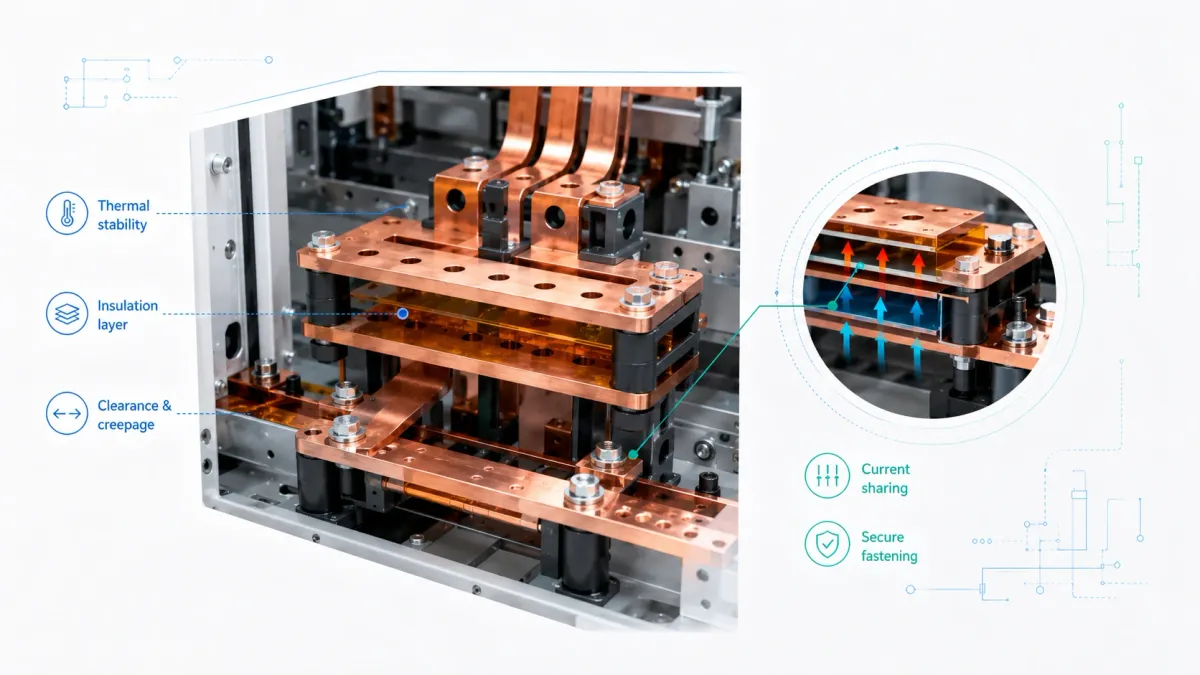
Many buyers ask for a simple ampacity table. Ampacity charts are useful during early planning, but they cannot replace project-specific design review. Current capacity depends on conductor cross-section, surface area, ambient temperature, allowed temperature rise, enclosure ventilation, conductor orientation, nearby heat sources, current waveform, frequency, plating, insulation, support structure and joint quality.
A bare copper bar in open air can release heat differently from an epoxy-coated busbar inside a sealed cabinet. A vertical bar may cool differently from a horizontal bar. A laminated flexible busbar may behave differently from a solid bar because layers, bonding zones and insulation affect heat flow. A bolted joint may run hotter than the conductor body if contact pressure is poor. A nearby breaker, fuse, transformer or power module may add heat to the same space.
The basic loss formula is easy to understand: heat generated by resistance is proportional to current squared. This means high-current systems are unforgiving. A small resistance increase may seem minor on paper, but at hundreds or thousands of amperes it can create measurable heat. For example, at 1,000 A, even 0.05 milliohm creates 50 W of heat at that point. If that heat is concentrated at a joint, the local temperature can rise, accelerating oxidation, loosening the joint through thermal cycling and increasing resistance further.
For this reason, the buyer should define allowable temperature rise rather than only rated current. If a project must comply with a particular switchgear, battery or data center equipment standard, the relevant test method should be discussed early. The final equipment manufacturer remains responsible for system-level validation, but a busbar supplier can help avoid obvious manufacturing and design risks before prototypes are built.
Short-circuit withstand and mechanical support
A power bus bar must survive not only normal operation but also abnormal events. Short-circuit current can create intense heating and strong magnetic forces. In switchgear and power cabinets, these forces can push busbars apart or pull them together depending on phase arrangement and current direction. If the design lacks adequate support spacing, conductor stiffness or insulation strength, the busbar can bend, damage supports or reduce clearances.
Short-circuit design is especially important in switchgear, UPS systems, battery combiner cabinets and high-current DC distribution. The buyer should provide available fault current, expected duration and protective-device data when available. Mechanical supports should be considered together with conductor geometry. A thick copper bar may carry current well, but if it is not supported correctly, it may still fail mechanically during a fault.
For battery systems, short-circuit risk also includes tool drops, service errors, damaged insulation and accidental contact between live conductors. This is why insulation windows, protective covers, barriers and service procedures matter. A power bus bar design should make correct assembly easy and incorrect contact difficult.
Manufacturing process for custom power bus bars
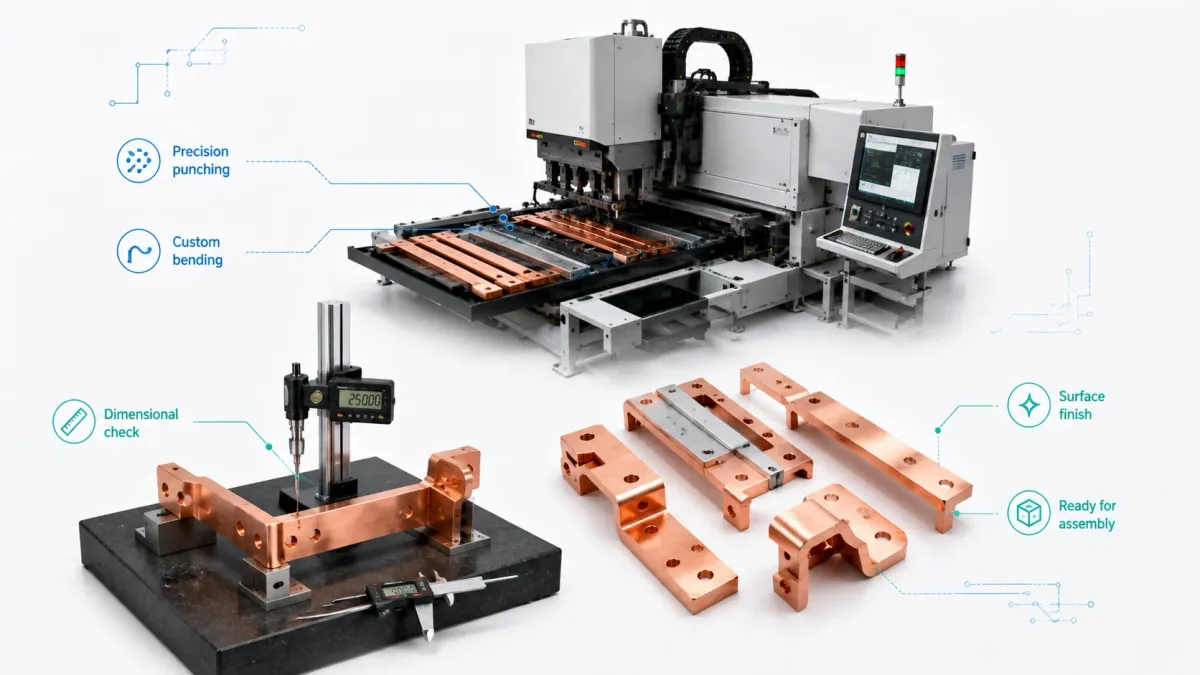
A custom power bus bar is usually produced through several controlled steps. The exact process depends on whether the part is rigid, laminated flexible, braided, plated, insulated or integrated with other metal components. A practical workflow may include:
- Requirement review. The supplier reviews drawings, current rating, voltage, application, material, plating, insulation and quantity.
- DFM feedback. The supplier checks bend radius, hole position, edge distance, tolerances, plating windows, coating windows and tooling feasibility.
- Material preparation. Copper sheet, strip, bar, foil or braid is selected according to grade, thickness and temper.
- Cutting or stamping. The conductor outline is made by stamping, punching, CNC cutting, laser cutting or other suitable methods.
- Deburring and edge control. Edges are processed to reduce burrs that could damage insulation or create assembly risk.
- Bending or forming. Rigid parts are bent or formed with controlled angle, radius and flatness.
- Welding or bonding. Flexible laminated busbars may use press welding, diffusion bonding, ultrasonic welding or other joining methods at terminal areas.
- Surface treatment. Tin, nickel, silver or other finishes are applied according to specification.
- Insulation or coating. Heat shrink, epoxy coating, sleeve, film, dipping or covers are applied with defined terminal windows.
- Inspection and testing. Dimensions, hole positions, coating areas, plating appearance, continuity, insulation and packaging requirements are checked.
- Packing and traceability. Parts are packed to protect plating, flatness, insulation and contact surfaces during shipping.
JUMAI’s Copper Busbar Guide provides a broader overview of copper busbar materials, types, manufacturing routes and custom options. For buyers, the key lesson is simple: manufacturability should be reviewed before the design is frozen. A small drawing change can reduce scrap, simplify bending, improve coating control or lower tooling cost.
Quality control items buyers can request
Quality control should match the risk level of the application. A simple grounding strap does not need the same inspection plan as an 800 V battery busbar or a switchgear main phase conductor. However, buyers should know which items may be relevant:
- Material certificate or material declaration.
- Dimensional inspection report.
- Hole diameter and position check.
- Bend angle and bend direction verification.
- Flatness check at bolted contact areas.
- Burr and edge condition inspection.
- Plating thickness and adhesion checks when required.
- Coating thickness and coverage inspection.
- Dielectric withstand test for insulated parts.
- Continuity or resistance check when required.
- Visual inspection for scratches, oxidation, coating damage and contamination.
- Packaging inspection to protect contact surfaces.
For production programs, the buyer may also request first article inspection, control plans, sampling inspection, process capability data for critical dimensions or lot traceability. The correct level depends on volume, application risk and customer requirements.
RFQ checklist for power bus bar projects
A clear RFQ reduces quotation time and improves engineering discussion. The following checklist can be copied into a sourcing document before contacting JUMAI.
A practical RFQ should include the following items:
- Application: switchgear, EV pack, BESS, UPS, PDU, rack power, inverter or other system. This helps the supplier understand the real operating environment.
- Drawings: PDF plus STEP/IGES when available. These files reduce interpretation errors and support DFM review.
- Current data: continuous current, peak current and duty cycle. These values drive copper size and thermal review.
- Voltage data: working voltage, AC/DC type and test voltage if known. This information drives insulation, creepage and clearance discussion.
- Thermal data: ambient temperature and allowed temperature rise. These limits help prevent undersizing and hot-spot risk.
- Material: C11000, C10200, C10100, T2 copper or customer standard. Material choice controls conductivity, cost and process behavior.
- Surface finish: bare copper, tin, nickel, silver or selective plating. Finish selection controls contact stability and corrosion resistance.
- Insulation: material, color, thickness, windows and dielectric test. Good insulation details prevent assembly interference and safety risk.
- Contact method: bolt size, torque, washer, mating material and overlap area. These details control joint resistance and service reliability.
- Standard: IEC, UL, customer specification or internal validation requirement. The standard aligns quality and design assumptions.
- Quantity: prototype, pilot and annual production volume. Quantity helps choose tooling and process route.
- Target cost and schedule: target price range, delivery date and validation stage. These commercial details support practical manufacturing recommendations.
Common design mistakes and how to avoid them
Many busbar problems are avoidable when engineering and purchasing teams review the part together before the RFQ is sent. The most common mistakes are not exotic. They are basic information gaps.
Mistake 1: specifying current without temperature rise. A busbar may carry a rated current in one environment but overheat in another. Always define ambient temperature, enclosure conditions and allowable temperature rise.
Mistake 2: ignoring contact resistance. A large conductor can still fail at the joint. Define overlap area, bolt size, torque, plating and flatness requirements.
Mistake 3: using rigid copper where movement exists. If terminals move because of vibration, thermal expansion or assembly tolerance, a rigid bar may transfer stress into the joint. Consider laminated flexible or braided copper in these zones.
Mistake 4: treating insulation as decoration. Insulation affects dielectric strength, heat dissipation, bendability, coating edge quality and assembly clearance. Define the material and exposed copper windows early.
Mistake 5: placing holes too close to edges or bends. Poor geometry may cause cracking, deformation or weak contact areas. Ask for DFM feedback before freezing the design.
Mistake 6: overusing expensive plating. Silver may be valuable in selected contact areas, but full-part silver plating may be unnecessary. Selective plating can control cost.
Mistake 7: not defining inspection criteria. If flatness, coating window or hole tolerance is critical, it must appear on the drawing or inspection plan.
Mistake 8: quoting too early with incomplete data. Early budget quotes are useful, but final sourcing should be based on complete drawings and operating requirements.
How JUMAI supports power bus bar projects
JUMAI is positioned as a custom manufacturing partner for copper busbars and related precision metal components. The company supports rigid copper busbars, laminated flexible busbars, braided copper conductors, insulated bus bars, plated terminals and related custom metal parts. It also provides deep drawing, stamping die customization and tooling components, which can be useful when a busbar assembly requires formed terminals, shields, brackets, covers, spacers or other metal accessories.
For switchgear customers, JUMAI can support rigid copper busbars, phase links, feeder bars, neutral bars, grounding bars, plated contact parts and insulated conductors. For battery system customers, JUMAI can support module busbars, flexible laminated links, BESS cabinet conductors, tin-plated contact areas, orange insulation and custom terminal shapes. For data center customers, JUMAI can support rack-level copper conductors, power shelf links, UPS/PDU busbars, braided grounding straps and insulated rack distribution parts.
The main value is not only production. It is the ability to review the part as an electrical-mechanical component. A JUMAI project review can help identify whether a design should use rigid copper, flexible laminated copper, braided copper or a hybrid structure. It can also help clarify manufacturability, plating windows, insulation windows, bend limits, hole tolerances, packaging requirements and cost drivers.
A good power bus bar starts with good project definition. Buyers who can provide CAD drawings, rated current, voltage, insulation requirements, surface finish, quantity and operating environment will receive more useful feedback than buyers who only send a copper size. When the application involves high current, compact packaging or safety-critical equipment, that difference matters.
Practical selection guide by application
For switchgear, start with rated current, short-circuit withstand, temperature rise, phase spacing, support spacing and applicable IEC or UL requirements. Use rigid copper for main distribution where geometry is fixed. Consider tin or silver plating at bolted contact surfaces depending on performance and cost. Add insulation, barriers or covers where touch protection and phase separation are required.
For EV battery packs, start with voltage, continuous current, peak current, vibration, thermal cycling and packaging space. Use laminated flexible copper where terminals move or where tolerance must be absorbed. Use rigid copper where fixed module connections need a stable shape. Define insulation color, exposed terminal windows and dielectric test clearly.
For BESS cabinets, start with DC voltage, module current, rack layout, service safety and cabinet thermal conditions. Use rigid copper for repeatable cabinet paths and flexible links for module transitions or tolerance zones. Define protective covers and insulation to reduce tool-drop and maintenance risk.
For data center racks, start with rack power, distribution voltage, current, airflow, service access and contact resistance. Use rigid busbars as power spines or fixed links. Use flexible laminated busbars near removable power modules. Use braided copper for grounding and bonding. Control plating and flatness at joints because milliohms matter at high current.
For UPS, inverters and power conversion equipment, start with current waveform, switching environment, DC link layout, thermal path and capacitor or semiconductor terminals. Busbar geometry can affect not only resistance but also loop inductance and packaging efficiency. Work with the supplier early when compact power electronics are involved.
FAQ
What is a power bus bar used for?
A power bus bar is used to collect, distribute or transfer electrical current inside high-current equipment. Common applications include switchgear, control cabinets, EV battery packs, BESS racks, UPS systems, inverters, data center power distribution units, rack power systems, transformers, charging equipment and industrial machinery.
Is copper or aluminum better for a power bus bar?
Copper is preferred in many compact high-current applications because it has higher electrical conductivity and better thermal performance for a given cross-section. Aluminum can reduce weight and cost in some systems, but it usually needs a larger cross-section for similar resistance and requires careful attention to joints, plating and thermal expansion. The best choice depends on space, weight, cost, current, joint design and the applicable standard.
What copper grade is commonly used for busbars?
C11000/ETP copper is commonly used because it offers high conductivity, broad availability and practical formability. C10200 and C10100 oxygen-free copper may be selected for special requirements involving purity, weldability, vacuum-related concerns or higher-reliability processes. Buyers should specify the required material standard instead of only writing “red copper” or “pure copper.”
Why is tin plating common on copper busbars?
Tin plating helps slow oxidation and provides a stable contact surface for many industrial environments. It is often a cost-effective finish for switchgear, battery systems, power cabinets and general distribution. Nickel and silver may be used when the contact environment or performance target requires them.
Does an insulated bus bar still need clearance and creepage distance?
Yes. Insulation helps reduce accidental contact and short-circuit risk, but it does not eliminate the need for proper equipment layout. Clearance, creepage and solid insulation should be considered together according to voltage, environment, pollution degree and the applicable equipment standard.
Are flexible busbars better than rigid busbars?
Not always. Rigid busbars are excellent for fixed high-current paths with stable geometry. Flexible laminated busbars are better when the conductor must absorb movement, vibration, thermal expansion or tolerance stack-up. Braided busbars are useful for grounding, bonding and flexible links. Many systems use a hybrid design.
What information should I send to JUMAI for a quote?
Send PDF drawings, STEP or IGES files if available, application description, continuous current, peak current, voltage, temperature rise target, material, plating, insulation, quantity, applicable standards and special inspection requirements. The clearer the RFQ, the faster and more accurate the technical review.
Can JUMAI manufacture custom power bus bars from drawings?
Yes. JUMAI can manufacture custom rigid copper busbars, laminated flexible busbars, braided copper conductors, insulated bus bars and plated copper parts according to customer drawings and application requirements. JUMAI can also support related stamped parts, deep-drawn components, brackets, covers, spacers and tooling-related parts when the project requires more than a simple conductor.
A better power bus bar starts with a better specification
Power bus bars are becoming more important because the equipment around them is becoming more power-dense. Switchgear must be safer and more verifiable. Battery systems must carry high DC current inside compact, insulated and vibration-sensitive structures. Data centers must deliver more power to racks while controlling loss, heat and service risk. In all three markets, the busbar is not only a conductor. It is a current path, thermal path, mechanical interface and manufacturing reference.
For buyers, the best sourcing strategy is to define the application before asking for the price. Provide the current, voltage, temperature, environment, surface finish, insulation, contact method, drawings and volume. Ask the supplier to review manufacturability, not only copper cost. Treat plating and insulation as functional requirements. Consider rigid, flexible, braided and hybrid busbar designs based on movement, packaging and service needs.
JUMAI supports global OEMs, equipment builders and engineering teams with custom copper power bus bars for switchgear, battery systems, data centers, renewable energy equipment, charging systems, UPS cabinets and industrial power distribution. To start a project, prepare your drawings and requirements, then contact JUMAI through the Custom Copper Busbars page for engineering review and quotation support.