In the rapidly evolving landscape of modern electrical engineering, the demand for efficient, reliable, and space-optimized power distribution has never been higher. Whether you are engineering the next generation of electric vehicles (EVs), scaling up hyperscale data centers, or designing robust eco-friendly renewable energy grids, the backbone of your power architecture relies on a critical component: Precision Copper Busbars.
At JUMAI, we have spent years at the forefront of designing, researching, and manufacturing custom flexible, rigid, and braided copper busbars, alongside specialized deep drawing dies and accessories. Drawing from decades of hands-on industry experience—spanning green energy, data center infrastructure, and large-scale power transmission—we understand that choosing the right busbar is not just a matter of conductivity; it is a complex decision involving thermal dynamics, mechanical stress, space constraints, and long-term economic viability.
This comprehensive guide will explore the critical differences between flexible and rigid Precision Copper Busbars, providing you with the industry data, comparative analysis, and technical insights needed to make the optimal choice for your next project.
Table of Contents
The Fundamental Role of Precision Copper Busbars in Modern Infrastructure
Before diving into the structural differences between flexible and rigid options, it is essential to understand why Precision Copper Busbars are the gold standard in power distribution. Historically, electrical systems relied heavily on traditional bundled cables. However, as power demands increased and spatial footprints shrank, the limitations of cabling—such as heat retention, complex routing, and higher resistance—became apparent.
Copper busbars solve these issues by offering a solid, highly conductive pathway for electrical current. According to the Copper Development Association, copper offers a benchmark electrical conductivity of 100% to 101% IACS (International Annealed Copper Standard), making it vastly superior to aluminum and other alloys in minimizing power loss during transmission.
When we use the term Precision Copper Busbars, we are referring to components manufactured to exact dimensional tolerances, ensuring perfect alignment in complex assemblies like switchgears or battery packs. This precision is critical; even a millimeter of deviation can lead to improper contact, increasing electrical resistance, generating dangerous heat, and potentially causing catastrophic system failure.
At JUMAI, our custom machining and deep drawing capabilities allow us to produce these busbars and their accompanying accessories with unparalleled exactness, ensuring that every connection is secure and highly efficient.
Deep Dive: Rigid Precision Copper Busbars
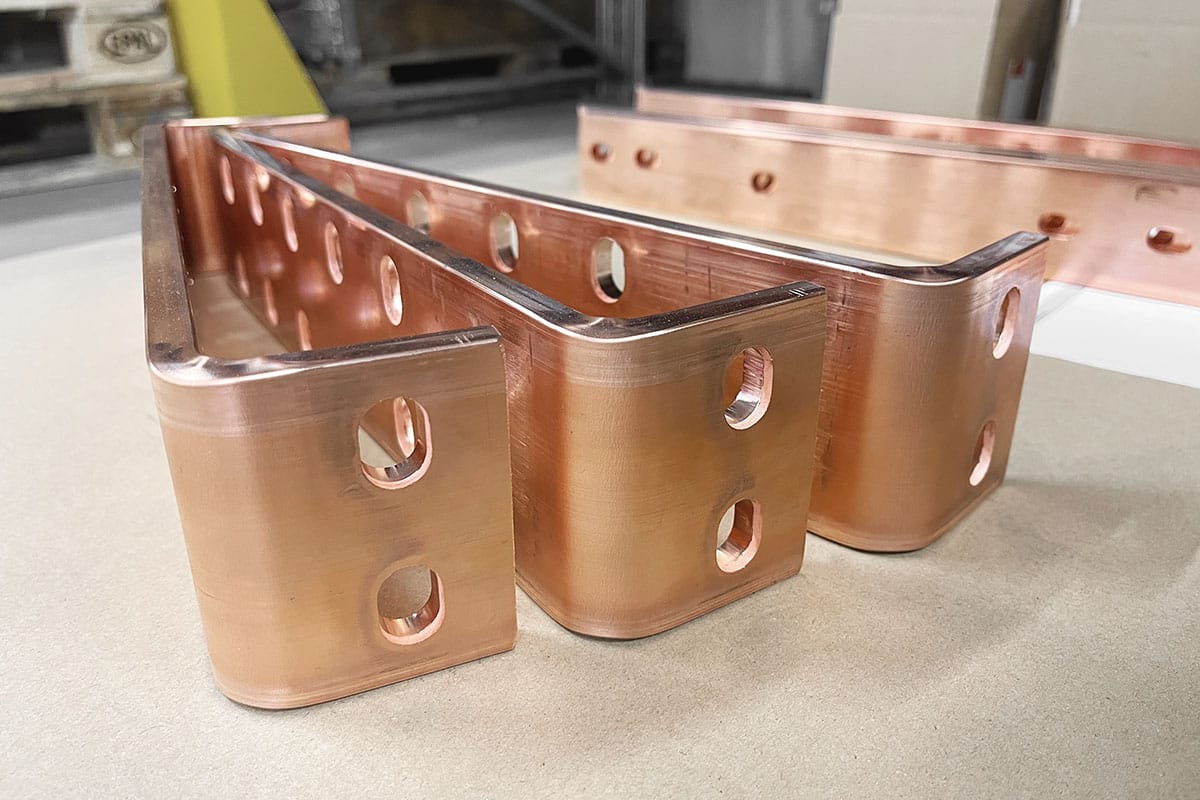
Rigid copper busbars are the traditional heavyweights of the power distribution world. Manufactured from solid copper billets, these bars are drawn, extruded, or milled into specific shapes—most commonly flat rectangles, but also U-shapes, tubes, and custom profiles.
Manufacturing and Material Specifications
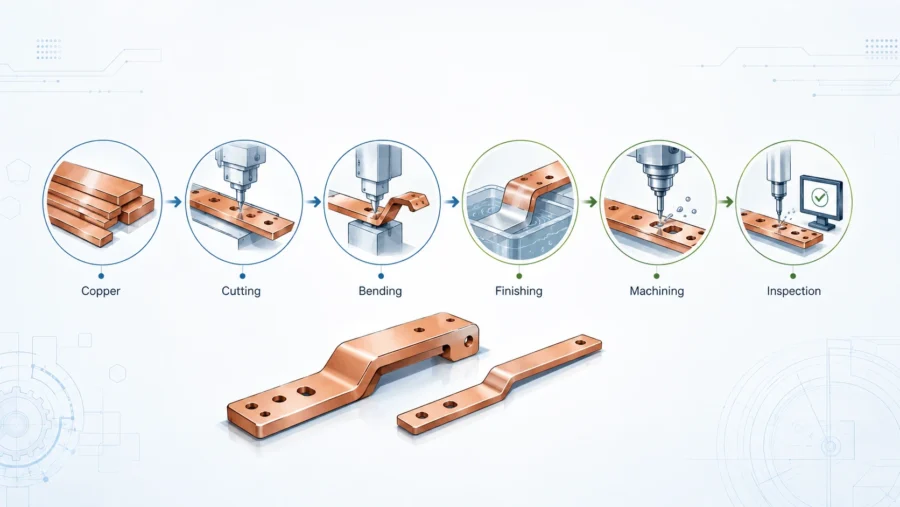
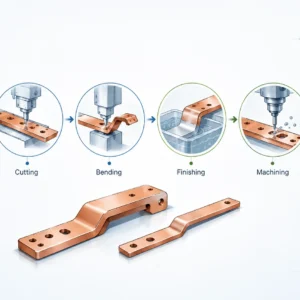
Rigid busbars are typically made from high-purity oxygen-free electronic (OFE) copper or electrolytic tough pitch (ETP) copper (such as standard C11000). The manufacturing process at JUMAI involves precision cutting, bending, punching, and milling. Because they are solid, they possess exceptional structural integrity and mechanical strength.
Key Advantages of Rigid Busbars
- Maximum Current Carrying Capacity (Ampacity): Because they have a large, uninterrupted cross-sectional area, rigid busbars can handle massive electrical loads with minimal voltage drop.
- Superior Heat Dissipation: The flat, solid surface area of rigid Precision Copper Busbars allows for excellent natural or forced-air cooling. In large data centers where thermal management is paramount, rigid busbars efficiently radiate heat away from critical components.
- Structural Support: In heavy-duty switchgears and large power transmission centers, rigid busbars double as structural components. They can support the weight of heavy breakers and insulators without sagging or warping.
- Cost-Effectiveness at Scale: For long, straight runs where complex routing is not required, rigid busbars are generally more cost-effective to produce and install than their flexible counterparts.
Limitations to Consider
The primary drawback of rigid busbars is their lack of mechanical flexibility. They cannot easily absorb vibrations, nor can they accommodate significant thermal expansion and contraction without transferring stress to the connected terminals. Furthermore, installing rigid busbars in confined or geometrically complex spaces requires meticulous pre-engineering and precise bending, which can increase lead times if not managed by an experienced manufacturer like JUMAI.
Deep Dive: Flexible Precision Copper Busbars
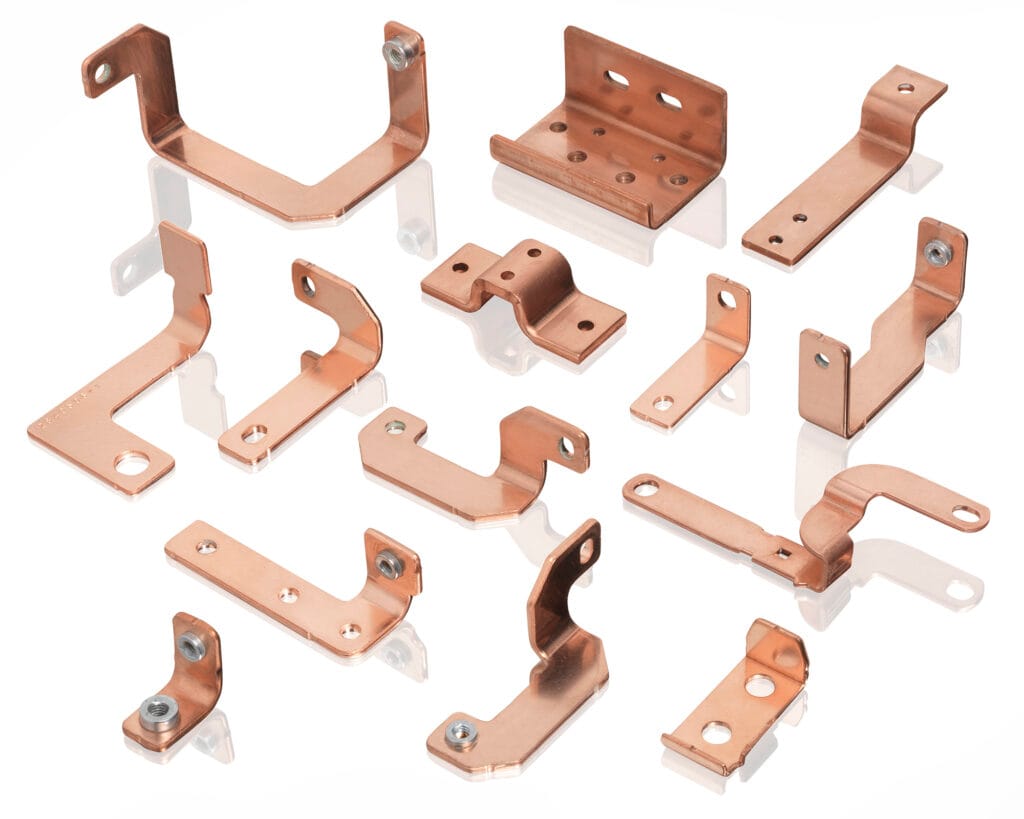
As technologies have advanced—particularly in the realms of renewable energy and electric mobility—the need for dynamic, adaptable power routing has surged. Enter flexible Precision Copper Busbars.
These components generally come in two primary forms:
- Laminated (Foil) Busbars: Constructed by stacking multiple layers of thin, highly conductive copper foils and fusing their ends together, often using specialized press-welding techniques.
- Braided Busbars: Made by weaving fine copper wires together, creating a highly pliable, rope-like structure equipped with solid, stamped terminal ends.
Key Advantages of Flexible Busbars
- Vibration Dampening and Shock Absorption: In applications like EV battery packs or wind turbine generators, continuous vibration is a reality. Rigid connections can suffer from metal fatigue and eventually crack under these conditions. Flexible busbars absorb this kinetic energy, protecting delicate terminals and ensuring a continuous electrical connection.
- Thermal Expansion Compensation: All metals expand when heated and contract when cooled. In systems with severe temperature fluctuations, a flexible busbar acts as an expansion joint, preventing the mechanical stress that would otherwise tear a rigid connection apart.
- Space Optimization: Flexible Precision Copper Busbars can be bent, twisted, and routed through tight, irregular spaces where rigid bars simply cannot fit. This is invaluable in compact electronics, aerospace applications, and modern automotive design.
- Tolerance Correction: In complex assemblies combining deep-drawn housings and multiple electrical components, slight dimensional stacking errors can occur. Flexible busbars easily bridge these minor gaps, simplifying the assembly process.
Limitations to Consider
Flexible busbars generally have a higher upfront manufacturing cost due to the complex processing required to laminate foils or weave braids. Additionally, they may have a marginally lower ampacity compared to a rigid busbar of the exact same outer dimensions, as the layers or braids introduce microscopic air gaps. However, precise engineering can easily account for this during the design phase.
Comparative Analysis: Flexible vs. Rigid Copper Busbars
To assist engineers and procurement managers in making data-driven decisions, we have compiled the following industry-standard comparative data.
Table 1: Performance and Application Matrix
| Feature / Characteristic | Rigid Precision Copper Busbars | Flexible Precision Copper Busbars |
|---|---|---|
| Primary Structure | Solid copper billet/extrusion | Layered copper foil or braided wire |
| Current Capacity (Ampacity) | Very High (Optimal for given volume) | High (Requires slight oversizing compared to rigid) |
| Vibration Resistance | Low (Susceptible to fatigue at terminals) | Very High (Absorbs kinetic energy) |
| Thermal Expansion Handling | Poor (Transfers stress to insulators) | Excellent (Acts as a thermal expansion joint) |
| Installation in Tight Spaces | Difficult (Requires complex pre-bending) | Easy (Can be manipulated on-site) |
| Structural Integrity | Excellent (Can support heavy components) | Low (Requires external support/insulation) |
| Cost Profile | Lower material/processing cost | Higher processing cost, lower installation time |
| Ideal Use Cases | Switchgears, Power Grids, Data Centers | EVs, Wind Turbines, Transformers, Robotics |
Table 2: Electrical and Thermal Properties (Typical Values)
Note: Values are based on standard C11000 ETP Copper at room temperature (20°C).
| Property | Value / Metric | Industry Implication |
|---|---|---|
| Electrical Conductivity | 100% – 101% IACS | Ensures minimal energy loss during transmission. |
| Thermal Conductivity | ~390 W/(m·K) | Rapidly dissipates heat generated by high currents. |
| Melting Point | 1083°C | Provides extreme safety margins during short circuits. |
| Coefficient of Thermal Expansion | 16.5 µm/(m·K) | Dictates the need for flexible busbars in fluctuating temps. |
| Tensile Strength (Annealed) | ~210 MPa | Determines the mechanical load rigid busbars can bear. |
According to data from the International Electrotechnical Commission (IEC), standardizing the use of high-purity copper in both flexible and rigid formats can reduce overall electrical distribution losses by up to 15% in industrial settings.
Industry-Specific Applications and Case Studies
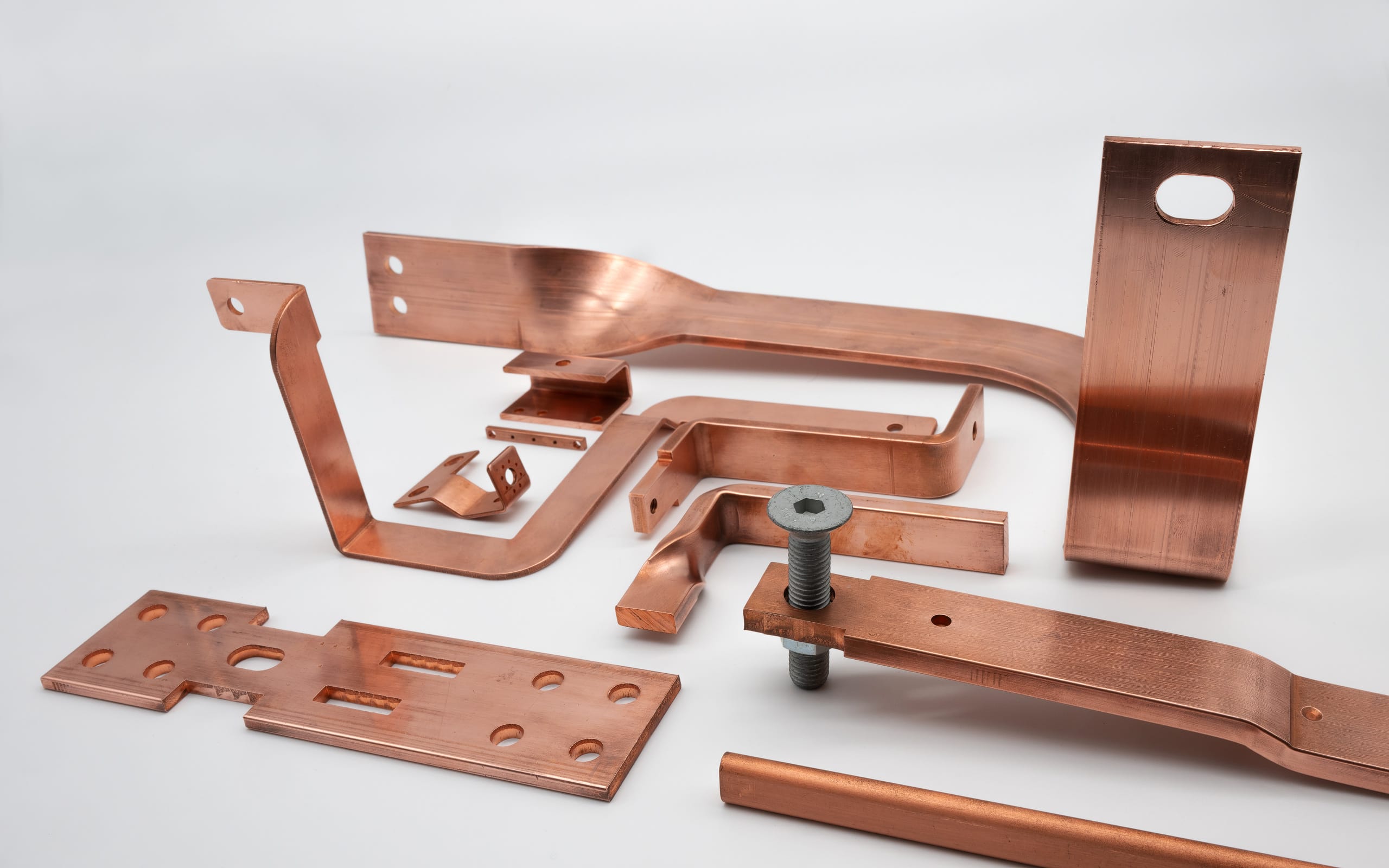
To truly understand the value of Precision Copper Busbars, we must look at how they perform in the field. Our experience at JUMAI has allowed us to engineer solutions for some of the most demanding industries on the planet.
1. Electric Vehicles (EVs) and Battery Storage Systems
The automotive industry is undergoing a historic shift. In EV battery packs, space is at an absolute premium, and the environment is harsh—subject to constant road vibration, rapid acceleration forces, and massive temperature spikes during fast charging.
- The Solution: Flexible Precision Copper Busbars are the industry standard here. Laminated busbars are used to connect individual battery cells into modules, while larger braided or laminated busbars connect the modules to the main power inverter. The flexibility prevents the brittle battery cell terminals from snapping under the stress of thermal expansion during a 150kW fast-charging session. Furthermore, custom insulation (such as PVC dipping or heat-shrink tubing provided by JUMAI) ensures safety against high-voltage arcing.
2. Renewable Energy: Wind Turbines and Solar Inverters
Eco-friendly new energy requires equipment that can survive decades in extreme environments. Wind turbines present a unique challenge: the generator sits in a nacelle hundreds of feet in the air, subject to high winds and continuous mechanical vibration, while the power must be transmitted down the tower.
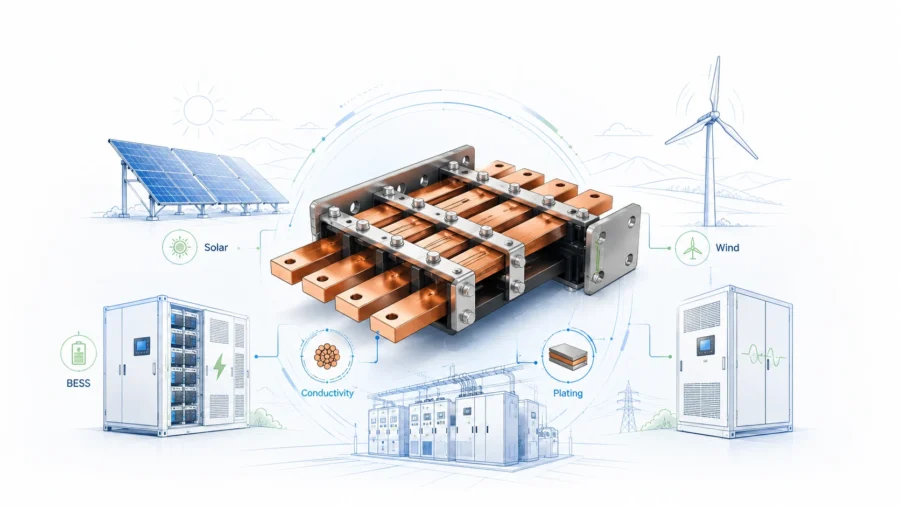
- The Solution: A hybrid approach is often utilized. Inside the nacelle, flexible braided busbars connect the vibrating generator to the static transformer. From the transformer down the tower, rigid Precision Copper Busbars are used for their high ampacity and structural stability. This combination ensures maximum efficiency and longevity, adhering to strict environmental and safety regulations globally.
3. Hyperscale Data Centers
With the rise of AI and cloud computing, data centers are consuming unprecedented amounts of power. A modern server rack can draw upwards of 30kW to 50kW of power. Managing this efficiently is critical to preventing thermal throttling and hardware failure.
- The Solution: Rigid Precision Copper Busbars are deployed in the massive switchgears and uninterruptible power supply (UPS) systems that feed the data center. They are also used in “busway” overhead distribution systems. Because data centers are static, climate-controlled environments, the flexibility is less important than raw current-carrying capacity and heat dissipation. JUMAI’s precision milling ensures these busbars fit perfectly into complex switchgear assemblies, minimizing contact resistance and lowering cooling costs.
4. Heavy Industrial Machinery and Power Transmission
Large power transmission centers step down massive grid voltages for industrial use. The transformers and switchgears involved handle thousands of amps.
- The Solution: Heavy-duty rigid busbars are mandatory here. However, where massive transformers vibrate due to magnetostriction (the humming sound you hear near power lines), heavy braided flexible busbars are installed as isolation links to prevent the vibration from shaking the rigid busbar infrastructure apart.
The Synergy of Deep Drawing Technology and Copper Busbars
What sets JUMAI apart in the global market (visit us at DeepDrawTech.com) is our comprehensive approach to hardware manufacturing. Power distribution does not happen in a vacuum; busbars must be housed, mounted, and protected.
This is where our expertise in deep drawing dies and accessories becomes invaluable. Deep drawing is a sheet metal forming process where a flat blank is drawn into a forming die by a mechanical punch. We use this technology to create custom, seamless metal housings, shielding enclosures, and precise mounting brackets that work in perfect tandem with our Precision Copper Busbars.
- Integrated Solutions: Instead of sourcing busbars from one supplier and metal enclosures from another—which often leads to tolerance mismatch and assembly headaches—JUMAI provides a holistic, custom-machined solution. Our deep-drawn components offer superior EMI/RFI shielding, which is critical in data centers and EV inverters where electromagnetic interference can disrupt sensitive electronics.
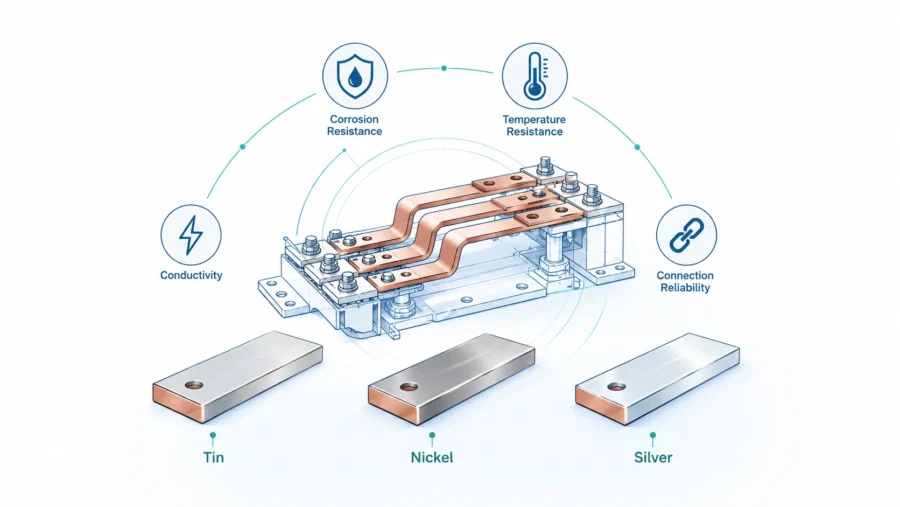
- Custom Surface Treatments: To further enhance performance, we offer custom plating options for both our flexible and rigid busbars. Tin plating is widely used to prevent copper oxidation and improve solderability, while silver plating is applied to contact areas to achieve the lowest possible contact resistance, crucial for high-frequency or extreme high-current applications.
Sizing and Engineering: Critical Considerations
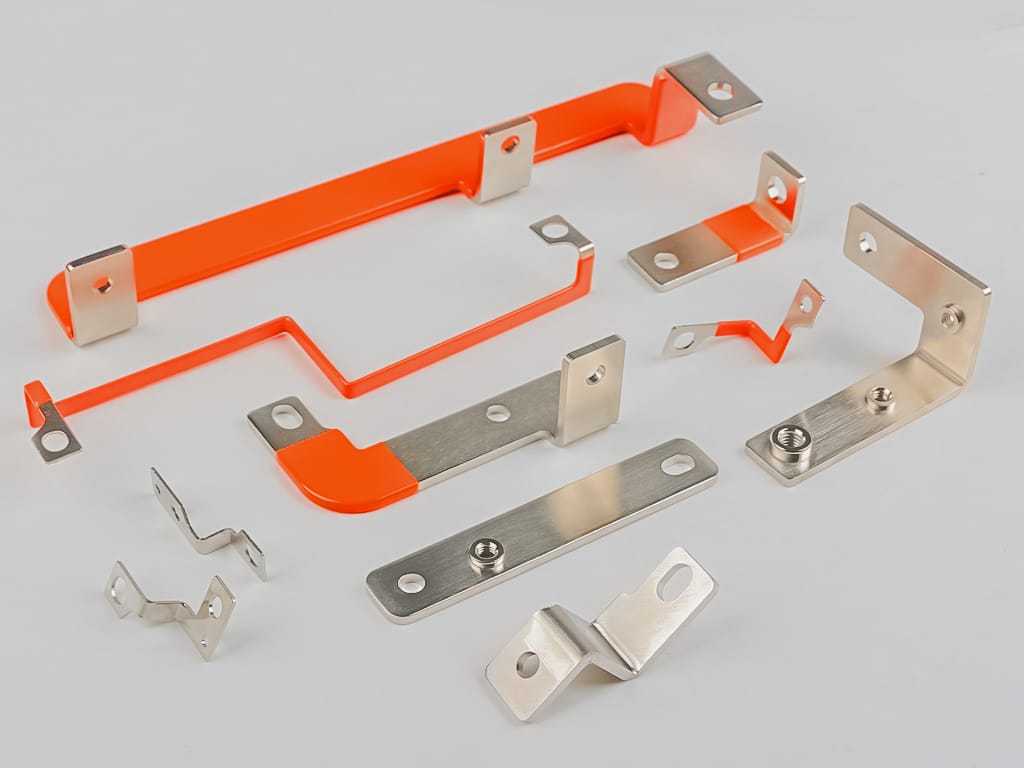
Choosing between flexible and rigid is only the first step. Proper sizing is paramount for safety and efficiency. Undersized busbars will overheat, potentially causing fires and system degradation, while oversized busbars waste valuable copper and increase project costs unnecessarily.
When JUMAI engineers consult on a project, we look at several critical metrics:
- Continuous Current vs. Peak Current: What is the steady-state load, and what are the transient fault currents (short circuits) the busbar must survive?
- Ambient Temperature: A busbar operating in a 40°C data center requires a different cross-sectional area than one operating in an 85°C engine compartment. We adhere to strict standards, such as those set by UL (Underwriters Laboratories), to calculate the permissible temperature rise.
- Skin Effect and Proximity Effect: In alternating current (AC) systems, the current tends to flow on the outer “skin” of the conductor, and adjacent busbars can interfere with each other’s magnetic fields. For high-current AC applications, we often design custom profiles (like hollow tubes or interleaved flat bars) to mitigate these effects, an area where precision CNC machining is essential.
Installation, Maintenance, and Safety Standards
Even the highest quality Precision Copper Busbars will fail if installed incorrectly. Proper installation and maintenance are critical to the lifecycle of the power system.
Best Practices for Installation
- Torque Specifications: When bolting busbars together, applying the correct torque is non-negotiable. Under-torquing leads to loose connections, high resistance, and arcing. Over-torquing can strip threads or deform the copper, reducing the contact area. JUMAI provides precise torque guidelines for all custom assemblies.
- Surface Preparation: Copper oxidizes when exposed to air. Before joining, the contact surfaces must be free of dirt, oil, and oxidation. While our plated busbars resist oxidation, bare copper must be properly cleaned and often coated with a specialized conductive joint compound to prevent air and moisture from entering the joint.
- Hardware Selection: Always use high-tensile, non-magnetic hardware (such as certain grades of stainless steel or specialized bronze alloys) for high-current AC joints to prevent the hardware from heating up due to magnetic induction. Belleville washers (conical spring washers) are highly recommended to maintain joint pressure as the copper expands and contracts over time.
Ongoing Maintenance
In critical infrastructure like data centers and power grids, proactive maintenance is standard operating procedure.
- Infrared Thermography: The most effective way to monitor busbar health is through regular infrared thermal imaging. A loose joint or failing flexible braid will show up as a “hot spot” on a thermal camera long before it causes a system failure, allowing for planned maintenance rather than emergency downtime.
- Visual Inspections: Regularly inspect flexible busbars—especially braided ones—for signs of frayed wires or discoloration, which can indicate excessive heat or chemical corrosion.
The Future of Power Distribution
As we look to the future, the requirements for power distribution are only becoming more stringent. The push for global decarbonization, as outlined by agencies like the U.S. Environmental Protection Agency (EPA), is driving massive investments in electrification.
We are seeing a trend toward higher system voltages—such as the transition from 400V to 800V architectures in EVs—which reduces current for the same power output, allowing for thinner, lighter Precision Copper Busbars. Additionally, we are pioneering the integration of liquid cooling channels directly into rigid busbar extrusions, allowing for unprecedented ampacity in incredibly dense packages for next-generation supercomputers.
At JUMAI, our R&D department is continuously testing new insulation materials, advanced pressing techniques for laminated foils, and more efficient deep-drawing processes to stay ahead of these industry demands.
Making the Right Choice with JUMAI
The debate between flexible and rigid Precision Copper Busbars is not about which is objectively better; it is about which is the precisely correct tool for your specific engineering challenge.
- Choose Rigid Busbars when you need structural integrity, massive current-carrying capacity, cost-efficiency over long runs, and operate in a static environment.
- Choose Flexible Busbars when you must combat vibration, compensate for thermal expansion, navigate tight spatial constraints, or bridge complex assemblies.
- Often, the most robust power systems utilize a strategically engineered combination of both.
Navigating these choices requires a partner with deep industry expertise and comprehensive manufacturing capabilities. At JUMAI, we don’t just supply metal; we supply custom-engineered power distribution solutions. From initial design consultation and prototype deep drawing, to high-volume production of tailored braided, laminated, and rigid copper busbars, we are dedicated to empowering your innovations.
Ensure your next project is built on a foundation of precision, reliability, and efficiency. Visit us today at DeepDrawTech.com to explore our online catalog, preview our deep drawing capabilities, and schedule a consultation with our custom machining experts. Together, we can build the efficient, electrified future.