Welcome to JUMAI, your trusted global partner in electrification. As the Editor-in-Chief at JUMAI, I have spent years working closely with engineers, procurement managers, and system designers across the green energy, data center, and high-voltage transmission sectors. Through our continuous dedication to innovation, we have established JUMAI as a premier manufacturer specializing in custom flexible, rigid, and braided copper busbars, as well as precision deep drawing dies and accessories.
In today’s rapidly evolving electrical landscape, the demand for efficient, reliable, and high-capacity power distribution has never been greater. At the heart of these modern power systems lie Precision Copper Busbars. Whether routing power through a hyperscale data center, managing the intensive electrical loads of a commercial solar farm, or driving the next generation of Electric Vehicles (EVs), the manufacturing techniques behind these components dictate the safety and efficiency of the entire system.
This comprehensive guide explores the advanced manufacturing techniques required to produce high-ampacity Precision Copper Busbars, the rigorous standards they must meet, and how JUMAI leverages cutting-edge technology to deliver bespoke solutions for our global clientele.
Table of Contents
The Indispensable Role of Precision Copper Busbars
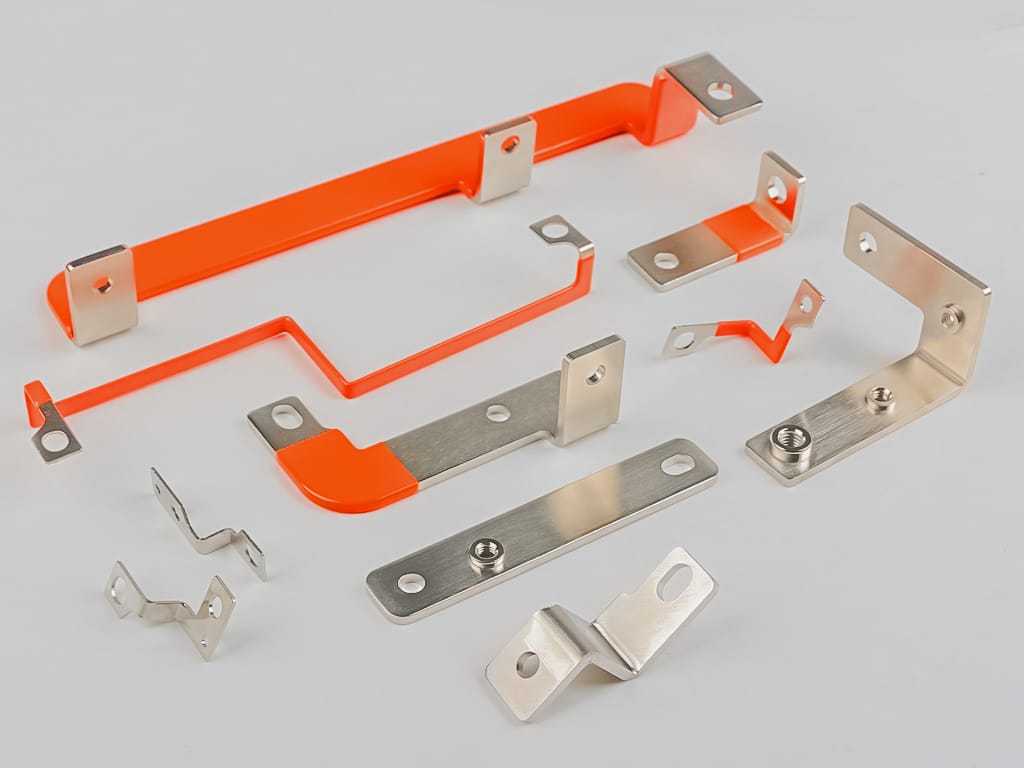
Before diving into the complex manufacturing processes, it is essential to understand why Precision Copper Busbars are the backbone of modern power architecture. A busbar is a metallic strip or bar—typically housed inside switchgear, panel boards, and busway enclosures—for local high-current power distribution.
While alternative materials like aluminum are sometimes utilized for cost-saving measures, copper remains the undisputed king of electrical conductors. According to data published by the Copper Development Association, copper offers superior thermal conductivity, higher tensile strength, and significantly lower electrical resistance compared to aluminum.
Key Applications Driving Demand
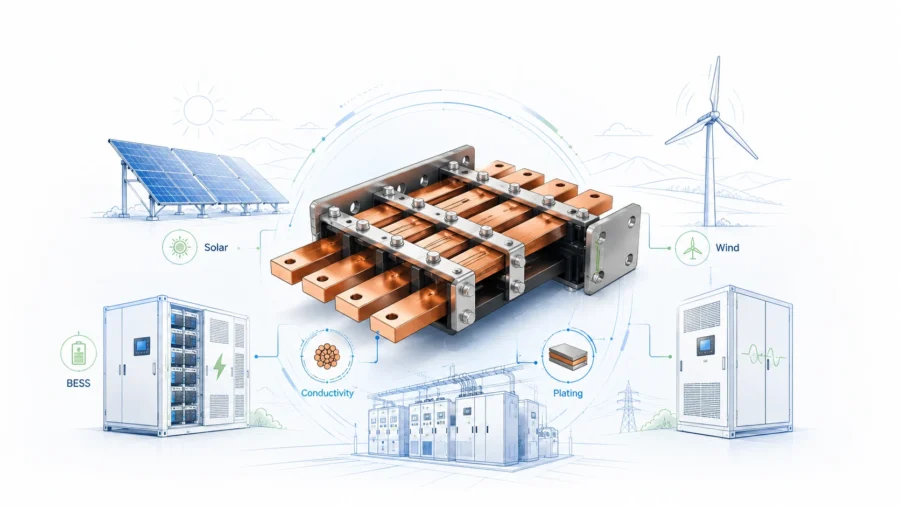
- Hyperscale Data Centers: With the rise of artificial intelligence and cloud computing, data centers demand flawless power continuity. Precision Copper Busbars are utilized in Uninterruptible Power Supplies (UPS) and power distribution units (PDUs) to handle massive current loads while minimizing space and heat generation.
- Renewable Energy Systems: Wind turbines and solar inverters require robust electrical pathways that can withstand harsh environmental conditions and fluctuating power generation.
- Electric Vehicles (EVs): The automotive industry relies heavily on flexible and braided Precision Copper Busbars to navigate the tight, vibration-heavy confines of EV battery packs while ensuring rapid energy transfer during acceleration and fast charging.
Material Science: The Foundation of High-Ampacity
The journey of manufacturing unparalleled Precision Copper Busbars begins with material selection. At JUMAI, we understand that not all copper is created equal. To achieve high ampacity—the maximum amount of electric current a conductor can carry continuously under the conditions of use without exceeding its temperature rating—we must utilize high-purity copper alloys.
Copper Grades and Purity
We primarily utilize C11000 (Electrolytic Tough Pitch – ETP) Copper and C10100 (Oxygen-Free Electronic – OFE) Copper.
- C11000 (ETP Copper): Contains a minimum of 99.90% copper. It is the industry standard for electrical applications due to its excellent electrical and thermal conductivity (101% IACS).
- C10100 (OFE Copper): Contains 99.99% pure copper with virtually no oxygen. It is highly resistant to hydrogen embrittlement and offers slightly better conductivity and formability, making it ideal for high-vacuum and highly specialized deep drawing applications.
Ampacity and Conductivity Analysis
To demonstrate the critical differences in material selection, consider the following comparative data. The table below outlines the physical and electrical properties of common conductor materials used in the industry, highlighting why our Precision Copper Busbars are engineered using specific grades.
| Material Grade | Composition | Electrical Conductivity (% IACS) | Thermal Conductivity (W/m·K) | Tensile Strength (MPa) | Primary JUMAI Application |
|---|---|---|---|---|---|
| C10100 (OFE Copper) | 99.99% Cu | 101% | 391 | 220 – 380 | Precision EV Battery Connectors |
| C11000 (ETP Copper) | 99.90% Cu | 100% | 388 | 220 – 380 | Rigid Switchgear Busbars |
| 1350 Aluminum | 99.50% Al | 61% | 234 | 80 – 130 | Low-budget overhead lines |
As clearly illustrated, copper provides nearly double the thermal conductivity of aluminum. In high-ampacity environments, managing heat is just as critical as conducting electricity. If a busbar overheats, it increases electrical resistance (creating a dangerous feedback loop) and can degrade surrounding insulation, leading to catastrophic system failure.
Categorization of JUMAI Copper Busbars
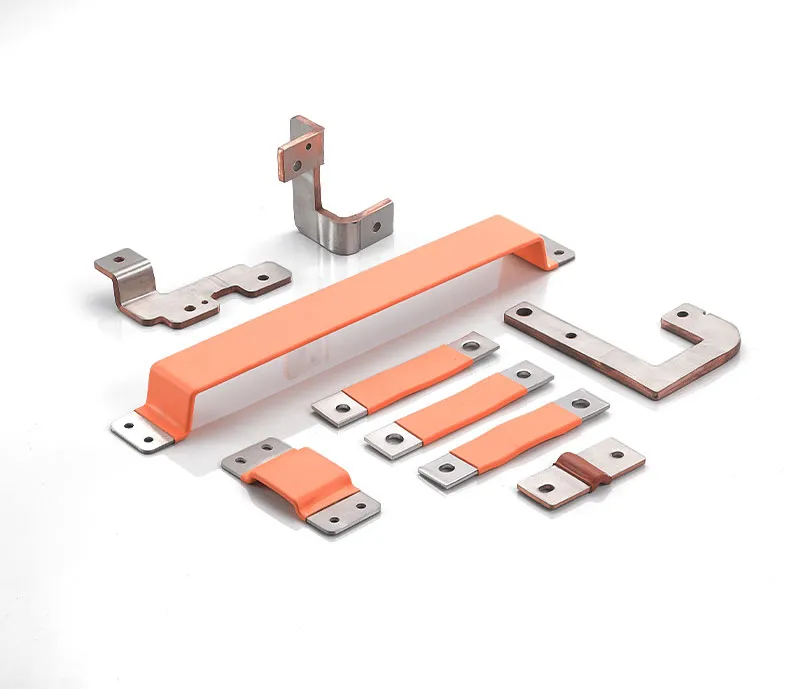
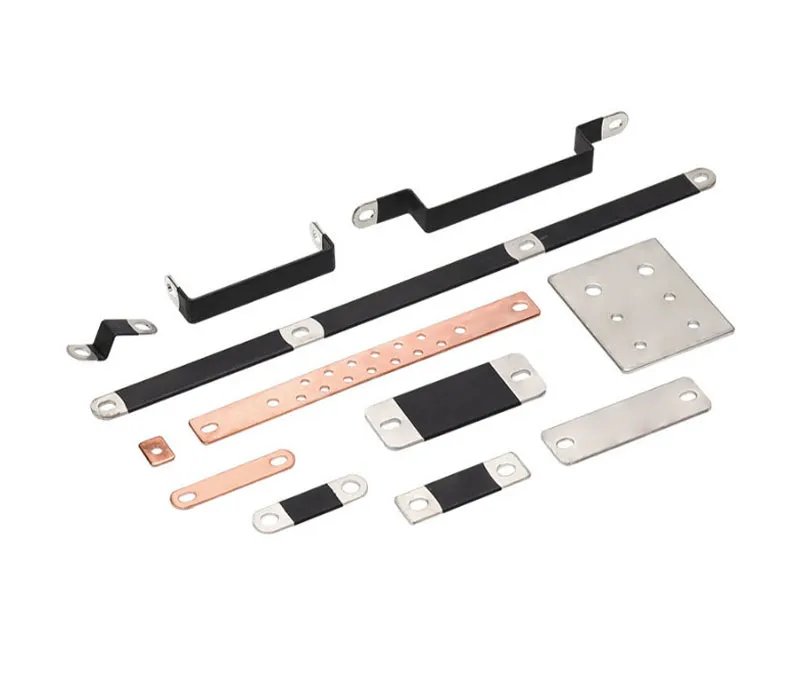
At JUMAI, we do not believe in a one-size-fits-all approach. Different industries face unique spatial, thermal, and mechanical challenges. To meet these diverse needs, we engineer three distinct types of Precision Copper Busbars.
1. Rigid Copper Busbars
Manufactured from solid copper plates or extruded bars, rigid busbars are the standard for stationary applications where maximum current-carrying capacity is required, and space allows for fixed routing. They are heavily utilized in large-scale switchgears, transformers, and static power distribution panels.
2. Flexible Copper Busbars (Laminated)
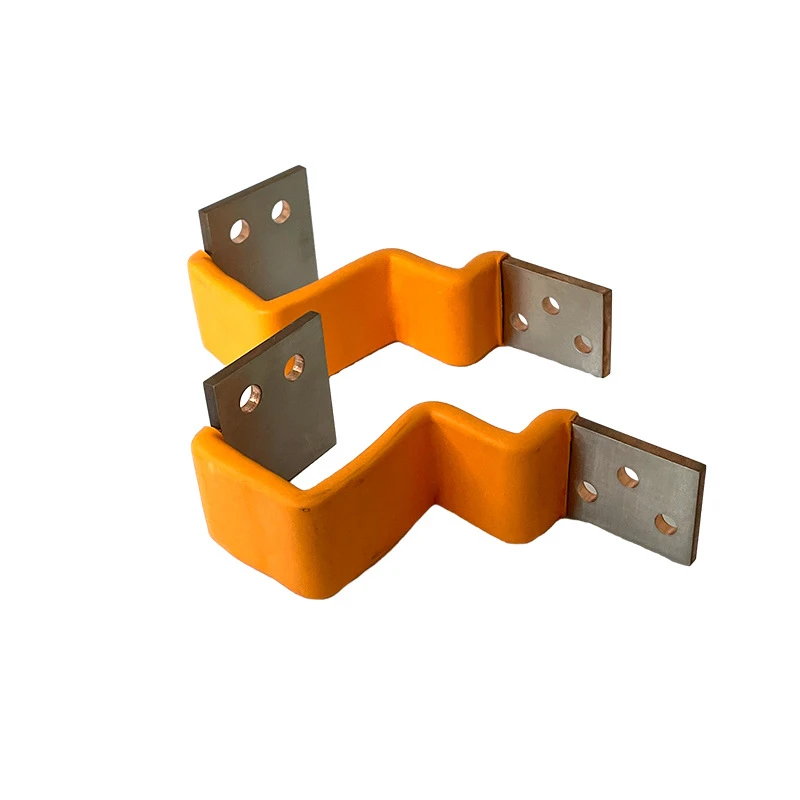
Flexible busbars consist of multiple thin layers of highly conductive electrolytic copper foils (typically 0.1mm to 1mm thick), fused at the mounting areas. This design provides excellent flexibility, allowing the busbar to absorb thermal expansion and dynamic vibrations. They are essential in wind turbine nacelles and heavy machinery where rigid bars would fracture under sustained mechanical stress.
3. Braided Copper Busbars
Constructed from weaving ultra-fine copper wires together, braided busbars offer extreme multi-directional flexibility. They are heavily deployed in EV battery packs and active seismic zones. The braided structure allows for continuous power transmission even under constant multidirectional movement, serving as an ideal grounding strap or flexible high-current connector.
Advanced Manufacturing Techniques
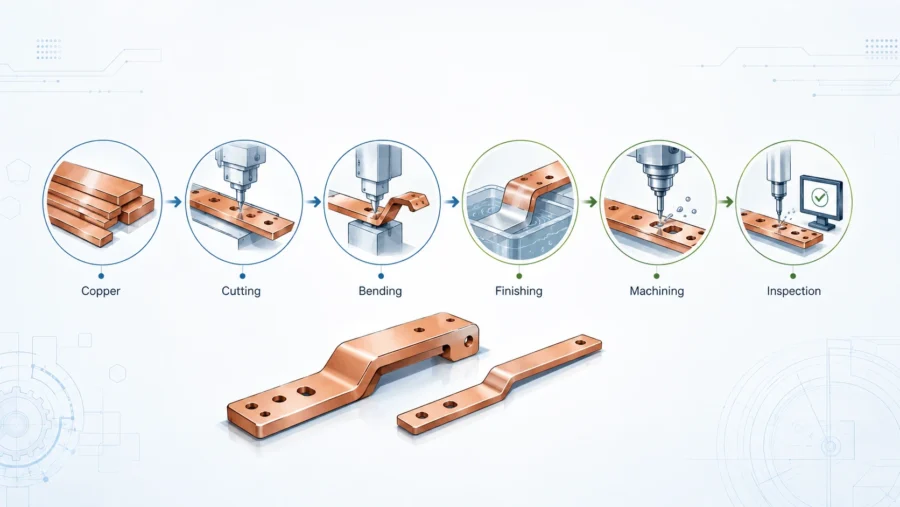
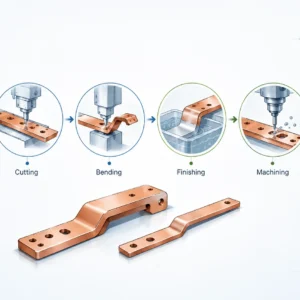
Transforming raw high-purity copper into Precision Copper Busbars requires a symphony of advanced metallurgical, mechanical, and chemical processes. Below are the core manufacturing stages we employ at JUMAI to ensure every custom order exceeds global standards.
1. Precision Extrusion and Drawing
The initial shaping of rigid busbars often involves extrusion, where heated copper billets are forced through a die to create long, continuous profiles. To achieve tighter dimensional tolerances and a superior surface finish, the extruded copper is then subjected to cold drawing. Cold drawing not only refines the dimensions but also work-hardens the material, increasing its mechanical strength without significantly compromising its electrical conductivity.
2. Deep Drawing and Stamping Operations
As a core competency at JUMAI, our expertise in deep drawing dies allows us to create highly specialized busbar components and accessories. Deep drawing is a sheet metal forming process where a copper blank is radially drawn into a forming die by the mechanical action of a punch.
This process is invaluable when manufacturing custom connection terminals, complex end-caps, or integrated housing components for enclosed busway systems. Utilizing advanced CAD/CAM software and CNC-machined tool steel dies, we achieve incredibly tight tolerances. Our deep drawing techniques prevent the thinning and tearing of the copper, ensuring structural integrity in the final electrical joint.
3. CNC Machining and Precision Bending
For rigid Precision Copper Busbars, accurate bending and hole-punching are critical for seamless assembly. We utilize highly advanced CNC (Computer Numerical Control) press brakes and multi-axis machining centers.
When bending thick copper busbars, engineers must account for “springback”—the tendency of the metal to partially return to its original shape after bending. Our automated CNC systems calculate the precise over-bend required based on the specific copper alloy, thickness, and temper, ensuring the final angle is accurate to within fractions of a degree. This precision is vital for large-scale switchgear assemblies where multiple busbars must align perfectly with pre-drilled insulators and breakers.
4. Advanced Joining and Welding Technologies
When creating flexible busbars or complex busbar assemblies, joining the copper elements without introducing high electrical resistance is a major engineering challenge. Traditional mechanical fasteners can loosen over time due to thermal cycling, leading to arcing. At JUMAI, we utilize advanced metallurgical bonding techniques:
- Diffusion Bonding (Press Welding): Used primarily for our flexible laminated busbars. The overlapping copper foils are subjected to high pressure and high temperature. The heat and pressure cause the copper atoms to diffuse across the boundaries of the foils, creating a solid, uniform copper mass at the contact point without the use of filler metals. This ensures the connection has the exact same conductivity as the parent material.
- Electron Beam and Laser Welding: For joining rigid busbars to deep-drawn terminals, we utilize precision laser welding. This provides a deep, narrow weld with a minimal Heat Affected Zone (HAZ), preventing the distortion of the Precision Copper Busbars and preserving the structural temper of the surrounding metal.
5. Surface Treatment and Insulation Coating
A raw copper busbar exposed to the atmosphere will eventually oxidize, creating a resistive patina. Furthermore, high-voltage applications require stringent insulation to prevent short circuits and protect personnel.
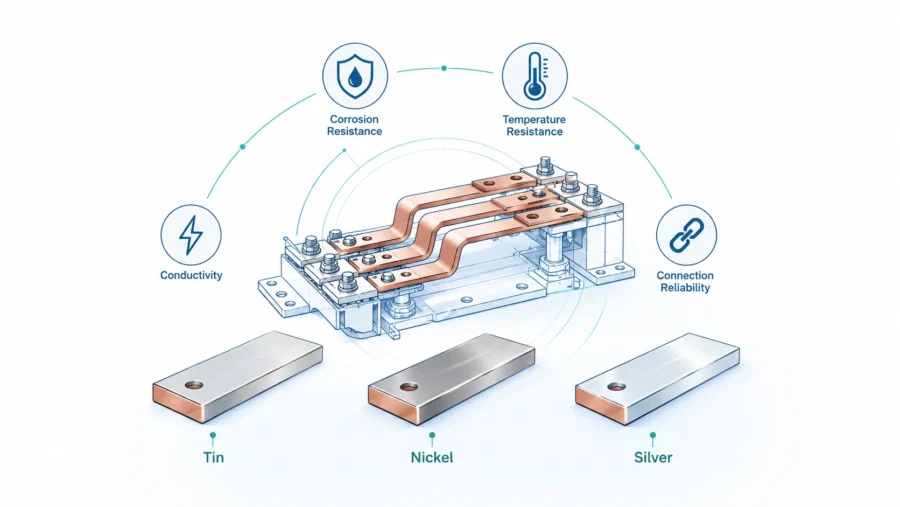
- Plating (Tin, Silver, or Nickel): We frequently electroplate the contact areas (or the entire busbar) with tin or silver. Silver plating dramatically reduces contact resistance and prevents fretting corrosion in high-frequency connection points. Tin plating provides excellent environmental protection and is a standard requirement per IEEE Standard 837 for substation grounding.
- Insulation: Depending on the client’s dielectric requirements, we apply insulation via heat-shrink tubing (PVC or Polyolefin), epoxy powder coating (fluidized bed dipping), or custom injection-molded plastics. Epoxy coating provides a seamless, highly durable dielectric barrier that conforms perfectly to complex, deeply drawn shapes and tight bends.
Engineering for High Ampacity: The Physics of Busbar Design
Designing Precision Copper Busbars is not merely about shaping metal; it is an exercise in applied physics. Our engineering team at JUMAI considers several complex electrical phenomena to guarantee safety and efficiency.
The Skin Effect and Proximity Effect
In direct current (DC) applications, current flows uniformly through the cross-section of the busbar. However, in alternating current (AC) applications—which represent the vast majority of grid and commercial power—the current tends to crowd toward the outer surface of the conductor. This is known as the Skin Effect.
Because the center of the busbar carries less current at higher AC frequencies, a thick, solid busbar becomes inefficient. This is why JUMAI often designs high-ampacity AC systems using hollow tubular busbars or multiple thin, parallel rectangular bars separated by air gaps.
Similarly, the Proximity Effect occurs when parallel busbars carrying AC current interact electromagnetically, causing further current crowding and increased effective resistance. Our engineers utilize advanced finite element analysis (FEA) software to model these magnetic fields and space the busbars optimally to mitigate these losses.
Ampacity Rating and Thermal Management
The ampacity of a busbar is dictated by its cross-sectional area, perimeter (for heat dissipation), ambient temperature, and allowable temperature rise. The table below illustrates standard ampacity ratings for single rectangular copper busbars in still but unconfined air, based on a 30°C temperature rise over a 40°C ambient temperature.
| Busbar Dimensions (Width x Thickness in mm) | Cross-Sectional Area (mm²) | DC Ampacity (Amps) | AC Ampacity (60Hz, Amps) |
|---|---|---|---|
| 20 x 3 | 60 | 250 | 248 |
| 40 x 5 | 200 | 580 | 570 |
| 60 x 10 | 600 | 1250 | 1200 |
| 100 x 10 | 1000 | 1850 | 1700 |
| 160 x 10 | 1600 | 2600 | 2300 |
Note: Data is representative. Actual ampacity depends on installation conditions, orientation (vertical vs. horizontal), and enclosures.
At JUMAI, we work closely with our clients to calculate the precise cross-sectional requirements, ensuring that the Precision Copper Busbars we manufacture operate safely within their thermal limits while optimizing material costs.
Rigorous Quality Control and Global Standards
High-ampacity electrical systems leave no room for error. A failure in a busbar can lead to devastating fires, equipment destruction, and fatal injuries. Therefore, JUMAI operates under strict international quality management systems, aligning our testing protocols with IEC 61439 standards for low-voltage switchgear and controlgear assemblies.
Our comprehensive Quality Control (QC) regimen includes:
- Conductivity Testing: Utilizing digital micro-ohmmeters, we test the resistance of raw materials and finished joints to ensure they meet the >100% IACS conductivity requirement.
- Dielectric Withstand (Hi-Pot) Testing: Insulated busbars are subjected to high voltage stress tests (often thousands of volts) to verify the integrity of the epoxy or PVC insulation and ensure there is no current leakage.
- Dimensional Metrology: Using optical comparators and Coordinate Measuring Machines (CMM), we verify that all bends, holes, and deep-drawn features match the client’s CAD models to within micrometers.
- Thermal Cycling and Microsectioning: For diffusion-bonded flexible busbars, we conduct accelerated thermal aging tests and physically cut cross-sections of the welds. These sections are examined under microscopes to verify complete atomic bonding without internal voids.
The JUMAI Advantage: Custom Customization and Digital Integration
What truly sets JUMAI apart in the global supply chain is our commitment to a seamless customer experience and total customization. We are not just a manufacturer; we are your engineering partner.
Custom OEM/ODM Services
Whether you are prototyping a revolutionary new EV battery architecture or retrofitting an aging power plant, our OEM (Original Equipment Manufacturer) and ODM (Original Design Manufacturer) services are designed to bring your concepts to reality. We can take rough schematics and, utilizing our extensive knowledge of deep drawing dies and busbar fabrication, engineer highly manufacturable, cost-effective solutions.
Interactive Online Preview and Order Consultation
To accelerate the procurement process, the JUMAI platform features an intuitive online preview and consultation system. Clients can submit their CAD files or technical specifications directly through our portal. Our engineering team rapidly reviews the designs for manufacturability, suggests material optimizations, and provides accurate lead times and pricing. This digital-first approach eliminates the traditional friction of international sourcing, providing transparency and speed.
Looking Forward: The Future of Electrification
As the world rapidly transitions away from fossil fuels, the infrastructure of the future will be overwhelmingly electrical. Megawatt-scale charging stations for electric semi-trucks, highly dense server racks for AI supercomputers, and massive offshore wind farms all share a common necessity: the safe, efficient transport of immense electrical currents.
Precision Copper Busbars are the silent arteries of this new global infrastructure. By continuously investing in advanced manufacturing techniques, proprietary deep drawing die technology, and stringent quality control, JUMAI ensures that our global partners have the reliable components they need to build the future.
Partner With Us
Excellence in electrification starts with the right connections. Explore our comprehensive range of soft, rigid, and braided copper busbars, discover our deep drawing capabilities, and experience our online consultation services today. Visit us at JUMAI – Deep Draw Tech to discuss your custom manufacturing requirements with our expert engineering team. Let us power your next innovation with unparalleled precision.
FAQ
What are Precision Copper Busbars?
Precision Copper Busbars are metal strips used for distributing high currents of electricity in various applications like data centers, solar farms, and electric vehicles. They are preferred over other materials because copper conducts electricity better and helps keep systems efficient. They look like flat bars and are very important in keeping electrical systems safe and running smoothly.
Why is copper better than aluminum for busbars?
Copper is considered better than aluminum for busbars because it conducts electricity more effectively and doesn’t get as hot, which helps prevent failures or damage in electrical systems. Copper is also stronger, which means it can handle more electrical current without breaking or overheating, making it a top choice for high-capacity power distribution.
What types of busbars does JUMAI manufacture?
JUMAI manufactures three types of busbars: Rigid, Flexible, and Braided Copper Busbars. Rigid busbars are solid and fixed in place, flexible busbars can bend and adapt to different shapes, and braided busbars are made from woven wires that allow for lots of movement. Each type serves different needs depending on the situation.
How does JUMAI ensure the quality of their busbars?
JUMAI takes quality very seriously. They use advanced equipment to test conductivity, check for any electrical leakage, and make sure all components meet strict size and strength requirements. This helps ensure that every busbar is safe and will work reliably for its intended use.
What is the process for creating a custom busbar?
To create a custom busbar at JUMAI, you can submit your designs or ideas online. Their team reviews your concept and suggests the best way to make it happen, ensuring it meets your needs. They use advanced technology and materials to make sure that your custom busbar is perfect for your application.
What industries use Precision Copper Busbars?
Precision Copper Busbars are used in various industries, including data centers, renewable energy installations like solar farms, and electric vehicle manufacturing. They help manage the high electrical currents needed to power these cutting-edge technologies safely and efficiently.
Can you explain the different manufacturing techniques used by JUMAI?
JUMAI uses several advanced manufacturing techniques to create Precision Copper Busbars. This includes extrusion and drawing for shaping, deep drawing for making complex parts, CNC machining for accurate cuts, and various welding technologies to ensure strong connections without losing conductivity. These methods help create high-quality busbars tailored to specific needs.
What is the importance of thermal management in busbar design?
Thermal management in busbar design is crucial because if a busbar gets too hot, it can fail and cause damage or even dangerous situations. Keeping the temperature in check allows these components to work efficiently, conducting electricity without generating excessive heat that can lead to problems.
How does JUMAI optimize their busbar designs for efficiency?
JUMAI optimizes their busbar designs by using advanced computer software to analyze how electricity flows through the bars. They consider factors like shape, size, and material used, making adjustments to improve electrical performance and reduce heat. This ensures the busbars are both effective and safe for high-capacity systems.
What does the future of electrification look like with busbars?
The future of electrification with busbars is bright as more renewable energy sources and electric vehicles emerge. Buildings, charging stations, and even robots will rely on efficient power distribution, highlighting the vital role Precision Copper Busbars will play in keeping our world powered and moving safely into the future.