
In the rapidly evolving landscape of modern electrical engineering, the demand for efficient, reliable, and safe power distribution has never been higher. From the sprawling infrastructure of hyperscale data centers to the harsh, demanding environments of renewable energy plants and electric vehicle (EV) manufacturing, the components we use to channel power must be nothing short of perfect. At the heart of these critical systems lies a component that is often overlooked but entirely indispensable: Precision Copper Busbars.
Welcome to JUMAI (Deep Draw Tech), your premier global partner for custom electrical distribution solutions. As an Editor-in-Chief with decades of hands-on experience in designing, researching, and manufacturing copper busbars for eco-friendly new energy, data centers, and large-scale power transmission, I have witnessed firsthand the catastrophic failures caused by sub-par power routing—and the incredible efficiencies unlocked by precision engineering.
In this comprehensive guide, we will dive deep into the engineering, material science, and manufacturing excellence behind precision copper busbars. Whether you are an electrical engineer designing a next-generation solar inverter, a procurement manager sourcing deep drawing dies and accessories, or a systems architect building a sustainable data center, this article will equip you with the knowledge to maximize both conductivity and safety in your applications.
Table of Contents
The Anatomy of Precision Copper Busbars
Before we explore the advanced physics and manufacturing techniques, we must understand what we are working with. A busbar (or bus bar) is a metallic strip or bar, typically housed inside switchgear, panel boards, and busway enclosures for local high-current power distribution. While cables have been the traditional choice for wiring, precision copper busbars offer superior thermal management, space efficiency, and structural integrity.
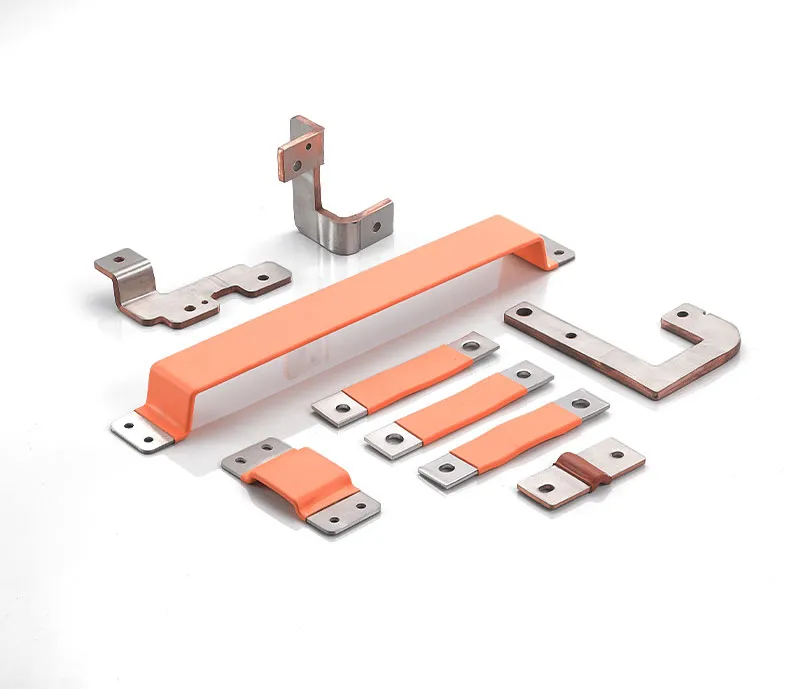
At JUMAI, we engineer several distinct categories of precision copper busbars to meet diverse mechanical and electrical demands.
Rigid Copper Busbars
Rigid busbars are solid blocks or flat strips of copper. They are the backbone of static power distribution systems, such as switchboards and major transmission hubs. Their primary advantage is their immense structural strength, allowing them to carry incredibly high fault currents without deforming.
Flexible Copper Busbars (Laminated)
When vibration, thermal expansion, or complex routing geometries are involved, rigid bars fall short. Flexible copper busbars are constructed from multiple thin layers (laminae) of pure copper, fused at the ends but loose in the middle. This allows them to bend and flex while maintaining the ampacity of a solid bar. They are critical in EV battery packs and transformer connections where thermal cycling causes traditional joints to stress and fracture.
Braided Copper Busbars
Braided busbars take flexibility to the extreme. Made from tightly woven copper wires, these connectors can absorb significant kinetic energy and multi-directional vibrations. They are frequently used in heavy machinery, wind turbines, and seismic-rated switchgear.
Deep Drawing Dies and Custom Accessories
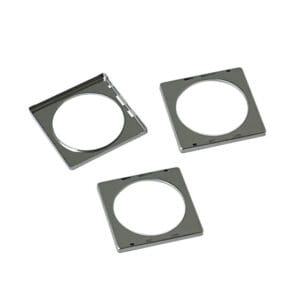
A busbar is only as effective as its integration into the broader system. This is where JUMAI’s expertise in deep stamping and deep drawing dies comes into play. Deep drawing allows us to create seamless, high-tolerance copper enclosures, connection terminals, and structural accessories that pair perfectly with our busbars, eliminating the electrical resistance usually introduced by mechanical fasteners.
Table 1: Comparative Analysis of Copper Busbar Types
| Busbar Type | Primary Characteristic | Flexibility | Typical Current Rating (Amps) | Best-Fit Applications |
|---|---|---|---|---|
| Rigid | Maximum structural integrity | Low | 100A – 10,000A+ | Main switchgear, power grids, structural power routing |
| Flexible | Thermal & kinetic absorption | High | 50A – 4,000A | Electric vehicles (EVs), transformers, battery banks |
| Braided | Multi-axis movement support | Extremely High | 50A – 3,000A | Wind turbines, heavy industrial robotics, seismic zones |
Material Science: The Superiority of Copper
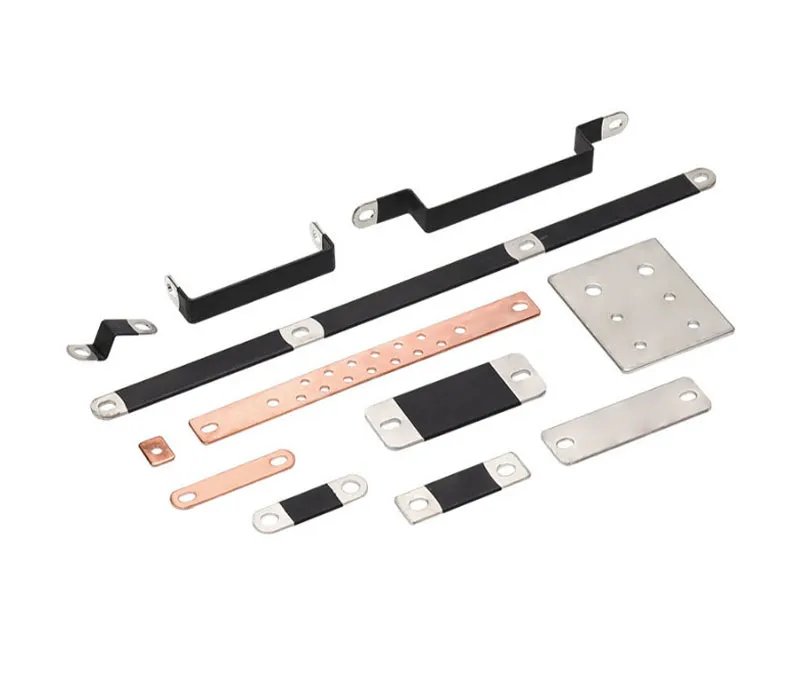
Why do industry leaders insist on copper for precision busbars, rather than cheaper alternatives like aluminum? The answer lies in atomic structure and material science.
Electrical Conductivity
Copper is the standard by which all other electrical conductors are measured. According to the Copper Development Association, pure unalloyed copper has an electrical conductivity of 100% IACS (International Annealed Copper Standard). Aluminum, by comparison, hovers around 61% IACS. This means that to carry the same amount of current, an aluminum busbar must possess a significantly larger cross-sectional area, consuming valuable space within tight equipment enclosures.
Thermal Conductivity and Expansion
Electrical resistance inherently generates heat. The formula for electrical power loss is $P = I^2R$, where $P$ is power lost as heat, $I$ is current, and $R$ is resistance. Precision copper busbars not only have lower electrical resistance ($R$), but copper’s high thermal conductivity allows it to dissipate the generated heat much faster than aluminum. Furthermore, copper has a lower coefficient of thermal expansion. In high-power systems that cycle on and off, materials expand and contract. Copper’s stability ensures that bolted joints do not loosen over time—a primary cause of electrical fires.
At JUMAI, we predominantly utilize C11000 Electrolytic Tough Pitch (ETP) Copper and C10200 Oxygen-Free Copper (OFC), ensuring up to 99.99% purity.
Table 2: Copper vs. Aluminum for Busbar Applications
| Property | Pure Copper (C11000) | Aluminum (1350-H19) | Business Impact |
|---|---|---|---|
| Electrical Conductivity | 100% IACS | 61% IACS | Copper requires less space for the same power capacity. |
| Thermal Conductivity | 390 W/(m·K) | 230 W/(m·K) | Copper dissipates heat faster, lowering cooling costs. |
| Tensile Strength | ~250 MPa | ~110 MPa | Copper withstands mechanical stress and short circuits better. |
| Galvanic Corrosion | Highly resistant | Susceptible | Copper requires less maintenance over a 20-year lifespan. |
The Physics of High-Current Conductivity
Designing precision copper busbars is not simply about cutting a piece of metal to size; it is an exercise in applied physics. Engineers must account for invisible electromagnetic forces that dictate how current flows through a solid mass.
Ampacity and Heat Dissipation
Ampacity is the maximum current a conductor can carry continuously under the conditions of use without exceeding its temperature rating. If a busbar is placed in a poorly ventilated inverter cabinet, its ampacity drops. Precision engineering involves calculating the exact cross-sectional area and surface area needed to maximize natural or forced convection cooling.
The Skin Effect and Proximity Effect
When alternating current (AC) flows through a busbar, it does not distribute evenly across the cross-section. Due to internal magnetic fields, the current is pushed toward the outer surface of the conductor—this is known as the Skin Effect.
Similarly, when two busbars carrying current are placed close together, their magnetic fields interact, pushing the current to the furthest edges of the bars. This is the Proximity Effect. Both phenomena effectively reduce the usable cross-sectional area of the busbar, increasing AC resistance and heat generation.
At JUMAI, we design our custom copper busbars to mitigate these effects. By optimizing the width-to-thickness ratio (often favoring thinner, wider profiles or hollow tubular designs for exceptionally high AC currents), we maximize the surface area, negate the skin effect, and ensure maximum conductivity.
Maximizing Safety in Extreme Environments

Safety is non-negotiable. Whether routing megawatt-level power through a hydroelectric dam or supplying reliable current to life-support systems in hospitals via backup data centers, the failure of a busbar can lead to catastrophic arc flashes, fires, and loss of life. Precision copper busbars maximize safety through several critical engineering mechanisms.
Short-Circuit Withstand Strength
In the event of an electrical fault, a busbar system may experience current spikes that are tens or hundreds of times higher than their normal operating current. These massive currents generate extreme electromagnetic repulsion and attraction forces between adjacent busbars. If the busbars are not engineered properly, they can literally rip themselves apart.
Our rigid copper busbars, combined with JUMAI’s precision-engineered deep stamped structural supports, provide immense mechanical strength, easily complying with rigorous international safety standards such as those set by the International Electrotechnical Commission (IEC).
Advanced Insulation Technologies
Bare copper is highly conductive, which means it poses a severe electrocution and short-circuit risk if accidentally touched or bridged by a foreign object. JUMAI offers advanced, custom-fitted insulation options tailored to the operating environment:
- Heat Shrink Tubing: Excellent for general-purpose insulation in switchgears.
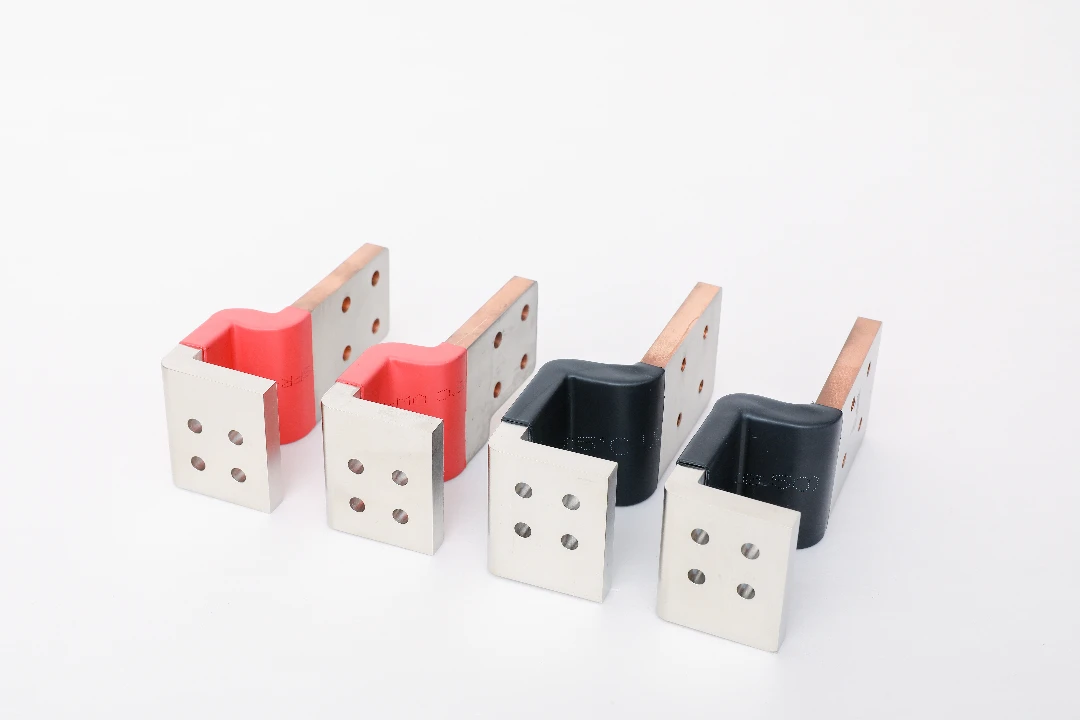
- Epoxy Powder Coating: Applied via an electrostatic fluid bed process, epoxy provides a thick, highly durable, and thermally conductive layer that conforms perfectly to complex geometries. It is the gold standard for EV battery busbars.
- PVC Dipping: A flexible, durable coating ideal for braided and flexible laminated busbars.
Thermal Runaway Prevention
In renewable energy storage and EV applications, lithium-ion battery cells are tightly packed. If one cell overheats, it can trigger thermal runaway. Precision copper busbars act as vital thermal sinks. Because of copper’s high thermal mass, JUMAI’s custom busbars actively pull heat away from battery terminals, significantly delaying or preventing thermal propagation.
Manufacturing Excellence: The Deep Draw Tech Advantage
Theoretical physics and material science must be translated into physical reality. The manufacturing processes at JUMAI separate standard, off-the-shelf conductors from true Precision Copper Busbars.
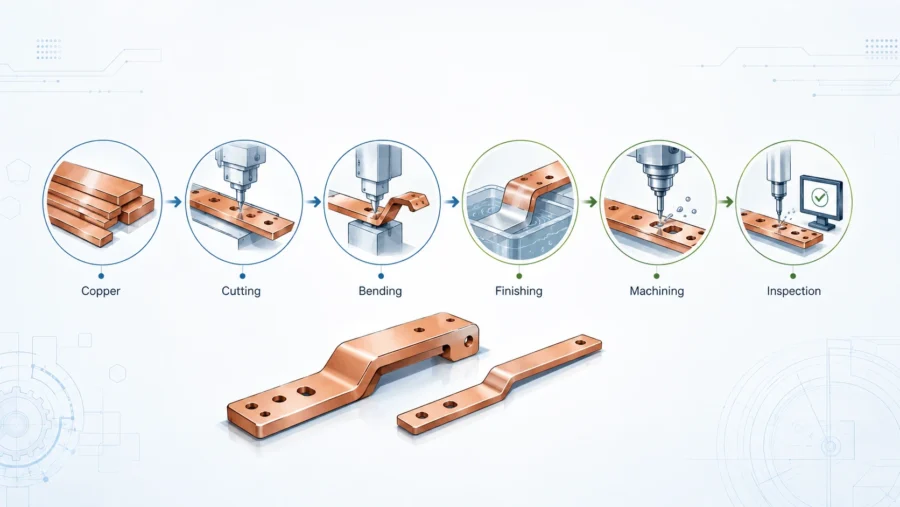
Precision Stamping, Cutting, and Bending
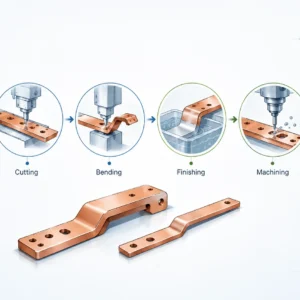
Using state-of-the-art CNC (Computer Numerical Control) punching and laser cutting machines, we achieve tolerances down to the micrometer. When busbars are bent, the outer radius stretches while the inner radius compresses. Without precise control, this creates micro-fractures in the copper, increasing localized resistance and creating hot spots. Our automated bending cells use calibrated radii based on the exact thickness and temper of the copper to ensure perfect microstructural integrity.
Deep Drawing Dies
JUMAI’s unique advantage lies in our deep draw technology. Deep drawing is a sheet metal forming process where a copper blank is radially drawn into a forming die by the mechanical action of a punch. This allows us to create seamless, 3D copper components without welding. Welds introduce impurities and resistance. Seamless deep-drawn copper accessories provide 100% uninterrupted conductivity for specialized grounding and connection points.
Surface Plating for Longevity
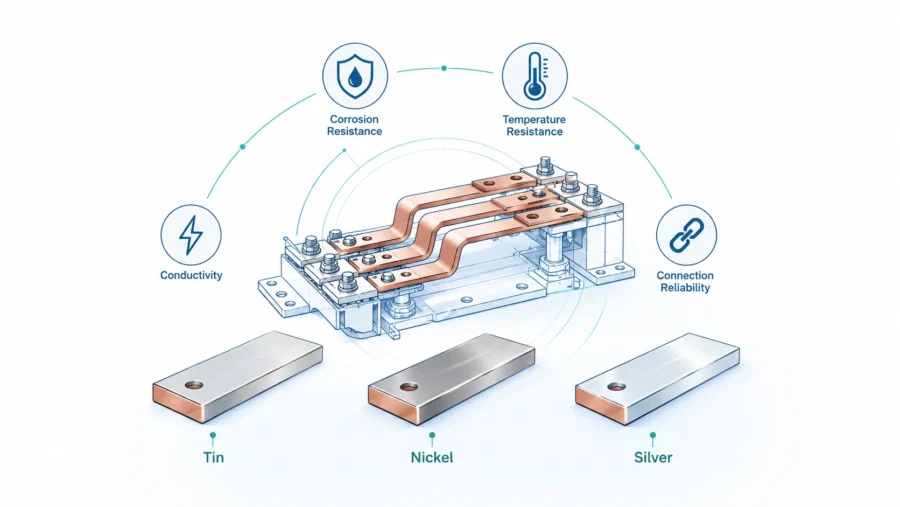
Raw copper oxidizes when exposed to air, forming a patina that increases electrical contact resistance. To guarantee life-long performance, JUMAI provides high-grade custom surface plating.
Table 3: Surface Plating Options for Precision Copper Busbars
| Plating Material | Primary Benefit | Typical Application | Contact Resistance |
|---|---|---|---|
| Tin Plating | Excellent corrosion resistance, prevents oxidation, cost-effective | Industrial switchgear, marine environments, general electronics | Very Low |
| Silver Plating | The absolute highest conductivity, prevents high-frequency skin effect losses | High-voltage breakers, aerospace, radio frequency (RF) equipment | Lowest Possible |
| Nickel Plating | Extreme wear resistance, high temperature tolerance | High-friction plug-in connectors, extreme heat environments | Low |
Industry Applications: Powering the Future
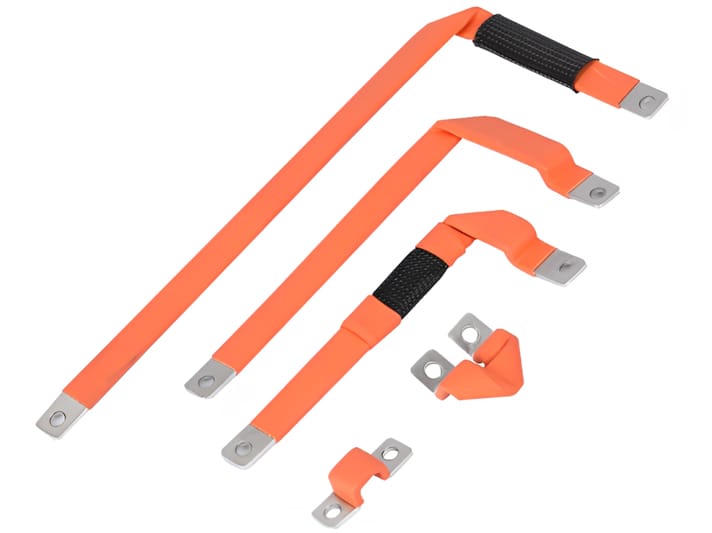
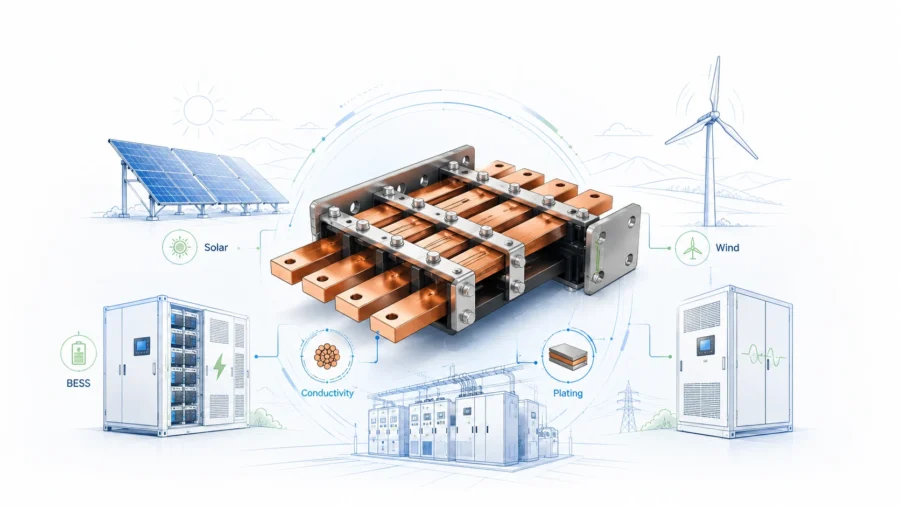
The versatility of JUMAI’s precision copper busbars means they are the critical arteries in nearly every modern technological leap.
1. Data Centers and Cloud Computing
The AI revolution is demanding unprecedented amounts of power. Modern server racks require High-Density Power Distribution Units (PDUs). Traditional wiring is too bulky to handle the high amperage required in minimal rack space. Our custom rigid and flexible copper busbars provide high-density, low-loss power delivery directly to server blades. By minimizing voltage drop and heat generation, data centers can drastically reduce their HVAC cooling costs—a massive win for overall PUE (Power Usage Effectiveness).
2. Renewable Energy (Solar & Wind)
Solar inverters convert DC power from solar panels into AC power for the grid. This process generates significant heat and requires moving massive currents. JUMAI’s precision laminated busbars handle the thermal cycling perfectly. In wind turbines, the nacelle rotates to face the wind, requiring flexible power connections. Our heavy-duty braided copper busbars easily absorb the continuous torsion and vibration without fatiguing. As the IEEE Standards Association outlines, wind infrastructure requires materials that can survive decades of mechanical stress.
3. Electric Vehicles (EVs)
The automotive industry is experiencing a paradigm shift. Inside the EV powertrain, custom flexible copper busbars are essential. They connect individual battery modules to form a massive pack, absorb the harsh vibrations of the road, and channel power to the motor inverters. Furthermore, our specialized deep drawing dies are used to manufacture precise copper battery terminal covers and high-voltage distribution boxes, ensuring safety in crash scenarios.
4. Eco-Friendly Power Transmission
As the world upgrades to smart grids, substations require reliable connections. Solid rigid copper busbars designed by JUMAI act as the central distribution hubs, efficiently routing power from step-down transformers to local distribution networks with virtually zero power loss.
Customization and Design Engineering Support
One of the biggest pitfalls in modern electrical design is treating busbars as an afterthought. Trying to force an off-the-shelf busbar into a complex system usually results in compromised safety, increased assembly time, and inefficient power routing.
At JUMAI, we are not just a manufacturer; we are your engineering partners. Our custom Original Equipment Manufacturer (OEM) and Original Design Manufacturer (ODM) services ensure that your precision copper busbars are designed for your system, not in spite of it.
The JUMAI Consultation Process:
- Requirement Analysis: We review your electrical schematics, space constraints, ampacity requirements, and thermal limitations.
- 3D Modeling & Simulation: Using advanced CAD software and finite element analysis (FEA), we simulate current flow and thermal dynamics to optimize the shape, thickness, and routing of the busbar.
- Prototyping: We utilize agile manufacturing to produce rapid prototypes, allowing your engineering team to perform physical fitment and load testing.
- Mass Production: Once validated, our automated deep drawing, stamping, and plating lines scale up production, delivering consistent, perfect components to your assembly line anywhere in the world.
The ROI of Precision: Why Quality Matters
Procurement departments often face pressure to reduce upfront costs, leading them to consider cheaper aluminum alternatives or lower-tier manufacturers. However, true business value is found in the Total Cost of Ownership (TCO).
Investing in JUMAI’s precision copper busbars provides a compelling Return on Investment (ROI):
- Reduced Energy Losses: Thanks to superior conductivity and optimized design, $I^2R$ losses are minimized. Over a 20-year lifespan, the electricity saved by preventing resistance heat far outweighs the initial cost of copper.
- Lower Maintenance Costs: Precision joints and anti-vibration flexible busbars mean no loose connections. This eliminates the need for expensive routine thermal imaging inspections and mechanical retightening.
- Space Savings: The compact nature of high-capacity copper busbars allows you to design smaller equipment enclosures, saving on sheet metal, real estate, and shipping costs.
- Brand Reputation: By utilizing components that guarantee safety and prevent thermal runaway, you protect your brand from the devastating PR and financial consequences of catastrophic equipment failure.
Future Trends in Copper Busbar Technology
As a veteran in this industry, I constantly look ahead. The demand for our products at JUMAI is shaping several exciting future trends:
- Liquid-Cooled Busbars: For extreme high-power applications (like megawatt EV charging stations and dense AI server farms), we are developing hollow precision copper busbars that circulate dielectric cooling fluids directly through the conductor.
- Smart Busbars: Integrating fiber optic sensors directly into the epoxy insulation of the busbar to provide real-time thermal and current monitoring to central AI grid management systems.
- Sustainable Sourcing: With a focus on eco-friendly new energy, JUMAI is deeply committed to utilizing high-grade recycled copper, maintaining 99.99% purity while drastically reducing the carbon footprint of our manufacturing process.
Conclusion
The engineering behind precision copper busbars is a complex symphony of material science, electromagnetic physics, and ultra-precise manufacturing. Whether it is a rigid bar handling the raw output of a hydroelectric dam, a braided bar surviving the tempest inside a wind turbine, or a flexible, laminated bar safely powering the electric vehicle revolution, these components are the silent heroes of modern infrastructure.
At JUMAI (Deep Draw Tech), we bring decades of global industry expertise to your fingertips. We don’t just supply metal; we deliver optimized power, guaranteed safety, and engineered peace of mind. By combining top-tier materials with our advanced deep drawing dies, stamping, and customization capabilities, we ensure your projects are built to lead the future.
Ready to maximize the conductivity and safety of your next big project? Explore our full range of custom soft, rigid, and braided copper busbars, deep stamping dies, and accessories online. Contact the JUMAI engineering team today for a comprehensive design consultation and online order preview.
Frequently Asked Questions (FAQ)
Q: Can I replace an existing aluminum busbar with a copper one?
A: Yes, and doing so will often allow you to significantly increase the current capacity within the same physical footprint. However, you must be cautious of galvanic corrosion if connecting copper directly to remaining aluminum components; JUMAI can provide specially plated transition joints for this purpose.
Q: How do I know whether to choose a flexible or braided copper busbar?
A: Use flexible laminated busbars when you need to absorb thermal expansion/contraction or require a rigid connection that can still flex slightly (e.g., EV battery packs). Choose braided busbars when the connection is subject to continuous, multi-directional kinetic movement and vibration (e.g., robotics, wind turbines).
Q: What is the maximum current a JUMAI precision copper busbar can handle?
A: While off-the-shelf bars have standard limits, our custom-engineered rigid busbars, configured in parallel with proper spacing and cooling, can handle tens of thousands of amps for heavy industrial applications.
Q: Does JUMAI offer international shipping and bulk order customization?
A: Absolutely. Deep Draw Tech (JUMAI) operates globally, serving clients across North America, Europe, and Asia. We provide end-to-end service from initial CAD review and prototyping to mass production and international logistics.