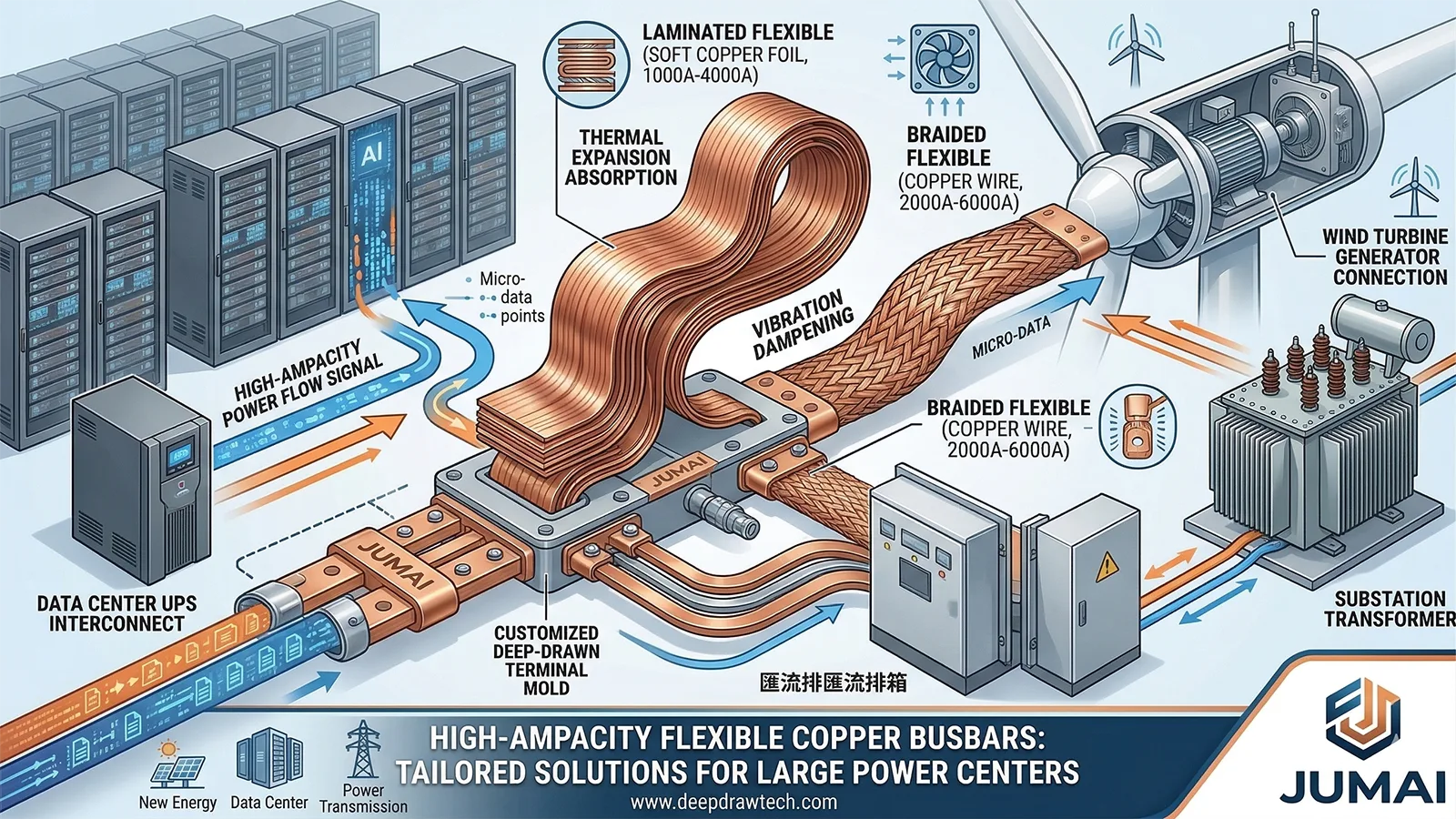

Welcome to the forefront of modern power distribution. At JUMAI (DeepDrawTech), we have spent years engineering, refining, and manufacturing the critical components that keep the world’s most demanding electrical infrastructures running seamlessly. From environmental new energy facilities and hyper-scale data centers to massive power transmission hubs, the lifeblood of these operations relies on one foundational element: efficient, reliable, and adaptable power transfer.
As the Editor-in-Chief at JUMAI, and someone who has spent decades on the engineering floor designing deep-drawn stamping molds and customizing power solutions, I have witnessed the evolution of power distribution firsthand. Today, we are diving deep into the world of Flexible Copper Busbars—specifically high-ampacity solutions designed for large power centers.
This comprehensive guide is designed to bridge the gap between complex electrical engineering principles and accessible, business-driven decision-making. Whether you are a procurement manager for a renewable energy firm, an electrical engineer designing a new data center, or a facility manager looking to upgrade your current infrastructure, this article will provide you with the data, insights, and industry knowledge needed to understand why customized flexible copper busbars are the ultimate solution for high-ampacity demands.
Table of Contents
The Evolution of Power Transmission in High-Demand Facilities
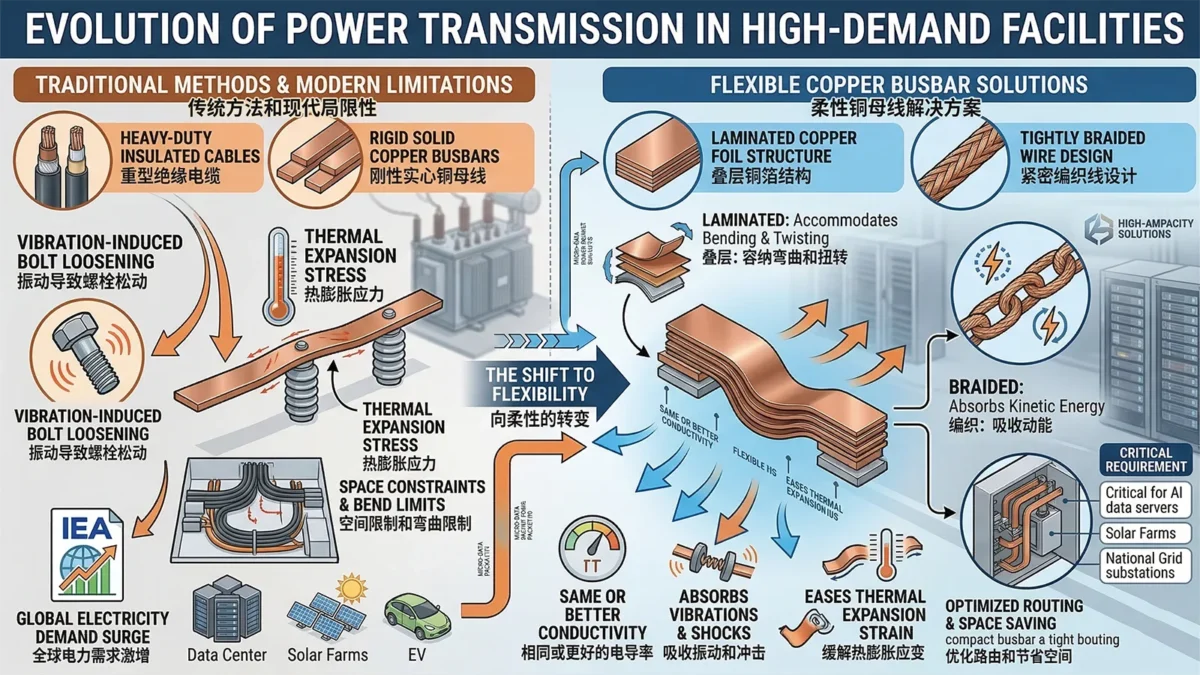
For decades, the standard approach to routing power within industrial facilities and power centers was through heavy-duty insulated cables or rigid solid copper busbars. While these traditional methods served their purpose, the rapid advancement of technology has fundamentally shifted the requirements of modern infrastructure.
Today’s large power centers—such as those powering artificial intelligence data servers, large-scale solar farms, and national grid substations—require systems that can handle immense electrical loads (high ampacity) while simultaneously dealing with space constraints, thermal expansion, and mechanical vibrations.
According to reports by the International Energy Agency (IEA), global electricity demand is growing at an unprecedented rate, driven by the electrification of transport, the push for renewable energy, and the exponential growth of data processing. This surge in demand means that facilities can no longer rely on rigid, unforgiving power routing systems.
The Shift to Flexibility
Rigid busbars, while excellent conductors, pose significant challenges in dynamic environments. When heavy machinery operates, or when massive transformers hum, they generate micro-vibrations. Over time, these vibrations can loosen bolts on rigid busbar connections, leading to increased electrical resistance, dangerous heat generation, and potential system failure.
Furthermore, as electrical loads increase, copper naturally heats up and expands. Rigid systems struggle to accommodate this thermal expansion, putting immense physical stress on connected insulators and switchgear terminals.
Enter the Flexible Copper Busbar. By utilizing multiple layers of thin copper foils or tightly braided copper wires, these busbars offer the exact same (if not better) electrical conductivity as their rigid counterparts, but with the added ability to bend, twist, and absorb kinetic energy. This flexibility is not just a convenience; in modern large power centers, it is a critical safety and efficiency requirement.
Anatomy and Material Science of Flexible Copper Busbars
To truly appreciate the value of a high-ampacity flexible copper busbar, we must look at how it is constructed and the materials used. At JUMAI, we do not just assemble busbars; we engineer them from the raw material level up to the final deep-drawn connection terminals.
Types of Flexible Copper Busbars
There are two primary categories of flexible copper busbars utilized in large power centers, each serving specific engineering requirements:
- Laminated Flexible Copper Busbars: Constructed by stacking multiple layers of highly pure, ultra-thin copper foils (typically ranging from 0.05mm to 0.3mm in thickness). The ends of these stacked foils are then press-welded (using diffusion welding or molecular welding techniques) to form a solid, unified block that can be drilled or punched for mounting. The middle section remains un-welded, providing exceptional flexibility along specific axes. These are ideal for absorbing thermal expansion and precise routing in tight spaces.
- Braided Flexible Copper Busbars: Made by weaving fine copper wires (often 0.10mm to 0.15mm in diameter) into a tubular or flat braid. The ends are gathered and crimped into solid copper tubes or custom-stamped terminals (often created using our specialized deep drawing molds at JUMAI). Braided busbars offer multi-directional flexibility and are superior at absorbing high-frequency vibrations from transformers and generators.
The Superiority of Copper
Why do we rely so heavily on copper? In the world of high-ampacity transmission, material choice dictates performance. We exclusively use high-purity Oxygen-Free Copper (OFC) or T2/C11000 grade copper, which boasts a minimum purity of 99.9%.
While aluminum is sometimes used in budget-conscious projects due to its lighter weight and lower cost, it falls fundamentally short in high-demand environments. Copper offers nearly double the electrical conductivity of aluminum per unit volume. Furthermore, copper is vastly superior in its resistance to creep (the tendency of a solid material to move slowly or deform permanently under the influence of mechanical stresses) and galvanic corrosion.
Table 1: Material Comparison – High-Purity Copper vs. Aluminum
| Property | High-Purity Copper (C11000) | Commercial Aluminum (1350) | Impact on Large Power Centers |
|---|---|---|---|
| Electrical Conductivity (IACS) | 100% – 101% | ~61% | Copper requires a much smaller cross-sectional area to carry the same current, saving critical space in switchgear. |
| Thermal Conductivity | 390 W/(m·K) | 230 W/(m·K) | Copper dissipates heat much faster, preventing dangerous temperature rises during peak load times. |
| Tensile Strength | 210 – 250 MPa | 60 – 95 MPa | Copper withstands mechanical stress, short-circuit forces, and vibration significantly better. |
| Oxidation Resistance | Excellent (forms protective layer) | Poor (forms insulating oxide) | Copper joints maintain low resistance over decades; aluminum joints require constant maintenance and special pastes. |
As the data shows, for tailored solutions where reliability, safety, and longevity are non-negotiable, high-purity copper is the only logical choice.
Ampacity and Thermal Dynamics: The Core Metrics
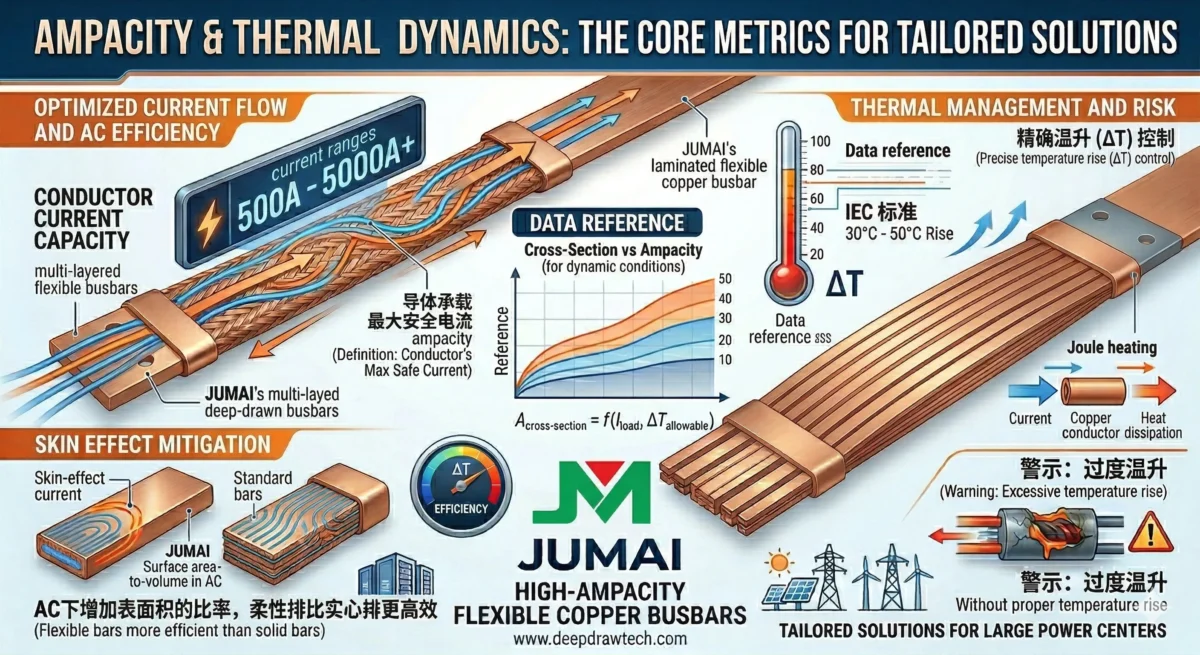
When we discuss “High-Ampacity” at JUMAI, we are talking about electrical currents ranging from hundreds to several thousands of amperes (Amps). Managing this level of power is not just about having a thick piece of metal; it is about managing thermal dynamics.
Understanding Ampacity
Ampacity is defined as the maximum amount of electrical current a conductor or device can carry before sustaining immediate or progressive deterioration. When current flows through a copper busbar, it encounters natural electrical resistance, which converts a portion of that electrical energy into heat (Joule heating).
If a flexible copper busbar is not correctly sized for the specific load of a power center, the temperature will rise uncontrollably. This can melt surrounding insulation, damage connected switchgear, and ultimately lead to catastrophic electrical fires.
Calculating the Right Fit
At JUMAI, our engineering team uses advanced thermal modeling and cross-sectional area calculations to tailor busbars specifically to your facility’s needs. The required cross-sectional area of a flexible busbar is not a simple linear equation; it depends heavily on the allowable temperature rise ($\Delta T$).
For instance, according to guidelines from standardizing bodies like the International Electrotechnical Commission (IEC), a standard temperature rise of 30°C to 50°C above ambient temperature is usually permitted, depending on the surrounding components.
Below is a reference data table showcasing how ampacity scales with the cross-sectional area of our premium laminated flexible copper busbars, based on an ambient temperature of 35°C.
Table 2: Ampacity Ratings for Laminated Flexible Copper Busbars (Ambient 35°C)
| Cross-Sectional Area (mm2) | Foil Dimensions (Width x Thickness x Layers) | Ampacity at 30°C Rise (Amps) | Ampacity at 50°C Rise (Amps) | Typical Application Scope |
|---|---|---|---|---|
| 100 | 20mm x 1mm x 5 layers | 340 A | 450 A | Small UPS systems, localized distribution |
| 250 | 25mm x 1mm x 10 layers | 650 A | 850 A | Mid-tier server racks, EV charging units |
| 500 | 50mm x 1mm x 10 layers | 1,150 A | 1,480 A | Substation interconnections, wind turbine inverters |
| 1000 | 100mm x 1mm x 10 layers | 1,900 A | 2,450 A | Heavy industrial switchgear, data center main feeds |
| 2000 | 100mm x 1mm x 20 layers | 3,200 A | 4,100 A | Massive power transmission centers, grid-scale batteries |
Note: The values in this table are approximate reference figures. Real-world ampacity is influenced by airflow, proximity to other conductors (proximity effect), and alternating current frequencies (skin effect). JUMAI provides precise engineering calculations for every custom order.
The Skin Effect and AC Power
In large power centers dealing with Alternating Current (AC), we must account for the “Skin Effect.” At higher currents and frequencies, AC tends to distribute itself predominantly near the surface (the “skin”) of the conductor, rather than uniformly across the cross-section.
This means that a massive, thick, rigid solid copper bar is actually highly inefficient for high-ampacity AC power; the center of the bar carries almost no current but adds massive weight and cost. Flexible copper busbars, particularly those made of multiple separated laminations or braided wires, inherently combat the skin effect by increasing the total surface area relative to the volume. This makes them significantly more efficient at carrying high-ampacity AC currents than traditional solid bars.
Key Applications in Modern Infrastructure
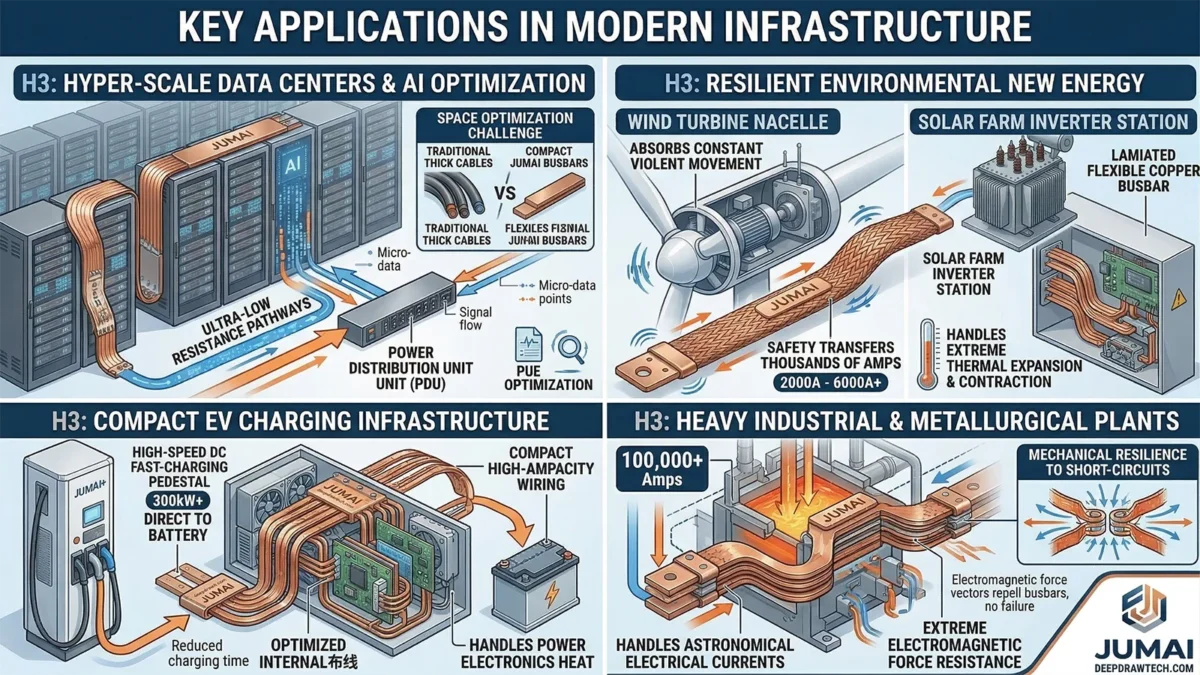
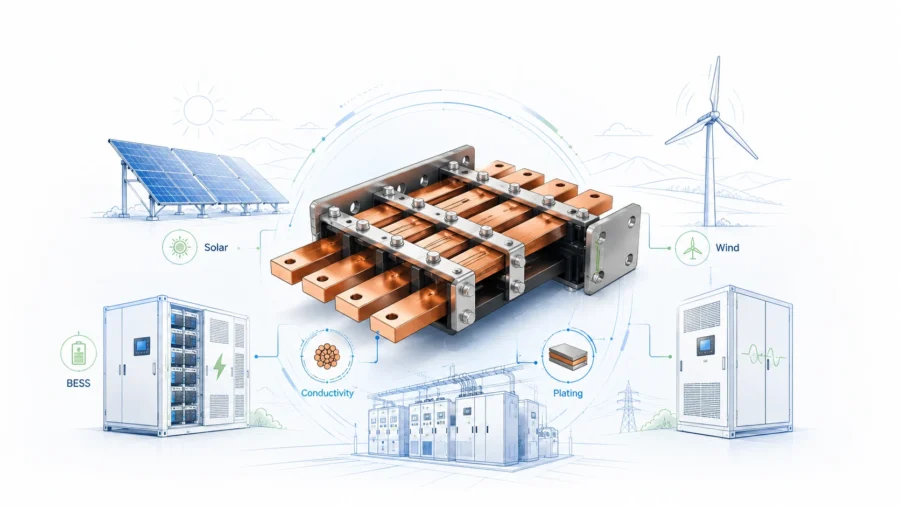
The versatility and high performance of JUMAI’s flexible copper busbars make them an indispensable component across various booming industries. Let us explore how these tailored solutions are implemented in the real world.
1. Hyper-Scale Data Centers
Data centers are the backbone of the modern digital economy. With the rise of AI processing and cloud computing, server racks that used to consume 5kW of power are now pushing 30kW to 50kW per rack. The Power Usage Effectiveness (PUE) is a critical metric for data centers, and efficient power distribution is key to optimizing it.
In these environments, space is at an absolute premium. Routing thick, rigid cables from massive Uninterruptible Power Supplies (UPS) to server rack distribution panels is cumbersome, wastes space, and restricts crucial airflow needed for cooling. Custom flexible copper busbars from JUMAI can be perfectly shaped to hug the contours of data center cabinets, providing ultra-low resistance pathways that maximize energy efficiency while requiring a fraction of the space of traditional cabling. Furthermore, their flexibility ensures that vibrations from massive cooling fans do not loosen critical power connections over time.
2. Environmental New Energy (Wind & Solar)
The transition to renewable energy involves capturing power in harsh, dynamic environments.
- Wind Turbines: Inside the nacelle of a wind turbine, massive generators convert kinetic energy into electricity. The nacelle is subject to constant, violent movement, extreme vibrations, and vast temperature swings. Rigid power connections would snap or vibrate loose within weeks. JUMAI’s heavy-duty braided flexible copper busbars are used to connect the generator to the transformer, easily absorbing the mechanical stress while safely transmitting thousands of amps.
- Solar Farms (Photovoltaic): Large-scale solar installations require huge inverter stations to convert DC power from the panels into AC power for the grid. These inverters experience significant thermal expansion and contraction as they heat up during peak sunlight and cool down at night. Laminated flexible busbars seamlessly absorb this thermal expansion, protecting the delicate internal components of the inverters.
3. Electric Vehicle (EV) Charging Infrastructure
As the world shifts away from internal combustion engines, high-speed DC fast-charging stations are popping up globally. These stations deliver massive bursts of power (often 350kW or more) directly to vehicle batteries. Inside these charging pedestals, space is extremely tight, and the power electronics generate significant heat. Flexible copper busbars allow for compact, high-ampacity internal wiring that can bend around cooling systems and sophisticated control boards, ensuring rapid and safe charging.
4. Heavy Industrial & Metallurgical Plants
In facilities such as aluminum smelting plants, steel mills, and chemical electrolysis facilities, the electrical currents required are astronomical—sometimes exceeding 100,000 Amps. The magnetic forces generated by short circuits in these environments are powerful enough to literally bend solid steel. JUMAI’s custom-engineered, multi-layered flexible busbar assemblies are designed to provide the necessary ampacity while possessing the mechanical resilience to withstand extreme electromagnetic forces without suffering structural failure.
The JUMAI Advantage: Precision Customization and Deep Drawing Technology
At DeepDrawTech.com, we do not just sell off-the-shelf components; we provide end-to-end engineering and manufacturing partnerships. Our brand, JUMAI, represents decades of refinement in metallurgical processing and custom mold design. What truly sets us apart in the global market is our integration of advanced deep drawing technology with busbar manufacturing.
What is Deep Drawing?
Deep drawing is a sheet metal forming process wherein a flat sheet of metal is drawn into a forming die by the mechanical action of a punch. It is “deep” drawing when the depth of the drawn part exceeds its diameter.
How Does This Apply to Flexible Busbars?
The weakest point of any electrical connection is the joint. In traditional braided busbars, the copper wires are often just crushed inside a standard, pre-bought copper pipe to form a terminal. This can lead to uneven pressure, air gaps, and increased electrical resistance.
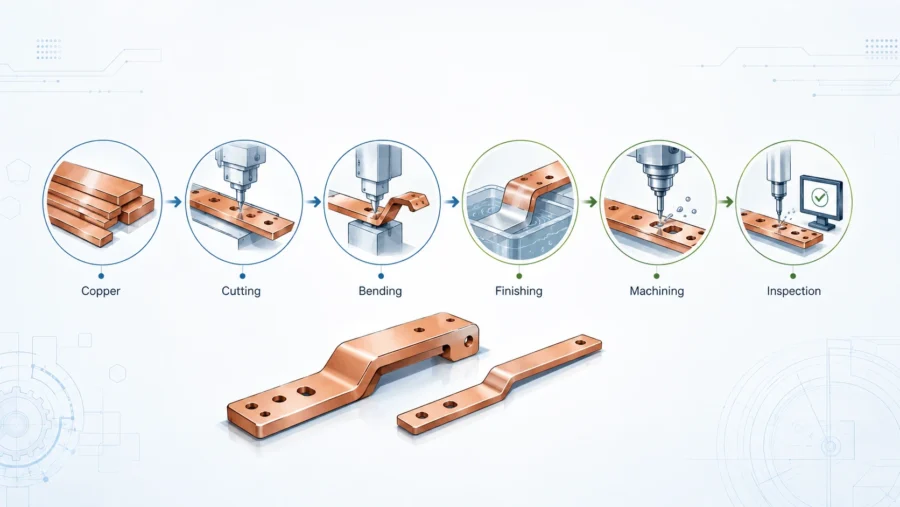
At JUMAI, we design and manufacture custom deep-drawn molds in-house. This allows us to create bespoke, seamless terminal ends that perfectly match the specific volume of the braided copper or laminated foils being used.
- Seamless Integration: By deep-drawing the terminal sleeves specifically for your project, we ensure a molecular-level tight crimp or weld. There are no seams to split under pressure, and no air gaps to cause micro-arcing.
- Custom Geometries: Does your power center require an L-shaped connection? A T-junction? A terminal with off-center mounting holes to fit a proprietary switchgear? Our deep-drawn stamping capabilities mean we can produce terminal shapes that are impossible to achieve with standard pressing methods.
- Accessories and Molds: Because we manufacture our own deep stamping molds and accessories, we pass the speed and cost-savings directly to our global clients. You do not have to wait for third-party machine shops. From online 3D preview to final order consultation, the entire process is handled within the JUMAI ecosystem.
Advanced Plating Options
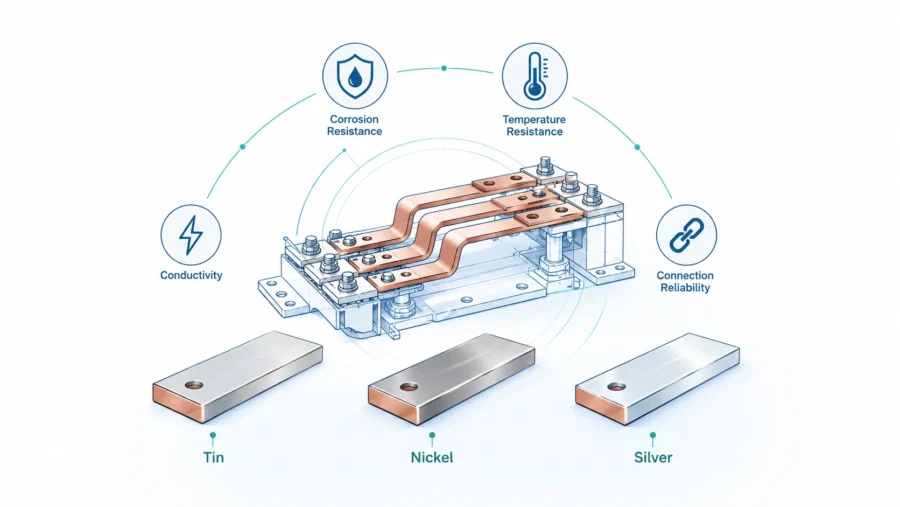
Copper, while exceptional, is susceptible to oxidation (tarnishing) when exposed to air, and particularly when exposed to humidity or corrosive industrial gases. Oxidation creates a thin insulating layer on the surface, which increases electrical resistance at the connection points.
To combat this, JUMAI offers customized surface plating for all our flexible copper busbars:
- Tin Plating: The industry standard for corrosion resistance. Tin plating prevents copper oxidation, ensures long-term low contact resistance, and is highly recommended for data centers, general industrial applications, and switchgear connections.
- Silver Plating: For the absolute highest performance and lowest contact resistance. Silver plating is utilized in aerospace, high-frequency AC applications, and environments where maximum power efficiency is prioritized over initial cost.
- Nickel Plating: Offers superior hardness and resistance to harsh chemical environments, ideal for battery manufacturing facilities or chemical processing plants.
Furthermore, we offer custom insulation sleeving (such as heat-shrinkable PVC, silicone, or specialized fire-retardant fiberglass tubing) to ensure safety and compliance with international voltage isolation standards.
Comparative Analysis: Flexible Busbars vs. Rigid Busbars vs. Traditional Cables
To truly understand the value proposition of JUMAI’s flexible copper busbars, we must compare them objectively against the alternatives. Facilities managers and electrical engineers constantly face the decision of how to route power. Let us break down the data.
Table 3: Comprehensive Power Routing Comparison
| Evaluation Criteria | JUMAI Flexible Copper Busbars | Traditional Rigid Copper Busbars | Heavy-Duty Insulated Power Cables |
|---|---|---|---|
| Space Efficiency | Excellent: Highly compact. Can be folded and bent precisely to fit exact 3D spaces. | Moderate: Very compact in straight lines, but requires large amounts of space for corner joints and transition pieces. | Poor: Thick insulation and large minimum bend radii waste massive amounts of space in cabinets. |
| Heat Dissipation | Excellent: Large surface area relative to volume (especially laminated/braided types) naturally dissipates heat rapidly. | Good: Solid metal dissipates heat well, but susceptible to skin effect in large sizes. | Poor: Thick rubber/PVC insulation traps heat inside, requiring derating of the cable’s ampacity. |
| Vibration Resistance | Excellent: Inherently absorbs mechanical vibrations and seismic shocks without stressing joints. | Poor: Vibrations transfer directly to joints, causing bolts to loosen and increasing failure risk. | Good: Cables absorb vibration well. |
| Thermal Expansion | Excellent: Expands and contracts safely within its own flexible structure. | Poor: Requires expensive and bulky slip-joints or expansion connectors to prevent structural damage. | Good: Naturally accommodates thermal expansion. |
| Installation Speed | Fast: Custom pre-formed at JUMAI. Arrives ready to bolt directly into place with zero on-site modification. | Slow: Requires precise alignment. Often requires heavy lifting equipment and on-site bending or cutting. | Slowest: Requires pulling heavy, stiff cables through conduits, stripping thick insulation, and massive crimping tools on-site. |
| Lifecycle Cost | Lowest: Virtually zero maintenance required once installed. Outlasts the equipment it connects to. | Moderate: Requires regular thermal imaging and retorquing of connecting bolts due to vibration loosening. | High: Insulation degrades over time (especially under heat/UV). Cables eventually require complete replacement. |
The Business Verdict: While heavy-duty cables might seem cheaper initially, the cost of installation labor, the massive space they consume, and their shorter lifespan make them a poor choice for high-ampacity internal connections. Rigid busbars are excellent for long, straight runs in protected environments, but fail in dynamic or tight spaces. Flexible copper busbars offer the ultimate intersection of performance, safety, space-saving, and long-term return on investment (ROI).
Technical Specifications and Industry Standards Compliance
At JUMAI, we understand that our products are installed in critical infrastructure where failure is not an option. A power outage at a major data center can cost millions of dollars per minute. A fire in a solar substation can be catastrophic. Therefore, rigorous adherence to international standards is paramount.
When you consult with us via deepdrawtech.com for a custom order, you are guaranteed a product that meets or exceeds the following global benchmarks:
- ISO 9001 Quality Management: Our entire manufacturing process, from raw copper sourcing to deep drawing and final assembly, is strictly governed by ISO 9001 protocols, ensuring complete traceability and consistent quality.
- IEC 61439 Compliance: The standard for low-voltage switchgear and controlgear assemblies. Our flexible busbars are designed to help your final assemblies pass the rigorous temperature-rise limits and short-circuit withstand strength tests required by the IEC.
- UL Certification Compatibility: For our clients serving the North American market, our materials and insulation options are selected to ensure your final systems easily pass Underwriters Laboratories (UL) safety certifications.
- RoHS and REACH: We are committed to environmental sustainability. Our copper, plating materials, and insulations comply with the Restriction of Hazardous Substances (RoHS) directive and the REACH regulation, ensuring no toxic heavy metals (like lead or cadmium) are used in our processes.
Rigorous In-House Testing
Before any custom batch of flexible busbars leaves our facility, it undergoes a battery of tests:
- Conductivity Testing: Using micro-ohm meters to ensure connection resistance is virtually zero.
- Tensile Strength Testing: Pull-testing the deep-drawn crimps to ensure they can withstand extreme mechanical stress.
- Hi-Pot (High Potential) Testing: Testing the dielectric strength of the applied insulation to ensure it will not break down under high voltage spikes.
- Salt Spray Testing: For plated busbars, simulating years of harsh environmental exposure to guarantee corrosion resistance.
Designing for High-Ampacity: Engineering Considerations for Our Clients
When you utilize our online preview and order consultation services, our engineering team will guide you through several critical design considerations. Understanding these factors will help you make the most informed decisions for your power center.
1. Determining the True Load Profile
It is not enough to know the “average” current. We need to design for the peak load and the continuous operating load. Furthermore, we must account for potential short-circuit currents. In the event of a fault, a large power center can deliver thousands of amps in a fraction of a second. This creates immense electromagnetic forces that attempt to repel parallel conductors. JUMAI designs flexible busbars with sufficient mechanical strength and appropriate mounting recommendations to withstand these massive short-circuit forces without tearing apart.
2. The Proximity Effect
If multiple flexible busbars carrying AC current are placed too closely together, their magnetic fields interact. This “proximity effect” forces the electrical current into even smaller areas of the copper, increasing resistance and heat. Our engineers will help you design the optimal spacing and phase arrangement (e.g., interleaved phases) to minimize the proximity effect and maximize ampacity.
3. Vibration Amplitude and Frequency
Are you connecting to a diesel backup generator that shakes violently at low frequencies, or a high-speed turbine with high-frequency micro-vibrations? The type of vibration dictates the design. High-amplitude, low-frequency movement often requires highly flexible, longer braided busbars. High-frequency vibrations might be better handled by precisely engineered laminated busbars that damp the resonance.
4. Environmental Factors
- Altitude: Air is thinner at high altitudes, which means it dissipates heat less efficiently. If your power center is located in a mountainous region, the busbars must be derated (upsized) to handle the heat.
- Ambient Temperature: A power center in the Middle East has a vastly different ambient starting temperature than one in Scandinavia. We factor local climate data into our thermal modeling.
- Contaminants: Data centers are clean, but heavy industrial plants are not. Corrosive gases or conductive dust require specific plating and specialized sealed insulation solutions.
Installation Best Practices and Safety Guidelines
Even the most perfectly engineered flexible copper busbar from JUMAI can underperform if installed incorrectly. Proper installation is critical for ensuring safety and maximizing the lifespan of the equipment.
Joint Preparation
The contact surface where the flexible busbar meets the rigid switchgear or transformer terminal must be pristine.
- Cleaning: Even if the busbar arrives freshly plated from JUMAI, the mating surface on your equipment must be cleaned with a specialized electrical contact cleaner to remove any oils, dust, or microscopic oxidation.
- Abrasive Padding (If unplated): If connecting bare copper to bare copper, lightly abrade the surfaces with a non-metallic abrasive pad to remove invisible oxide layers immediately before bolting. Never do this on tin or silver-plated surfaces, as it will destroy the protective plating.
- Contact Paste: Apply a very thin, even layer of conductive electrical joint compound (contact grease). This prevents oxygen and moisture from entering the microscopic gaps in the joint, halting future oxidation.
The Importance of Torque
The number one cause of busbar failure in large power centers is improper bolt torque.
- Under-torquing: Leaves micro-gaps, leading to high resistance, massive heat generation, and eventual arcing or fire.
- Over-torquing: Crushes the copper, distorts the terminal, strips the bolt threads, and ultimately weakens the connection.
Always use calibrated torque wrenches and highly graded steel hardware (e.g., Grade 8.8 or Stainless Steel 304/316, combined with Belleville spring washers to maintain pressure during thermal expansion).
Table 4: Recommended Reference Torque Values for Copper Busbar Connections (Metric, Property Class 8.8 Bolts)
| Bolt Size | Recommended Torque (Nm) | Recommended Torque (lb-ft) | Applications |
|---|---|---|---|
| M6 | 9 – 11 Nm | 6.5 – 8 lb-ft | Small control circuits, low-amp connections |
| M8 | 22 – 25 Nm | 16 – 18 lb-ft | Standard ground connections, mid-tier loads |
| M10 | 44 – 50 Nm | 32 – 37 lb-ft | Heavy UPS connections, standard busbar joints |
| M12 | 75 – 85 Nm | 55 – 63 lb-ft | Main switchgear feeds, heavy industrial |
| M16 | 185 – 210 Nm | 136 – 155 lb-ft | Massive transformer terminals, grid connections |
(Note: Always consult the specific equipment manufacturer’s guidelines, as they supersede general reference tables).
Maintenance, Longevity, and Lifecycle ROI
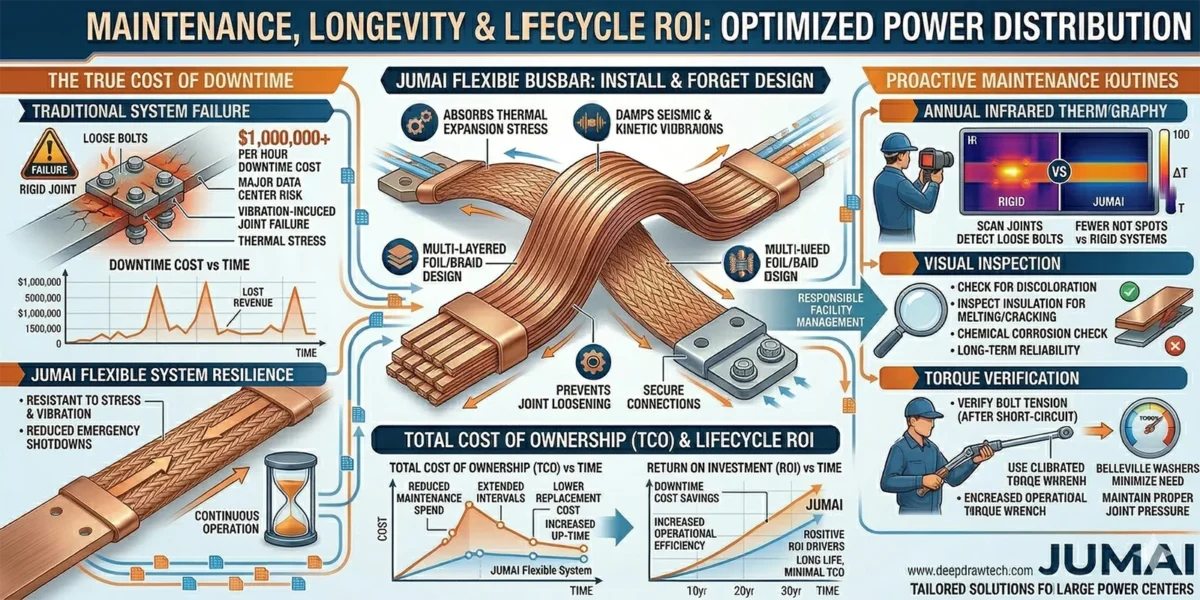
One of the most compelling business arguments for investing in customized JUMAI flexible copper busbars is their exceptional Return on Investment (ROI) driven by their longevity and minimal maintenance requirements.
The True Cost of Downtime
In a large power center, maintenance is not just the cost of labor and parts; it is the cost of downtime. If a rigid cable fails or a traditional rigid busbar joint burns out due to vibration, the facility must be powered down. For a major e-commerce data center, an hour of downtime can equate to millions of dollars in lost revenue.
JUMAI flexible busbars are designed to be a “install and forget” component. Because they absorb the stresses that typically destroy rigid connections, they drastically reduce the need for emergency shutdowns.
Proactive Maintenance Routines
While highly resilient, responsible facility management dictates a proactive inspection routine:
- Annual Infrared Thermography: This is the most effective maintenance tool for power centers. While under normal load, technicians scan the busbar joints with an infrared thermal camera. Any joint that is glowing significantly hotter than the surrounding metal indicates an increase in resistance (likely a loose bolt). Because flexible busbars don’t transfer vibration to the joint, you will find far fewer “hot spots” compared to rigid systems.
- Visual Inspection: Check for discoloration of the copper or plating, which indicates overheating or severe chemical corrosion. Inspect the insulation for cracking or signs of melting.
- Torque Verification: Every few years, or after a major short-circuit event, utilize a calibrated torque wrench to verify that bolts have not yielded or loosened. (Belleville washers drastically reduce the need for this).
By significantly extending the intervals between required maintenance and virtually eliminating connection failure due to thermal/kinetic stress, JUMAI flexible busbars lower the Total Cost of Ownership (TCO) of your power infrastructure.
The Future of Power Distribution and Sustainability
As we look toward the future, the demands on large power centers will only intensify. The push toward a fully electrified global economy means that the infrastructure supporting it must evolve. At JUMAI, we are already pioneering the next generation of power distribution technology.
The Rise of “Green” Copper and the Circular Economy
Sustainability is no longer a buzzword; it is a corporate mandate. Copper is one of the most remarkable materials on the planet because it is 100% recyclable without any loss of performance. According to the Copper Alliance, nearly 75% of all copper ever mined in human history is still in use today.
At DeepDrawTech, we are deeply committed to the circular economy. The scrap generated during our deep drawing and stamping processes is meticulously collected and recycled. Furthermore, when our flexible busbars eventually reach the end of their multi-decade lifespan within a power center, they can be entirely recycled, offering significant scrap value that further offsets the initial investment. We are actively working with supply chains to source copper produced using renewable energy, lowering the carbon footprint of our manufacturing process.
Smart Busbars and IoT Integration
The future power center is intelligent. We are seeing a rising demand for “Smart Busbars.” This involves integrating custom-designed flexible busbars with embedded fiber-optic temperature sensors or compact IoT (Internet of Things) current monitors.
By designing customized deep-drawn terminals that include specific mounting points and protective channels for these sensors, JUMAI allows facility managers to monitor the health, temperature, and power flow of every critical connection in real-time. This data feeds into predictive AI maintenance models, ensuring that a failing connection is identified and repaired weeks before it actually causes an outage.
Higher Voltages, Tighter Spaces
As Electric Vehicles transition to 800V and even 1000V architectures to achieve faster charging times, and as data centers push for higher distribution voltages to reduce current and save copper weight, the requirements for insulation become vastly more stringent. JUMAI is continually researching and implementing advanced dielectric coatings and high-temperature extruded insulations that allow our flexible busbars to operate safely at these extreme voltages while maintaining the thinnest possible profile.
Frequently Asked Questions (FAQ)
To provide maximum clarity for our global clients navigating the complexities of custom power solutions, we have compiled the most frequent inquiries our JUMAI engineering team receives during online consultations.
How long does the customization and order process take through DeepDrawTech.com?
From initial consultation to final delivery, the timeline depends on complexity. However, because we manufacture our own deep drawing molds and stamping accessories in-house, we cut out third-party delays. Typically, 3D modeling and prototyping take 1-2 weeks, with full production scaling rapidly thereafter.
Can JUMAI manufacture flexible busbars that transition from braided to laminated?
While technically complex, we can engineer multi-stage busbar systems. However, it is usually more efficient to select the specific technology (braided for multi-axis vibration, laminated for thermal expansion/tight routing) best suited for the specific connection point. Our engineers will advise on the optimal design.
Is tin plating absolutely necessary?
While bare copper has excellent conductivity, we highly recommend tin plating for almost all industrial and data center applications. It provides a robust barrier against oxidation and environmental degradation, ensuring the connection resistance remains near zero for the lifespan of the equipment. The small upfront cost of plating saves massive maintenance costs down the line.
How do I know if I need a braided or a laminated flexible busbar?
Generally, if the primary challenge is absorbing movement in three dimensions (like connecting a vibrating generator), braided is best. If the primary challenge is routing high-ampacity power through tight, specific angles in a cabinet while accommodating thermal expansion (like in a UPS system), laminated is superior.
What information do I need to provide for a custom order consultation?
To provide an accurate design and quote, we need:
1. Continuous Operating Current (Amps) and peak/short-circuit current.
2. Operating Voltage (AC or DC).
3. Maximum allowable temperature rise.
4. Dimensional constraints (3D CAD models of your space are ideal).
5. Environmental conditions (ambient temperature, humidity, chemical presence).
Does JUMAI provide the mounting hardware (bolts, washers)?
Yes, as a comprehensive solutions provider, we can supply the necessary high-grade hardware, including Belleville spring washers and custom insulators, ensuring you have everything needed for a perfect installation.
How flexible is “flexible”? Will it bend like a rubber hose?
Flexible copper busbars are highly malleable compared to rigid bars, but they are still solid metal. Braided busbars have high flexibility resembling a stiff rope. Laminated busbars are highly flexible in the axis perpendicular to the flat foils, but rigid edge-to-edge. They are designed to absorb micro-movements and allow for complex permanent routing, not for continuous, rapid flexing like a robotic arm cable.
Can you process aluminum instead of copper if our budget is tight?
While our deep drawing and stamping machinery can process various metals, we strongly advise against aluminum for high-ampacity, critical power center applications due to its higher resistance, lower strength, and severe oxidation issues. The long-term safety and efficiency of copper heavily outweigh the initial material cost difference.
What is the maximum length of a flexible busbar you can produce?
We can produce continuous braided or laminated busbars in lengths of several meters. However, for extremely long runs, it is often more practical and economical to use rigid busbars, utilizing JUMAI flexible busbars only at the connection points and expansion joints.
Are your products certified for use in Europe and the USA?
Yes. Our manufacturing processes and materials comply with major international standards including ISO, IEC, and RoHS, and our products are designed to seamlessly integrate into UL-certified and CE-marked electrical assemblies.
Partnering for Power Reliability
The architecture of large power centers is changing rapidly. As energy density increases and the tolerance for downtime drops to absolute zero, the components holding these systems together must be perfect.
At JUMAI, accessed via DeepDrawTech.com, we do not view ourselves merely as a vendor; we are your engineering partners. Our mastery over copper metallurgy, our innovative in-house deep drawing and stamping capabilities, and our decades of experience in the high-ampacity sector allow us to deliver tailored flexible copper busbar solutions that traditional manufacturers simply cannot match.
Whether you are routing 500 Amps through a tight data center server rack or 5,000 Amps out of a massive solar inverter, rigid thinking will only lead to broken connections. It is time to embrace flexibility.
We invite engineers, procurement officers, and facility managers globally to visit our website, explore our online preview tools, and initiate an order consultation. Let JUMAI’s expertise ensure that your power center operates with unparalleled efficiency, safety, and reliability for decades to come.
Powering the future requires flexibility. Let JUMAI build it for you.