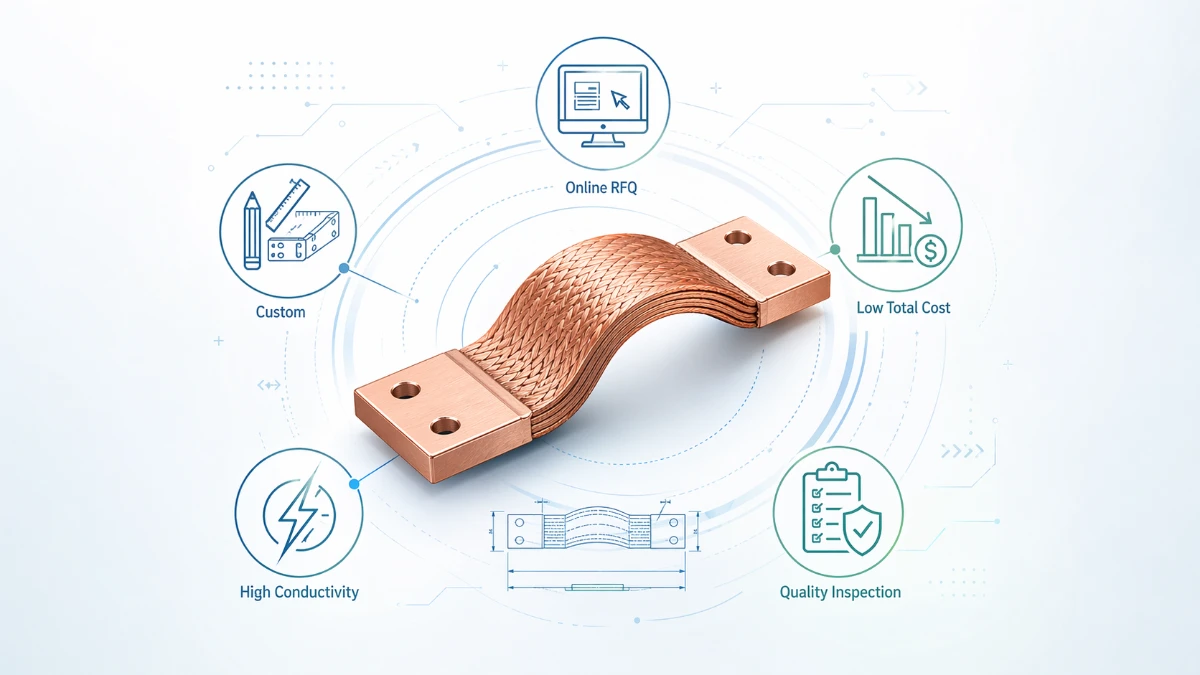

Flexible Copper Busbars are no longer niche components reserved for a few special projects. They are now a practical, high-value solution for OEMs, panel builders, EV system designers, data center integrators, renewable-energy equipment makers, and power distribution specialists who need high current density, tight packaging, mechanical compliance, and dependable long-term connections. On paper, ordering them online looks simple: upload a drawing, receive a quotation, confirm production, and wait for delivery. In practice, however, the cost outcome depends on many technical details that are often decided before the first quote is issued.
That is why procurement teams that consistently buy well do not ask only one question: What is the unit price? They ask a more profitable set of questions: What copper grade is really required? Which plating is enough but not excessive? How much tolerance is actually critical? Where can we standardize terminal zones? Can one integrated part replace several separate conductors and brackets? What data must a supplier review before quoting? These questions change the economics of the order.
For global B2B buyers, the smartest online ordering strategy is not aggressive price squeezing. It is disciplined specification, structured comparison, and early engineering alignment. That approach reduces scrap, avoids overdesign, improves manufacturability, shortens iteration cycles, and lowers total cost over the full life of the program. At JUMAI, this is exactly how we support customers who source Soft & Rigid Copper Busbar solutions, evaluate ampacity and temperature-rise tradeoffs, compare flexible busbar vs. cable architectures, and develop integrated assemblies with deep-drawn metal accessories.
This article explains how to order custom Flexible Copper Busbars online in a way that is genuinely cost-effective. It combines practical sourcing logic with engineering basics, market data, standards awareness, and a supplier-evaluation framework that can be used across industries. It is written for decision-makers who want the article to be clear enough for procurement, but technical enough for engineering, quality, and operations teams to use in real projects.
Table of Contents
Why “cost-effective” does not mean “lowest price”
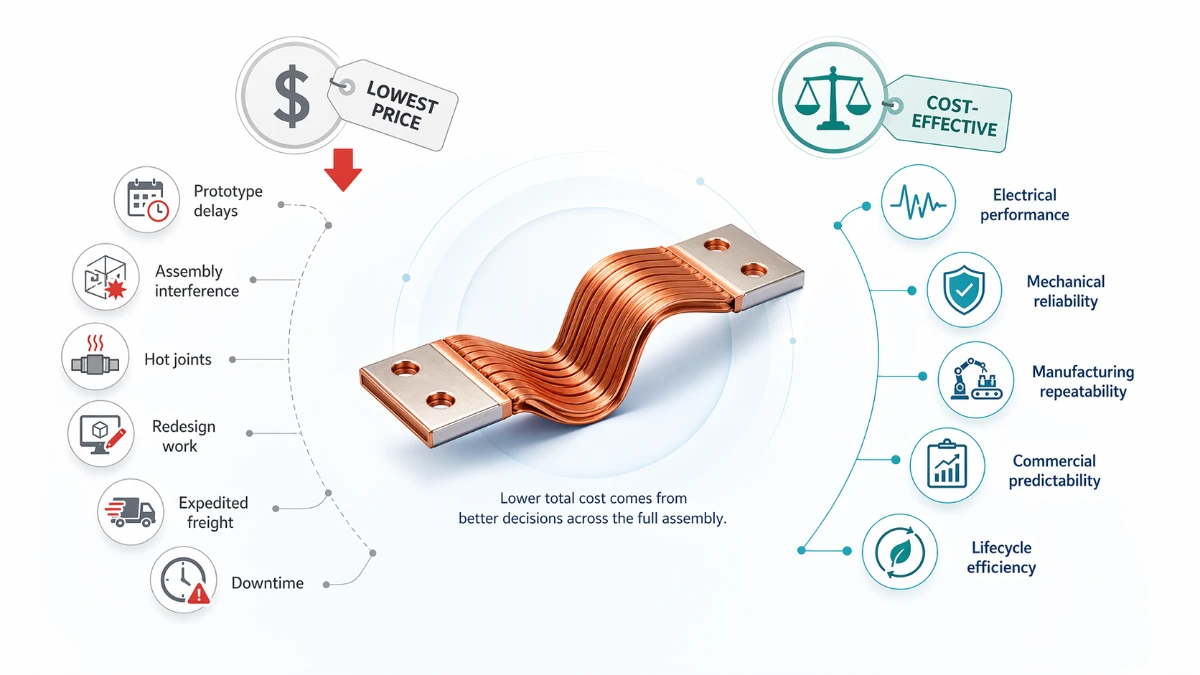
In custom power-distribution hardware, the cheapest quote is often the most expensive decision. A low initial price can hide loose tolerance control, vague material definitions, poor joining quality, unstable plating, incomplete inspection, or a design that is theoretically manufacturable but difficult to assemble in the customer’s real installation envelope. The cost then reappears later as prototype delays, assembly interference, hot joints, warranty risk, redesign work, expedited freight, or production downtime.
A truly cost-effective online order balances five business outcomes at the same time:
- Correct electrical performance so the busbar meets current, resistance, and temperature-rise targets.
- Mechanical reliability so vibration, thermal cycling, and mounting misalignment do not damage joints or connected equipment.
- Manufacturing repeatability so the first samples and mass-production parts behave the same way.
- Commercial predictability so lead time, raw-material exposure, and change control are transparent.
- Lifecycle efficiency so the busbar lowers assembly time, reduces service issues, and supports long-term supply continuity.
This distinction matters because Flexible Copper Busbars are often selected precisely to solve system-level problems that rigid bars or cable assemblies handle less efficiently. A good flexible busbar can absorb movement, reduce stress on terminals, simplify routing, improve cooling access, and replace multiple cables with one cleaner, lower-resistance current path. If the component is specified correctly, the value is not just inside the copper. It appears across the full assembly.
What Flexible Copper Busbars are really buying you
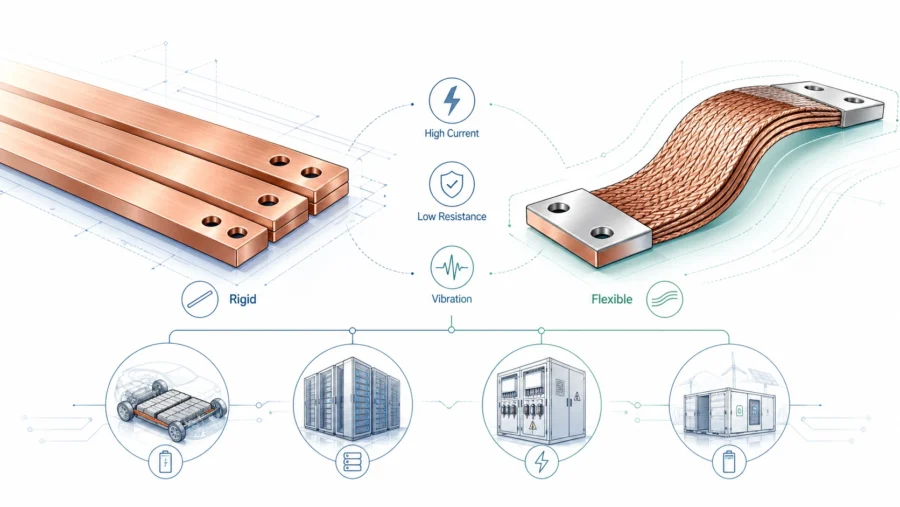
A flexible copper busbar is usually built from multiple thin copper foils or laminations that are bonded together at the terminal zones while remaining free to flex in the active section. JUMAI explains this construction in its overview of Flexible Copper Busbars and in its technical article on Flexible Busbar vs. Cable. The point is simple: you keep the conductivity and compact profile of a busbar, while gaining a degree of mechanical compliance that solid bars do not offer.
That combination is especially valuable when systems face one or more of the following conditions:
- thermal expansion and contraction;
- vibration or shock loading;
- compact packaging with awkward routing paths;
- repeated installation or service access constraints;
- parallel high-current paths that must remain organized and inspectable;
- integration with rigid terminals, brackets, shields, or deep-drawn parts.
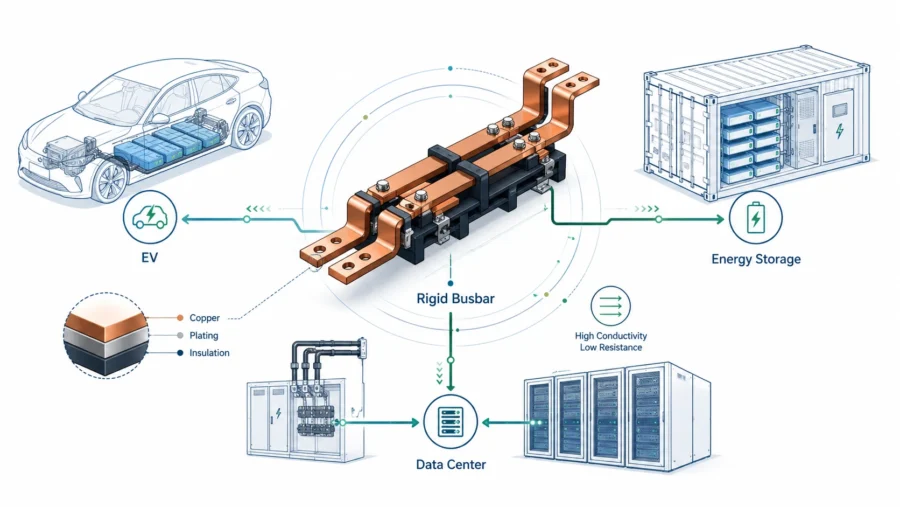
In applications such as EV battery systems, ESS cabinets, switchgear, inverter platforms, UPS systems, and data center power trains, flexible designs are often chosen because they absorb movement better than rigid bars and can offer a more controlled current path than large cable bundles. JUMAI’s article on Flexible Busbars for EV Battery Modules highlights why this matters in environments where interconnects must tolerate both vibration and thermal breathing.
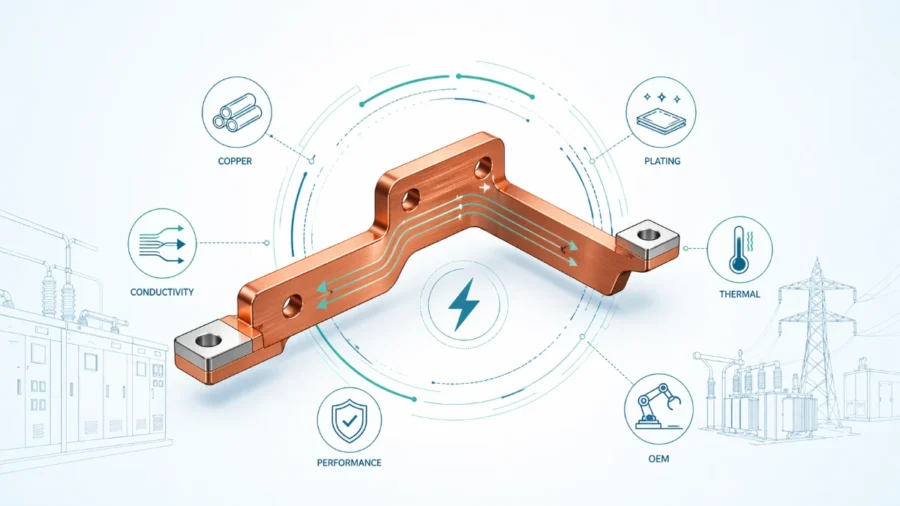
From a cost perspective, this means Flexible Copper Busbars should not be judged as raw metal only. They are engineered conductors with geometry, joining technology, insulation choices, terminal design, plating, and assembly implications. When buyers understand that, they stop overfocusing on kilograms and start optimizing the full design package.
The industry data that should influence your buying decision
Before discussing sourcing tactics, it helps to look at the data that should shape any serious RFQ.
Electrical and physical data that matter during specification
Copper remains the default conductor for busbars because of its combination of conductivity, thermal performance, corrosion resistance, and formability. The Copper Development Association lists annealed copper at roughly 58.0–58.9 MS/m conductivity, equivalent to 100.0–101.5% IACS, with electrical resistivity around 0.01724–0.0170 Ω·mm²/m at 20°C. The same source gives thermal conductivity near 3.94 W/cm·°C, which is approximately 394 W/m·K. Those properties explain why copper is so widely used in high-current, low-resistance paths.
For custom busbar sourcing, this is not abstract physics. It affects how much cross-sectional area you need, how much heat the part will generate under load, how much terminal temperature margin you retain, and whether a modest material upgrade is economically justified. A conductivity difference of only 1% can matter in dense, sealed, or thermally difficult assemblies where the busbar runs hot and cooling is expensive.
Copper-grade data for purchasing decisions
For many standard electrical applications, C11000 ETP copper is the sensible baseline. The Copper Development Association’s alloy database states that C11000 has a minimum copper content of 99.90% and a minimum conductivity of 100% IACS, while oxygen-free grades such as C10100 reach 101% IACS and are produced with much lower oxygen content. The CDA also notes that C10100 contains a minimum of 99.99% Cu and is suited to demanding vacuum or fabrication environments where oxygen-bearing grades may be less desirable. JUMAI’s own guide comparing C10100 vs C11000 Copper Busbar Selection is useful when the buyer must decide whether the oxygen-free premium is functionally necessary or merely a specification habit.
Commodity-price data that procurement should not ignore
Because copper is a globally traded metal, raw-material volatility can materially change a quote. The World Bank’s April 2026 Pink Sheet shows LME copper averaging $8,490/mt in 2023, $9,142/mt in 2024, and $9,947/mt in 2025. It also shows January 2026 at $13,012/mt, February 2026 at $12,951/mt, and March 2026 at $12,529/mt. Buyers do not need to predict the market perfectly, but they should understand a basic truth: if your project has a meaningful copper mass and a long decision cycle, raw-material timing can influence landed cost more than small quote differences between suppliers.
Compliance and test data that affect hidden cost
Many buyers still underestimate the downstream cost of compliance gaps. The European Commission’s RoHS page notes that the RoHS framework restricts ten hazardous substances in electrical and electronic equipment. For many export programs, RoHS declarations, plating chemistry control, and traceability are not optional paperwork; they are procurement risk controls.
Likewise, corrosion and vibration validation are not cosmetic tests. ISO 9227:2022 covers neutral salt spray and related corrosion testing, while ISO 16750-3:2023 defines mechanical-load testing for road-vehicle electrical and electronic equipment. These are especially relevant in EV, transport, outdoor energy, and industrial environments. When a supplier cannot clearly discuss these tests, the “cheap” quote often carries hidden reliability risk.
Table 1: Copper property reference points relevant to Flexible Copper Busbars
| Property | Typical reference value | Why buyers should care |
|---|---|---|
| Electrical conductivity of annealed copper | 58.0–58.9 MS/m | Determines resistance and I²R loss |
| Conductivity benchmark | 100.0–101.5% IACS | Useful for comparing copper grades |
| Electrical resistivity at 20°C | 0.01724–0.0170 Ω·mm²/m | Used for quick resistance estimates |
| Thermal conductivity | ~394 W/m·K | Affects heat spreading and thermal design |
| C11000 minimum copper content | 99.90% | Standard high-conductivity commercial grade |
| C11000 minimum conductivity | 100% IACS | Good value for most mainstream applications |
| C10100 minimum copper content | 99.99% | Higher-purity oxygen-free grade |
| C10100 minimum conductivity | 101% IACS | Useful where welding, purity, or thermal margin matters |
Source basis: Copper Development Association fact sheet, CDA alloy data, and CDA types-of-copper reference.
Table 2: Recent copper-price signals that affect online purchasing strategy
| Period | LME copper average ($/mt) | Procurement implication |
|---|---|---|
| 2023 annual average | 8,490 | Lower raw-material baseline |
| 2024 annual average | 9,142 | Moderate increase vs. 2023 |
| 2025 annual average | 9,947 | Higher budget pressure for copper-rich parts |
| January 2026 | 13,012 | Buyers should confirm quote validity period |
| February 2026 | 12,951 | Material-index language becomes more important |
| March 2026 | 12,529 | Lock windows and hedging discussions matter for larger orders |
Source: World Bank Commodities Price Data (The Pink Sheet), April 2, 2026.
Table 3: Standards and compliance references buyers commonly need
| Topic | Reference | Why it matters in procurement |
|---|---|---|
| Copper bus bar and shapes | ASTM B187/B187M | Material and product baseline for bus bar, rod, and shapes |
| Copper sheet, strip, plate, rolled bar | ASTM B152/B152M | Relevant when foil, strip, or rolled material is specified |
| Low-voltage assemblies | IEC 61439-1:2020 | Important when busbars sit inside verified assemblies |
| Corrosion testing | ISO 9227:2022 | Common for plated parts in harsh environments |
| Automotive mechanical loads | ISO 16750-3:2023 | Common in EV and vehicle-related applications |
| Restricted substances | RoHS Directive | Required in many export and electronics supply chains |
These references do not tell you exactly what your busbar should look like, but they do help prevent underspecified purchasing. That alone saves money.
The first big savings decision: choose the right construction, not just the right supplier
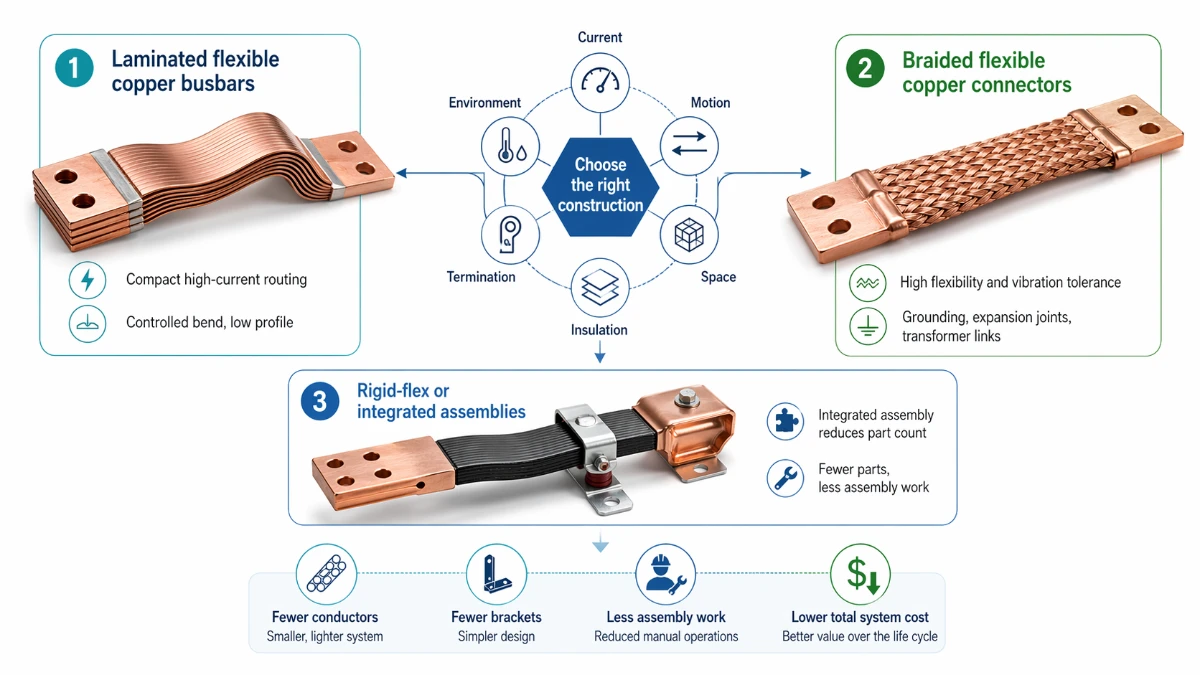
When buyers say they need Flexible Copper Busbars, they may actually mean several different product families. The correct architecture depends on current, motion, space, insulation, termination method, and installation environment.
Laminated flexible copper busbars
These are typically built from stacked foils, often in the range described by JUMAI’s technical content, with bonded ends and a free-flex center zone. They are ideal when the project needs compact high-current routing, controlled bend behavior, and low-profile installation. Laminated designs often make sense in battery systems, inverter links, UPS modules, switchgear interfaces, and power-electronics assemblies.
Braided flexible copper connectors
Braided constructions are often preferred when very high flexibility, vibration tolerance, or repeated movement is more important than a highly controlled flat profile. They can be valuable for grounding, expansion joints, transformer links, and equipment where the path is less geometrically constrained.
Rigid-flex or integrated assemblies
Sometimes the most cost-effective answer is not a pure flexible part at all. It is a hybrid design that combines rigid terminals, formed ends, insulation features, and even deep-drawn or stamped accessories. This is where JUMAI’s cross-capability becomes commercially useful, because a customer can pair the conductor with deep-drawn components or use insights from custom precision copper busbar design to reduce part count and assembly work.
The buyer’s savings opportunity here is large. When one engineered assembly replaces several separate conductors, insulators, brackets, and manual operations, the total system cost often drops even if the busbar itself looks more “custom” on the quote.
The second big savings decision: specify only what your application really needs
Over-specification is one of the most common ways buyers waste money online. Under-specification causes failures. The goal is neither extreme. The goal is a disciplined, evidence-based specification.
Copper grade: premium only when the application justifies it
For many industrial and commercial power applications, C11000 ETP copper is the best value choice. It is widely available, highly conductive, and familiar to fabricators. It should be the default starting point unless the application has a clear reason to move higher.
C10100 or another oxygen-free grade becomes commercially logical when one or more of the following are true:
- the part must tolerate welding or brazing conditions that make oxygen-bearing copper less desirable;
- the application is sealed, compact, and thermally stressed enough that the conductivity margin matters;
- the geometry requires extreme ductility or high-integrity forming;
- the environment includes vacuum, specialty electronics, or other purity-sensitive conditions.
The cost-effective mindset is simple: do not buy oxygen-free copper because it sounds premium. Buy it when the process, environment, or reliability case justifies it.
Plating: choose for contact stability, corrosion environment, and mating interface
Tin plating is commonly selected because it offers a practical balance of cost, solderability, and corrosion protection for many electrical interfaces. Silver plating may be justified where contact performance, temperature, or specific connection conditions demand it. Bare copper may be acceptable in controlled environments, but many buyers learn too late that “saving” on plating can increase oxidation management, handling sensitivity, or field maintenance.
A cost-effective RFQ should define:
- whether plating is required on the full part or terminal areas only;
- target plating type and thickness range;
- mating hardware or terminal material;
- expected humidity, salt, sulfur, or outdoor exposure;
- whether salt-spray or related corrosion testing is part of validation.
Insulation: only specify the dielectric system your environment demands
Some flexible busbars are uninsulated because the assembly already provides clearances, barriers, or encapsulation. Others require PVC, TPE, heat-shrink, PA12, epoxy, or specialized coatings depending on voltage class, abrasion, temperature, and assembly density. The right question is not “what is the best insulation?” The right question is “what insulation is sufficient, manufacturable, and durable for the actual operating envelope?”
In high-voltage EV and energy-storage environments, buyers may need more stringent dielectric performance. In lower-voltage indoor equipment, a simpler solution may be enough. Over-insulating a part can add cost, thickness, process time, and lead-time complexity without improving practical value.
Tolerances: specify tight only where function demands tight
Tight tolerances increase manufacturing effort, inspection effort, and rejection risk. That does not mean buyers should accept sloppy parts. It means they should separate functional dimensions from non-critical dimensions.
Terminal-hole position, pad flatness, bonded-end thickness, and key interface lengths may be truly critical. Other dimensions may not need the same discipline. When buyers provide a tolerance map or clearly mark critical-to-function features, suppliers can price the job more accurately and avoid hidden conservatism.
The RFQ package that saves the most money
Most costly online busbar orders begin with incomplete RFQs. Suppliers can only quote what they understand. If they do not understand the application, they either guess, overbuild, or underquote risk. None of those outcomes is good for the buyer.
A cost-effective RFQ for Flexible Copper Busbars should include more than a 2D drawing. It should include the engineering context that determines whether the design is correct.
Table 4: RFQ checklist for custom Flexible Copper Busbars
| RFQ item | Why it matters | Cost impact if missing |
|---|---|---|
| 2D drawing with dimensions | Establishes geometry and tolerances | Requotes, dimensional disputes, sample failure |
| 3D file or routing reference | Helps assess bend path and packaging | Hidden interference, poor manufacturability |
| Current profile (continuous/peak) | Supports cross-section and temperature decisions | Overdesign or overheating |
| Voltage level | Affects spacing, insulation, and safety design | Compliance and dielectric risk |
| Ambient temperature range | Influences thermal margin | Incorrect ampacity assumptions |
| Duty cycle | Distinguishes steady from intermittent load | Wrong conductor sizing |
| Installation environment | Guides plating and corrosion choices | Premature oxidation or coating failure |
| Required copper grade | Prevents assumptions | Overpaying or buying the wrong material |
| Plating type/thickness target | Aligns contact and corrosion strategy | Rework, poor contact reliability |
| Flexing requirement | Determines architecture and life expectations | Cracking or stiffness mismatch |
| Mounting hardware details | Protects joint geometry and assembly fit | Hot spots, torque issues, misfit |
| Test or inspection requirements | Aligns quality expectations before quoting | Late-stage cost escalation |
| Forecast quantity and lot size | Drives tooling and process route decisions | Wrong cost model |
| Required Incoterm and destination | Affects landed-cost accuracy | Freight surprises |
| Change-control expectation | Protects repeat orders | Drift between sample and mass production |
A strong RFQ also states what is still undecided. That gives the supplier permission to recommend a better configuration instead of pricing a bad assumption.
How to compare online suppliers without being misled by quotes
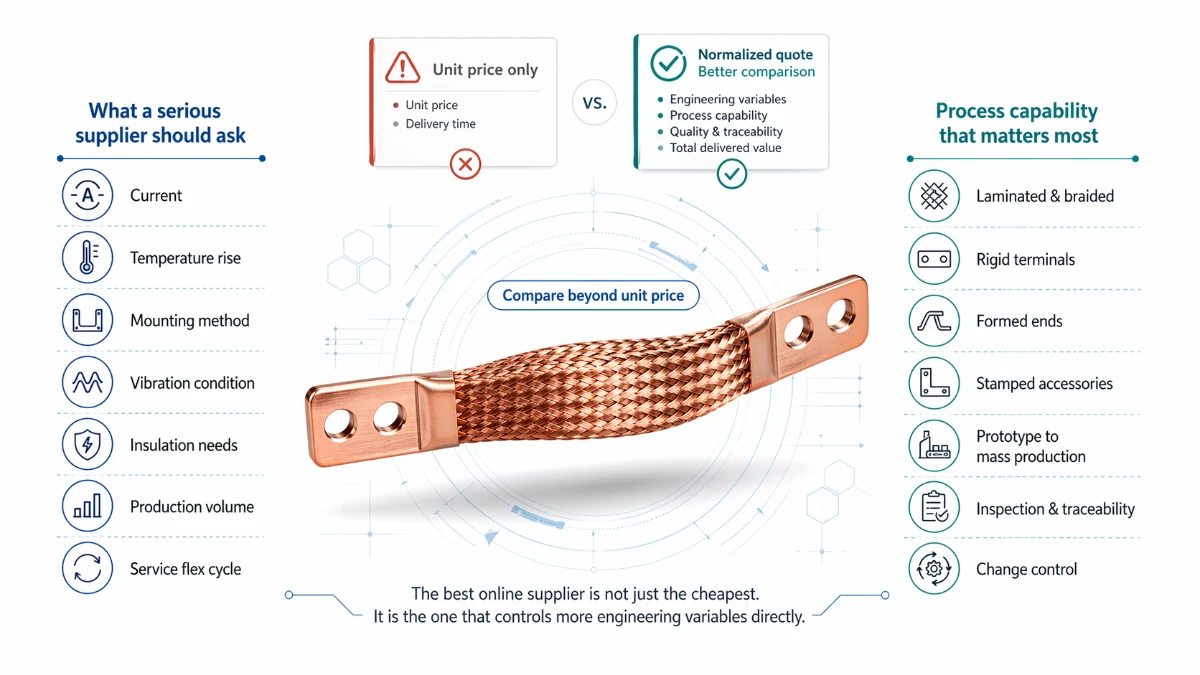
Online sourcing is efficient, but only when the buyer normalizes the quotations correctly. Many quotations look similar because they summarize only copper thickness, size, plating, and unit price. That is not enough.
A smarter comparison method evaluates both price and quote quality.
What a serious supplier should ask you
When a supplier asks good questions, that is often a positive sign. They should want to know your current, temperature rise, mounting method, mating materials, vibration condition, insulation needs, and expected production volume. They may also ask whether the part flexes once during installation or repeatedly during service, whether the ends are welded, and whether the bar must fit within a specific creepage-clearance envelope.
A supplier who quotes immediately without clarifying anything may still be capable, but the probability of hidden assumptions is much higher.
What process capability matters most
For custom Flexible Copper Busbars, buyers should look beyond “we can make it.” The more useful questions are:
- Can the supplier process both laminated and braided constructions?
- Can they support rigid terminals, formed ends, or integrated stamped accessories?
- Can they align conductor design with deep-drawn and precision stamped components when the assembly requires it?
- Can they discuss the difference between prototype routing and repeatable mass production?
- Can they define inspection points, traceability, and change-control rules clearly?
This is where a specialist manufacturer often outperforms a trading-only source. It is not just about raw price. It is about the number of engineering variables the supplier can control directly.
Table 5: Practical supplier scorecard for online custom busbar sourcing
| Evaluation area | Weight | What good looks like |
|---|---|---|
| Technical review quality | 20% | Supplier challenges assumptions and improves DFM |
| Material transparency | 15% | Clear copper grade, plating, insulation, and standards basis |
| Prototype-to-mass-production consistency | 15% | Defined process route, tooling logic, and inspection plan |
| Integration capability | 10% | Can combine busbar with rigid ends, brackets, or stamped parts |
| Quality evidence | 15% | Inspection records, traceability, test thinking, sample discipline |
| Lead-time realism | 10% | No vague promises; explains tool, sample, and production timing |
| Commercial clarity | 10% | Quote validity, Incoterms, packaging, MOQ, and revision handling |
| Communication responsiveness | 5% | Fast, precise, technically literate responses |
This scorecard often reveals that the “best value” supplier is not the one with the lowest nominal unit price. It is the one most likely to produce a stable, repeatable, low-risk part.
Use online ordering to standardize, not just to source
One of the biggest savings opportunities in online busbar procurement is standardization. Many companies repeatedly buy similar parts with slightly different hole spacing, terminal widths, foil counts, or insulation colors because each project team works independently. That creates unnecessary SKU growth, low-volume fragmentation, and frequent engineering rework.
A better strategy is to review your program portfolio and ask:
- Can terminal pad sizes be standardized across several products?
- Can the same foil thickness be used across multiple current classes by adjusting width or layer count?
- Can plating be standardized by application family?
- Can bracket and shield interfaces be unified using common deep-drawn or stamped accessories?
- Can a small number of modular busbar platforms cover many variants?
This is where online ordering becomes more than procurement. It becomes a design-governance tool. Once standard platforms are established, quotations become faster, supplier learning improves, scrap drops, and the buyer gains better leverage on repeat orders.
Prototype correctly, or the online order will cost more later
A lot of busbar projects fail commercially because the buyer treats the prototype as a cosmetic checkpoint rather than a process-learning phase. A sample that merely “fits the drawing” is not enough.
What prototype validation should really cover
A meaningful prototype review should check:
- fit inside the actual installation path;
- access for bolts, tools, and torque application;
- terminal pad contact quality and flatness;
- flex behavior in the installed condition;
- interference with insulation barriers or covers;
- temperature behavior if current density is demanding;
- plating quality after handling and assembly;
- resistance or voltage-drop consistency if the application is sensitive.
This is why JUMAI’s content around busbar ampacity and custom precision copper busbars matters commercially. A busbar is not successful because it is made. It is successful because it performs electrically and mechanically inside the customer’s equipment with repeatable manufacturability.
When prototype cost is actually a saving
Some buyers resist prototype expenditure because they want to minimize NPI cost. That can be a mistake. When the prototype phase identifies an oversized copper section, unnecessary plating thickness, a non-critical tolerance, or an assembly feature that should be integrated into the busbar rather than added later, the prototype quickly pays for itself.
In custom conductors, small design refinements can cut recurring cost for years. That is why prototype work should be judged against program savings, not only sample invoice value.
Four hidden cost drivers buyers often miss
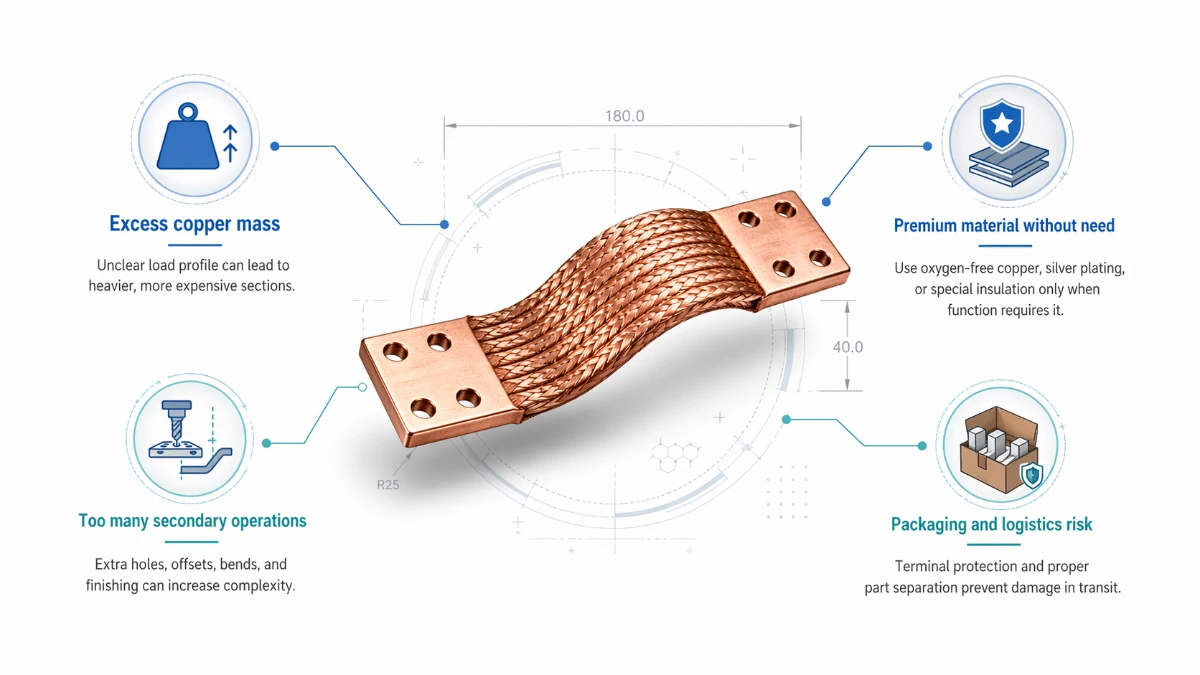
1. Excess copper mass caused by conservative assumptions
When current, duty cycle, ambient temperature, and allowable rise are not defined properly, the supplier often increases section area to protect the quote. This makes the part heavier and more expensive than necessary. If your engineering team can define the load profile more clearly, the busbar can often be optimized.
2. Unnecessary premium material
Specifying oxygen-free copper, silver plating, or highly specialized insulation “just to be safe” is a common cost leak. Safety is important, but premium material should have a clear functional reason. Otherwise, the RFQ accumulates unnecessary cost without improving business performance.
3. Too many secondary operations
Extra hole patterns, unusual terminal offsets, decorative finishing requirements, custom labels, or multiple small bends can create process complexity. Sometimes they are essential. Sometimes they exist only because no one challenged the initial layout. A cost-effective supplier should help identify which operations add real value and which are legacy design habits.
4. Poor packaging and logistics planning
Custom busbars can be damaged by poor stacking, rubbing, or terminal-surface contamination during shipping. That damage is expensive because it may not appear until the goods reach assembly. Buyers should specify packaging expectations for plated surfaces, terminal protection, part separation, and carton labeling. A few cents spent on proper packaging can prevent a disproportionate quality loss.
Industry-specific buying strategies
Different industries require different cost-control logic. A strategy that works for switchgear may not be optimal for EVs or data centers.
Flexible Copper Busbars for EV and battery systems
In EV battery modules, pack interconnects, and power electronics, thermal cycling and vibration are central design conditions. ISO 16750-3:2023 is often relevant because it covers mechanical loads for automotive electrical and electronic equipment. JUMAI’s EV busbar guide also highlights why movement accommodation is not optional in these environments.
Cost-effective EV sourcing usually focuses on these priorities:
- minimize interconnect stress on cells, modules, or terminals;
- validate flex behavior under thermal breathing and vibration;
- align conductor geometry with creepage and clearance requirements in higher-voltage systems;
- control plating and insulation quality to prevent long-term degradation;
- consider integrated assemblies where busbar, terminal zones, and stamped accessories can reduce part count.
In this segment, spending slightly more for a better conductor design often saves much more by reducing service risk and assembly complexity.
Flexible Copper Busbars for data centers and AI power infrastructure
High-current data-center power paths value low resistance, compact routing, easy serviceability, and predictable thermal behavior. Even small efficiency gains become meaningful when multiplied across large current paths and long operating hours.
For these projects, cost-effective ordering often means:
- selecting section area based on true load and thermal conditions rather than generic rules;
- keeping current paths short and joints stable;
- simplifying installation compared with cable-heavy layouts;
- prioritizing repeatable terminal geometry and surface quality;
- considering rigid-flex combinations and integrated shields or structural features.
If the busbar sits inside a tested low-voltage assembly, buyers should also be aware of the broader compliance environment represented by IEC 61439-1 and related assembly-verification practices.
Flexible Copper Busbars for renewable energy, ESS, and power conversion
Renewable and storage equipment often combines high current, outdoor or semi-outdoor environmental exposure, constrained cabinets, and demanding maintenance economics. Corrosion control, insulation durability, and assembly simplification therefore have direct commercial value.
In these sectors, cost-effective sourcing usually means:
- matching plating to the true environmental exposure;
- validating insulation against abrasion, heat, and service conditions;
- reducing unnecessary joints or cable transitions;
- improving maintenance access inside tight cabinets;
- ensuring documentation supports export compliance and customer audits.
Flexible Copper Busbars for switchgear and industrial power panels
In switchgear and panel applications, buyers often gain the most from standardization and assembly efficiency. These projects frequently reward disciplined tolerance mapping, repeatable terminal geometry, and integration with brackets or formed metal accessories.
For this segment, the best savings often come from:
- standard terminal platforms;
- clear ampacity and temperature-rise assumptions;
- copper-grade selection based on actual need rather than habit;
- supplier familiarity with assembly-verification logic;
- packaging and labeling that fit plant receiving and kitting workflows.
Sustainability is now part of cost-effectiveness
More B2B customers are asking suppliers to support sustainability reporting, recycled content discussions, and responsible-material narratives. This does not replace performance requirements, but it increasingly influences vendor selection.
The International Copper Association states that copper is 100% recyclable without loss of performance, and its recycling infographic reports that copper recycling can consume up to 85% less energy than primary production. For buyers, that matters in three ways.
First, copper scrap has real retained value. A design and supply strategy that improves material yield, scrap segregation, or closed-loop recovery can reduce effective lifecycle cost. Second, sustainability evidence can strengthen the buyer’s own customer-facing value proposition. Third, suppliers that treat material traceability seriously are often stronger operationally in general.
This does not mean every RFQ needs a complex carbon model. It does mean that modern cost-effectiveness includes material efficiency, yield discipline, and end-of-life recovery logic.
How to handle copper-price risk in online orders
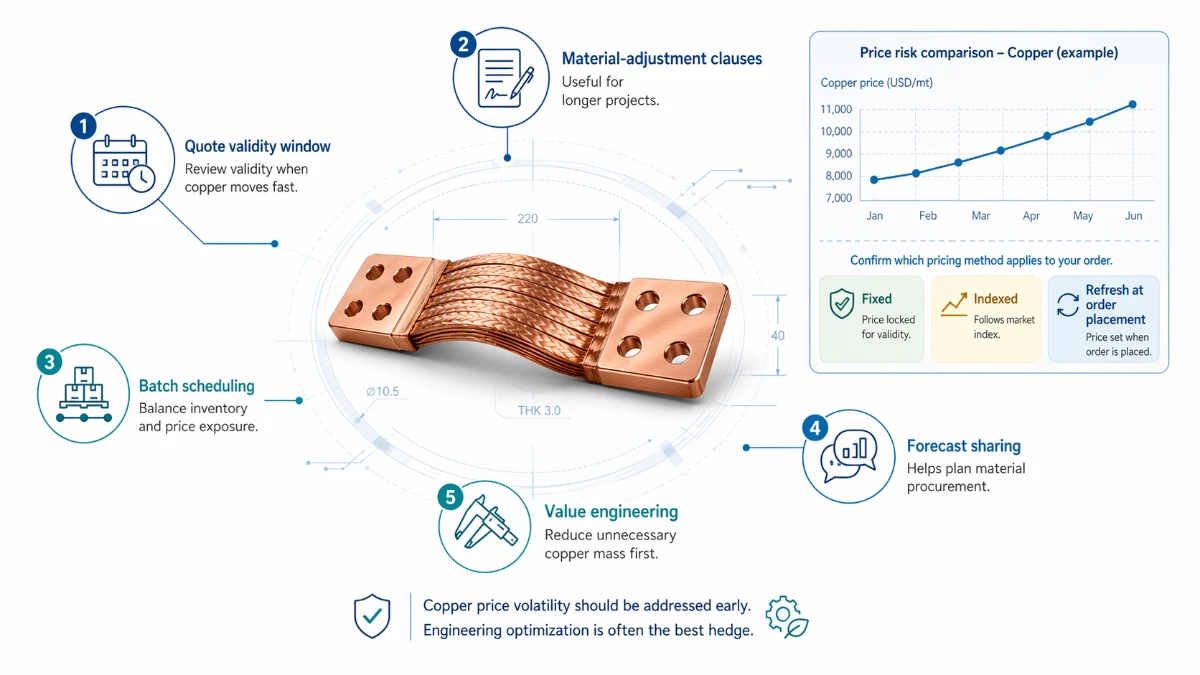
Because Flexible Copper Busbars are copper-intensive components, buyers should address price volatility directly instead of pretending it does not exist.
Useful commercial approaches include:
- quote validity windows, especially when copper markets are moving quickly;
- material-adjustment clauses for longer projects;
- batch scheduling to balance inventory risk and price exposure;
- forecast sharing so the supplier can plan material procurement more efficiently;
- value engineering to optimize copper mass before larger releases.
When the World Bank Pink Sheet shows a sharp increase versus prior annual averages, buyers should not rely on old budget assumptions. Instead, they should confirm whether the quote is fixed, indexed, or subject to refresh at order placement.
For many medium and large programs, a strong engineering review is actually the best hedge. Reducing unnecessary copper mass often saves more than arguing over small conversion-cost differences.
An illustrative total-cost model for online ordering
The following example is illustrative rather than universal, but it shows how serious buyers should think.
Assume an OEM needs 10,000 custom Flexible Copper Busbars per year for a high-current cabinet program. Two sourcing options are available.
- Option A: lower unit price, but generic design assumptions, wider dimensional scatter, more manual assembly steps, and no optimization support.
- Option B: slightly higher unit price, but optimized conductor width, terminal standardization, clearer packaging, and one integrated stamped support feature that removes a separate bracket.
Table 6: Illustrative total-cost comparison for two online sourcing options
| Cost element | Option A | Option B |
|---|---|---|
| Quoted unit price | $18.20 | $19.10 |
| Annual part spend (10,000 pcs) | $182,000 | $191,000 |
| Additional assembly labor | $21,000 | $8,000 |
| Separate bracket/component cost | $14,000 | $0 |
| Rework/scrap from fit and handling issues | $12,000 | $3,500 |
| Expedite/logistics premium | $6,500 | $2,500 |
| Field/warranty reserve assumption | $9,000 | $3,000 |
| Estimated annual total | $244,500 | $208,000 |
In this simple model, the higher unit-price source is still $36,500 lower in annual total cost. This is not unusual in custom copper components. Unit price matters, but it is only one part of the commercial equation.
A practical online ordering workflow that reduces cost and risk
The most reliable way to order custom Flexible Copper Busbars online is to follow a repeatable workflow.
1. Map the application before you ask for price
Define current, voltage, duty cycle, ambient temperature, installation space, motion requirement, and compliance context. Decide what is truly known and what is still open.
2. Prepare a real RFQ package
Do not send a rough sketch only. Send a drawing set, application notes, expected volume, and any special requirements for copper grade, plating, insulation, testing, or packaging.
3. Invite engineering feedback, not just price
Ask suppliers to identify possible design simplifications, copper-saving opportunities, tolerance adjustments, or integration options.
4. Normalize the quotes technically
Check whether all suppliers assumed the same copper grade, plating scope, tolerance basis, packaging method, and inspection level.
5. Validate samples in the real installation
Do not stop at dimensional review. Check fit, access, flex behavior, and assembly practicality.
6. Lock change control before production release
Agree on what counts as a controlled change: copper source, foil thickness, plating bath, insulation material, terminal process, packaging format, and inspection plan.
7. Build a repeat-order structure
Once the design is stable, standardize packaging, documentation, revision control, and release cadence. That reduces cost on every later order.
Why JUMAI is well positioned for business-focused online busbar projects
The strongest manufacturing partners for custom Flexible Copper Busbars are usually the ones that understand both conductor performance and manufacturability. That matters because most savings do not come from bargaining harder after the drawing is frozen. They come from shaping the design correctly before volume production begins.
JUMAI’s website reflects this broader capability set. Buyers can review the company’s Soft & Rigid Copper Busbar portfolio, study how to think about ampacity and thermal design, compare flexible busbars with cables, evaluate C10100 vs C11000 material choices, and explore how busbars can be combined with deep-drawn accessories or broader precision copper busbar development.
For B2B customers, that combination matters because it supports a more complete sourcing conversation:
- not just what the part should cost;
- but also what copper grade is justified;
- what construction is most manufacturable;
- what plating or insulation is truly necessary;
- whether a deeper integration approach can reduce parts and labor;
- and how the design can move cleanly from prototype to stable repeat production.
That is the real meaning of cost-effectiveness in custom Flexible Copper Busbars.
Final takeaways for buyers who want lower total cost
If you remember only a few points from this article, remember these.
First, define the application before requesting price. In busbar sourcing, ambiguity becomes cost.
Second, choose the correct architecture before comparing suppliers. Laminated, braided, and integrated rigid-flex solutions do not deliver the same value in every environment.
Third, specify premium material only when the application justifies it. C11000 is often the right answer. Oxygen-free grades pay off when welding, purity, ductility, or thermal margin make them functionally superior.
Fourth, compare suppliers on technical clarity, not price alone. The best quote is the one that reduces failure risk and lifecycle cost.
Fifth, treat the prototype as a savings phase, not a paperwork phase. This is where recurring cost is won or lost.
Sixth, manage copper-price exposure openly. When commodity prices rise, engineering optimization becomes even more valuable.
Seventh, use online ordering as a standardization tool. The more your program can reuse validated busbar platforms, the better your economics become.
The companies that order Flexible Copper Busbars most effectively are not the ones that buy the cheapest part. They are the ones that buy the right part, from the right supplier, with the right documentation, at the right level of specification discipline. That is how online sourcing becomes a strategic advantage instead of a transactional gamble.
FAQ
What is the most cost-effective copper grade for Flexible Copper Busbars?
In many mainstream power-distribution applications, C11000 ETP copper is the most cost-effective choice because it combines high conductivity, broad availability, and lower cost than oxygen-free grades. Buyers should move to C10100 or other oxygen-free grades when welding behavior, purity, ductility, or thermal constraints make the upgrade functionally valuable.
How can I reduce the quotation cost of a custom flexible busbar without hurting quality?
The best first steps are to provide a complete RFQ package, define the real current and thermal conditions, mark critical tolerances clearly, avoid unnecessary premium materials, and ask the supplier for DFM suggestions. Better information often reduces cost more effectively than aggressive price pressure.
Are Flexible Copper Busbars always better than cables?
No. They are often better for compact high-current routing, organized layouts, and movement accommodation, but the correct choice depends on current, geometry, flexibility needs, insulation requirements, and installation method. That is why technical comparison at the RFQ stage is important.
When should I ask for tin plating, silver plating, or bare copper?
That decision should be driven by contact stability, mating materials, environment, and service conditions. Tin plating is a good value choice in many applications, while silver plating is usually justified only where performance demands it. Bare copper can work in controlled conditions, but buyers should be careful about oxidation and handling exposure.
How should I compare online suppliers for Flexible Copper Busbars?
Use a scorecard that includes technical review quality, material transparency, process capability, prototype-to-production consistency, quality evidence, and commercial clarity. Unit price is important, but it should not be the only variable.
Why do some custom flexible busbar projects become expensive after the first quote?
Because the initial RFQ was incomplete, the design was over-specified, the prototype was not validated in the actual assembly, or the supplier’s assumptions were not normalized. Most hidden cost appears after quotation, not inside it.
Can sustainability goals support a better business case for copper busbars?
Yes. Copper is highly recyclable, and recycled copper can help support circularity, material-efficiency, and customer-facing sustainability goals. It may not replace electrical-performance requirements, but it increasingly supports supplier selection and lifecycle value discussions.