
When you design a power distribution system, the quality of your busbar copper determines how efficiently every amp leaves the transformer and reaches the load. Small choices in copper grade, temper, and surface finish can translate into big differences in temperature rise, energy loss, and long-term reliability. For OEMs and panel builders, that is not just a theoretical discussion – it directly affects lifecycle cost, uptime, and customer satisfaction.
At JUMAI TECH, we work every day with OEMs, switchgear manufacturers, and system integrators who need custom copper busbars, flexible connectors, and deep-drawn components that balance electrical performance, mechanical robustness, and cost. This article walks you through the main busbar copper material options, how they compare, and what to consider when you are defining low-resistance current paths in your next design.
We will also point you to widely recognized reference sources – such as the Copper Development Association, IEC 61439 guidance, and ASTM material standards – so your internal specifications can be backed by independent, globally accepted data.
Table of Contents
1. What Do We Mean by “Busbar Copper” and Low-Resistance Paths?

1.1 The role of busbar copper in modern power distribution
In simple terms, busbar copper is the metallic backbone that carries large currents in low- and medium-voltage systems. Instead of relying on multiple cables, designers concentrate current into solid or laminated copper bars to achieve better control over impedance, clearances, and heat dissipation.
These copper busbars appear in switchgear, distribution boards, UPS systems, renewable energy inverters, traction converters, battery energy storage systems, and heavy industrial equipment. In each case, the goal is the same: create a predictable, low-resistance path so that current flows with minimal losses and temperature stays within specified limits over decades of operation.
1.2 Why low-resistance paths matter for efficiency and reliability
Electrical resistance in busbar copper converts part of your current into heat. The higher the resistance, the more energy you lose as I²R losses, and the hotter the busbar becomes for a given current. Excessive temperature rise accelerates oxidation, increases contact resistance at joints, and stresses insulation and mounting hardware.
By carefully choosing a high-conductivity copper grade, optimizing cross-section, and respecting temperature-rise limits defined in standards like IEC 61439, you can significantly extend equipment life and improve energy efficiency.Schneider Electric Blog A low-resistance busbar is not just a “nice to have” – it is a central design lever for safety, performance, and operating cost.
2. Core Busbar Copper Grades and Their Properties
2.1 ETP copper (C11000): the workhorse busbar copper
For most low-voltage busbar systems, the default busbar copper choice is Electrolytic Tough Pitch (ETP) copper, usually designated as UNS C11000 or Cu-ETP in EN standards. ETP copper typically contains at least 99.9% copper and a small controlled amount of oxygen.
In the annealed condition, C11000 offers electrical conductivity of roughly 100–101% IACS (International Annealed Copper Standard), which means it is about as conductive as copper can get in commercial practice.Sequoia Brass and Copper This high conductivity makes ETP the logical starting point when you want the lowest possible resistance per unit length. At the same time, Cu-ETP has good formability and can be readily punched, bent, and stacked, which suits typical busbar manufacturing processes such as stamping, drilling, and edge rounding.
However, ETP copper has some limitations. Its oxygen content can make it susceptible to hydrogen embrittlement in certain high-temperature, reducing atmospheres and can constrain some brazing and welding processes.kme.com For standard LV panels in normal atmospheres this is rarely an issue, but for specialized vacuum applications or high-reliability power electronics, designers sometimes look beyond ETP.
2.2 Oxygen-free copper (C10200): for demanding joining and thermal conditions
When a project demands exceptional purity, improved weldability, and very low gas content, oxygen-free busbar copper becomes attractive. UNS C10200 (Cu-OF) is a widely used oxygen-free high-conductivity copper with a copper content of at least 99.95% and minimal oxygen (commonly less than 0.001%).
Oxygen-free copper maintains electrical conductivity around 100% IACS as well, but its extremely low oxygen content reduces the risk of hydrogen embrittlement during brazing or high-temperature processing.mitsubishi-copper.com This characteristic makes it a preferred busbar copper for vacuum equipment, high-frequency power circuits, and applications where the busbar will be welded, brazed, or operated at elevated temperatures over long periods.
The trade-off is cost. C10200 and other oxygen-free grades are more expensive than standard ETP copper. That makes them best suited where the additional reliability, lower outgassing, or joining advantages clearly justify the added material cost, such as in rail traction converters, semiconductor manufacturing equipment, or critical medical power systems.
2.3 High-strength copper alloys: when mechanical demands increase
In many designs, pure copper offers more than enough mechanical strength for static busbar arrangements. But in some cases, designers must consider vibration, mechanical shock, clamping loads, or spring-contact functions where higher yield strength and fatigue resistance are required.
Here, copper alloys such as CuCrZr (copper–chromium–zirconium) or silver-bearing coppers provide a useful compromise. These alloys have slightly lower conductivity than pure C11000 or C10200, but they still offer reasonably high IACS values alongside significantly improved mechanical strength.mitsubishi-copper.com For example, they can be used where busbars carry very high short-circuit forces, or where movable contacts and sliding interfaces are needed.
At JUMAI TECH, we help customers evaluate whether they genuinely need a copper alloy for a given busbar, or whether geometric reinforcement and mounting design can keep them within the range of higher-conductivity pure copper grades. This approach often saves cost and reduces resistive losses without sacrificing mechanical integrity.
3. Key Design Factors When Choosing Busbar Copper
3.1 Conductivity and IACS rating
The first parameter most engineers think about in busbar copper selection is conductivity. The IACS rating expresses conductivity as a percentage of a reference annealed copper. Standard ETP copper (C11000) typically sits at or just above 100% IACS, while oxygen-free copper grades can also achieve around 100% or slightly higher under optimized conditions.
Even seemingly small differences in IACS can matter in high-current systems. A 5–10% drop in conductivity leads to a corresponding increase in resistive losses and temperature for the same current and cross-section. When you multiply that across thousands of hours per year of operation, the energy penalty becomes tangible. That is why our engineers always ask how much current density and temperature rise you are willing to accept before suggesting thinner or alloyed busbar copper.
3.2 Thermal behaviour and temperature-rise limits
Low resistance alone does not guarantee a successful busbar design. Heat dissipation depends not only on resistive losses but also on busbar geometry, spacing, mounting, enclosure airflow, and ambient temperatures. International standards such as IEC 61439 define maximum allowable temperature rises for busbars and associated equipment to ensure safe and reliable operation. Typical limits keep copper busbars below about 140°C at maximum load, depending on ambient conditions and insulation details.
The Copper Development Association (CDA) publishes practical tables and “Quick Busbar Selector” tools that correlate copper cross-section, current, and permissible temperature rise.These references help designers quickly estimate whether a given size of busbar copper is in the right ballpark before detailed thermal calculations or tests. At JUMAI TECH we use such reference data as a starting point, then refine the design by considering forced or natural convection, enclosure configuration, and real-world duty cycles.
3.3 Mechanical strength, formability, and fatigue
Busbar systems are not just static copper blocks; they experience mechanical loads from short-circuit forces, thermal expansion, vibration, and installation handling. Pure C11000 copper is relatively soft and very formable, which makes it excellent for bent profiles and punched hole patterns.
However, when you expect severe fault currents or dynamic loads, you may need to increase section thickness, add bracing, or select a higher-strength alloy. For flexible busbars, the situation is different: laminated and braided copper connectors are designed to absorb movement and vibration instead of resisting it. In both cases, the choice of busbar copper and temper must align with mechanical and fatigue expectations, not just electrical ones.
3.4 Surface quality, plating, and corrosion
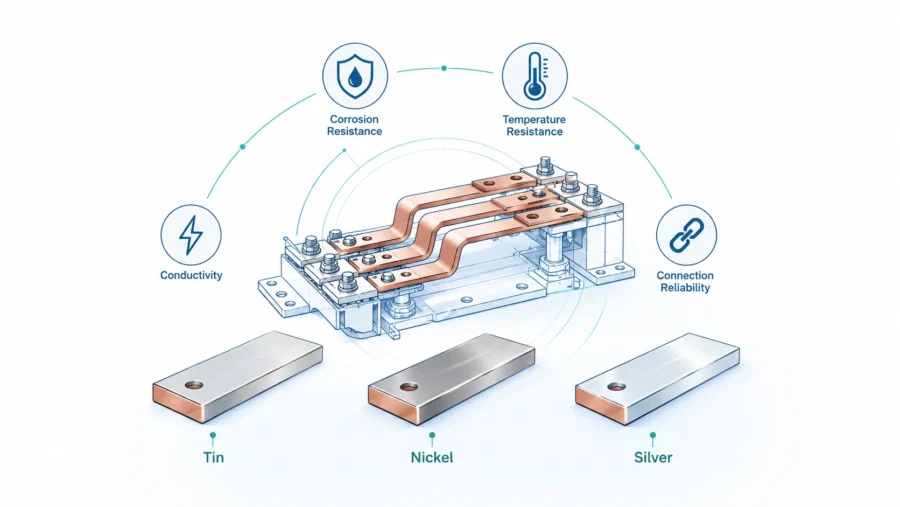
Surface condition is another critical factor, especially at bolted joints and sliding contacts. Oxidation and contamination increase contact resistance, which in turn raises local temperature and can undermine the low-resistance design you targeted. Clean, smooth copper surfaces with appropriate contact pressure help to maintain low resistance over time.
In many industries, designers specify surface plating – typically tin, silver, or nickel – over the base busbar copper to improve corrosion resistance and reduce contact resistance. Tin plating is common in low-voltage switchgear, while silver or nickel may be used in high-temperature or high-frequency environments. Good plating practice, combined with appropriate joint design (such as serrated washers, correct torque, and controlled surface roughness), is essential to preserve low-resistance paths throughout the life of the equipment.
4. Standards and Reference Data for Busbar Copper Selection

4.1 Material standards and designation systems
When you specify busbar copper materials, it is important to reference recognized standards so that suppliers, OEMs, and end users share a common understanding. ASTM B152/B152M, for example, defines requirements for copper sheet, strip, plate, and rolled bar, covering multiple copper grades including C10100, C10200, and C11000.
European and international norms, such as EN designation systems (e.g., CW004A for Cu-ETP and CW008A for Cu-OF), provide equivalent material references.kme.com By tying your specification to these standards, you ensure that every batch of busbar copper meets minimum chemical composition, mechanical property, and dimensional tolerances, regardless of the producing mill. JUMAI TECH routinely works with these material standards and can help convert between ASTM, EN, and JIS designations when needed.
4.2 Busbar temperature-rise and ampacity references
For ampacity and temperature-rise evaluation, engineers often lean on tables and formulae published by technical associations and standard-making bodies. The Copper Development Association busbar resources, for example, provide detailed ampacity tables and guidelines that relate current, cross-section, and temperature rise for various busbar arrangements and cooling conditions.
Standards such as IEC 61439 go a step further by specifying design verification methods for low-voltage switchgear and controlgear assemblies. These include testing or calculation approaches for temperature rise, clearances, creepage distances, and short-circuit withstand strength of busbars and associated components.cognitor.com.br When you combine these formal standards with manufacturer application notes and design guides, you create a robust framework for busbar copper selection.
4.3 Typical design tools and calculation guides
Beyond tabulated data, there are numerous calculation guides and engineering papers that describe methods for estimating current-carrying capacity and temperature rise in copper busbars. Many of them show that acceptable current density in air-cooled rectangular busbars is often in the range of 1.5–2.0 A/mm² for conservative designs, with higher values possible under forced cooling and well-ventilated conditions.
At JUMAI TECH, we integrate this type of reference with our own experience from past projects and thermal tests. When a customer brings us a new device, we can quickly screen several candidate sections, compare their thermal margins, and recommend the most efficient busbar copper profile that still respects applicable standards and safety factors.
5. Advanced Busbar Copper Solutions: Laminated, Flexible and Deep-Drawn
5.1 Laminated and insulated copper busbars
As power density increases in modern equipment, designers often move from simple solid bars to laminated busbars. In these solutions, multiple thin layers of busbar copper are stacked with insulating films in between, creating a compact structure with controlled inductance and carefully managed creepage distances.
Laminated busbars allow you to route high currents in tight spaces while minimizing electromagnetic interference and reducing assembly complexity. By choosing high-conductivity copper grades and selecting appropriate insulation and plating, you can achieve low resistance, low inductance, and excellent dielectric performance in a single integrated component. JUMAI TECH can support this by supplying precision-stamped copper layers and deep-drawn sub-components ready for lamination.
5.2 Flexible copper busbars and braided connectors
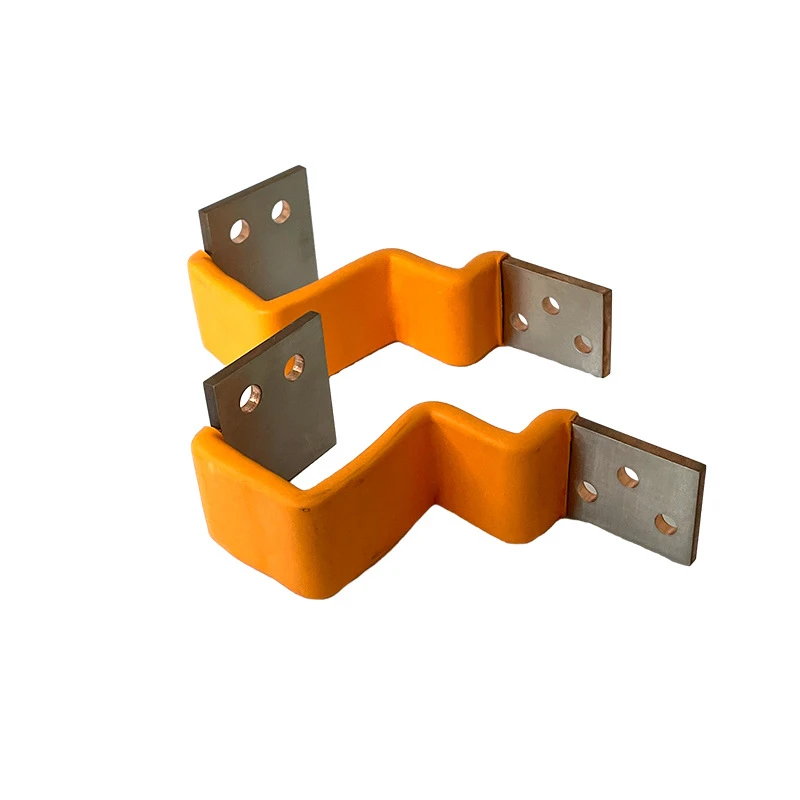
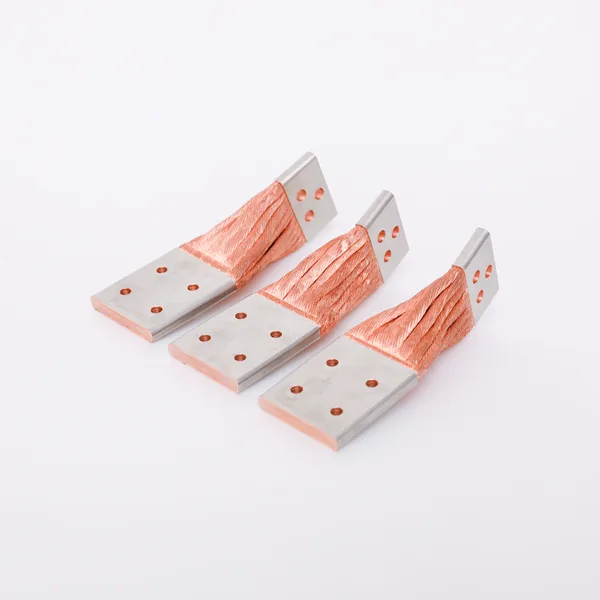
In applications where equipment moves, vibrates, or experiences thermal expansion, rigid busbars alone are not enough. Flexible copper busbars and braided connectors act as compliant links that absorb movement while maintaining low resistance between fixed points.
These components typically use stacked thin copper foils, woven copper braid, or press-welded layers made from high-conductivity busbar copper. The choice of foil thickness, number of layers, braid cross-section, and end-termination design all influence resistance, flexibility, and fatigue life. Because JUMAI TECH also manufactures precision stamping dies and terminals, we can deliver flexible connectors as part of an integrated copper busbar system rather than as an afterthought.
5.3 Integrated deep-drawn components and precision stamped copper parts
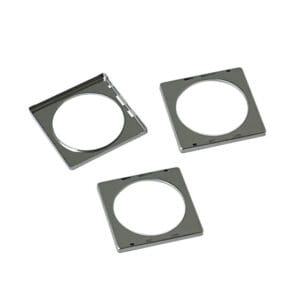
Many modern power assemblies require more than straight bars. They incorporate busbar copper that has been deep-drawn or formed into three-dimensional shapes, as well as stamped contact fingers, mounting brackets, and complex thermal interfaces.
By combining deep-drawn components with flat or laminated busbars, designers can reduce the number of fasteners, minimize contact interfaces, and optimize current paths. Our experience in deep-drawn metal forming and precision stamping allows us to integrate busbar copper with shields, terminals, and structural parts, turning multiple pieces into a compact and repeatable sub-assembly. That integration can lower assembly time, improve reliability, and provide more freedom in mechanical layout.
6. How JUMAI TECH Supports Your Busbar Copper Projects
6.1 Co-engineering and material recommendation
Specifying the right busbar copper is easier when you have a manufacturing partner involved from the early design stage. At JUMAI TECH, our engineering team works with your electrical and mechanical designers to understand current ratings, short-circuit levels, environmental conditions, and installation constraints.
Based on these inputs and referencing authoritative sources such as Copper Development Association guidelines, IEC 61439 temperature-rise criteria, and ASTM material standards, we help you select the most suitable copper grade, thickness, and temper.copper.org This collaborative approach reduces iteration loops, avoids over- or under-specification, and usually lowers total cost of ownership.
6.2 Precision manufacturing and quality control
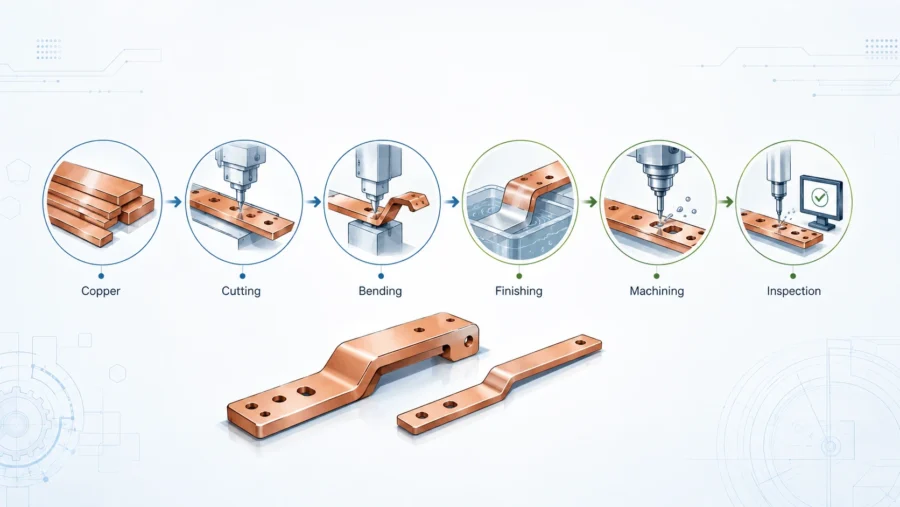
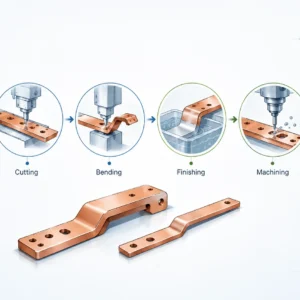
Once the material is chosen, the performance of your busbar copper still depends heavily on manufacturing quality. Our facilities are equipped for precision punching, bending, edge deburring, deep-drawing, and surface treatment, along with the manufacture of custom stamping dies and related tooling.
We work to tight dimensional tolerances and use robust quality control procedures to verify hole positions, flatness, edge condition, and plating thickness. This level of precision matters because even small deviations can lead to misalignment, uneven contact pressure, or unexpected hot spots in a high-current system. By controlling both the material and the process, JUMAI TECH helps ensure that the low-resistance paths you designed on paper are realized consistently in production.
6.3 Typical industries and application examples
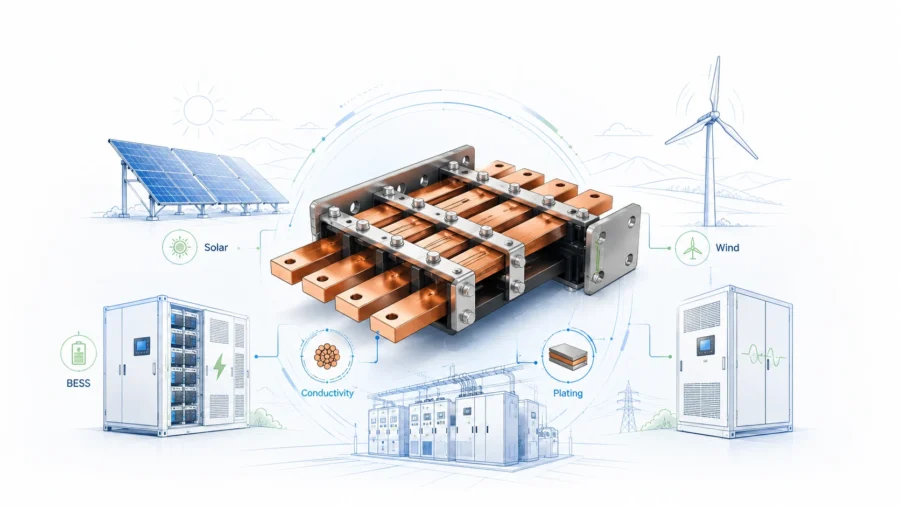
Our busbar copper solutions serve a wide range of industries, including low- and medium-voltage switchgear, renewable energy (solar and wind inverters), rail traction systems, EV charging infrastructure, industrial drives, and data center power distribution.
In each of these sectors, customers face similar challenges: high continuous currents, demanding short-circuit requirements, limited space, and strict standards compliance. By tailoring copper grade, geometry, and surface treatment to the specific environment – whether it is a dusty factory, a climate-controlled data hall, or a mobile rail vehicle – we help our clients achieve robust, low-resistance current paths with predictable thermal margins.
6.4 How to start your next busbar copper project
Starting a project with JUMAI TECH is straightforward. You can share your single-line diagrams, preliminary 3D models, or even hand sketches summarizing current ratings, voltage levels, spacing constraints, and preferred materials.
Our experts will review your requirements, suggest appropriate busbar copper grades and cross-sections, and propose manufacturable geometries that align with your cost and performance goals. From there, we can support you with rapid prototyping, sample validation, and full-scale production backed by long-term supply agreements.
7. Practical Selection Checklist and Next Steps
7.1 Quick checklist for busbar copper material choice
When you evaluate busbar copper options for a new design, it helps to run through a concise checklist rather than focus on conductivity alone. First, confirm your continuous and short-circuit current requirements, as well as acceptable temperature-rise limits based on IEC 61439 or equivalent standards. Second, determine whether standard Cu-ETP (C11000) provides enough conductivity and mechanical strength, or if special conditions (such as vacuum, high-temperature brazing, or severe vibration) justify oxygen-free or alloyed copper.
Third, consider joining methods, plating, and environmental exposure, since these factors strongly influence long-term contact resistance and corrosion behaviour. Finally, check that your chosen busbar copper grade is clearly tied to recognized material standards (ASTM, EN, JIS), so procurement and quality teams can verify every delivery. When you work through this checklist with JUMAI TECH’s engineers, you turn material selection into a structured, repeatable process instead of a one-off guess.
7.2 Turn material choices into a competitive advantage
At first glance, busbar material decisions can look like a small detail inside a much larger product design. In reality, your choice of busbar copper strongly influences energy efficiency, thermal performance, serviceability, and compliance with global standards. Utilizing high-conductivity ETP copper where it brings the best value, and upgrading to oxygen-free or alloyed copper only where truly necessary, lets you optimize performance without wasting budget.
By combining authoritative reference data with practical manufacturing experience, JUMAI TECH helps you design low-resistance current paths that are safe, reliable, and economical to produce. If you are planning a new switchgear lineup, power converter, or high-current industrial system, now is the ideal time to review your busbar copper strategy – and to partner with a specialist who can turn that strategy into high-precision hardware.
FAQ
What is Busbar Copper and Why is it Important?
Busbar copper is a special type of copper used in power distribution systems. It acts like the main road for electric currents, helping electricity travel efficiently from transformers to the devices that need it. Using good quality busbar copper helps reduce energy loss and keeps everything running at the right temperature, which is super important for safety and performance.
What are the Different Types of Busbar Copper?
There are a few main types of busbar copper: Electrolytic Tough Pitch (ETP) copper which is standard and very good for most uses. Oxygen-free copper, which is purer and better for high-temperature or welding situations. Lastly, there are high-strength copper alloys, which are stronger and used in situations that need more robustness.
How Do I Choose the Right Copper for My Design?
Choosing the right busbar copper involves looking at your power needs, the space you have, and how hot things can get. Think about how much electricity will go through it and how much heat it might generate. Good resources help guide you to find the right type and size of copper that fits your project.
What Standards Should I Consider for Busbar Copper?
It’s important to follow certain standards when selecting busbar copper. These include guidelines from organizations like ASTM and IEC. They help ensure that your copper meets safety and quality levels. By adhering to these standards, you can ensure your busbars perform well and stay reliable.
Can Busbar Copper Get Damaged?
Yes, busbar copper can get damaged, especially from heat or if it’s not connected properly. This can cause it to lose efficiency. It’s crucial to check that the copper is clean and free from corrosion to keep connections strong and performance high. Regular maintenance helps prevent such problems.
What is the Role of Conductivity in Busbar Copper?
Conductivity is how well the busbar copper can carry electricity. The higher the conductivity, the better it is at transporting electric currents with minimal energy loss. When choosing copper for busbars, look for high conductivity ratings to ensure efficient power distribution.
Why is Surface Quality Important for Busbar Copper?
Surface quality is really important for busbar copper because any dirt or rust can decrease how well the copper conducts electricity. A clean surface helps keep the connections stable and reduces heat buildup, which can lead to malfunctions. Good maintenance is key to preserving high-quality contacts.
How Can I Start My Busbar Copper Project?
To start a busbar copper project, share your initial ideas or drawings with a manufacturer like JUMAI TECH. Discuss your power requirements, space limitations, and other specific needs. They can help you choose the best copper grade and design to fit your project.
What Are the Benefits of Working With a Busbar Copper Specialist?
Working with a busbar copper specialist ensures you get expert guidance on material selection and design. They offer valuable insights on industry standards and help you avoid mistakes in your design. This partnership can lead to better performance, safety, and cost savings in your project.