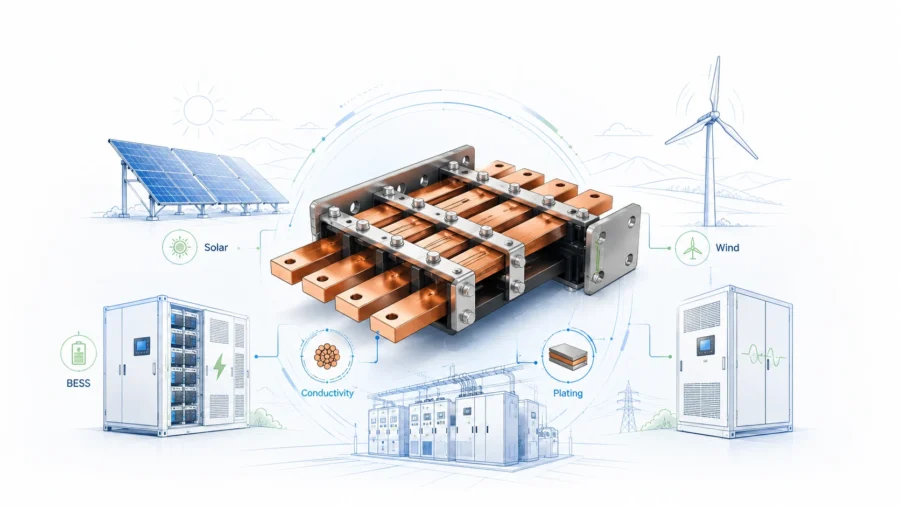

The global transition toward electrification, renewable energy, and high-density computing has fundamentally reshaped power distribution architecture. Whether designing battery energy storage systems (BESS), electric vehicle (EV) powertrains, hyper-scale AI data centers, or massive power transmission grids, the efficiency of power delivery dictates the success of the entire system. At the heart of this power infrastructure lies a critical, yet often underappreciated component: the busbar.
As a chief editor at JUMAI (DeepDrawTech) and an engineer with years of hands-on experience in the design, research, and manufacturing of power distribution components, I have witnessed firsthand the evolution of this industry. Off-the-shelf solutions are no longer sufficient for modern, high-stress environments. Today, global clients require custom OEM Precision Copper Busbars and complementary deep drawing accessories that are engineered to exact specifications.
In this comprehensive guide, we will explore the top five design considerations that engineers, procurement managers, and system architects must evaluate when partnering with an OEM manufacturer for custom flexible, rigid, and braided copper busbars. By understanding these core principles, you can ensure minimal power loss, maximum thermal efficiency, and long-term mechanical reliability in your equipment.
Table of Contents
Material Selection: Maximizing Conductivity and Purity
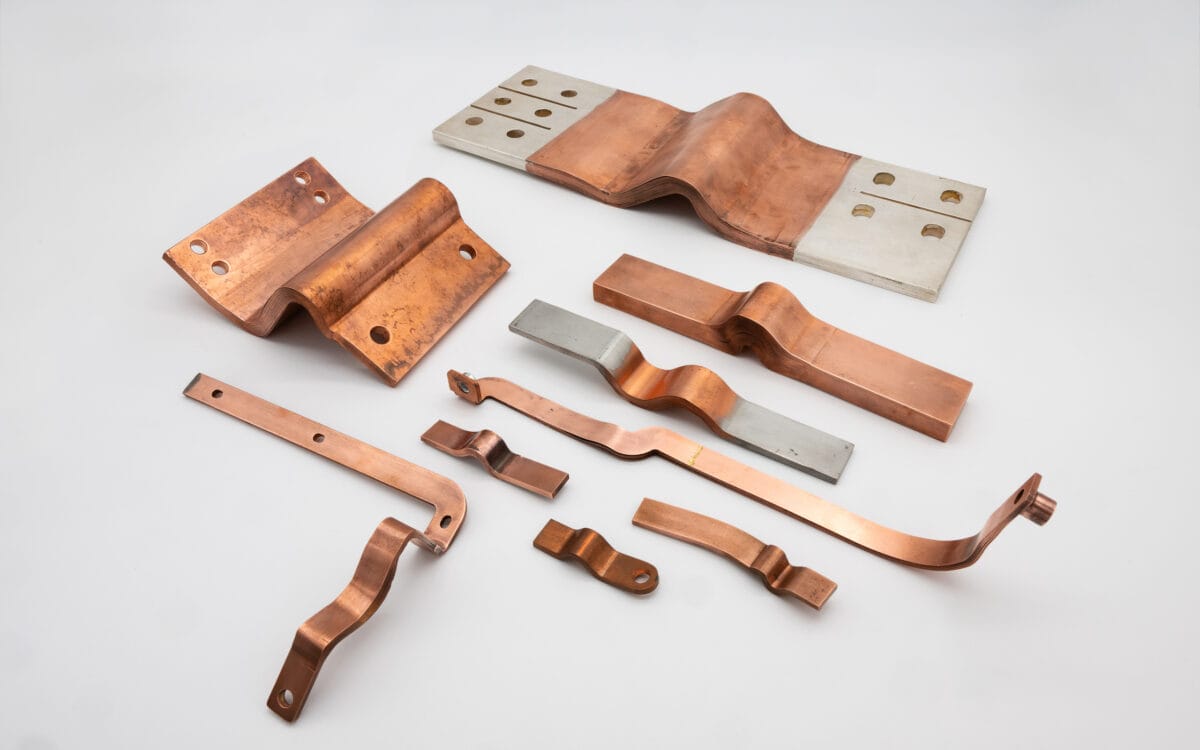
The foundational element of any power distribution system is the raw material. When designing Precision Copper Busbars, the grade of copper selected directly impacts the electrical conductivity, thermal performance, and mechanical workability of the final product. Not all copper is created equal, and understanding the metallurgical differences is paramount for applications in large-scale power transmission and data centers.
The Importance of IACS (International Annealed Copper Standard)
Electrical conductivity is measured against the International Annealed Copper Standard (IACS). For high-performance OEM busbars, manufacturers must utilize copper that meets or exceeds 100% IACS. Even a 1% drop in conductivity can lead to significant $I^2R$ (power) losses over time, translating to massive operational costs in energy-intensive environments like data centers. According to the Copper Development Association (CDA), high-purity copper is non-negotiable for modern electrical engineering.
Common Copper Grades for Precision Copper Busbars
When JUMAI manufactures custom busbars, we typically recommend specific grades based on the client’s end-use application:
| Copper Grade | UNS Designation | Purity (%) | Minimum Conductivity (IACS) | Key Characteristics & Best Applications |
|---|---|---|---|---|
| ETP (Electrolytic Tough Pitch) | C11000 | 99.90% | 100% – 101% | Contains a small amount of oxygen. Excellent for general electrical applications, switchgears, and standard rigid busbars. Not ideal for high-heat brazing or welding due to hydrogen embrittlement risks. |
| OFHC (Oxygen-Free High Conductivity) | C10100 / C10200 | 99.99% | 101% | Oxygen-free. Superior ductility and conductivity. Essential for high-vacuum electronics, deep drawing accessories, and applications requiring extensive welding, brazing, or extreme thermal cycling (e.g., EV battery packs). |
| Silver-Bearing Copper | C11400 / C11500 | 99.90% + Ag | 100% | Contains trace amounts of silver. Raises the softening temperature of the copper. Ideal for high-temperature operating environments like heavy-duty power grid transformers. |
Design Takeaway: For standard switchgear, C11000 is highly cost-effective and performs exceptionally well. However, if your design requires complex forming, deep drawing processing for custom accessories, or TIG welding without the risk of microscopic cracking, investing in oxygen-free C10200 is a necessary engineering decision.
Thermal Management and Current Carrying Capacity (Ampacity)
The primary function of Precision Copper Busbars is to carry high electrical currents safely. As current flows through the copper, resistance generates heat. If this heat is not properly managed, the busbar can exceed its maximum operating temperature, leading to insulation degradation, increased resistance, and catastrophic system failure.
Calculating Ampacity and Temperature Rise
Ampacity is the maximum current a conductor can carry continuously under the conditions of use without exceeding its temperature rating. When designing OEM busbars, engineers cannot simply look at a cross-sectional area; they must calculate the expected temperature rise ($\Delta T$).
For example, a standard operating parameter for data center uninterruptible power supplies (UPS) might dictate a maximum ambient temperature of 40°C, with a maximum allowable busbar temperature of 90°C, resulting in a permissible temperature rise of 50°C.
Ampacity Data for Rectangular Precision Copper Busbars (C11000 ETP)
Data represents approximate AC current capacity (Amps) at 60Hz for bare copper in still air with a 30°C temperature rise.
| Dimensions (Thickness x Width in mm) | Cross-Sectional Area (mm2) | DC Current Capacity (A) | AC Current Capacity (A) |
|---|---|---|---|
| 3 x 20 | 60 | 250 | 245 |
| 5 x 30 | 150 | 480 | 470 |
| 10 x 50 | 500 | 1100 | 1050 |
| 10 x 100 | 1000 | 1900 | 1750 |
The Skin Effect in High-Frequency Applications
For applications involving alternating current (AC), particularly in high-frequency power inverters used in renewable energy (solar and wind), designers must account for the “Skin Effect.” At higher frequencies, alternating current tends to flow near the surface (the “skin”) of the conductor rather than through its core.
This means that making a solid, rigid copper busbar excessively thick yields diminishing returns in AC ampacity. Instead, designers should opt for wider, thinner busbars, or utilize multiple thin layers (which is where custom flexible copper busbars excel) to maximize the surface area-to-volume ratio. Partnering with an experienced OEM like JUMAI ensures that cross-sectional geometries are optimized mathematically to mitigate skin effect losses, guided by IEEE Standards for Power Distribution.
Structural Dynamics: Rigid vs. Flexible vs. Braided Configurations
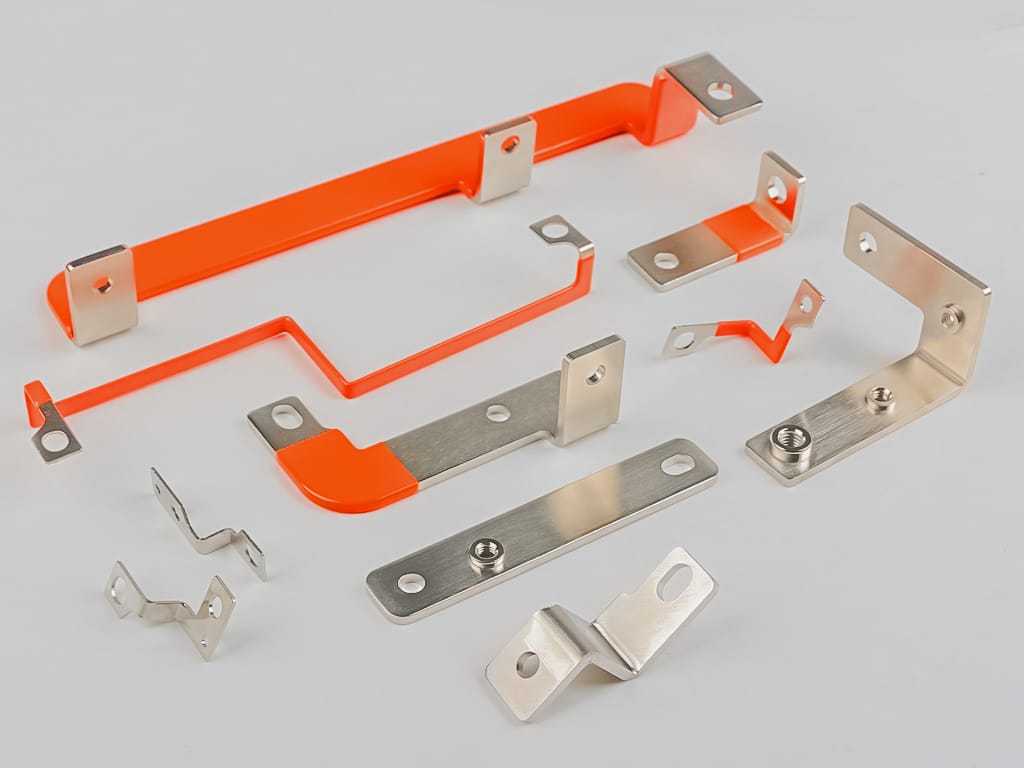
One of the most frequent challenges I encounter when consulting with global clients is selecting the correct structural configuration. A busbar is not just an electrical conduit; it is a mechanical component subjected to dynamic forces, thermal expansion, and environmental vibrations.
JUMAI specializes in manufacturing three distinct types of Precision Copper Busbars, each tailored to specific mechanical environments:
Rigid Copper Busbars
Manufactured from solid copper bars, these are the backbone of traditional electrical panels, low-voltage distribution boards, and heavy industrial machinery.
- Advantages: High structural integrity, can act as a physical support for other components, easy to manufacture in straight runs.
- Design Consideration: Rigid busbars are susceptible to thermal expansion. In large power transmission centers, long runs of rigid busbars must incorporate expansion joints. Without these, the thermal expansion and contraction cycles will shear the mounting bolts and destroy the deep drawn connector accessories.
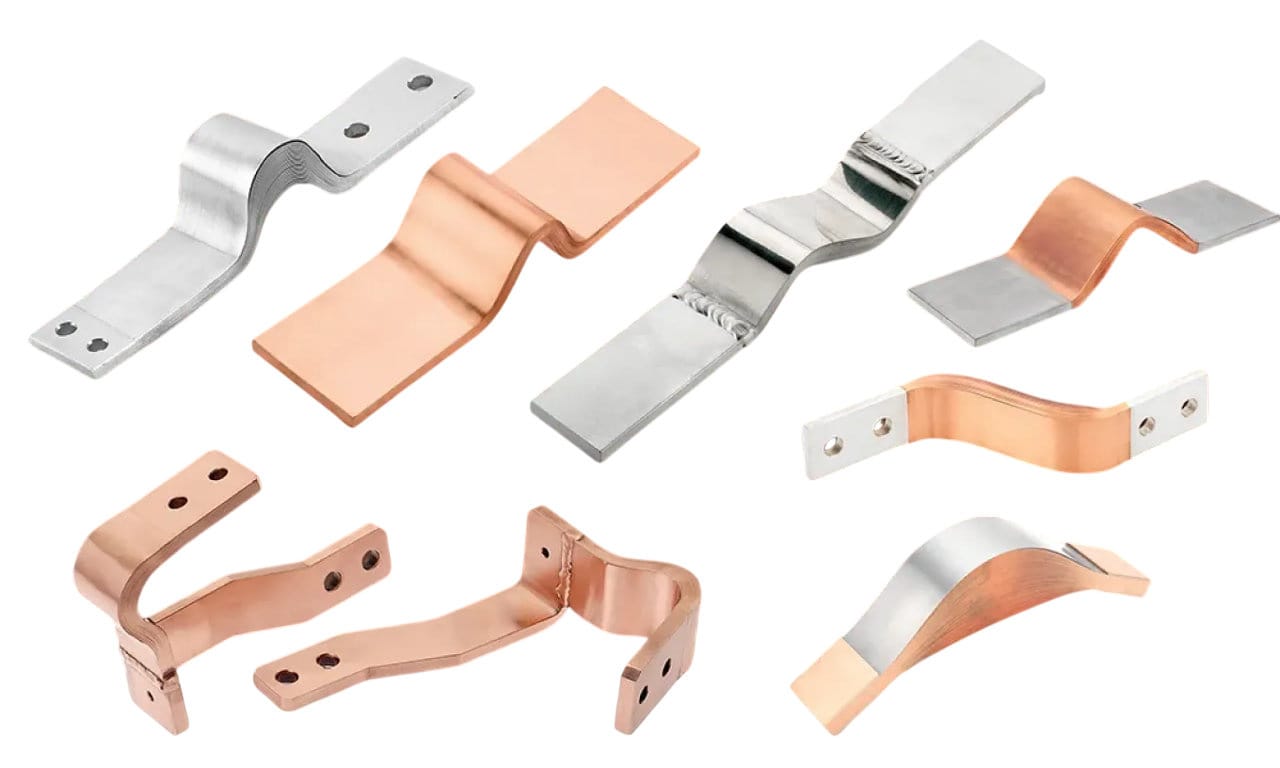
Flexible Copper Busbars (Laminated)
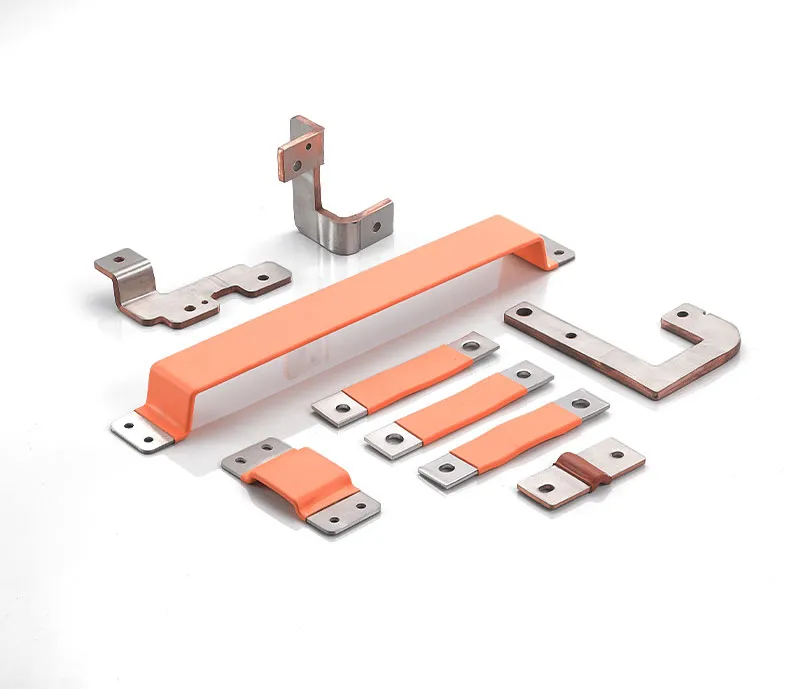
Flexible busbars are constructed by stacking multiple layers of highly pure, thin copper foils (often 0.1mm to 1mm thick), which are then fused at the mounting terminals using molecular diffusion welding.
- Advantages: They absorb thermal expansion and handle misalignments perfectly. In the EV sector, where battery modules undergo constant vibration during driving, rigid bars would snap. Laminated flexible busbars flex with the chassis.
- Design Consideration: Because the individual layers can slide against one another, they offer incredible flexibility in tight spaces. JUMAI engineers these to bend and twist into complex 3D shapes without compromising the cross-sectional area, saving valuable space in compact AI server racks.
Braided Copper Busbars
Woven from fine copper wires (sometimes as thin as 0.05mm), braided busbars offer the ultimate in multidirectional flexibility.
- Advantages: Superior vibration dampening. These are heavily utilized in heavy machinery, seismic zones, and wind turbine nacelles where mechanical movement is extreme.
- Design Consideration: Braided wires have a slightly higher resistance profile due to the air gaps between weaves. When designing braided OEM solutions, we must upsize the cross-sectional area slightly to match the ampacity of a solid bar.
Configuration Comparison Matrix
| Feature | Rigid Busbars | Flexible (Laminated) Busbars | Braided Busbars |
|---|---|---|---|
| Vibration Tolerance | Low | High | Excellent |
| Space Efficiency | Moderate | Excellent (easily routed) | Moderate |
| Thermal Expansion Handling | Poor (requires joints) | Excellent | Excellent |
| Primary Use Case | Main Switchgears, Substations | EV Batteries, Inverters | Wind Turbines, Transformers |
At JUMAI, we pair these configurations with our custom deep drawing processing dies. Deep drawing allows us to manufacture highly precise, seamless end-caps, terminal brackets, and mounting accessories that perfectly mate with the busbars, ensuring a high-pressure, low-resistance connection regardless of the structural configuration chosen.
Advanced Dielectric Insulation and Safety Standards
An uninsulated copper busbar is a severe safety hazard in compact environments. As electrical systems become more power-dense—particularly in modern data centers and EV battery packs—the physical distance between live conductors is shrinking. This increases the risk of electrical arcing and short circuits. Therefore, the insulation applied to Precision Copper Busbars is just as critical as the copper itself.
Designers must consider the required creepage (the shortest path between two conductive parts along the surface of the insulation) and clearance (the shortest distance between two conductive parts through the air).
To meet rigorous international safety certifications, such as those governed by Underwriters Laboratories (UL) and the IEC, JUMAI provides several OEM insulation solutions for our custom busbars:
1. Heat Shrink Tubing (Polyolefin/Teflon)
- Process: A cross-linked polyolefin tube is placed over the busbar and shrunk using controlled heat.
- Benefits: Cost-effective, excellent dielectric strength, and available in flame-retardant grades (UL94 V-0).
- Limitations: Difficult to apply smoothly over highly complex, multi-angled bends or intricate deep-drawn terminal shapes. Air pockets can form, leading to corona discharge in high-voltage applications.
2. Epoxy Powder Coating
- Process: The busbar is heated and dipped into a fluidized bed of epoxy powder, or the powder is electrostatically sprayed onto the copper and cured in an oven.
- Benefits: This is the premium choice for highly complex geometric shapes. It provides a seamless, uniform coating with zero air gaps. It has exceptional thermal conductivity, meaning it allows the busbar to dissipate heat much better than thick plastic wraps.
- Dielectric Strength: Can easily achieve 15kV/mm to 30kV/mm depending on the thickness.
3. PVC Dipping
- Process: The busbar is dipped into liquid Polyvinyl Chloride.
- Benefits: Highly flexible, making it the ideal insulation for flexible laminated and braided copper busbars where the insulation must bend and move with the conductor without cracking.
Insulation Material Performance Data
| Insulation Type | Dielectric Strength (kV/mm) | Max Operating Temp (°C) | Flame Retardant Standard | Flexibility |
|---|---|---|---|---|
| Polyolefin Heat Shrink | 15 – 20 | 125°C | UL94 V-0 | Moderate |
| Epoxy Powder Coating | 25 – 35 | 130°C – 155°C | UL94 V-0 | Rigid |
| PVC Dip | 10 – 15 | 105°C | UL94 V-0 | High |
When clients use JUMAI’s online preview and order consultation services at DeepDrawTech.com, our engineering team actively reviews the operating voltage of the system to recommend the exact insulation thickness required to prevent dielectric breakdown, ensuring full compliance with global safety mandates.
Precision Manufacturing, Surface Treatments, and Deep Drawing Integration
The final consideration separates standard commodity metalworking from true Precision Copper Busbars. The interface where a busbar connects to a battery terminal, a circuit breaker, or an IGBT (Insulated-Gate Bipolar Transistor) module is the most vulnerable point in the entire electrical system. Poor contact surfaces lead to micro-arcing, localized heating, and rapid failure.
Surface Plating and Treatments
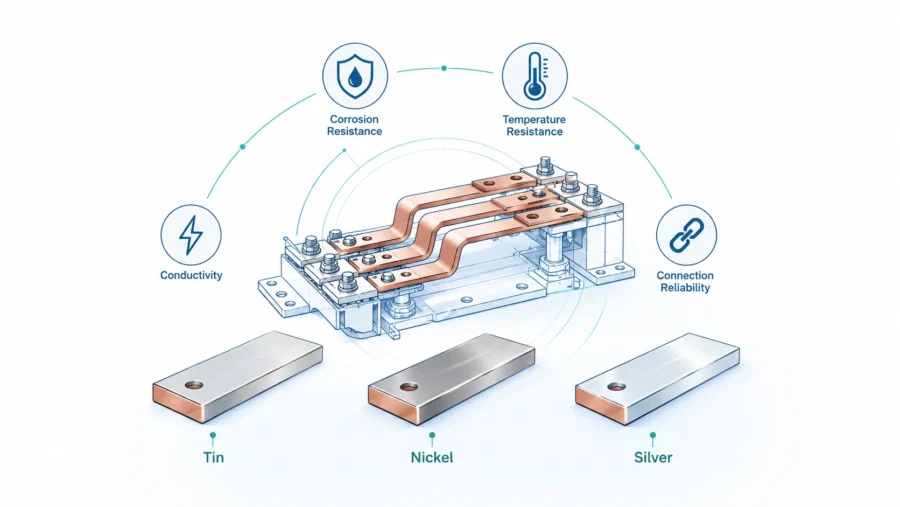
Bare copper, when exposed to oxygen and humidity, rapidly forms copper oxide. Unlike silver oxide, which remains highly conductive, copper oxide acts as an electrical insulator. This increases contact resistance at connection points. To prevent this, OEM manufacturing must include high-quality surface plating.
- Tin Plating: The most common and cost-effective solution. It prevents oxidation and is excellent for environments with high humidity. It provides a soft, malleable surface that flattens out under bolting pressure, creating a gas-tight, low-resistance connection.
- Silver Plating: Used in ultra-high-current applications (like massive power transmission centers and heavy-duty switchgears). Silver has lower electrical resistance than copper and withstands higher temperatures before degrading.
- Nickel Plating: Often used as a barrier layer beneath tin or silver, or as a top coat in highly corrosive environments (such as marine applications or chemical plants) to prevent the underlying copper from migrating or corroding.
The Role of Deep Drawing Processing and Custom Accessories
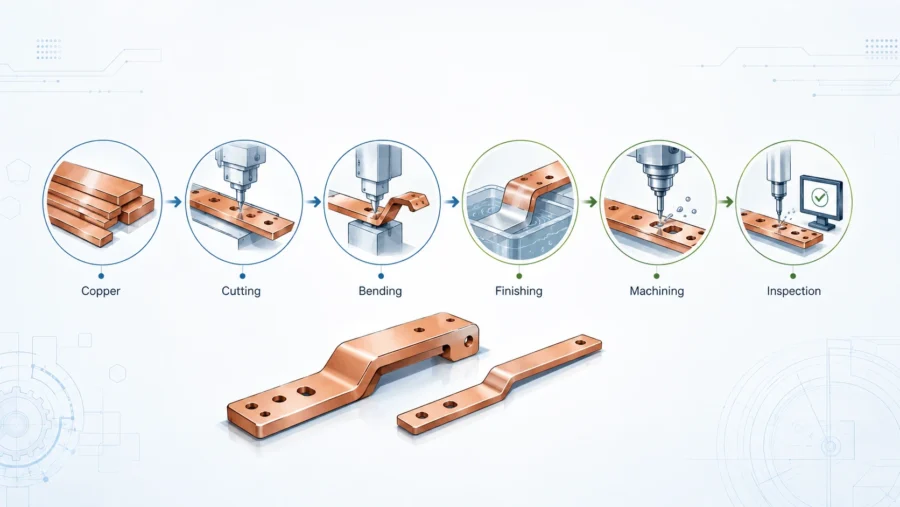
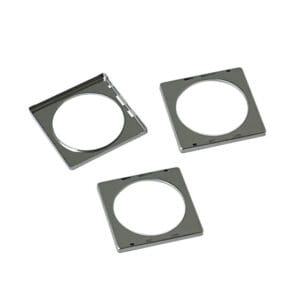
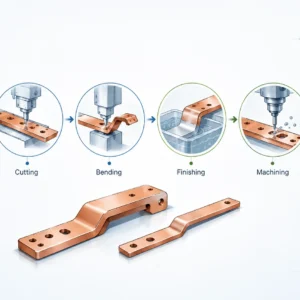
This is where JUMAI (DeepDrawTech) truly excels globally. Standard busbar manufacturing involves cutting, punching, and bending. However, modern high-tech equipment often requires specialized mounting brackets, intricate terminal caps, and precision shielding components.
Our expertise in deep drawing processing dies and accessories allows us to manufacture bespoke copper and alloy components from flat sheet metal, forming them into seamless, complex 3D shapes without joints or welds.
- Why is this important? Welded joints introduce impurities, increase electrical resistance, and create mechanical weak points. Deep-drawn accessories are structurally continuous, maintaining 100% of the material’s conductivity and mechanical strength.
- By designing custom deep-drawn dies in-house, JUMAI provides clients with end-to-end OEM processing. Whether you need a simple flexible copper busbar or a highly complex, multi-layered busbar assembly integrated with precision-drawn grounding caps and custom hardware, we ensure microscopic tolerances (often down to $\pm 0.05$mm) are met consistently across high-volume production runs.
Partnering for Power Infrastructure Success
Designing power distribution systems for the next generation of environmental green energy, AI-driven data centers, and advanced manufacturing requires more than just raw materials; it requires precision engineering. By carefully evaluating material purity, ampacity, mechanical structure, dielectric insulation, and manufacturing tolerances, engineers can build systems that are safer, more efficient, and incredibly durable.
As the industry pushes toward higher voltages and tighter physical footprints, the margin for error approaches zero. This is why partnering with an experienced OEM provider is critical. At JUMAI, we leverage our deep industry expertise—spanning from large power transmission to intricate data center architecture—to deliver world-class Precision Copper Busbars and custom deep drawing accessories.
We invite global clients, engineers, and procurement specialists to leverage our expertise. For online previews, technical consultations, and custom OEM processing orders tailored to your exact specifications, visit us at DeepDrawTech.com. Let us help you engineer the future of high-efficiency power distribution.
FAQ
What is a busbar and why is it important?
A busbar is a key electrical component used to conduct electricity in power systems. It helps distribute energy effectively in various applications, such as data centers, electric vehicles, and energy storage systems. Choosing the right busbar is crucial because it can affect the efficiency and reliability of the entire power system.
What materials are best for making busbars?
The most commonly used material for busbars is copper because it has excellent conductivity and thermal performance. Different grades of copper, like Electrolytic Tough Pitch (ETP) and Oxygen-Free High Conductivity (OFHC), serve different purposes based on conductivity requirements and environmental conditions.
How do I know how much current a busbar can carry?
The amount of current a busbar can safely carry is called ampacity. To determine this, engineers consider the size (cross-sectional area) of the busbar and the expected temperature rise when current flows through it. It’s essential to understand these calculations to avoid overheating and potential system failures.
What is thermal management in relation to busbars?
Thermal management is crucial for busbars because when electrical current flows through them, they generate heat. If not managed properly, this heat can lead to damage or system failures. Proper design involves ensuring the busbar does not exceed its maximum operating temperature by calculating the heat generated and selecting suitable materials.
What types of busbars exist?
Busbars come in three main types: rigid, flexible (laminated), and braided. Rigid busbars are stable for fixed connections, flexible busbars adapt well to movements and vibrations, and braided busbars offer multidirectional flexibility, making them suitable for applications with high mechanical stress.
What is the role of insulation in busbars?
Insulation is vital for busbars, particularly as electrical systems become more compact. Proper insulation prevents electrical arcing and short circuits, ensuring safety. Designers must consider how far apart conductors are and the type of insulation used to meet safety standards.
How are busbars manufactured?
Busbars are typically manufactured through processes like cutting, punching, and deep drawing. Deep drawing allows for the creation of complex shapes without joints, reducing potential weaknesses and increasing conductivity, making it a preferred method for high-performance busbars.
What safety standards apply to busbars?
Busbars must meet safety standards, such as those defined by Underwriters Laboratories (UL) and the International Electrotechnical Commission (IEC). These standards ensure that busbars can safely handle electrical loads and withstand specific conditions without failing.
Why should I choose custom busbars over standard options?
Custom busbars are designed to meet specific requirements for different applications, ensuring maximum efficiency and reliability. Unlike off-the-shelf products, custom options can be tailored for unique conditions, which can ultimately lead to lower operational costs and longer-lasting equipment.
Where can I get more information about OEM Precision Copper Busbars?
Where can I get more information about OEM Precision Copper Busbars?